

DAP Pros and Cons: When Should Importers Use It?
DAP can be right when seller-carried risk to a named place is worth the buyer-side remainder. This decision guide runs five tests, compares DAP with DDP, DPU, CIP and FOB, and works through five buyer situations.
Short answer
DAP suits an importer who can clear import customs, pay duty and unload at a precisely named place, and who wants the seller to carry carriage cost and transit risk to that place. It does not suit a buyer with no broker or unloading crew, a buyer who needs a named carrier, or a buyer who wants seller-bought insurance priced into the quotation. Name the place in full, close the insurance gap, and price the buyer-side remainder before agreeing.
On this page
Key takeaways
Under DAP the seller pays carriage and bears transit risk to a named place, where the goods arrive ready for unloading; the buyer then unloads, clears import customs and pays duty and taxes.
DAP applies to any mode of transport, and delivery and destination are the same place, unlike the C terms, where risk passes at origin.
No D term obliges the seller to arrange insurance for the buyer, so close the insurance gap in writing before shipment.
Test the named place, import readiness, unloading setup, insurance gap and carriage control before agreeing DAP, and compare DDP, DPU, CIP or FCA where a test fails.
Name the place in full, state the Incoterms 2020 edition, and price the buyer-side remainder before ranking quotations.
DAP answers one question well: who carries the journey to your door. Under Delivered at Place, the seller pays for carriage to a named place and bears the risk of loss or damage until the goods arrive there, ready for unloading.1 2 The buyer then unloads the goods, clears import customs, and pays duty and taxes. The difference is rarely the headline price: it is the named place, the buyer's import readiness, and the insurance gap.
This article weighs the DAP advantages and disadvantages as a decision guide: five tests in order, a comparison with DDP, DPU, CIP and FOB, and five buyer situations. Use it before the term is written into a contract.
The DAP decision in five tests
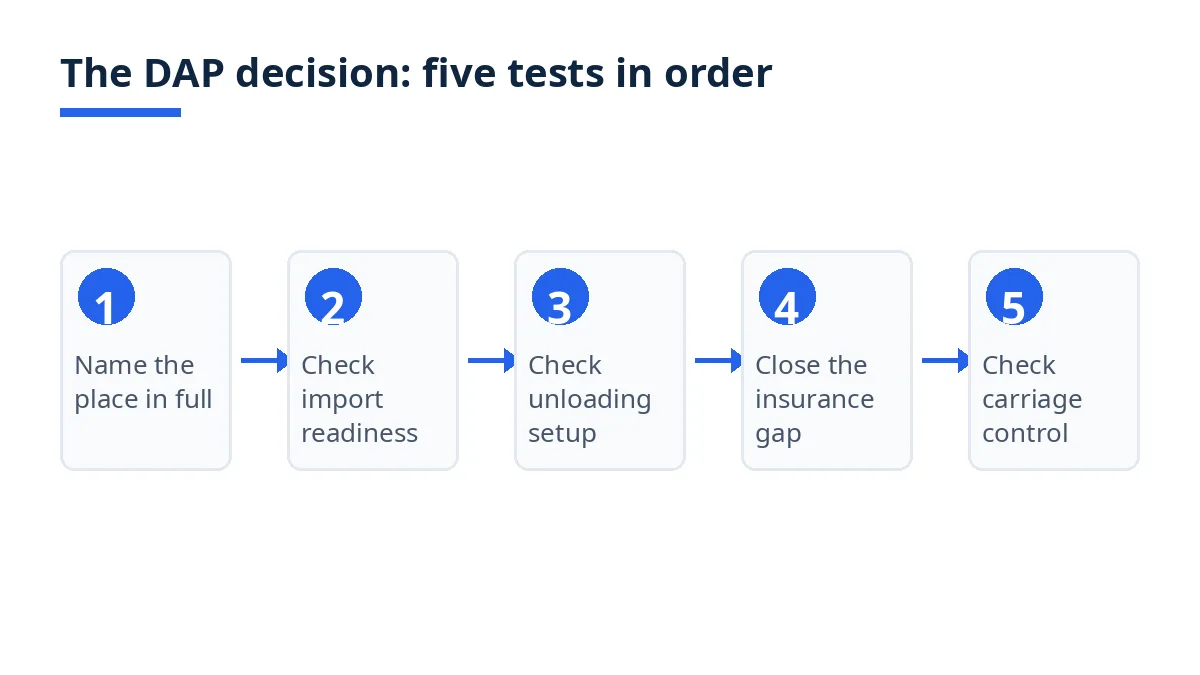
Run them in order: a failed test means pricing the gap, booking the missing help, or changing the term.
Test 1: Is the named place precise enough to price and to receive at? DAP delivery happens when the goods are placed at the buyer's disposal on the arriving means of transport, ready for unloading, at the named place of destination.3 2 A city name leaves the final leg open to argument. Name the address, including the dock, gate or terminal.
Test 2: Can the buyer clear import customs and pay duty on arrival? Under DAP the buyer handles all import procedures and pays duties, taxes and official charges, and bears the risk of loss or damage during the import clearance process.1 2 Without a broker, importer registration, or duty estimate, do not agree DAP until that help is booked and priced.
Test 3: Can the buyer unload safely at the named place? The buyer covers the cost of unloading and bears the risk during unloading.1 2 Unloading cost follows the carriage contract, but the buyer still bears the risk during unloading.1 Check the dock, labour and equipment before the vehicle arrives.
Test 4: Is the insurance gap closed? No D term obliges the seller to arrange insurance for the buyer.3 The seller bears the transit risk and may insure its own interest, but the buyer should arrange cover itself or agree in the contract that the seller will add it, with the price shown separately.3 4 An uninsured DAP price and an insured CIP price are not comparable until the insurance line is stated.
Test 5: Does the buyer accept seller-chosen carriage? The seller contracts and pays for carriage to the named place.1 3 A buyer who needs a named carrier, a fixed sailing, or a route that avoids a particular transhipment point gives up that choice under DAP. If carrier control matters more, test FCA or FOB first.
The diagram below summarises the five tests.
What DAP hands you, and what it keeps back
DAP is one of the 11 Incoterms 2020 rules, which allocate cost, risk and obligations between seller and buyer.5 It replaced the older terms DAF, DES and DDU, and it applies to any mode of transport, including combinations of modes.6 2
The defining feature of the D terms is that delivery and destination are the same concept: the named destination is both where the goods are delivered and where risk passes.1 3 Under the C terms, delivery and risk transfer happen at origin.3 If the goods do not arrive at the named destination in sound condition, the seller bears the transport risk and must provide a remedy, such as reshipment, or be in default.3
What DAP keeps back is everything after arrival: unloading, import clearance, duty and taxes, and onward transport beyond the named place.1 2 The seller must handle export clearance and transit customs, give notice of arrival, and provide proof of delivery.1 2
Where DAP earns its price
One delivered price to compare. When every supplier quotes DAP to the same named place, on the same Incoterms edition, the buyer compares like with like.
Transit risk stays with the seller. The seller bears all risk until the goods arrive at the named place, ready for unloading.6 2 For a buyer with no influence over a carrier it did not choose, that allocation removes the hardest part of a damage claim.
Any mode, one term. DAP covers sea, air, road and rail, and combinations of modes, so one term can cover a container that moves by sea and then by truck to an inland warehouse.6 2
Where DAP costs more than it returns
The buyer-side remainder is easy to underprice. Import clearance, duty, taxes, unloading and onward transport sit outside the DAP price.1 2 A buyer who budgets only the headline price will meet the remainder at the dock, when storage and delay charges start to run.
No insurance duty, on either side. DAP imposes no insurance obligation on the seller for the buyer, and none on the buyer either.3 The seller's transit risk does not automatically produce a policy the buyer can claim on. Close the gap in writing before shipment.
Import delay risk sits with the buyer. Once the goods arrive, the buyer must clear them, and bears the risk of loss or damage during the import clearance process.1 Prepare the declaration, classification and duty estimate while the goods travel.
No choice of carrier or route. The seller contracts the carriage and chooses the carrier, sailing and route, subject to the contract.1 3 A buyer with a preferred carrier or a route it wants to avoid cannot enforce that choice through DAP alone.
DAP beside DDP, DPU, CIP and FOB
On the four questions that decide most choices:
Term | Transit risk carried by | Cost visibility for the buyer | Customs burden | Control over carriage |
|---|---|---|---|---|
DAP | Seller, to arrival at the named place | One delivered price; buyer-side remainder must be added | Buyer: import clearance, duty, taxes | Seller contracts carriage |
DDP | Seller, to arrival at the named place | One delivered price including duty; seller's import costs are inside it | Seller: export, transit and import clearance, duty, taxes | Seller contracts carriage |
DPU | Seller, to after unloading at the named place | One delivered price; unloading is inside it | Buyer: import clearance, duty, taxes | Seller contracts carriage |
CIP | Buyer, from handover to the first carrier | Carriage and Clause (A) insurance inside the price; destination costs outside it | Buyer: import clearance, duty, taxes | Seller contracts carriage |
FOB | Buyer, from loading on board at origin | Goods price only; buyer adds freight, insurance and destination costs | Buyer: import clearance, duty, taxes | Buyer contracts main carriage |
DDP differs from DAP only on import clearance and duty: under DDP the seller carries out and pays for all customs formalities, including import, while under DAP the buyer does.1 3 Some destination authorities impose restrictions, or even a prohibition, that make it difficult for a foreign seller to handle import formalities, and in such cases DAP is the appropriate rule.1 3
DPU differs from DAP only on unloading: DPU is the only rule that requires the seller to unload, and risk passes after unloading.5 4 The former DAT rule was renamed DPU in Incoterms 2020.5
CIP and FOB differ from DAP on the risk point, not only on the price. Under CIP the seller pays carriage and wide Clause (A) insurance to a named destination, but risk passes to the buyer at handover to the first carrier.4 Under FOB the seller delivers the goods on board the vessel, risk passes on board, and the buyer books and pays for main carriage.4 A CIP or FOB price therefore leaves the buyer carrying transit risk from origin, while a DAP price keeps it with the seller until arrival. The CIF cost, insurance and freight guide sets out the same origin risk split for the sea-only term, where risk passes on board even though the seller pays freight and minimum Clause (C) insurance to the destination port.7
Five buyer situations: choose DAP, or choose otherwise
Situation 1: Leather handbags to a Rotterdam warehouse, buyer holds a broker and a dock crew. Choose DAP first. The buyer clears import customs and unloads without help, the seller manages carriage to the warehouse door. Name the warehouse address and gate in full.
Situation 2: First-time buyer of cotton cushion covers to a Dallas fulfillment center, no broker and no unloading crew. Choose DDP first, or DAP only once a broker and unloading labour are booked and priced. Under DAP the buyer handles import clearance and unloading.1 2
Situation 3: Regular buyer with its own forwarder rates, shipping containers from Chattogram to Felixstowe, who wants a named carrier. Choose FCA first. DAP hands carriage choice to the seller, and a buyer who already holds competitive freight rates may pay more for seller-arranged carriage.
Situation 4: Goods delivered to a small high-street shop in Leeds with no dock, forklift or unloading crew. Choose DPU first. Under DAP the buyer unloads at its own cost and risk.1 2 Under DPU the seller unloads.4
Situation 5: High-value brass lighting to Hamburg, where the buyer wants seller-bought wide insurance priced into the quotation. Choose CIP first. Under DAP no insurance duty falls on either side, so a buyer who wants Clause (A) cover inside the price should use the term that obliges the seller to buy it.3 4 If DAP is still preferred, agree the cover and premium in writing, with the insurance line shown separately.
Costs, documents and timing on a DAP decision
DAP fixes who pays, not how much. No DAP rule sets a freight rate, a premium, a duty rate or a transit time. Ask the seller to break the DAP price into goods, export clearance and documents, and carriage to the named place. The illustration below shows the arithmetic only. Example figures.
Price line | Example figure (USD) |
|---|---|
Goods, including export packing | 8,400 |
Export clearance and documents | 210 |
Carriage to the named place | 1,950 |
DAP price to the named place | 10,560 |
Import clearance and broker | 180 |
Duty and taxes, example lump sum | 720 |
Unloading at the named place | 150 |
Buyer-side total | 1,050 |
Landed total at the named place | 11,610 |
It proves nothing about the market. Compare quotations only on the same named place, specification and quantity, with the same buyer-side lines added to each. No duty rate is stated here, because duty depends on the classification of the exact goods and the rules of the destination country.
For documents, the buyer should hold the commercial invoice, packing list and transport document, and the seller must provide proof of delivery.2 Agree before shipment which transport document will be provided and how arrival notice will be given, and agree the shipment date or period. DAP itself sets none of these.
Bangladesh checks before you agree DAP
State the named place of destination in full, and confirm the carriage end point before agreeing.
Confirm the export document set before the shipment date. Under section 131 of the Customs Act, 1969, goods must not be loaded or stuffed for export unless a Bill of Export, also called a Shipping Bill, has been submitted and approved by Customs.8 The enclosed set includes the export letter of credit or equivalent export contract, commercial invoice, packing list, EXP form certified by Authorised Dealer banks, certificate of origin, VAT certificate and Taxpayer Identification Number.8 Check that the invoice and packing list match the contract on quantity, value, HS code, Incoterm and destination.
Confirm the insurance position in the same check: DAP gives the buyer no seller-bought policy to claim on.3
Mistakes that turn DAP against the buyer
Accepting a city as the named place. Risk and cost transfer at the named place, so it must be identified precisely, with the warehouse address and the dock or gate.6 A city name leaves the final leg open to argument.
Treating a DAP price as a duty-paid price. DAP excludes import clearance, duty and taxes.1 2
Assuming the seller unloads. Under DAP the seller is not required to unload.5 2 Book labour and equipment before arrival, and confirm whether the carriage contract includes the unloading charge, while remembering that the buyer still bears the risk during unloading.1
Assuming insurance is included. DAP imposes no insurance obligation on either party.3 Agree cover in writing, with the price shown separately.
Comparing a DAP headline price with an FOB or CIF headline price. FOB ends on board at origin, CIF ends at the destination port, and DAP ends at the named place.4 7 Price every quotation to the same point, adding each cost the rule leaves to the buyer, before ranking.
Leaving the edition out. Write "DAP (named place), Incoterms 2020" in full. Without the edition, the governing rules are not fixed.
What should I know first about DAP?
Know the split: the seller pays carriage and bears transit risk to the named place, where the goods arrive ready for unloading, and the buyer then unloads, clears import customs and pays duty and taxes.1 2 The named place fixes where the seller's cost and risk end, and close the insurance gap before shipment, because DAP obliges neither side to buy insurance.3
What are the typical costs and timelines under DAP?
DAP sets no typical cost and no timeline. The seller pays export clearance and carriage to the named place; the buyer pays import clearance, duty and taxes, unloading, and onward transport beyond that place.1 2 Compare quotations only on the same named place.
Which documents are needed under DAP?
The buyer should hold the commercial invoice, packing list and transport document, and the seller must provide proof of delivery so the buyer can take delivery.2 For a Bangladesh export shipment, the clearance set includes the approved Bill of Export or Shipping Bill, the export contract or letter of credit, the commercial invoice, packing list, EXP form certified by an Authorised Dealer bank, and certificate of origin, with VAT and Taxpayer Identification Number documents in the file.8
What are the most common mistakes with DAP?
Accepting a city name as the named place, treating a DAP price as duty-paid, assuming the seller unloads or that insurance is included, and comparing a DAP headline price with a price written on another rule. Read the named place first, then the cost lines, then the buyer-side remainder.
Next steps on Exportain
Read the Incoterms guide for shipments from Bangladesh to compare all 11 rules, then use the DAP quotation guide to rank quotations on the same named place and basis. When the named place, specification and insurance position are fixed, post a free RFQ on Exportain stating the DAP term, named place in full, Incoterms 2020 edition, and who arranges insurance, and check the how to buy guide for the buying steps.9 Keep the agreed term and destination in the written contract.
Sources
- DAP & DDP Incoterms 2020 explained: Key differences. ICC Academy (accessed )
- DAP Incoterms 2026: Meaning, Seller vs Buyer Duties & Examples. Drip Capital, (accessed )
- Incoterms® 2020 C rules vs D rules: Risk transfer explained. ICC Academy (accessed )
- Incoterms for Shipments From Bangladesh. Exportain (accessed )
- Incoterms® 2020. International Chamber of Commerce (ICC) (accessed )
- DAP in Shipping: A Guide to Delivered at Place Incoterms. FreightAmigo, (accessed )
- CIF Meaning (Cost, Insurance & Freight). Exportain (accessed )
- Customs Clearance Procedures for Export. Bangladesh Customs, National Board of Revenue (accessed )
- How to source and buy from Bangladesh. Exportain (accessed )
About the author
Sourcing from Bangladesh?
Post a request for quotation and suppliers on Exportain can send you their quotes directly.
Post an RFQ


