

CIF for Small Importers: Is It the Right Incoterm for Your First Order?
CIF can simplify a first sea order, but it leaves risk, insurance limits and destination costs with a small importer. This decision guide uses order-size scenarios to show when CIF suits a first order and when FCA, CIP or DAP suits better.
Short answer
CIF suits a first order only when the shipment travels by sea or inland waterway to one port, the seller knows CIF, minimum Clause (C) insurance is agreed in writing, and a broker has priced the destination charges. Under CIF the seller pays freight and minimum insurance to the port, but risk passes to the buyer on loading, and the buyer handles import clearance, duty and destination charges. For air freight or inland handovers, FCA, CIP or DAP fits better.
On this page
Key takeaways
CIF suits a first sea order only when one destination port is named, minimum Clause (C) insurance is agreed in writing, and a broker has priced the destination lines before sailing.
Under CIF the seller pays ocean freight and minimum insurance to the named port, but risk passes to the buyer when the goods are loaded on board.
CIF is for sea and inland waterway transport only; air, multimodal and inland handovers need FCA, CIP or DAP.
Price every CIF quotation to the warehouse, not to the port, and confirm carrier, sailing, clause level and destination charges in writing.
A first order from Bangladesh is usually small, paid for out of tight cash flow, and arranged with a seller you have not worked with before. That combination is what makes cif for small importers a decision to test, not a default to accept. CIF can remove one job, arranging ocean freight, while leaving three others with you: the risk from loading onward, the limits of minimum insurance, and every cost and formality after the destination port.
This guide is for a first-time or small importer buying by sea from Bangladesh for delivery in the United States, the United Kingdom, the European Union or the United Arab Emirates. It works through three order profiles, a decision framework and a pre-order checklist, so you can judge a CIF quotation on its full cost to your warehouse.
Three first orders, three different answers
Order A: small, simple and sea-bound. One product, one destination port, a seller who has shipped CIF before, and a broker at destination who is ready before the goods sail. CIF can suit this order. The seller arranges the carriage and the minimum insurance, and your remaining work is a short list: destination charges, import clearance, duty and tax, and onward transport.
Order B: small, high in value, or easy to damage. CIF still leaves risk with you from loading, and the cover the seller must buy is minimum cover under Institute Cargo Clauses (C).1 If damage would hurt more than the order is worth, CIF is a weak fit unless you agree wider cover in writing or arrange your own insurance from loading. Compare CIP, which requires the higher Clause (A) cover, or FCA with insurance you control.1
Order C: urgent, by air, or handed over before the port. CIF does not fit at all. CIF can only be used for sea or inland waterway transport, port to port.1 An air shipment or a container handed to a carrier at an inland terminal needs a term built for that movement. FCA and CIP cover any mode of transport, and DAP keeps delivery and risk transfer at the named destination.2 3
A small order makes destination work a larger share of the total, which is why the destination lines matter more, not less.
What CIF for small importers actually hands over
CIF stands for Cost, Insurance and Freight. Under CIF, the seller delivers the goods and transfers the risk of loss or damage to the buyer once the goods are loaded on board the vessel at the named port of shipment.1 The seller must arrange and pay for port-to-port carriage and insurance up to the port of destination, and must carry out the export formalities.1 2 The buyer is responsible for completing import formalities, including customs procedures at ports in transit or transshipment, if any.1
The Incoterms 2020 rules provide a clear allocation of cost, risk and obligations across 11 rules, and the CIF rule is reserved for maritime trade.4 The point most first-time buyers miss is that under the C terms, delivery and destination are different places. Delivery and risk transfer happen at origin, while the seller arranges transport, and for CIF insurance, to the named destination.2 Write the term in full on every quotation and order, and keep the port of shipment in the contract as well, since that is where risk passes.1
The insurance line, in plain terms
The insurance the seller must arrange under CIF complies with Clause (C), sometimes called minimum cover, of the Institute Cargo Clauses or similar clauses.1 The ICC states the same point: under CIF, Institute Cargo Clauses (C) remains the default level of coverage, with the option to agree a higher level, while CIP now requires the higher Clause (A) cover.4 Minimum cover is not full cover. Ask which clause applies, what the insured value is, and who can claim directly from the insurer. Under the C terms, the insurance must enable the buyer, or any party with an insurable interest, to claim directly from the insurer.2
CIF never covers import clearance, import duty or tax, destination charges beyond what the contract of carriage provides, or transport to your warehouse.
The decision framework: CIF, FCA, CIP or DAP
Use four questions in order, with the actual order in front of you. How will the goods travel? If the answer is sea or inland waterway, port to port, CIF stays in play. If it is air, road, rail, courier or a mix of modes, CIF is out. FCA can be used for any mode of transport, including air, truck, rail, vessel or multimodal shipments.3 CIP is suitable for any mode or a combination of modes.1 Where should risk pass? Under CIF, risk passes on loading on board.1 Under the D terms, delivery and risk transfer occur at the named destination.2 If you want the seller to carry the risk through the voyage, price DAP. Under DAP and DPU the buyer still handles import formalities, while under DDP the seller handles export, import and transit formalities.2 Who should control the main carriage? CIF gives that job to the seller. FCA gives it to you: the buyer hires the transport, and the seller loads the goods on the buyer's transport at the seller's premises or delivers them to another named place.3 What cover does the order need? CIF requires minimum Clause (C) cover, while CIP requires Clause (A) cover, described as all risks or maximum cover.1
When CIF suits a first order, the pattern is consistent: a sea shipment, a simple product, a seller who has shipped on CIF before, a single named destination port, and a broker who has priced the lines CIF leaves out. When any part of that pattern is missing, price FCA, CIP or DAP on the same goods and destination, and compare the totals to the warehouse. The Incoterms for shipments from Bangladesh guide sets out all 11 rules side by side.
Reading your first CIF quotation to the warehouse door
A CIF quotation answers one question: what the seller charges for the goods, the ocean carriage and the minimum insurance to the named port. A first order needs a second answer: what the goods will cost at your warehouse. The commercial invoice amount under CIF and CIP includes the goods, freight and insurance, plus export clearance costs and documentation.1 Then add destination handling, broker fees, import duty and tax, storage if clearance runs past free time, and inland transport. Ask the broker at destination to price those lines before you confirm the order.
Three lines deserve a direct question on every first CIF quotation. Prepaid freight, with no control: who is the carrier, what are the sailing and expected arrival dates, and does the routing include transshipment? Destination charges and free time: which charges sit inside the freight the seller paid, which sit outside it, and how many days of free time apply before storage charges start? The insurance document: what is the clause, the insured value, the beneficiary for claims, and the time limit for notifying a claim?
Example figures: goods valued at $8,000, ocean freight of $1,150 and insurance of $200 give a CIF price of $9,350. Destination handling, broker fees and inland transport of $720 and import duty and tax of $1,100, both example figures, give a warehouse cost of $11,170. The example shows the gap between a CIF price and a warehouse cost only. It is not a quotation, a rate or a duty calculation, and duty depends on classification, value and destination country. The landed cost guide works through each line in full.
From quotation to warehouse: the first-order sequence
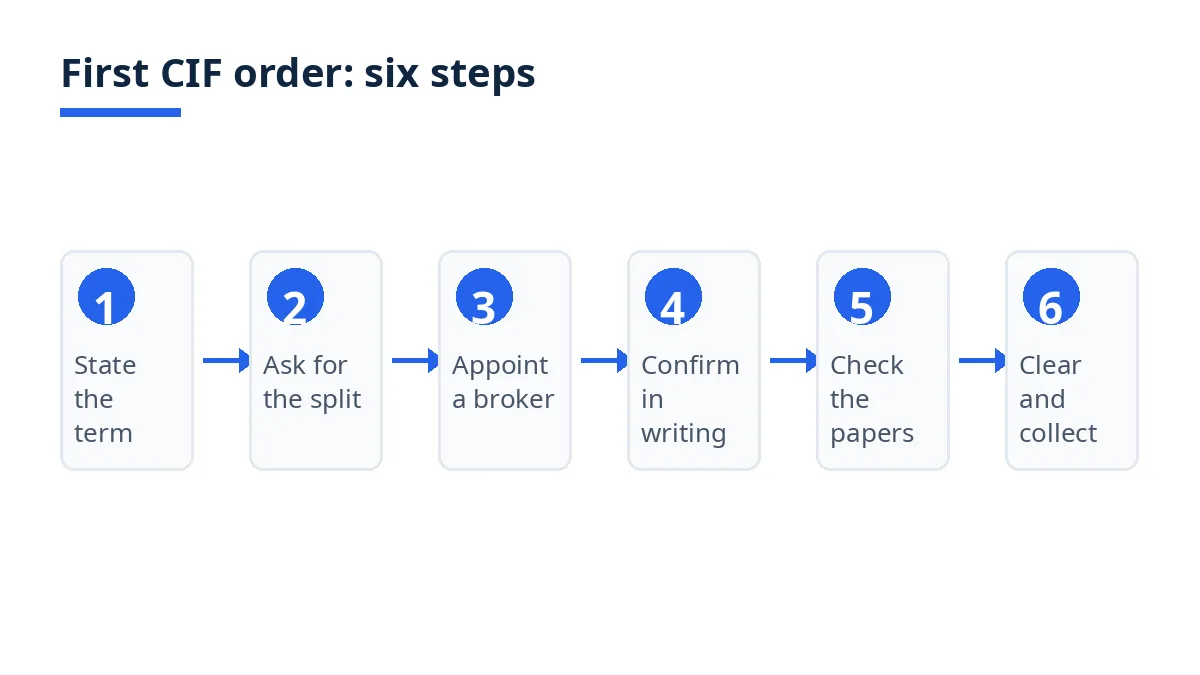
State the term, the port and the product in the RFQ. Write "CIF, named destination port, Incoterms 2020", the product, quantity, packing and destination country.
Ask for the split behind the CIF price. Request the goods value, freight and insurance as separate lines, the carrier and sailing, and the clause level.
Appoint the destination help before sailing. Confirm the broker, the importer registration for your country, and the duty and tax treatment.
Confirm the order in writing. Put the term, the named port, the clause level, the sailing window, the payment terms and the document set on the purchase order.
Check the papers as they arrive. Match the commercial invoice, packing list, bill of lading and insurance document: names, quantities, values, ports and marks.
Clear, pay and collect in order. Complete import clearance, pay duty and tax, collect within the free time, and record any damage or shortage before you sign for the goods.
Documents, export clearance and your import registration
The export side is the seller's job under CIF, but a buyer who cannot read the export set cannot check it. In Bangladesh, goods shall not be allowed to load or be stuffed in containers or a ship for export unless an export declaration, the Bill of Export or Shipping Bill, is submitted to Customs and approved.5 Documents enclosed with the Bill of Export include the export letter of credit or, where there is none, the export contract or purchase order, the commercial invoice, the packing list, the EXP form certified by an authorized dealer, and a certificate of origin issued by the Export Promotion Bureau or a Chamber of Commerce and Industry.5 Ask for copies before sailing.
For the European Union, an Economic Operators Registration and Identification (EORI) number is mandatory for the clearance of all types of customs operations in the customs territory of the EU, such as import, export and transit.6 In Great Britain, you may need an EORI number for moves between Great Britain and any other country, and without the right number you may face delays and storage costs.7 Confirm your destination requirement with your broker before sailing. The CIF cost, insurance and freight guide explains the price build and the customs value point in more detail.
The four first-order traps in CIF
Trap 1: prepaid freight you cannot influence. The seller chooses the carrier and the routing. A slow routing, a transshipment port or a missed sailing becomes your delay, even though you paid for the freight inside the CIF price. The check is carrier, sailing, routing and expected arrival in writing.
Trap 2: minimum cover treated as full cover. Clause (C) is the default under CIF, and it is the lower level of cover.4 A buyer who reads "insurance included" as "every loss covered" discovers the limit only when a claim is refused or reduced. The check is the clause, the insured value and the claim route, agreed in writing.
Trap 3: destination charges outside the CIF price. Terminal handling, storage, broker fees and inland transport sit outside the seller's price unless the contract of carriage says otherwise.2 On a small order those charges are a large share of the total. The check is a written destination quote from your broker, obtained before the order is confirmed.
Trap 4: clearance assumed to be the seller's job. It is not. The buyer completes import formalities under the C terms.2 A first order that sails without an importer registration, a broker and a duty estimate will wait at the terminal while the paperwork catches up, and storage charges will follow.
Pre-order checklist for a first CIF order
Term written in full: CIF, named destination port, Incoterms 2020.
Mode confirmed as sea or inland waterway, port to port.
Carrier, sailing date and routing named in writing by the seller.
Insurance clause, insured value, claim route and claim time limit confirmed; wider cover agreed in writing if needed.
Destination charges priced by your broker, including handling, storage after free time, broker fees and inland transport.
Importer registration held for the destination country, and broker appointed before sailing.
Export set checked: Bill of Export, commercial invoice, packing list, EXP form and certificate of origin, with names and values matching.5
Warehouse cost calculated to your door, with the CIF price as one line, not the total.
How Exportain helps
Post a request for quotation (RFQ) stating the quantity, destination, Incoterm, required certifications and deadline, so sellers in the category can view it and quote against it.8 State CIF and the named destination port in the RFQ, and ask every reply for the same split: goods value, freight, insurance clause, carrier and sailing. Quotations on Exportain are versioned, with unit price, MOQ, lead time, Incoterm, payment terms and validity, and accepting a quotation creates an order record with those terms.8
Read badges for what they record. Verification is free, Exportain staff review every submission, and it is a document and photo review, not a factory inspection.9 Membership plans are a separate product and never grant a trust badge.9 A badge is not a capacity or quality guarantee, so sample approval, inspection and the document checks in this guide stay with you.
What should I know first about CIF?
CIF for small importers is a sea-only term in which the seller pays ocean freight and minimum Clause (C) insurance to a named destination port, while risk passes to you when the goods are loaded on board.1 The seller handles export clearance and the buyer handles import clearance, duty, tax, destination charges and onward transport.1 2
What are the typical costs and timelines?
There are no typical CIF costs or transit times a guide can state for every order, because freight, insurance, duty and destination charges depend on the goods, the route, the carrier and the destination country. The CIF price covers the goods, the ocean carriage and the minimum insurance to the named port.1 The warehouse cost adds destination handling, broker fees, duty and tax, storage and inland transport.
Which documents are needed?
The seller provides the commercial invoice, packing list, bill of lading and insurance document, and the export set for Bangladesh, including the Bill of Export, the EXP form certified by an authorized dealer, and a certificate of origin.5 The buyer provides the import declaration and pays duty and tax, and holds the importer registration for the destination country, such as an EORI number for clearance in the European Union.6
What are the most common mistakes?
The most common mistakes are accepting a CIF price without the destination lines, treating minimum Clause (C) cover as full cover, leaving the carrier and sailing unnamed, and assuming the seller will clear import customs. Under CIF the buyer completes import formalities.1 A second group comes from mode: using CIF for air freight or inland handovers, where FCA or CIP fits.1 3
Next steps on Exportain
Read how to buy on Exportain to see how an RFQ, a quotation and an order record work, then post your first order with the term, destination port and insurance clause stated. Before you compare replies, read the landed cost guide and work each quotation to your warehouse door, so a low CIF price is never mistaken for a low total cost.
Sources
- CIF & CIP Incoterms 2020 explained: Key differences. ICC Academy, (accessed )
- Incoterms® 2020 C rules vs D rules: Risk transfer explained. ICC Academy (accessed )
- Incoterms 2020 FCA: Spotlight on Free Carrier. Shipping Solutions (accessed )
- Incoterms® 2020. International Chamber of Commerce (ICC) (accessed )
- Customs Clearance Procedures for Export. Bangladesh Customs, National Board of Revenue (accessed )
- Economic Operators Registration and Identification number (EORI). European Commission, Taxation and Customs Union (accessed )
- Get an EORI number. UK Government (accessed )
- How to source and buy from Bangladesh. Exportain (accessed )
- Supplier verification: Earn trust badges buyers can see. Exportain (accessed )
About the author
Sourcing from Bangladesh?
Post a request for quotation and suppliers on Exportain can send you their quotes directly.
Post an RFQ


