

Sustainable Home Textiles & Towels From Bangladesh: Certifications and Green Factories
Home textile exports reached USD 871.57 million in 2024-25 on EPB data. This guide explains what GOTS, OEKO-TEX Standard 100, GRS, Better Cotton and LEED actually certify, and how a buyer checks scope and validity before relying on a claim.
Short answer
Sustainable home textiles from Bangladesh are towels, bed linen and household textiles produced inside a stated certification scope. Buyers source them by fixing the exact claim first, checking the certificate holder, site, scope and expiry, approving tested samples, and agreeing MOQ, price and lead time per product in writing. No certificate covers a whole company by default.
On this page
Key takeaways
Home textile exports were USD 871.57 million in 2024-25 on EPB data, and a certified programme is a subset of a supplier output, not a separate industry.
GOTS requires at least 70 percent certified organic fibres, with the Organic label grade at at least 95 percent, through a certified chain with physical segregation.
OEKO-TEX Standard 100 tests products for harmful substances in four product classes; towels and bed linen sit in Class II, and a certificate is valid for 12 months.
Better Cotton sourced through Mass Balance supports a sourcing claim, not a claim that a specific product contains physical BCI Cotton.
LEED rates a factory building, not the product made inside it; the reported total of 270 LEED-certified factories covers garment factories, not home textile mills.
If you buy towels, bed linen or other household textiles and your customers ask for organic fibre, recycled content or proof that a product was tested for harmful substances, sustainable home textiles bangladesh is a sourcing route worth examining closely. Part of the supply base works inside recognised certification systems. This guide explains what those systems actually certify, what they do not certify, and how you check a claim before it reaches your packaging.
This article is the sustainability companion to the wider home textiles industry in Bangladesh pillar, which covers capacity and clusters in full. Here the focus stays narrow: fibre claims, product safety certification, building ratings, and claim wording.
Market overview with latest data
Export Promotion Bureau (EPB) data put home textile export earnings at USD 871.57 million in fiscal year 2024-25, up 2.42 percent on the previous year, after USD 1.62 billion in 2021-22, USD 1.09 billion in 2022-23 and USD 850 million in 2023-24.1 The same report records USD 139 million in July to August, up 12.68 percent, and links the two weak years to higher yarn prices, higher gas prices and inadequate gas supply.1 The sector exports to 131 countries, with the USA, Germany, France, the UK and Canada named as major markets, and although there are over 150 companies in the sector, only 50 to 60 were engaged in exports in the period reported.1
A certified programme is a subset of a supplier's output, not a separate industry. The same mill can ship conventional towels, a certified organic line, a recycled-content line or none of these, depending on the fibre it buys and the chain of custody it maintains. This guide therefore treats every claim at programme level: product, site, scope and expiry date, never at company level by default.
Buyer pressure is also regulatory, not only commercial. The European Commission's Strategy for Sustainable and Circular Textiles sets a 2030 vision in which all textile products placed on the EU market are durable, repairable and recyclable, to a great extent made of recycled fibres, free of hazardous substances, and produced in respect of social rights and the environment.2 The same strategy page lists design requirements for textiles, a Digital Product Passport, and action against greenwashing through the Empowering Consumers Directive and the proposed Green Claims Directive among its implementation steps.2 If you sell into the EU, hangtag wording is a regulated claim, and the certificate behind it has to match the claim exactly. See also Bangladesh export data.
Main products and production clusters
The sustainable offer follows the same product families as the conventional offer, because certification attaches to a fibre, a process and a site rather than to a product name.
Terry towels and towelling. Bath towels, hand towels, face towels, bath mats and kitchen towels in terry construction. Harmful-substance certification and organic claims are requested most often here, because towels sit in direct skin contact and are laundered repeatedly. Buyers judge the product on weight per square metre (GSM), absorbency, colour fastness and edge stitching, and a claim has to survive those same tests.
Bed linen and bedroom textiles. Flat and fitted sheets, pillowcases, duvet covers and bedding sets. Organic cotton and licensed-fibre programmes are common requests here, and fibre composition labelling decides whether the article can be sold as described.
Table, kitchen and living textiles. Tablecloths, napkins, tea towels, curtains and cushion covers. Skin contact is lower for most of these lines, which changes which product class of a harmful-substance certificate applies.
Production sits within the same textile geography as the wider industry, around Dhaka, Gazipur, Narayanganj and Chattogram. Treat cluster descriptions as orientation only. What decides your claim is the named plant that weaves, dyes, finishes and stitches your order, and whether each stage sits inside the certified chain. The pillar covers the home textiles industry in Bangladesh in depth, including the specialist association BTTLMEA and the wider bodies in BGMEA and BKMEA.
How to find and verify suppliers
Start from the claim you need to make, then work backwards to the supply chain that can support it. An organic label grade needs certified organic fibre entering a certified chain at every stage. A harmful-substance claim needs a certificate for the finished article in the correct product class. If you need neither, do not pay for certification language that adds cost without adding evidence.
Build the shortlist from association lists, trade data, referrals and supplier platforms, including finding suppliers in Bangladesh. Then run the same checks on every name:
Identity and site. Match the legal name and factory address across the trade licence, the association listing and the certificate the supplier sends you. A certificate that names a different legal entity or a different site does not cover your order, however genuine the document is.
Scope. Read what the certificate covers: standard, product categories, processes and materials. Scope is the most commonly skipped check, and the one that decides whether a claim is accurate.
Validity. Check the expiry date and, where the scheme offers a public register or label check, confirm the certificate number there before you place the order, not after production.
Chain of custody. For fibre claims, ask how certified material is kept separate or accounted for at each stage, and which document will accompany your shipment. If a stage sits outside the chain, the claim stops there.
Samples and testing. Order samples in your specification and test dimensions after washing, weight, absorbency for towels, colour fastness and stitching. Approve a physical sample in writing and keep a sealed counter-sample.
Export readiness. Ask which markets the supplier ships to and which documents it prepares as a routine. Bangladesh Customs requires an approved Bill of Export before goods are loaded, supported by the export letter of credit or contract, a commercial invoice, a packing list, an EXP form certified by an authorised dealer bank, a certificate of origin, a VAT registration certificate and a taxpayer identification number.3
Independent inspection. For larger programmes, commission a factory audit or a pre-shipment inspection, and agree sampling and defect limits in the order using the AQL acceptance quality limit method.
Warning signs include a certificate offered for a product it does not list, a logo supplied as an image file instead of a numbered certificate, reluctance to name the dyeing site, and pressure to print a claim before the documents exist. Any one of these should pause the order until it is resolved in writing.
MOQ, pricing and lead times
There is no single typical minimum order quantity (MOQ), price or lead time for sustainable home textiles. Each is quoted per supplier, per product and per colour against a written specification, and certified programmes add their own drivers.
MOQ is set by the smallest workable lot at each stage: certified yarn or fabric lots, dye-lot size per colour, and the stitching run. A certified fibre lot may be larger than the conventional lot a mill usually buys, and keeping certified material separate through weaving and dyeing is easier at larger volumes. Expect minimums per design, per colour and per size, and reduce them by simplifying colours, consolidating sizes, or accepting a certified stock fabric.
Pricing is built from fibre and yarn cost, weaving, dyeing and finishing, stitching, trims and packing, testing, certification and audit costs, inland transport and the export margin. Certified organic fibre, recycled feedstock and licensed-fibre programmes each price differently from conventional fibre, and the gap moves with fibre markets, so quotations carry validity periods. Compare quotations only on an identical specification that states the exact claim, standard and label grade, and ask each supplier to state what its price includes and excludes, in writing.
Lead times cover certified input availability, weaving, dyeing and finishing queues, making up, testing, inspection, packing and transport to port, after sample approval. A certified input that is not in stock adds a procurement stage first. Plan backwards from your in-store date, confirm the production slot in the purchase order, and add buffer for re-testing.
For method only, consider this comparison. Example figures: two mills quote for the same towel specification with the same certificate in the correct product class, one at USD 4.10 per kilogram EXW and one at USD 4.34 per kilogram FOB. Adding inland transport and loading of USD 0.26 per kilogram to the EXW quote gives a like-for-like FOB cost of USD 4.36 per kilogram, so the mill that looked cheaper is marginally more expensive on equal terms. Adjust every comparison to the same delivery term before you judge it.
Quality, certifications and compliance
This section decides whether a sustainability claim survives contact with your customer, your regulator and your compliance team. Read each framework for what it actually certifies. None of them certifies a whole company in general terms, and none replaces your specification, sampling, laboratory testing or inspection.
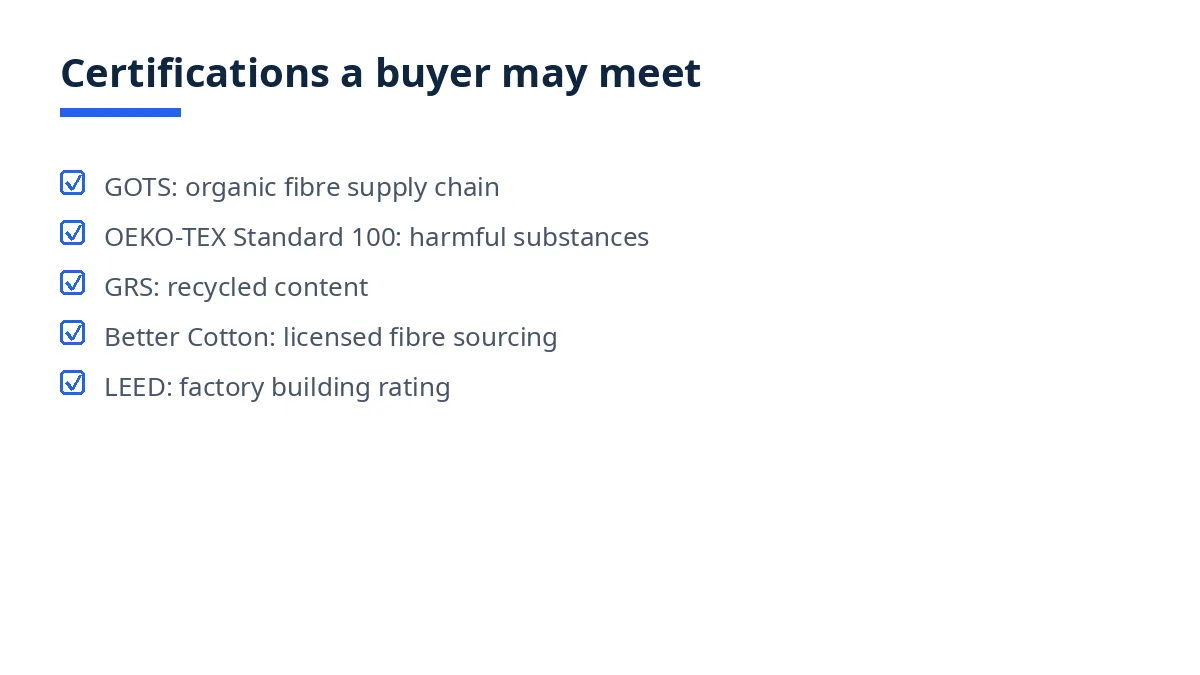
The diagram below summarises the five frameworks a buyer is most likely to meet in this category.
What does GOTS certify?
The Global Organic Textile Standard (GOTS) certifies products made with certified organic fibres through a certified processing chain. GOTS-certified products must contain a minimum of 70 percent certified organic fibres, with two label grades: Organic at at least 95 percent certified organic fibres, and Made with Organic Materials at at least 70 percent.4 Organic fibres entering the chain must be certified organic to one of the IFOAM Family of Standards, which means they are produced without synthetic pesticides, herbicides or genetically modified organisms.4
GOTS also sets environmental and chemical criteria across processing, including wastewater treatment, resource efficiency, greenhouse gas emission management and chemical input restrictions, and social criteria covering safe and hygienic working conditions and the prohibition of child labour and forced labour.4 Certification is carried out by accredited certification bodies through on-site audits, and GOTS states that it uses physical segregation and volume reconciliation, rather than a mass balance approach, to maintain product integrity across processing and trading stages.4
Scope accuracy matters here. A GOTS certificate covers the certified entity, its sites and the product and process categories listed on it. It supports an organic claim only for goods produced inside that scope and shipped with the chain-of-custody documents the scheme requires. It does not make every product a company sells organic.
What does OEKO-TEX Standard 100 certify?
OEKO-TEX Standard 100 is an independent testing and certification system for textile raw materials, intermediate and finished products and their accessories, confirming that products have been tested for harmful substances.5 It is a product safety scheme. It does not certify organic content, recycled content or factory working conditions.
The criteria depend above all on intended use, across four product classes: Class I for babies and young children up to three years, Class II for textiles whose surface comes into direct contact with the skin, expressly including bed linen and towels, Class III for textiles with limited skin contact, and Class IV for furnishing materials such as table linen and curtains.5 A certificate is awarded only if all components of an item meet the criteria, and a Standard 100 certificate is valid for 12 months and can be renewed annually.5
The practical point is the class. A Class IV certificate held for curtains says nothing about a towel programme, which belongs in Class II. Ask for the certificate number, holder, product class, article description and expiry date, and check the class matches your article.
What do GRS and RCS certify?
The Global Recycled Standard (GRS) and the Recycled Claim Standard (RCS) are Textile Exchange standards for recycled content. The GRS is a voluntary international standard that sets requirements for third-party certification of recycled content, chain of custody, responsible social and environmental practices and restrictions on the use of hazardous chemicals, with a minimum recycled content of 20 percent.6 It verifies and tracks recycled raw materials through the supply chain.6
The RCS covers traceability and recycled content with a minimum of 5 percent, without the wider social and environmental processing requirements that distinguish the GRS.6 The related Organic Content Standard (OCS) verifies the presence and amount of organic material in a final product through a chain of custody system, and applies to products containing 5 to 100 percent organic material.6 Choose the standard that matches the claim you intend to print. An RCS result supports a recycled-content claim. It does not support the wider production claims a GRS scope covers.
What does Better Cotton sourcing actually mean?
Better Cotton, run by the Better Cotton Initiative (BCI), is a farm-level cotton programme, and its chain of custody decides what a buyer can accurately say. Under the Mass Balance system described by BCI, BCI Cotton may be substituted or mixed with conventional cotton along the supply chain, as long as equivalent volumes are sourced as BCI Cotton, and the amount sold never exceeds the amount produced.7 BCI states directly that when you see its logo on a product sourced through Mass Balance, it does not mean the product is made of traceable, physical BCI Cotton.7
That distinction decides your wording. Mass Balance supports a claim that your brand sources a stated volume of cotton as BCI Cotton and invests in the programme, which BCI links to farmer training and support.7 It does not support a claim that the physical cotton in a specific towel came from a licensed farm. If your packaging needs that claim, agree a traceable route and its documents before production.
What is a green factory, and what does LEED rate?
A green factory claim usually refers to the building, not the product. LEED, Leadership in Energy and Environmental Design, is a building rating awarded by the US Green Building Council (USGBC). It rates the building and its operation. It does not certify the towels or linen made inside it, their fibre content or their chemical safety.
Bangladesh's garment sector added 38 LEED-certified factories in 2025, taking the total to 270 LEED-certified garment factories, including 114 Platinum-rated and 137 Gold-rated facilities, according to figures attributed to the USGBC.8 Read that figure with care. It describes garment factories, not home textile mills, and this guide makes no claim about how many home textile plants hold LEED ratings, because no opened source states that number. Ask the individual supplier for its rating document, and check the rated address against the plant making your order.
A LEED-rated building can still produce a non-compliant product, and a conventional building can produce a fully certified one. Keep building ratings, product certificates and social audit reports in separate files, because each answers a different question.
How do you check a certificate before you rely on it?
Use the same sequence for every scheme:
Read the document, not the logo. A logo image proves nothing. Require the certificate itself, with number, holder, issuing body, standard and version, scope, site address and validity dates.
Match the holder and the site. The holder must be the legal entity you are contracting with, or a named stage in its chain, and the site must be the plant in your production plan.
Match the scope to your article. The categories, processes and materials listed must cover your product and your intended claim, in the correct class or label grade where the scheme uses them.
Check validity on the issue date and the ship date. A certificate that expires mid-production needs a renewal plan agreed in advance. Standard 100 certificates, for example, run for 12 months.5
Confirm in the scheme register where one exists. Use the certification body's or scheme owner's public label check or buying guide where offered, and keep a dated record of the check in the order file.
Require the shipment document. For chain-of-custody claims, agree which transaction document will accompany your goods, and print the claim only after that document arrives and matches the shipment.
Which destination rules govern the claim itself?
Certification is voluntary. Market law is not. In the European Union, Regulation (EU) No 1007/2011 of 27 September 2011 lays down rules on textile fibre names and the related labelling and marking of the fibre composition of textile products.9 Your fibre composition label must use the names and rules your destination requires, whether or not the product carries a voluntary certificate.
Alongside labelling, the EU textiles strategy records that the Empowering Consumers Directive and the proposed Green Claims Directive aim to tackle greenwashing, and its action list includes design requirements for textiles and a Digital Product Passport.2 The direction is consistent: a general claim such as green or eco needs specific evidence behind it. Write the narrow claim the certificate proves, name the standard, and keep the documents with the order file.
What quality controls sit alongside certification?
Certification does not test whether a towel is absorbent, a sheet keeps its size, or a seam survives laundering. Specify measurable quality in the purchase order: GSM and tolerance, dimensions before and after washing, fibre composition, absorbency, colour fastness to washing and rubbing, seam strength and appearance after laundering, and standards for stitch density, hemming and label placement.
Then control it in stages. Approve lab dips or strike-offs for colour, approve a pre-production sample in the correct fabric, test through an accredited laboratory, inspect during production on large programmes, and always inspect before shipment against the approved sample and specification. Agree the sampling method in the order itself using AQL acceptance quality limit and pre-shipment inspection. Keep reports and retained samples from each shipment.
Shipping, Incoterms and duties
Most home textile exports move by sea in full or shared containers, with samples and urgent small consignments by air. Towels and linen are bulky relative to their weight, so packing choices affect freight cost per unit. Agree compressed packing, carton dimensions and palletisation before the price is fixed. The sequence in how to import from Bangladesh places this stage inside the wider import process.
The Incoterms rules published by the International Chamber of Commerce are eleven three-letter trade terms used in contracts for the sale and purchase of goods, and they clarify the tasks, costs and risks involved in delivering goods from sellers to buyers.10 Incoterms 2020, the current version, entered into force on 1 January 2020.10 Under EXW you arrange almost everything from the factory gate. Under FOB the supplier delivers goods on board at the named Bangladeshi port and you control the main freight. Under CIF the supplier arranges freight and minimum insurance to your destination port, while risk passes at loading. Under DDP, duties and clearance sit with the seller, a term to use only where you have checked the seller's arrangements in your market. Name the port or place precisely in the purchase order.
Duties must be checked, not assumed. Duty depends on the exact HS classification, your destination tariff and any preferential scheme applying to Bangladesh on the import date, and arrangements differ between the EU, the UK, the USA and the UAE and change over time. Classify the product first, then confirm the current rate and origin evidence in your destination's official tariff or with your broker, before you calculate landed cost. A sustainability certificate does not change the duty rate. Origin evidence and classification do.
Bangladesh Customs requires the Bill of Export to be approved before export loading, supported by the documents listed in the verification section, including the invoice, packing list, EXP form and certificate of origin.3 Check names, HS codes, weights and quantities across draft documents as soon as they arrive, and check that certificate copies travelling with the shipment match the versions you verified at order stage.
Step-by-step buying process
Decide the claim first. Write down the exact claim your packaging and product pages will carry, the standard behind it, and the market where it will be sold.
Fix the specification. Product family, construction, GSM or thread count, sizes, colours, quantities, labelling, packing and delivery window, with tolerances as numbers.
Shortlist suppliers. Build the list from more than one route, then run the identity, site, scope and validity checks in this guide on each name.
Request comparable quotations. Send the identical specification, including the exact certification scope required, and require delivery term, currency, validity, MOQ per colour and size, and lead time in writing.
Sample and test. Approve physical samples, colours and packing mock-ups, run wash, absorbency and fastness tests, and seal a counter-sample.
Verify certificates again at contract stage. Repeat the register check, record certificate numbers and expiry dates in the purchase order, and agree the shipment documents that will support the claim.
Agree the contract. Purchase order with full specification, inspection rights, document list, claim wording, payment terms tied to re-checked bank details, and the agreed delivery term and named place.
Control production. Confirm the certified input lot and the dyeing slot, and resolve any request to substitute fibre, fabric or trims in writing before it happens, since a substitution can void the claim.
Inspect, ship and file the evidence. Inspect before shipment, check document drafts early, and file the certificate copies and shipment documents with the order record so the printed claim can be evidenced later.
Related guides
Read the home textiles industry in Bangladesh pillar for capacity, products and clusters in full. Use how to import from Bangladesh for the end-to-end import sequence, pre-shipment inspection and AQL acceptance quality limit for the inspection stage, and Bangladesh export data to read EPB figures without mixing data series.
FAQs
Is Bangladesh a good place to source home textiles & towels?
It can be, when the supplier, the specification and the claim are right. EPB data show export earnings recovering to USD 871.57 million in 2024-25, across a sector exporting to 131 countries.1 Part of that supply base works inside recognised systems such as GOTS and OEKO-TEX Standard 100. Results depend on checking the individual factory and its certificate scope, approving samples and controlling quality.
What is the typical MOQ?
There is no single typical MOQ. Minimums are set by certified fibre or fabric lot sizes, dye-lot size per colour and the stitching run, and are quoted per design, per colour and per size. A plain white certified towel programme will usually carry a different minimum from a multi-colour printed bedding programme. Ask each supplier to state its MOQ against your exact specification and claim.
How long is the lead time?
Lead time is product- and programme-specific. It covers certified input availability, weaving, dyeing and finishing queues, making up, testing, inspection, packing and transport to port, after sample approval. A certified input that is not in stock adds a procurement stage first. Require a written lead time, confirm the production slot in the purchase order, and build buffer for re-testing.
Which certifications matter?
It depends on the claim you need to make and the market you sell into. For an organic claim, GOTS applies, with its 70 percent minimum and its 95 percent Organic label grade.4 For harmful-substance testing, OEKO-TEX Standard 100 applies, in the product class that matches the article, with Class II covering bed linen and towels in direct skin contact.5 For recycled content, the GRS sets a 20 percent minimum with wider processing requirements, while the RCS starts at 5 percent for content and traceability.6 For licensed cotton sourcing through Mass Balance, Better Cotton supports a sourcing claim, not a claim about the physical cotton in a specific product.7 In every case, check the holder, site, scope and expiry date before you rely on the certificate.
Next steps on Exportain
Browse suppliers by product category and note the mills whose range and certification scope match your claim, then check current category data in trade intelligence before you enquire. When your specification and claim wording are ready, use how to import from Bangladesh to run the order from quotation to inspection.
Sources
- Home textile sector rebounds after a two-year slump. TOB News, (accessed )
- Textiles Strategy. European Commission (accessed )
- Customs Clearance Procedures for Export. Bangladesh Customs, National Board of Revenue (accessed )
- GOTS - All key features at a glance. Global Standards (accessed )
- OEKO-TEX STANDARD 100 for textiles tested for harmful substances. Hohenstein (accessed )
- Textile Exchange standards certification | GRS, RCS, CCS, OCS. Eurofins, (accessed )
- History of the Mass Balance On-Product Mark. Better Cotton Initiative (accessed )
- Bangladesh garment sector adds record number of LEED-certified green factories in 2025. Apparel Resources (accessed )
- Regulation (EU) No 1007/2011 on textile fibre names and related labelling and marking of the fibre composition of textile products. European Union, (accessed )
- Incoterms® rules. International Chamber of Commerce (ICC) (accessed )
About the author
Sourcing from Bangladesh?
Post a request for quotation and suppliers on Exportain can send you their quotes directly.
Post an RFQ


