Workwear and Uniforms From Bangladesh to Saudi Arabia: A Buyer's Import Checklist
How Saudi buyers import workwear and uniforms from Bangladesh: supplier verification, samples, SABER certificates, tariff classification, duty, VAT and a landed cost example.
Short answer
To import workwear and uniforms from Bangladesh to Saudi Arabia, fix the specification garment by garment, shortlist woven-garment factories that already make workwear, and verify company documents before paying. Approve a pre-production sample in production fabric, open the SABER product certificate file at sample stage, classify each garment for the Saudi tariff, and obtain a shipment certificate for every consignment before clearing customs through FASAH.
On this page
Key takeaways
Saudi conformity gates entry: textiles fall under a Saudi technical regulation, and SABER requires a product certificate valid for one year plus a shipment certificate for every consignment, so open the file at sample stage, not at shipment stage.
Classification comes before pricing: woven workwear sits in Chapter 62 and knitted workwear in Chapter 61, with industrial and occupational lines inside Chapter 62, and duty is set per garment line in the Saudi tariff schedule in force on the entry date.
There is no single typical MOQ, price or transit time for workwear from Bangladesh: the minimum is set per garment and colour, quotes must be compared on an identical specification, and sea transit takes weeks and varies by routing.
Import VAT at 15 percent applies on the duty-paid customs value, is paid at clearance, and is recoverable as input tax for a VAT-registered buyer, so build it into the cash-flow plan even when it is recoverable.
Inspection needs an agreed plan before production: AQL sampling under ISO 2859-1:2026, an inline check during sewing and finishing, and a final random inspection covering size range, shade consistency and set completeness.
A Saudi buyer importing workwear and uniforms from Bangladesh is buying two things at once: garments cut and sewn to a specification, and a conformity file that lets those garments clear Saudi customs. The order works when the specification is fixed garment by garment, the supplier is checked before payment, a pre-production sample is approved in production fabric, and the Saudi conformity certificates are in place before the shipment sails. This guide follows that sequence from first supplier search to delivery at a Saudi warehouse.
The Harmonised System is an international commodity classification of approximately 5,000 six-digit product categories, organised by chapters, headings and sub-headings, and countries subdivide the six-digit categories further for their own tariffs.1 For workwear, the classification starting point is usually Chapter 62 for woven garments, and the tariff schedule itself carries dedicated industrial and occupational lines, such as men's or boys' industrial and occupational trousers and breeches of cotton.2 That line-level detail is why classification comes before pricing in this guide: the code decides the duty line, the conformity route and the documents.
Why source workwear and uniforms from Bangladesh
Workwear and uniforms are woven-garment orders in most cases: trousers, shirts, jackets, coveralls, bib overalls and aprons, cut from cotton, polyester-cotton or blended fabrics and sewn to a size range. The buying decision therefore turns on woven-garment capability rather than on fashion range: consistent cutting across sizes, durable seams and trims, colourfast dyeing, and packing that keeps sets complete. A factory that sews fashion shirts may not be set up for heavy twill trousers with bar tacks, reinforced knees or reflective tape, so shortlist on the garment type, not on general garment capacity.
The second reason to plan carefully is the Saudi end of the order. Saudi Arabia runs its own product conformity system for textiles, so a supplier shipping the same workwear to other markets without a Saudi file cannot simply redirect a shipment. Build the conformity step into the timeline from the start.
Find and verify suppliers
Start with a specification, not with factory names
Write the specification before contacting any supplier. For each garment, record the garment type, fabric composition and weight as your own choices, the size range and size chart, colour, trims and closures, reflective or protective features where you need them, labelling and packing. State whether garments are sold as sets or as separate pieces, and how many pieces make one set. Then shortlist woven-garment factories and exporters whose current range already includes workwear or uniforms. A supplier making only fashion apparel or only knitwear is not a close substitute, because heavy woven workwear uses different cutting, sewing and finishing operations.
Send every candidate the identical specification and ask for the same reply format: fabric assumed, price inclusions, validity, and the minimum split by garment, colour and size range. Browse suppliers on Exportain, read finding suppliers in Bangladesh, and compare your approach with the workwear and uniforms HS classification guide.
How do you verify a supplier before you pay?
Verification has three layers. The first is company documents: trade licence, export registration and association membership where applicable, checked so that name, address and bank account name agree across every document. The second is capability: monthly workwear capacity, fabric sourcing route, dyeing and finishing route, and which recent workwear styles the factory can show from current production. A finished garment from current production shows seam strength, trim attachment and shade consistency across sizes.
The third layer is payment discipline. Keep payments to the company account named in the documents, never to a personal account, and verify any change of bank details separately. Read how supplier verification works on Exportain for what document and photo checks cover. On Exportain, supplier profiles carry document and photo review badges. A badge is a review of documents and photos, not a factory inspection or a guarantee, and Exportain is not a party to the goods contract.
MOQ, pricing and samples
What is the typical MOQ for workwear and uniforms from Bangladesh?
There is no single typical minimum order quantity for workwear and uniforms from Bangladesh, and this guide states none. The minimum is set per garment and usually per colour, because fabric is woven, dyed or finished in batches and a cutting plan is set up per size range. A plain cotton trouser and a taped coverall with several colours will not carry the same minimum. Ask each supplier how its minimum splits by garment, colour, size range and set composition, and get the answer in writing before comparing quotes.
How is the price built, and how should you compare quotes?
Fabric is usually the largest cost element in a workwear garment, followed by cutting and sewing, dyeing or finishing, trims, reflective tape where specified, testing, packing and the factory margin. Fabric use per garment depends on size, cut and any reinforcement. Detail adds operations: bar tacks, double-needle stitching, reinforced knees, taped seams and pattern matching each cost more to process. Two quotes can differ because one assumes a lighter fabric, simpler trims, no tape or a shorter size range. Ask what each price is based on, in writing, so a lower quote is judged as a different specification rather than accepted as a saving.
Compare quotes on the same basis: same garment and set composition, sizes, fabric, trims, delivery term and packing. Ask each supplier to state what is excluded, for example reflective tape, testing, special packing or labelling.
Which samples do you need, and how do you approve them?
Work in stages. A development sample shows whether the factory can construct the garment, attach trims evenly and hold the size chart. A pre-production sample, made in the actual production fabric, colour, trims and finish, is the sample you approve for bulk. Fit, shade and tape performance cannot be approved from a sample in substitute fabric, because washing and finishing change dimensions and shade.
Test the samples as your end users will wear them: measure every size against your chart, check seams and trims at stress points, wash to your care label and re-measure, and check shade consistency. Approve in writing and keep one sealed counter-sample of each garment.
Quality control and certifications needed
Which quality checks are specific to workwear and uniforms?
Against the approved sample and chart, check fabric composition and finished weight, measurements across the full size range, and consistency from the smallest to the largest size. Then check construction garment by garment: seam type and stitch density, bar tacks at stress points, button and zip attachment, pocket placement, tape placement and adhesion where reflective tape is specified, and shade match across pieces in a set. A set can pass piece by piece and still fail as a set if one piece comes from a different shade batch.
Agree the inspection method and defect limits before production. ISO 2859-1:2026 defines a system of acceptance sampling plans for inspection by attributes, and AQL stands for acceptance quality limit, the maximum average percentage of defective items considered acceptable during random sampling, used to determine sample sizes and acceptance and rejection thresholds.3 Inspect in stages: an inline check during sewing and finishing catches a drift while correction is still possible, and a final random inspection on packed goods checks quantity, workmanship, measurements, labels and packing. See the acceptance quality limit, pre-shipment inspection and workwear quality control checklist guides.
What does Saudi conformity require for textiles?
Textiles sold in Saudi Arabia fall under a Saudi technical regulation for textile products. The regulation described by UL applies to all textile products containing at least 80 percent by weight of textile fibres, and it is a mandatory certification for textile products to be sold in Saudi Arabia.4 SABER is the online platform introduced by SASO for registering products and obtaining a Type Approval Certificate and a shipment certificate, both of which are mandatory to enter the Saudi market.4
The working sequence runs through SABER in four steps: the importer establishes an account, registers the products, obtains the product certificate from a registered notified body for a regulated product (valid for one year) or uploads a self-declaration for a non-regulated product, and creates a shipment certificate request for every shipment.4 Under the SALEEM programme, all importers of regulated and non-regulated products register their products in SABER to obtain their certificate of conformity, the product certificate is valid for one year, and the shipment certificate is required for every consignment, with non-compliant shipments subject to re-exportation.5 Start this sequence at sample stage, not at shipment stage: the product certificate must cover the exact garments in the order, and a late start is the most common avoidable delay in a Saudi workwear order.
Which other certifications do you actually need?
No single certificate covers every workwear order. What you need follows your end user and your market: a corporate, industrial or government buyer may name a specific performance requirement in its own tender or supplier manual, for example high-visibility performance or flame resistance for oil, gas or construction use. Name any such requirement in the specification, ask for the matching test report, and check its scope, product covered, issuing body and date. A report for a different fabric or an untaped version does not cover your taped garment. Agree label wording and content with your Saudi importer and the conformity body before bulk label printing begins.
Incoterms, shipping and transit time
Which delivery term should a first order use?
The Incoterms 2020 rules set out, for each rule, where delivery takes place, and risk passes from seller to buyer at the same point and time as delivery.6 Under FOB, CFR and CIF the seller must place the goods on board the vessel.6 On customs, in all rules but EXW the seller must carry out export formalities, and in all rules but DDP the buyer must carry out import formalities.6 The same ICC Academy summary notes that the four sea rules, FAS, FOB, CFR and CIF, are only intended for port-to-port bulk or break-bulk shipments and are not suitable for container shipments, because a container is handed to the carrier before it is on board.6
For a first order shipped in containers, weigh FOB at the Bangladeshi port against FCA at the named terminal. Under FCA, delivery happens when the goods are handed to your carrier, which matches how containerised cargo moves. See Incoterms for shipments from Bangladesh for the comparison for this trade lane.
How long does shipping take?
There is no single typical transit time for workwear from Bangladesh to Saudi Arabia. Sea freight is the standard route for bulk orders and it takes weeks rather than days, varying by port, routing, transshipment and season. Plan from your forwarder's current sailing schedule, and add clearance and delivery. Keep production time separate: an order is ready only when every garment has finished sewing, finishing, inspection and packing. Confirm pieces per carton and carton dimensions in the specification.
Import duty, taxes and documents
How are workwear and uniforms classified for duty?
Duty follows the classification of each garment in the Saudi tariff, not the supplier's product name. The Harmonised System gives the structure: chapters at two digits, headings at four digits and sub-headings at six digits, with countries subdividing further for their own tariffs.1 Woven workwear sits in Chapter 62, which covers articles of apparel not knitted or crocheted, and the schedule carries industrial and occupational lines within it, such as men's or boys' industrial and occupational trousers and breeches of cotton.2 Knitted workwear, where you order it, falls in Chapter 61 instead, and garments of different headings are classified in their own headings even when put up in sets.2 Confirm the full national code for each garment before you price or ship, and keep set components on separate invoice lines matching their classifications.
What import duty applies?
Your rate depends on each garment's line in the Saudi tariff schedule in force on the entry date, so there is no single rate for a whole workwear order, and this guide states none. The schedule that applies is the GCC Integrated Customs Tariff Schedule, which is amended from time to time by decisions published in the official gazette.7 ZATCA provides a customs and tax calculator service that enables users to calculate customs duties and taxes for imported goods by selecting the type of goods and entering the total value.8 Use that service, or your customs broker's line-by-line calculation, for every garment before you commit to a selling price. Confirm the rate again at shipment stage, because a schedule amendment between order and entry changes the amount due.
What about VAT?
Import VAT is charged on goods imported into Saudi Arabia, collected by ZATCA at the point of importation before goods are released, and calculated on the customs value inclusive of any applicable customs duty, at the standard rate of 15 percent.9 For a VAT-registered buyer, import VAT is a recoverable cost through the input tax credit mechanism, provided the goods are used for taxable business activities; for a non-registered buyer it is a final cost.9 Build VAT into the cash-flow plan even when it is recoverable, because it is paid at clearance and recovered later through the return. The landed cost example below shows VAT separately for exactly this reason.
Which documents do you need for clearance?
The standard import set is the commercial invoice, packing list, bill of lading or air waybill, certificate of origin where a preference or origin proof is needed, and the SABER shipment certificate for the consignment.9 The declaration is filed electronically through the FASAH system, with the commercial invoice, bill of lading or airway bill, packing list, certificate of origin and certificates of conformity among the key documents.9 The invoice should name each garment plainly, for example men's cotton industrial trousers with reflective tape, with composition, sizes, quantities, unit prices and the delivery term, on its own line. Quantities, weights and carton counts must agree across every document, and every garment on the invoice must match a garment covered by the product certificate.
Landed cost example (table)
A landed cost is the full cost of one workwear set, ready for a Saudi warehouse. Every number below is an example figure only, not a quote, and the duty figure uses an assumed example amount for arithmetic only. It is not a schedule rate. Confirm the schedule rate for each garment line with your broker before ordering.
Example figures: 2,400 workwear sets, FOB Chattogram, sea freight to a Saudi port, conformity and clearance handled by the Saudi importer.
Cost element | Example figures (per set) | How to obtain your figure |
|---|---|---|
Product price, FOB | $9.50 | Confirmed pro forma invoice |
International freight | $0.90 | Forwarder quote divided by sets shipped |
Insurance | $0.08 | Policy or forwarder quote |
Duty | $0.85 | Broker calculation from confirmed codes and rates; example amount only |
Port, clearance and broker fees | $0.35 | Broker invoices divided by sets |
Local delivery to warehouse | $0.25 | Local carrier quote divided by sets |
Total landed cost, excluding VAT | $11.93 | Sum of all lines above |
Import VAT is not included in that total. In this example, VAT at 15 percent on the duty-paid customs value (freight and insurance plus product price plus duty, $11.33) would be $1.70 per set in example figures, paid at clearance and recoverable as input tax for a VAT-registered buyer. Work the calculation twice: at quote stage, garment by garment, and again after shipment with the actual invoices. See landed cost for imports from Bangladesh for the full method.
Step-by-step import checklist
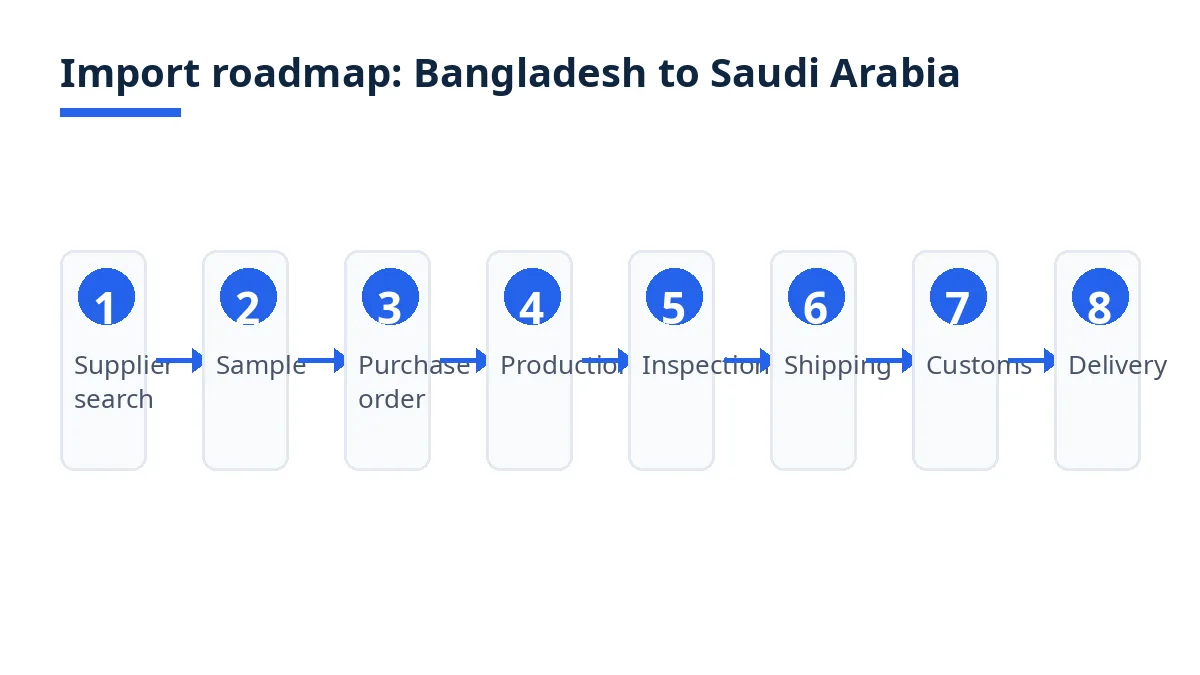
Write the specification garment by garment: garment type, fabric, weight, size range, colours, trims, tape or protective features, labelling and packing, and whether garments are sold as sets or separate pieces.
Classify every garment, starting from Chapter 62 for woven workwear and Chapter 61 for knitted workwear, and confirm each full national code and duty line with your broker.
Open the SABER sequence at sample stage: confirm whether each garment is regulated, and start the product certificate file with your Saudi importer.
Shortlist factories whose range includes workwear, and request comparable quotes on the identical specification and delivery term.
Verify the chosen supplier: company documents, workwear capacity, fabric source, dyeing and finishing route, and a video or in-person factory check for a first order.
Order samples in stages, measure and wash-test them, then approve a pre-production sample of each garment in production fabric and trims.
Confirm the order in writing: purchase order, pro forma invoice, delivery and payment terms, inspection plan with AQL and defect limits, labelling, packing and shipment date.
Inspect during production and again on packed goods against the approved samples, checking size range, shade consistency and set completeness.
Obtain the shipment certificate for the consignment, ship, clear customs with the confirmed code for each garment, and reconcile the actual landed cost.
How Exportain helps
Browse suppliers for Bangladeshi woven-garment exporters and compare their ranges against your garment list. Then post your specification and target quantity as an RFQ and compare replies on the same terms before you choose a factory for sampling. Exportain is a B2B marketplace where buyers post RFQs, receive quotations and message suppliers. It does not inspect goods, book freight or clear customs.
FAQs
What is the typical MOQ for workwear and uniforms from Bangladesh?
There is no single typical minimum. It is set per garment and usually per colour, because fabric is woven, dyed or finished in batches and a cutting plan is set up per size range.
How long does shipping take?
Production time and transit time are separate, and neither has a single typical figure. Sea transit takes weeks rather than days and varies by port, routing and season.
What import duty applies?
Duty follows the confirmed classification of each garment in the Saudi tariff schedule in force on the entry date. Workwear sits mainly in Chapter 62 for woven garments, with industrial and occupational lines inside it.2 Confirm each line with your broker or through the ZATCA calculator service before you commit to a selling price.8 Import VAT at 15 percent applies on the duty-paid customs value.9
How do I verify a supplier?
Check company documents first, so that name, address and bank account agree across the trade licence, export registration and invoices. Then check capability: workwear capacity, fabric source, dyeing and finishing route and recent workwear production. Keep payments to the company account named in the documents, and approve a pre-production sample of each garment before bulk production.
Next steps on Exportain
Read how to import from Bangladesh for the full process, then use how to write an RFQ to set out your garment list. When ready, post a free RFQ on Exportain and compare quotes on the same terms.
Sources
- Harmonised System. European Commission (accessed )
- HS Code 62034211 - Men's or boys' industrial and occupational trousers and breeches of cotton. tariffnumber.com (accessed )
- ISO 2859-1:2026 - Sampling procedures for inspection by attributes — Part 1: Sampling schemes indexed by acceptance quality limit (AQL) for lot-by-lot inspection. International Organization for Standardization (accessed )
- New SASO Regulations and the Effects on Textiles and Apparel Industry. UL Solutions (accessed )
- Navigating SASO & Imports into Saudi Arabia. QIMA (accessed )
- Insider thoughts: Bob Ronai on Incoterms 2020 Rules; What are they about?. International Chamber of Commerce (accessed )
- Duties revised on certain products as per amended GCC Customs Tariff Schedule. Saudi Gazette, (accessed )
- Customs and Tax Calculator Service. Zakat, Tax and Customs Authority (accessed )
- Guide to Import VAT in Saudi Arabia for Foreign Companies. Commenda (accessed )
About the author
Sourcing from Bangladesh?
Post a request for quotation and suppliers on Exportain can send you their quotes directly.
Post an RFQ