HS Code for Workwear and Uniforms: Classification Guide for Importers
There is no single workwear heading: woven workwear splits across 6203 and 6204 by garment type, coated and nonwoven garments sit in 6210, and other woven garments in 6211.
Short answer
There is no single HS code for workwear and uniforms, because the Harmonized System classifies garments, not jobs. Woven work trousers, jackets and bib and brace overalls sit in headings 6203 and 6204, coveralls and other unnamed woven garments can sit in 6211, and garments of felt, nonwoven or coated fabric sit in 6210. The full code comes from the importing country tariff.
On this page
Key takeaways
There is no HS heading named for workwear or uniforms: each garment is classified by type, construction and fibre.
Woven work trousers, jackets and bib and brace overalls sit in 6203 for men's or boys' garments and 6204 for women's or girls' garments.
Garments of felt, nonwoven or coated fabric sit in 6210, which takes priority over the other Chapter 62 headings, while coveralls and other unnamed woven garments can sit in 6211.
Bib and brace overalls have their own named national lines inside the trousers subheadings, such as under 6203.43 and 6204.63 for synthetic fibres in the US schedule.
High-visibility tape or a flame-retardant finish does not by itself change the heading; the fabric construction behind the protection is what can move a garment to 6210.
There is no single hs code for workwear and uniforms in the tariff. The Harmonised System is an international classification system developed by the World Customs Organization (WCO), organising approximately 5,000 six-digit product categories by sections, chapters, headings and sub-headings.1 Workwear is a use, not a garment type, so each piece is classified as the garment it is: a trouser, a jacket, a coverall or a coated protective garment.
Quick answer: indicative headings 6203, 6204, 6210 and 6211
Most woven workwear sits in Chapter 62, split across four headings. Heading 6203 covers men's or boys' suits, ensembles, jackets, blazers, trousers, bib and brace overalls, breeches and shorts, and heading 6204 carries the same group for women's or girls' garments.2 A work trouser, jacket or bib and brace overall starts in 6203 or 6204, with the six-digit line set by fibre, such as 6203.43 or 6204.63 for synthetic fibres.2
Heading 6210 covers garments made up of fabrics of heading 5602, 5603, 5903, 5906 or 5907: felt, nonwovens and coated or laminated fabrics.2 Heading 6211, worded as track suits, ski-suits and swimwear; other garments, is the residual woven heading for garments such as coveralls that no earlier heading names.2
Garment in the range | Indicative heading | Why |
|---|---|---|
Woven trousers, jackets, bib and brace overalls | 6203 (men's) or 6204 (women's) | The headings name these garment types |
Coveralls and other unnamed woven garments | 6211 | The heading ends with "other garments" |
Garments of felt, nonwoven or coated fabric | 6210 | The heading is defined by the fabric |
Knitted workwear | Chapter 61 headings | Chapter 62 excludes knitted articles |
Treat this map as indicative only. The full code comes from the destination tariff, read for the exact garment.
How HS codes are structured
Each pair of digits narrows the category, supported by general rules for interpretation and explanatory notes.1
Level | Digits | For workwear and uniforms |
|---|---|---|
Chapter | 2 digits (62) | Articles of apparel and clothing accessories, not knitted or crocheted |
Heading | 4 digits (6203, 6204, 6210 or 6211) | Set by garment type, or by fabric for 6210 |
Subheading | 6 digits (for example 6203.43) | Split mainly by textile material |
National extension | 8 to 10 digits | Set by the importing country; details such as bib overalls split out |
The diagram below summarises the levels.
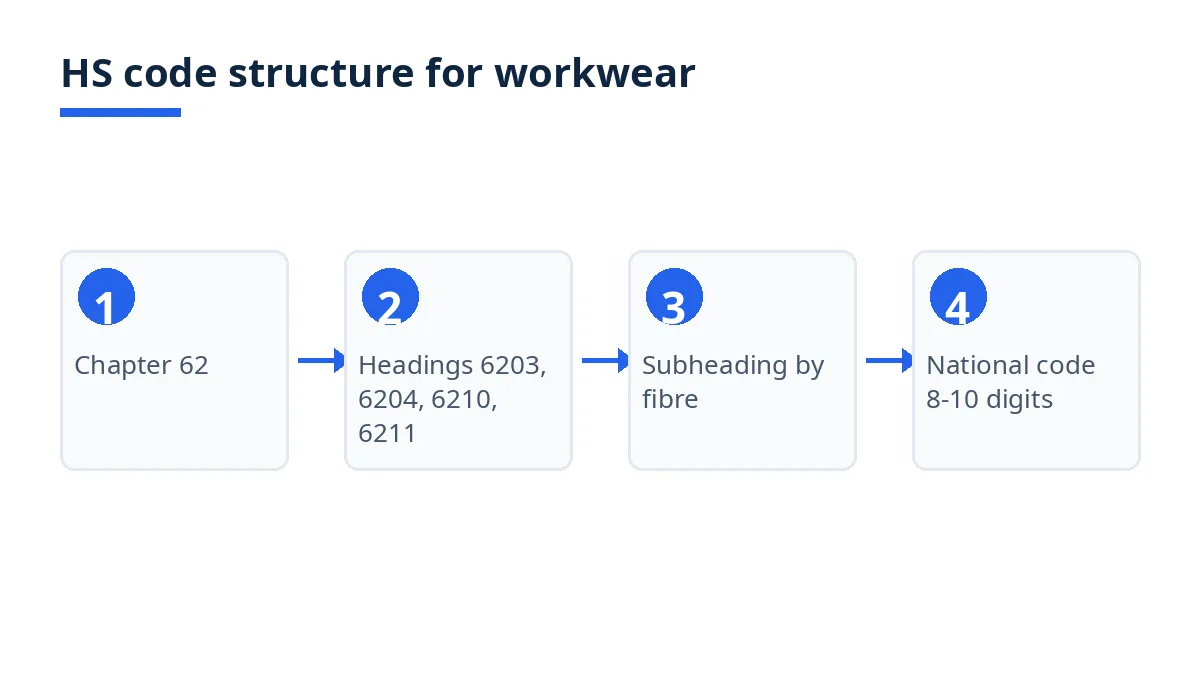
Countries use the HS as the basis for customs tariffs and statistical data, and they subdivide the six-digit categories into national subheadings.1 The current version is HS 2022.1 Read the 6-digit HS code guide and the harmonized system tariff code explainer for more on the structure.
Factors that decide the code for workwear and uniforms
Classification follows the heading texts and chapter notes, not the words workwear or uniform on an invoice or catalogue.
Garment type comes first. Headings 6203 and 6204 name suits, ensembles, jackets, blazers, trousers, bib and brace overalls, breeches and shorts.2 The European textile guidance places trousers, dungarees and shorts under 6103, 6104, 6203 or 6204 as appropriate, and jackets and blazers under the same four headings.3 A uniform set is classified piece by piece.
Woven or knitted construction. Chapter 62 applies only to made up articles of textile fabric other than wadding, excluding knitted or crocheted articles.2 A knitted work trouser or coverall leaves Chapter 62 for the matching Chapter 61 heading, such as 6103 or 6104 for trousers.3 Record the construction for every style.
Fabric construction can move a garment to 6210. Heading 6210 covers garments made up of fabrics of heading 5602, 5603, 5903, 5906 or 5907.2 Chapter 62 note 6 gives 6210 priority: garments classifiable both in 6210 and in other headings of the chapter, excluding 6209, go to 6210.2 The European guidance agrees: felt or non-woven garments sit in 6210, as does a woven fabric with a visible non-cellular coating.3 The US schedule lists nonwoven disposable apparel for hospitals, clinics and laboratories under 6210.10.2
Protective features alone do not set the heading. Reflective tape or a flame-retardant finish is not a heading term in 6203, 6204 or 6211. What changes the heading is the fabric behind the protection: a coated or laminated fabric of heading 5903 pulls the garment into 6210, while the same coverall in plain woven fabric stays with the garment headings or 6211.2 3 A US chapter note defines occupational outerwear as outerwear garments, including uniforms, designed to protect against workplace hazards such as fire, electrical or chemical hazards, or impacts and cuts.2 That note serves specific US lines only.
Industrial and occupational criteria are narrow. The European guidance describes industrial and occupational clothing as items worn solely or mainly to provide protection, made from tough or non-shrink fabric, usually classified under Chapter 62.3 Only garments of commercial size 158 or more can qualify, and uniforms and official garments are not considered industrial or occupational garments.3 Typical examples are boiler suits and coveralls for mechanics and factory workers, and aprons and dust coats for doctors and bakers.3 Woven working trousers, other than wool, can qualify if they meet the criteria, bib and brace overalls may also qualify, and shorts never do.3
Fibre composition and blends. Inside 6203 and 6204, the six-digit split is by material: 6203.43 and 6204.63 are the synthetic fibres lines.2 For a blend, the textile section notes classify a mixture as the material that predominates by weight over any other single material.4 A polycotton trouser in which polyester predominates takes the synthetic line. Record exact fibre percentages by weight.
Wearer group and closure. Headings 6203 and 6204 split by wearer group before material.2 Chapter 62 note 9 adds the closure rule: left over right marks a men's or boys' garment, right over left a women's or girls' garment, and a garment that cannot be identified as either goes to the women's or girls' headings.2 A unisex jacket can land on the women's line by default.
National codes: US HTS, EU CN/TARIC, UK commodity code
United States: HTS, ten digits. The US schedule splits the six-digit subheadings further, and bib and brace overalls get named lines at eight digits. Under 6203.43, of synthetic fibers, bib overalls are named separately from trousers, with water resistant lines at 6203.43.03 and 6203.43.55.2 Heading 6204 follows the same pattern at 6204.63.2 Read the full ten-digit line for your garment.
European Union: CN at eight digits, TARIC for measures. The Combined Nomenclature integrates the HS and adds EU subdivisions, producing eight-digit codes.1 Industrial and occupational lines appear at that level for some garment groups, judged by the European criteria above.3 Read the confirmed line in TARIC for the entry date and origin Bangladesh, because preferential treatment depends on origin rules and proof of origin.
United Kingdom: commodity code. The UK builds its commodity code on the same first six digits, with its own extension after them.1 Take the full code from the UK Trade Tariff for your garment and entry date, and never reuse a US or EU code for a UK entry.
How to confirm the code officially
Write a precise description: woven or knitted construction, fabric type including any coating, fibre percentages by weight, garment type, wearer group, and front closure direction.
Start from the official tariff for the destination: the USITC HTS, TARIC or the UK Trade Tariff. Read the heading text and chapter notes.
Check published rulings for similar garments. For the United States, the USITC advises traders to use the Customs Rulings Online Search Service (CROSS), because the correct classification of many items can be found there.5
For a borderline garment, such as a coated coverall between 6210 and 6211, apply for a binding decision before you ship. In the EU, a Binding Tariff Information (BTI) application needs a separate application for each type of product and a detailed description of the goods.6 In the United Kingdom, a legally binding decision is generally valid for 3 years, through an Advance Tariff Ruling.7 In the United States, if the merchandise is not described in any ruling on CROSS, you may request a binding ruling from U.S. Customs and Border Protection.5
Give your broker the description and confirmed code, and use the same code on the invoice, packing list and declaration.
Common classification mistakes
Filing the whole uniform under one code. The headings name garment types: jackets and trousers sit in 6203 or 6204, while a coverall can sit in 6211.2 3 Classify each piece separately, even when the pieces ship together.
Assuming a workwear heading exists. No heading is named for workwear or uniforms, and the European guidance treats uniforms as outside the industrial and occupational category.3 Start from the garment, not the job.
Missing the 6210 fabric test. A coverall in a coated, laminated, felt or nonwoven fabric is a heading 6210 garment, and chapter note 6 gives 6210 priority over the other headings of the chapter.2 Check fabrics 5602, 5603, 5903, 5906 and 5907 before settling on 6211.
Filing a knitted garment under 6203 or 6204. Chapter 62 excludes knitted articles,2 and knitted trousers fall under 6103 or 6104.3
Filing a polyester-predominant blend as cotton. A mixture is classified as the material that predominates by weight.4 If polyester outweighs cotton, the line is 6203.43 or 6204.63,2 not the cotton line.
Copying a code from another country. A six-digit match does not mean the national code matches. The EU extends to eight digits,1 and the United States names bib and brace overalls on their own lines under 6203.43.2 Check the destination tariff before shipping.
Related duties and documents
The code decides which duty line and measures customs applies. This guide states no duty rates: a rate on one line does not carry to a coated coverall in 6210 or to an EU or UK entry. Read the rate beside your confirmed code for your origin and entry date, and check what proof of origin a preference claim requires. Keep the garment description, fibre percentages and fabric specification with the invoice and packing list.
FAQs
What is the HS code for workwear and uniforms?
There is no single HS code for workwear and uniforms. Woven trousers, jackets and bib and brace overalls sit in 6203 for men's or boys' garments and 6204 for women's or girls' garments,2 coveralls and other unnamed woven garments can sit in 6211,2 and garments of felt, nonwoven or coated fabric sit in 6210.2 Verify the full national code for each garment.
Is the HS code the same in every country?
Only the first six digits are harmonized. Beyond six digits, each country sets its own lines: eight digits in the EU Combined Nomenclature,1 and ten in the United States, where bib and brace overalls are named on separate lines under 6203.43.2
How do I confirm the correct code?
Describe the garment precisely and read the heading text and chapter notes in the destination tariff. Check published rulings, such as CROSS for the United States.5 For a borderline garment, apply for a binding decision before shipping: a BTI in the EU,6 an Advance Tariff Ruling in the United Kingdom,7 or a binding ruling from U.S. Customs and Border Protection.5
What happens if I use the wrong code?
Duty, licensing and quota treatment are worked out from the code on the declaration, so a wrong code brings the wrong treatment. GOV.UK notes that a binding decision helps calculate customs duties, licensing requirements, quotas and other restrictions in advance.7 Confirm each garment's code before the first shipment.
Next steps on Exportain
Read how to import workwear and uniforms from Bangladesh for the ordering steps, and compare the HS code for chino trousers if your range includes woven cotton trousers. Browse Bangladeshi suppliers and post a free RFQ at Exportain RFQs with the confirmed code for each garment.
Sources
- Harmonised System. European Commission (accessed )
- Harmonized Tariff Schedule of the United States, Chapter 62: Articles of apparel and clothing accessories, not knitted or crocheted (Revision 17, 2026). United States International Trade Commission (accessed )
- Classifying textiles. European Commission, Access2Markets (accessed )
- Harmonized Tariff Schedule of the United States, Section XI Notes (2025 Revision 11). U.S. International Trade Commission (accessed )
- MTB 2019: Get Out Ahead of the Pack with a Binding Ruling from CBP. U.S. International Trade Commission (accessed )
- European Binding Tariff Information (EBTI). European Commission, Taxation and Customs Union, (accessed )
- Check what you'll need to get a legally binding decision on a commodity code. GOV.UK, HM Revenue and Customs (accessed )
- HS Codes
- Customs Classification
- woven garments
- importing from Bangladesh
- tariff codes
- Workwear and uniforms
About the author
Sourcing from Bangladesh?
Post a request for quotation and suppliers on Exportain can send you their quotes directly.
Post an RFQ