

How to Import Tank Tops From Bangladesh in 2026: Complete Buyer Guide
A staged 2026 buyer guide to importing tank tops from Bangladesh: specification, supplier checks, MOQ, samples, quality control, Incoterms, HS 6109 duty and landed cost.
Short answer
To import tank tops from Bangladesh, write a precise specification for fabric, fit, colours and packing, shortlist suppliers of knitted singlets and vests, check their documents, agree the MOQ and price on one Incoterm, approve a pre-production sample in bulk fabric, inspect the packed order, and confirm heading 6109, the duty and the origin documents for your destination before shipment.
On this page
Key takeaways
Knitted tank tops classify under heading 6109, T-shirts, singlets, tank tops and similar garments, with the subheading set by fibre: 6109.10 for cotton and 6109.90 for other textile materials.
The US general duty rate is 16.5 percent for cotton tank tops under 6109.10.00 and 32 percent for man-made fibres under 6109.90.10, while Bangladesh benefits from duty-free, quota-free EU access under Everything But Arms, subject to origin rules and proof of origin.
There is no official MOQ, price or transit time for tank tops: each is set per factory, specification and routing, so compare suppliers on the same specification, quantity ladder and Incoterm.
Agree the AQL standard and defect classes in the purchase order, approve a pre-production sample in bulk fabric, and inspect the fully packed order before shipment.
To import tank tops from Bangladesh, you work through one sequence: write a precise garment specification, find and check suppliers against it, agree the minimum order quantity (MOQ), price and samples, inspect production before shipment, and confirm classification, duty and documents for your destination before you pay a deposit. This guide follows that sequence for buyers in the United States, the United Kingdom, the European Union and the United Arab Emirates.
Why source tank tops from Bangladesh
The European Commission records that the EU was Bangladesh's largest trading partner, with a share of 21.5 percent of Bangladesh's goods trade with the world, and that EU imports from Bangladesh are dominated by textiles, at almost 94 percent of the total in 2025.1 A knitwear order such as tank tops is therefore a mainstream purchase from Bangladesh, not a niche one.
Market access is the second reason. As a least developed country, Bangladesh benefits from the EU's Everything But Arms (EBA) arrangement, granting duty-free, quota-free access for all exports except arms and ammunition, and the Commission describes Bangladesh as the largest EBA beneficiary.1 An EU buyer prices that preference into landed cost, while a US buyer prices the standard tariff, so the same factory quotation gives a different margin in each market.
Find and verify suppliers
Start from the specification, then look for suppliers whose range already covers knitted singlets and vests. A factory that mainly sews woven shirts is a poor match even if its price looks low, because the machines, fabric sourcing and finishing differ. Shortlist three to five suppliers and send each the same specification.
Your specification, often called a tech pack, should state:
Fabric composition by weight, and fabric weight in grams per square metre (GSM)
Construction: single jersey, rib or another named knit, with strap and neckline finish
Size range, measurements per size, and your tolerance on each measurement
Colours, with a named reference for each, and the quantity split by colour and size
Decoration, with position and size, or a statement that there is none
Labels, hangtags and packing: units per polybag and carton, carton marking
The Incoterm and named place for prices, for example FOB Chattogram
Ask each supplier for business registration, export registration, factory address and photos, and the range it produces in its own unit. Check that the documents name the same company, address and legal form: a mismatch between the registration and the quotation is a reason to stop.
How do I verify a supplier?
Verify in layers, because no single check covers the whole risk. First, check identity and registration documents for currency and consistency. Second, test capability with a paid sample measured against your own size chart, not the supplier's report. Third, start with a trial order sized so a failure is survivable, inspected before shipment. Fourth, keep payment terms that leave a remedy if goods do not match the approved sample.
On Exportain, supplier profiles carry badges recording document and photo reviews by the Exportain team. A badge shows what has been reviewed; it is not a factory inspection or a guarantee of an order's outcome, so still run your own checks. Browse suppliers by category, and use how supplier verification works on Exportain to see what each badge covers.
MOQ, pricing and samples
There is no official MOQ, price or lead time for tank tops from Bangladesh. Each factory sets its own minimum against your specification, moving with the fabric, the number of colours and sizes, and whether fabric is in stock or must be knitted and dyed for your order.
What is the typical MOQ for tank tops from Bangladesh?
The typical MOQ is the one in the written quotation for your exact style, usually per style and often per colour, not for the order as a whole. A plain tank top in a stock fabric and one colour normally carries a lower minimum than the same style split across many colours, because each colour adds dyeing and changeover cost spread over the run. Ask each supplier for the MOQ per style and colour and the price breaks at higher quantities, and compare on the same ladder, using the minimum order quantity explainer if terms differ.
Ask for a price build-up in writing: fabric, trims, making, decoration, packing, and the delivery point covered. Two quotations on different Incoterms are not comparable until you add the missing freight and insurance to one of them, which the landed cost section below does.
Samples close the gap between quotation and production:
Development sample. Tests style, fit and fabric hand. Measure it, wash it, and record every change in writing.
Pre-production sample. Made in bulk fabric and colours, with final labels and packing. Approve it, sign it, and keep a sealed copy.
Shipment sample. Drawn from finished production before dispatch, checked against the sealed sample.
Pay for samples and the courier: a paid sample gives you a dated record of what was agreed, which an inspector or claim later relies on. Do not approve from photographs alone: strap width, binding tension and shrinkage only show up on a physical garment.
Quality control and certifications needed
Agree the quality standard in the purchase order, not after the goods are finished. For lot-by-lot inspection, ISO 2859-1 specifies sampling schemes indexed by the acceptance quality limit (AQL), designed to press a supplier to keep its process average at least as good as the specified AQL.2 Name the standard, the inspection level and a separate AQL value for critical, major and minor defects, and define each class with examples for this garment: a hole or a wrong label is not the same fault as a loose thread.
Write these inspection points into the order:
Measurements. Every size against your chart and tolerance, including strap width, body length and chest width.
Fabric. Composition as specified, GSM within tolerance, colour against the approved reference, shrinkage on washed pieces.
Workmanship. Binding even, side seams aligned, no skipped stitches, no oil marks, trimming finished.
Labels and marking. Fibre content, care instructions, size and origin marking as your destination requires, matched to carton marks.
Packing. Ratio, polybag and carton counts against the packing list, carton weight and dimensions recorded.
No single certificate covers every tank top order, and a certificate only helps if it is real, current, and issued for the factory and scope you are buying. If your market or customer asks for a named certificate, name it in the purchase order, ask for its number and issuing body, and check the number with the issuer before you pay a deposit. A certificate logo sent as an image, with no number, is no evidence at all. The pre-shipment inspection guide covers booking and reporting a final inspection.
Book the final inspection for a fully finished, packed order, and hold shipment until you have accepted the report in writing.
Incoterms, shipping and transit time
The Incoterm decides who arranges and pays for each leg, who clears the goods for export and import, and where risk passes. Under Incoterms 2020, Free On Board (FOB) is a maritime-only rule: risk passes when the goods are on board the vessel nominated by the buyer at the named port of shipment, and for containerised goods the International Chamber of Commerce (ICC) Academy notes that Free Carrier (FCA) is typically a better choice.3 Under Cost, Insurance and Freight (CIF), risk also passes on board the seller's vessel, and the seller must also insure against the buyer's risk of loss or damage.3 Under Delivered Duty Paid (DDP), the seller must clear the goods for import at destination, a step the ICC Academy advises parties to consider carefully.3
Rule | Who arranges main carriage | Where risk passes | Who clears for import |
|---|---|---|---|
FCA (any mode) | Buyer | When handed to the buyer's carrier at the named place | Buyer |
FOB (sea only) | Buyer | When on board the vessel at the port of shipment | Buyer |
CIF (sea only) | Seller, with insurance | When on board the vessel at the port of shipment | Buyer |
DAP (any mode) | Seller | At the named destination, ready for unloading | Buyer |
DDP (any mode) | Seller | At the named destination | Seller |
Read the Incoterms for shipments from Bangladesh guide before you sign, and name the place precisely, for example FOB Chattogram.
How long does shipping take?
There is no fixed transit time for tank tops from Bangladesh: it depends on the destination port, the carrier's service, and whether the container is transshipped. Any number of days quoted without a port pair and a sailing schedule is not a fact you can plan around. Ask your forwarder for a written quotation stating the ports of loading and discharge, any transshipment port, sailing frequency and port-to-port transit time for that service, then add time at both ends for handling, clearance and onward delivery. Build your delivery date from that quotation and recheck it when you book.
Choose sea or air by the order, not by habit. Tank tops are light but bulky, so carton volume usually decides freight cost; ask for chargeable weight and cubic metres with the quotation. Air freight suits a small top-up or a fixed launch date, and the sea-only rules FOB and CIF do not apply to air.3
Import duty, taxes and documents
Classification comes before duty. The Harmonized System (HS) is a multipurpose international product nomenclature developed by the World Customs Organization (WCO), comprising more than 5,000 commodity groups, each identified by a six-digit code, and used by more than 200 countries and economies as a basis for their customs tariffs.4 Tank tops sit in it as singlets and other vests.
In the Harmonized Tariff Schedule of the United States (HTS), published by the U.S. International Trade Commission (USITC), heading 6109 covers "T-shirts, singlets, tank tops and similar garments, knitted or crocheted," with tank tops named separately for men's and boys' and for women's and girls' garments.5 Chapter 61 applies only to made up knitted or crocheted articles, and its note 5 states that heading 6109 does not cover garments with a drawstring, ribbed waistband or other tightening at the bottom.5 A woven tank top, and a knitted style with a drawstring hem, are therefore outside 6109.
The six-digit subheading follows the fibre: 6109.10 for cotton, 6109.90 for other textile materials, with 6109.90.10 for man-made fibres.5 Access2Markets gives the same test from the garment side: heading 6109 covers singlets and vests, including fancy designs worn next to the body, without a collar, with or without sleeves, including shoulder straps, while a garment with a partial front opening at the neckline is excluded.6
What import duty applies?
The duty that applies is the rate on the full national code for your destination, on your entry date, for goods of Bangladeshi origin, read in the official tariff.
Destination | Code to confirm | Duty position to check |
|---|---|---|
United States | HTS 6109.10.00 cotton; 6109.90.10 man-made fibres | General rate 16.5 percent cotton, 32 percent man-made fibres, in the HTS revision cited here5 |
European Union | CN line under 6109, eight digits | Standard rate on that line, and whether EBA treatment applies |
United Kingdom | UK commodity code under 6109 | Third country duty on that line, and any preference claimed |
United Arab Emirates | National line under 6109 | Rate and any exemption for the entry date |
For the United States, the HTS shows a general rate of 16.5 percent for 6109.10.00, of cotton, and 32 percent for 6109.90.10, of man-made fibres, with no general preference for Bangladesh on those lines, so budget the general rate and confirm it against the current revision.5 For the EU, the Combined Nomenclature uses eight-digit codes built on the six-digit HS structure,7 and Bangladesh, as a least developed country, benefits from the EBA arrangement granting duty-free, quota-free access for all exports except arms and ammunition.1 Preference is not automatic: it depends on the origin rules and the proof of origin presented at entry, so confirm both with your broker before assuming a zero rate. For the United Kingdom, work from the UK Trade Tariff, whose Chapter 61 notes carry the same singlet and vest definition for heading 6109, including shoulder straps.8
Value added tax or sales tax at destination, where charged on imports, is separate from customs duty and calculated under that market's own rules, so keep the two lines apart and take the calculation from your broker or tax adviser.
For a standard sea shipment, assemble these documents and check that description, code, quantities and weights agree across them:
Commercial invoice, naming the goods, fibre composition, code, unit price and Incoterm
Packing list, by carton, with quantities per size and colour, weights and carton dimensions
Bill of lading for sea freight, or air waybill for air freight
Certificate or declaration of origin, in the form your destination requires for a preference
The approved inspection report and its packing list
Any test report or certificate named in the purchase order
The export documents from Bangladesh guide lists the export-side paperwork in more detail. Most clearance delays come from a mismatch between documents, not from the goods: an invoice fibre composition that differs from the label, or a carton count that differs from the packing list, is enough to hold an entry.
Landed cost example (table)
Landed cost is the full cost per piece on your shelf: goods, freight, insurance, duty, local charges. Build it per order, because freight is charged per shipment and spreads differently over 5,000 pieces and over 50,000.
Example figures. The order below uses invented prices, except the duty rate, which is the US general rate for cotton tank tops under HTS 6109.10.00 stated above.5 Replace every other figure with your own quotations.
Cost line | Example calculation | Amount (USD) |
|---|---|---|
Goods, 20,000 cotton tank tops, FOB Chattogram | 20,000 × 2.00 per piece | 40,000 |
Ocean freight, one container | Quoted per shipment | 3,200 |
Marine insurance | Quoted per shipment | 120 |
US import duty | 16.5 percent of the 40,000 goods value | 6,600 |
Port and terminal charges | Per shipment | 850 |
Customs brokerage | Per entry | 450 |
Inland delivery to warehouse | Per shipment | 700 |
Total landed cost | Sum of the lines above | 51,920 |
Landed cost per piece | 51,920 ÷ 20,000 pieces | 2.60 |
Duty is the second largest line after the goods, so the fibre decision at sampling stage changes landed cost by more than most freight negotiations will. Per-piece freight and local charges also fall as the order grows, so judge a trial order as a supplier test, not as your production margin. The landed cost guide for imports from Bangladesh lists the cost lines in full.
Step-by-step import checklist
The roadmap below is the order of work. Keep each step's output in the order file.
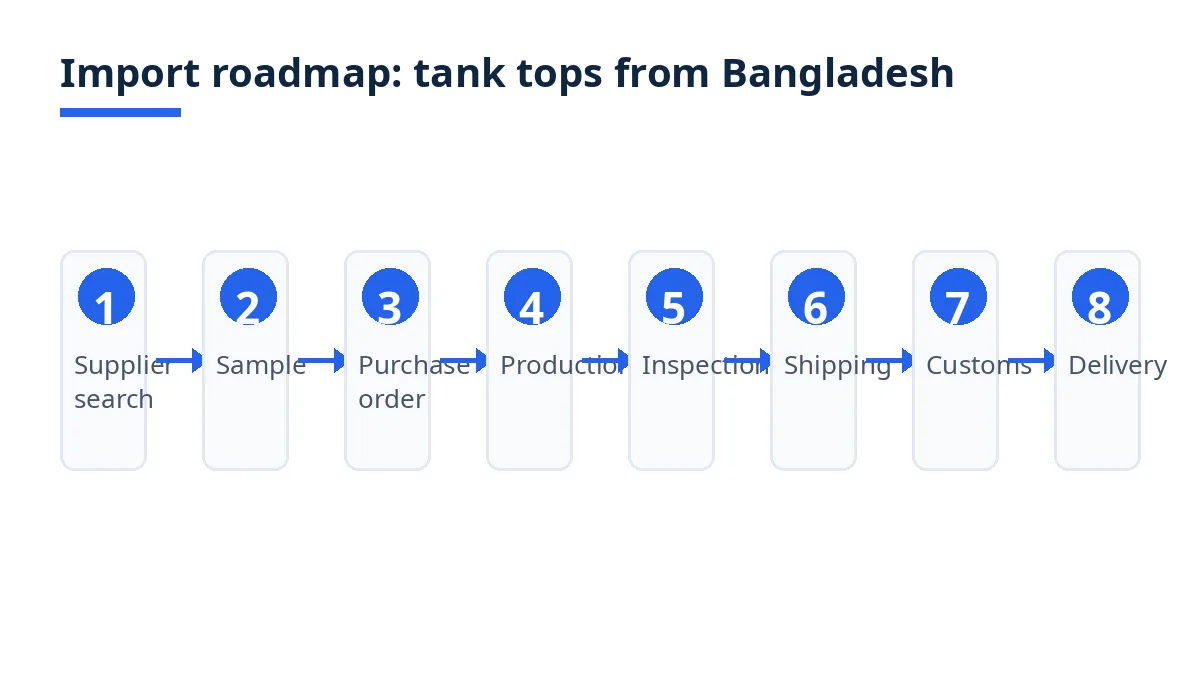
Supplier search. Write the specification, shortlist suppliers whose range covers knitted singlets and vests, and send each the same enquiry.
Sample. Order development samples, measure and wash them, record changes, then approve a pre-production sample in bulk fabric and keep a sealed copy.
Purchase order. State the specification, quantities by size and colour, price and Incoterm with a named place, AQL standard and defect classes, documents, delivery date and payment terms.
Production. Confirm fabric and trim bookings, check an inline report part way through, and agree how a delay or substitution is approved.
Inspection. Book the final inspection for a fully packed order, read the report against the sealed sample, and accept or reject in writing before shipment.
Shipping. Book freight on the routing quoted in writing, and check the bill of lading draft against invoice and packing list.
Customs. Give your broker the confirmed code, invoice, packing list and origin document in advance, so the entry is ready before arrival.
Delivery. Count cartons on arrival, sample-check sizes and colours, and raise any claim inside the time limit in your contract and insurance.
Most first-order problems trace back to a skipped step: an unapproved sample, an inspection booked before packing finished, or a code confirmed after the goods sailed. If you are new to the route, read how to import from Bangladesh alongside this checklist.
How Exportain helps
Exportain is a B2B marketplace for sourcing from Bangladesh. Buyers browse supplier profiles and listings, post a request for quotation (RFQ), receive quotations, message suppliers and place orders in one workflow. Post an RFQ with your specification, quantity split and target Incoterm, and suppliers answer against the same brief. See how to write an RFQ for the fields that draw usable replies.
Two limits are worth stating plainly. Exportain is not a party to the contract for your goods, and it does not inspect goods, book freight or clear customs for you: the checks, inspection and broker work in this guide stay yours. The platform gives you a structured way to find suppliers, compare quotations and keep an order's messages and documents in one place. Read how to buy for the buyer journey.
FAQs
What is the HS code for tank tops from Bangladesh?
Knitted or crocheted tank tops point to heading 6109, covering T-shirts, singlets, tank tops and similar garments in the US HTS.5 The subheading follows the fibre: 6109.10 for cotton, 6109.90 for other textile materials.5 Extend that stem to the full national code for your destination, eight digits in the EU Combined Nomenclature,7 and confirm it before you file, because a woven tank top, and a knitted style with drawstring or ribbed tightening at the hem, fall outside the heading.5 6
Which payment terms should a first order use?
Use terms that keep a remedy open until the goods are inspected: a deposit to start production, with the balance against the accepted inspection report and shipping documents, is a common first-order structure. Write into the purchase order what happens if inspection fails, who pays for re-inspection, and which documents trigger each payment. Avoid paying the full value in advance to a new supplier.
Can I mix tank tops with other garments in one shipment?
Yes, if each line is described, coded and priced separately on the invoice and packing list. One description covering different products makes the entry and inspection report harder to check, and a fault in one line can delay the whole shipment.
Next steps on Exportain
Browse Bangladeshi suppliers whose range covers knitted singlets and vests, then post your specification as an RFQ so suppliers quote on the same brief. Before accepting a quotation, confirm the full national code and duty in the official tariff, and work through how to import from Bangladesh once more.
Sources
- EU trade relations with Bangladesh. European Commission, (accessed )
- SIST ISO 2859-1:2003 - Sampling procedures for inspection by attributes, Part 1: Sampling schemes indexed by acceptance quality limit (AQL). International Organization for Standardization, (accessed )
- Place of delivery & risk transfer in trade contracts. ICC Academy (accessed )
- What is the Harmonized System (HS)?. World Customs Organization (accessed )
- Harmonized Tariff Schedule of the United States Revision 18 (2026), Chapter 61. U.S. International Trade Commission (accessed )
- Classifying textiles. European Commission, Access2Markets (accessed )
- Harmonised System. European Commission (accessed )
- Jerseys, pullovers, cardigans, waistcoats and similar articles, knitted or crocheted - Northern Ireland Online Tariff. GOV.UK, UK Trade Tariff (accessed )
About the author
Sourcing from Bangladesh?
Post a request for quotation and suppliers on Exportain can send you their quotes directly.
Post an RFQ


