7 Costly FOB Mistakes Importers Make (and How to Avoid Them)
Seven FOB mistakes that quietly raise the cost of importing from Bangladesh, each with the fix to agree in writing before the vessel is booked.
Short answer
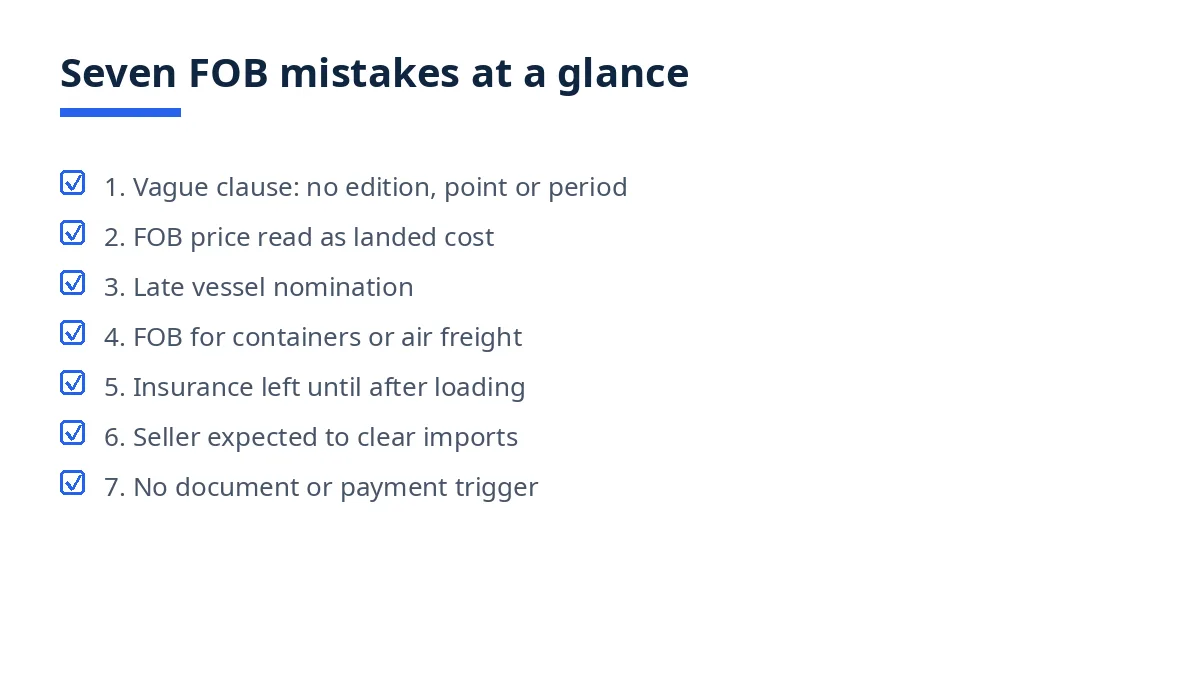
The costliest FOB mistakes are accepting a price with no named port or Incoterms edition, comparing FOB prices as landed costs, nominating the vessel late, using FOB for container or air shipments, leaving insurance until after loading, expecting the seller to handle import clearance, and leaving delivery documents and payment triggers unwritten. Fix each in writing before booking: name the port and point, split the costs, nominate early, insure before loading, and tie payment to proof of loading.
On this page
Key takeaways
Under FOB, the seller delivers the goods on board the vessel the buyer nominated at the named port of shipment, clears them for export, and bears the risk until they are on board.
A late vessel nomination shifts risk and added costs to the buyer, including port storage while the vessel is delayed.
FOB imposes no insurance obligation on either party, so the buyer must arrange cover before loading, with the voyage risk passing on board.
The FOB price ends at loading, so budget ocean freight, insurance, import clearance, duty and destination handling as separate buyer lines.
FOB is for sea and inland waterway transport only; cargo handed to a container terminal or shipped by air fits FCA better.
Picture two quotations for the same cotton T-shirts, both marked FOB Chattogram. One is lower by a clear margin, so a buyer accepts it, books a vessel, and only later learns that the lower price stopped short of loading charges, that no one arranged insurance before the cartons went on board, and that import duty and destination handling were never in the budget. None of those surprises came from the goods. Each one came from a gap in how FOB was written into the order.
FOB (Free On Board) is one of the Incoterms 2020 rules for sea and inland waterway transport. Under FOB, the seller delivers the goods loaded on board the vessel nominated by the buyer at the named port of shipment, clears the goods for export, and bears the risk until the goods are on board. From that moment the buyer bears the risk, pays the ocean freight, decides on insurance, and handles import clearance and duty.1 Each mistake below is stated as what happens, why it costs money, and the fix to agree in writing before the vessel is booked. For the full definition, read the guide to FOB (Free On Board).
The list: seven FOB mistakes that cost importers money
The list follows the order in which the mistakes are made, from the quotation to the payment trigger.
1. Accepting an FOB price with no edition, no loading point and no shipment period
What happens. A quotation or purchase order says only "FOB Chattogram" or "FOB Bangladesh". No Incoterms edition, loading point inside the port, or shipment date or period is stated.
Why it costs money. The edition matters because the Incoterms rules were revised in 2020, with clearer security-related obligations and a consolidated costs article in each rule, so a contract that names no edition leaves the parties arguing about which version governs.2 The loading point matters because FOB delivery is tied to a specific place and point within the port, and the buyer must give the seller timely notice of the vessel name and that point.1
How to fix it. Write the full clause in every quotation and order: "FOB Chattogram, Incoterms 2020", plus the loading point inside the port, the shipment window, and the deadline by which the buyer will nominate the vessel. Ask the seller to confirm the clause in writing before production starts.
2. Comparing FOB prices as if they were landed costs
What happens. A buyer lines up three FOB prices, picks the lowest, and treats that figure as the cost of the goods at the destination warehouse, without asking what each price includes up to loading or adding the buyer-side lines FOB leaves out.
Why it costs money. An FOB price ends when the goods are on board. The seller covers the goods, inland transport to the port, export clearance and loading, while the buyer contracts and pays for carriage from the delivery point onward and handles import formalities.1 Two FOB prices can differ for honest reasons, such as different terminal handling or checking costs up to loading, so the cheapest FOB price can prove the most expensive once the buyer-side lines are added.
How to fix it. Ask every supplier for the same cost split: goods, packing, inland transport, export clearance, port and terminal handling, and loading. Then build a landed-cost estimate beside each FOB price using the same freight, insurance, duty and destination lines. Example figures: for an illustrative order with an FOB value of US$10,000, a buyer might budget US$1,850 for ocean freight, US$140 for cargo insurance and US$320 for destination handling, with duty added at the rate for the goods HS code, to be confirmed with the customs broker. Those are example figures only, not quotes. Use the landed cost guide for imports from Bangladesh to keep the same lines in every comparison.
3. Nominating the vessel late, or naming no loading point at all
What happens. The buyer, or the freight forwarder acting for the buyer, books the vessel late and tells the seller the vessel name and loading point after the seller needed them, or sends only the port name and leaves the seller to guess which berth or terminal will take the cargo.
Why it costs money. Under FOB, the buyer must inform the seller in time of the vessel name and the specific loading place and point within the port.1 If the buyer fails to do so and the goods cannot be loaded, the risk and the additional costs transfer to the buyer.1 Where the nominated vessel is delayed, the buyer bears the risk and cost of storage at the port until the vessel arrives, and where late notice means the master closes for cargo early, risks and costs still pass to the buyer even though the goods are not yet loaded.1
How to fix it. Put a nomination deadline in the order, dated a stated number of working days before the shipment window opens, and name the person on each side who sends and receives the notice. Send the vessel name, loading point and loading window in writing, and get a written acknowledgment from the seller. If the vessel changes, send a fresh notice at once.
4. Using FOB for container cargo handed to a terminal, or for air freight
What happens. Cartons are delivered to a container terminal at Chattogram, where they wait for days before the vessel loads them, yet the contract still says FOB. Or a buyer asks for an air shipment and the quotation still reads "FOB Dhaka airport".
Why it costs money. FOB delivery happens when the goods are loaded on board the vessel. Containerised goods are typically delivered to a container terminal rather than on board, and containers may stay at the terminal for several days before loading.1 For air freight the gap is wider: FOB applies only to sea and inland waterway transport, and an air shipment has no vessel and no on-board moment at all.1
How to fix it. Use FCA (Free Carrier) where the handover is at a terminal, a depot or an airport, naming the place where the goods are handed to the carrier. Keep FOB for cargo loaded directly on board, such as bulk, break-bulk or conventional cargo. The guide to FOB for air freight sets out the FCA wording to use instead.
5. Leaving insurance until after the goods are on board
What happens. A buyer assumes the seller arranged cover, or plans to arrange cover after the vessel sails, and discovers the gap only when cargo is damaged or lost during the voyage. No policy is in force for the ocean leg, and the buyer has no insurer to claim from.
Why it costs money. FOB imposes no insurance obligation on either party. The Incoterms rules provide insurance obligations only under CIF and CIP, where the seller must arrange cover for the buyer, and the 2020 rules set different default levels of cover for those two rules.2 Under FOB the buyer bears the risk from the on-board moment onward, so the voyage is the buyer's risk without a policy the buyer arranged.
How to fix it. Arrange cargo cover before loading, with the policy in force from the on-board moment, and record the insured value and the voyage in writing. State who arranges cover in the order, even though FOB does not oblige either side to do so. Tell the insurer at once if the vessel, route or destination changes. The guide to insurance under FOB explains how buyers set the insured value.
6. Expecting the seller to clear import customs and pay the duty
What happens. A buyer budgets no customs broker, no duty and no import authorisations at destination, on the assumption that the seller's FOB price covered the import side. The goods arrive, customs asks for a declaration, duty and supporting documents, and the shipment waits while the buyer assembles paperwork that should have been ready before sailing.
Why it costs money. Under FOB the seller carries out export formalities and the buyer carries out import formalities, including any transit customs in third countries.1 In the European Union, goods are released for free circulation only once all import requirements are met: tariff duties and other charges paid, import licences presented, and authorisations and certificates presented.3 The entry summary declaration for container maritime cargo must be lodged at least 24 hours before loading commences in the foreign port, and it relies on documents originating with the exporter.3 On the Bangladesh side, certificates, licences and permits from 19 designated organisations must be submitted through the Bangladesh Single Window system for customs clearance.4
How to fix it. Appoint the destination customs broker before the goods are loaded, confirm the HS classification, and get a duty and tax estimate from the broker against the official schedule. Ask the seller early for the documents the import declaration needs, including any proof of origin. The guide to customs clearance under FOB sets out the export and import split in full.
7. Leaving delivery documents and the payment trigger unwritten
What happens. An order is placed by email or chat with the price and quantity agreed but no statement of what proves delivery, no notice duty after loading, and no link between payment and any document.
Why it costs money. The on-board moment is the moment risk passes and the seller's delivery duty is complete, so the document that evidences it is the document the payment and any letter of credit will turn on. The seller must give the buyer timely notice that the goods have been delivered on board, or that the vessel has failed to take the goods within the agreed period.1 An order with no document term leaves the buyer paying on a seller's word and the seller chasing payment on an unproved delivery.
How to fix it. State in the order which document proves delivery, normally the on-board bill of lading, who must send it, and how quickly after loading. Tie the payment trigger to presentation of that document, and state the notice the seller must give on loading or on failure to load.
Summary table
Mistake | Where the cost appears | Fix in one line |
|---|---|---|
No edition, loading point or period | Dispute over which rule and delivery govern | Write "FOB Chattogram, Incoterms 2020" with point and window |
FOB price treated as landed cost | Freight, insurance, duty and handling added later | Split the FOB price and build the landed cost beside it |
Late vessel nomination | Storage, re-handling and missed sailing | Nomination deadline, written notice, written acknowledgment |
FOB for containers or air freight | Risk gap at the terminal or no on-board moment | Use FCA at the named handover place |
Insurance left until after loading | Voyage loss with no policy in force | Arrange cover before loading and record the terms |
Seller expected to handle import side | Storage and delay at destination | Broker, classification and duty estimate before loading |
No document or payment trigger | Payment disputed on unproved delivery | Name the proof of delivery and tie payment to it |
How Exportain helps
Exportain is a marketplace for sourcing from Bangladesh, and the buying steps on the platform map directly onto the fixes above. A request for quotation states quantity and unit, target price, destination, Incoterm, required certifications and deadline, so the FOB clause, the named port and the shipment window can be set in the request itself.5 Quotations are versioned, stating unit price, MOQ, lead time, Incoterm, payment terms and validity for each version, so two FOB prices can be compared on the same fields.5 Freight, customs and inspection providers listed on the platform can be asked for quotes for the buyer-side lines, including the insurance, brokerage and destination charges that FOB leaves to the buyer.5
Use the platform badges as a starting filter and nothing more. Badges record document and photo checks reviewed by the Exportain team, and a badge is not a guarantee of production capacity, product quality or delivery.6 Supplier profiles show the verification level, location, main products and certifications the supplier has declared.5 Run the checks in this article on the shortlist, keep the FOB clause and the nomination and document duties in the quotation thread, and agree inspection and shipment conditions in writing before settling payment.
FAQs
What is the biggest mistake?
The biggest mistake is accepting an FOB price with the delivery term left vague: no Incoterms edition, no loading point, no shipment period and no nomination deadline. That one gap lets the other mistakes happen, because neither side can show what delivery was agreed.
How can I avoid it?
Check the order at each stage in the list order: clause, cost split, nomination, transport fit, insurance, import clearance and documents. Ask for the cost split beside every FOB price, send the vessel nomination in writing with an acknowledgment, arrange insurance before loading, and appoint the destination broker before the goods sail.
Who is responsible?
The seller is responsible for delivering the goods on board the vessel the buyer nominated, clearing the goods for export, and giving timely notice of delivery or failure to load.1 The buyer is responsible for nominating the vessel and loading point in time, contracting and paying for carriage, deciding on insurance, and clearing the goods for import and paying duty.1
Where can I get help?
Start with the ICC guidance on the FOB rule, the destination customs broker for classification and duty, and the insurer for the voyage cover. On Exportain, read what each supplier badge covers before relying on it, and keep questions and answers in the RFQ and quotation thread.6 For the rule itself, the Incoterms guide for shipments from Bangladesh compares FOB with the other rules buyers use.
Next steps on Exportain
Re-read the FOB (Free On Board) definition against your current quotations and check that each one names the port, the edition and the loading point. Build the landed-cost estimate for each FOB price with the landed cost guide for imports from Bangladesh. Then post a free RFQ stating the quantity, destination, Incoterm and deadline, and compare the versioned quotations that come back.
Sources
- FOB & FAS Incoterms® 2020 explained: Key differences. ICC Academy (accessed )
- Incoterms® 2020. International Chamber of Commerce (ICC) (accessed )
- Customs clearance documents and procedures. European Commission (accessed )
- NBR makes BSW submission mandatory for customs clearance from July 1. United News of Bangladesh (accessed )
- How to source and buy from Bangladesh. Exportain (accessed )
- Trust & Safety Center. Exportain (accessed )
About the author
Sourcing from Bangladesh?
Post a request for quotation and suppliers on Exportain can send you their quotes directly.
Post an RFQ