Can You Use FOB for Air Freight? Rules, Alternatives and Examples
No, FOB cannot be used for air freight. FOB delivery happens on board a vessel, so it has no delivery point at an airport. Use FCA for buyer-arranged air freight, or CPT or CIP where the seller arranges the flight.
Short answer
No. FOB (Free On Board) is for sea and inland waterway transport only under Incoterms 2020, because delivery happens when goods are loaded on board a vessel at a named port of shipment. Air cargo has no vessel loading point, so use FCA for buyer-arranged air freight, or CPT or CIP where the seller arranges the flight, with the named place and Incoterms 2020 written in full.
On this page
Key takeaways
FOB cannot be used for air freight or courier shipments, because FOB delivery happens only when goods are loaded on board a vessel at a named port of shipment.
Writing "FOB Dhaka airport" does not create a valid air version of FOB. It leaves the risk transfer point undefined, because no vessel loading ever occurs.
For buyer-arranged air freight, use FCA with the cargo terminal or other named place stated in full, under Incoterms 2020.
If the seller arranges the flight, use CPT, or CIP where the seller must also provide insurance at the Institute Cargo Clauses (A) level.
Fix the term on every document, and expect an air waybill, not a bill of lading.
No, you cannot use FOB for air freight. FOB (Free On Board) is a sea and inland waterway rule under Incoterms 2020, and its delivery point is goods loaded on board a vessel at a named port of shipment. Air cargo has no vessel, so the event FOB depends on never happens on a flight. This guide explains why the answer is no, what goes wrong when FOB is written into an air contract, and which rule to write instead.
Buyers usually ask because they want the sea split for air: the seller handles export clearance and delivery to the departure point, and the buyer arranges and pays for the main carriage. That split is FCA, not FOB, and the correction must be made in writing before goods move.
The air-freight answer at a glance
FOB cannot be used for air freight or courier shipments, because FOB delivery happens only when goods are loaded on board a vessel at a named port of shipment.
Writing "FOB Dhaka airport" does not create a valid air version of FOB. It leaves the risk transfer point undefined, because no vessel loading ever occurs.
For buyer-arranged air freight, use FCA with the cargo terminal or other named place stated in full, under Incoterms 2020.
If the seller arranges the flight, use CPT, or CIP where the seller must also provide insurance at the Institute Cargo Clauses (A) level.
Fix the term on every document, and expect an air waybill, not a bill of lading.
Why this matters for buyers and sellers
Incoterms 2020 divides its 11 rules into two groups. Seven rules work for any mode of transport: EXW, FCA, CPT, CIP, DAP, DPU and DDP. Four rules work for sea and inland waterway transport only: FAS, FOB, CFR and CIF.1 Air freight belongs in the first group, so every air shipment that uses an Incoterms rule must use one of those seven.
Under FOB, the seller delivers the goods on board the vessel at the named port of shipment, completes export formalities, and risk passes to the buyer once the goods are loaded on board.1 The buyer then contracts and pays for the main carriage. That split works for a vessel sailing from a port. It has no matching moment at an airport.
The undefined point is the practical danger. When FOB is written on an air contract, the risk transfer point becomes undefined because there is no vessel to load onto, so the condition that triggers the handover of risk never occurs, and if damage or loss happens in transit, neither party can point to the exact moment responsibility changed hands.2 A dispute must then be settled from the rest of the contract, not from the rule.2 The documentation mismatch adds to the problem: FOB implies a bill of lading, while air freight uses an air waybill, a non-negotiable document that operates under different legal rules.2
Courier shipments fail for the same reason: a courier collection, hub and waybill are not a vessel, port and sea delivery. To invoke the ICC meaning, write the rule with its named place and the words Incoterms 2020.2 The FOB definition guide sets out the sea rule in full, and the Incoterms guide for shipments from Bangladesh compares all 11 rules.
Rule | Modes | Delivery and risk point | Who pays main carriage | Seller insurance duty |
|---|---|---|---|---|
FOB | Sea and inland waterway only | Goods loaded on board the vessel at the named port of shipment | Buyer | None stated; buyer arranges cover after loading |
FCA | Any mode | Goods handed to the carrier nominated by the buyer at the named place | Buyer | None; buyer should hold cover from handover |
CPT | Any mode | Goods handed to the first carrier | Seller, to the named destination | None |
CIP | Any mode | Goods handed to the first carrier | Seller, to the named destination | Yes, at Institute Cargo Clauses (A) level |
Under CPT and CIP the seller pays carriage to the named destination, but risk still passes at handover to the first carrier.3
Step-by-step: how it works
Use this sequence when a quotation, proforma invoice or draft contract arrives with FOB on an air shipment. The steps build the FCA flow for air cargo, not an FOB air flow.
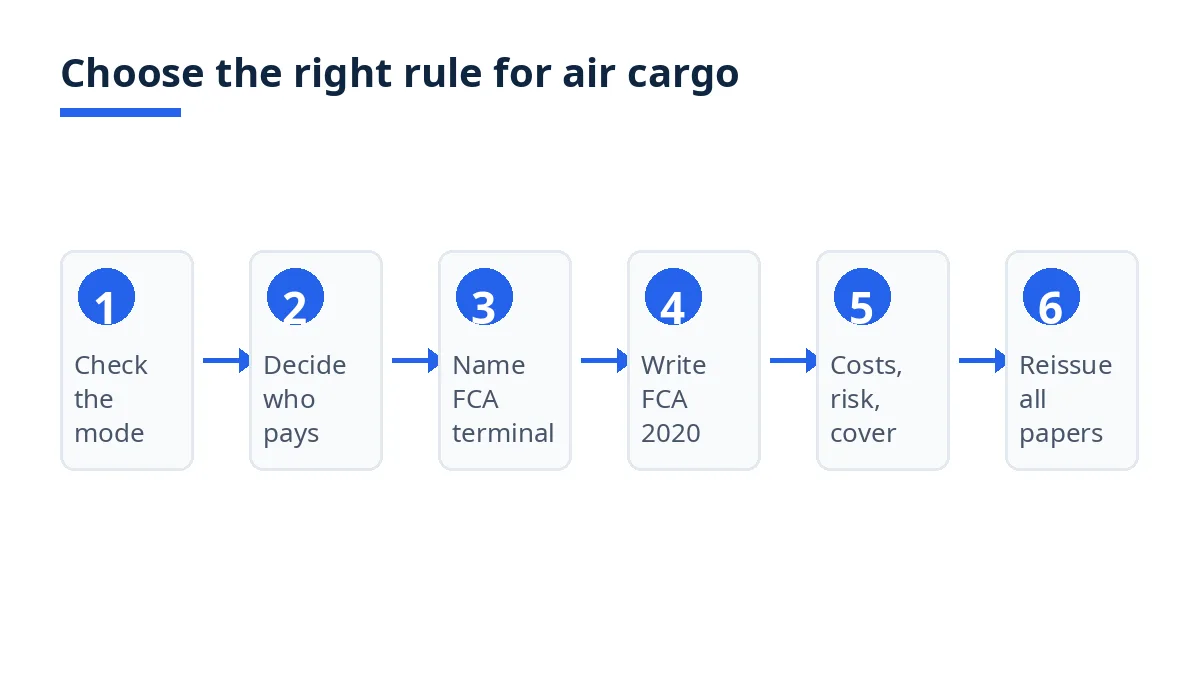
Stop at the term, not at the price. If the shipment travels by air, in whole or in part, FOB is out, whatever the price looks like. Do not compare prices until both are restated on the same any-mode rule with the same named place.
Decide who arranges and pays for the flight. Buyer-arranged air carriage means FCA. Seller-arranged air carriage means CPT, or CIP where the seller must also provide insurance.2
Name the FCA place precisely. For buyer-arranged air freight, the named place is typically the cargo terminal at the export airport, where the seller hands the goods to the carrier nominated by the buyer.2 Name the terminal or carrier facility, and confirm it with the forwarder first.
Write the full term. Use the form "FCA [named place], Incoterms 2020". The named place fixes where delivery happens and where risk passes. A bare "FCA Dhaka" leaves the handover point open to argument.
Reallocate cost, risk and documents on the new term. Under FCA, the seller handles export clearance and delivers to the carrier nominated by the buyer at the named place, and risk passes at that handover, while the buyer arranges main carriage, pays for it, and handles import clearance and duties.1 Under CPT or CIP, restate the destination and the carriage payment.3
Reissue every document that carried the old term. Correct the quotation, purchase order, proforma invoice, forwarder instruction and any export form that said FOB, so no paper in the set still points to a vessel loading.
FOB for air freight: costs, timelines and documents
What are the typical costs and timelines for an air shipment restated from FOB?
There are no typical air freight costs or timelines that a guide can state as fact, because the rate depends on the route, the chargeable weight, the carrier, the season and the forwarder quote for that shipment. What the term change fixes is who pays for each leg, and that split is what you should compare across quotations. Under the corrected FCA term, the seller bears export clearance and delivery to the named place, and the buyer bears main carriage, import clearance, duties and onward delivery.1
For timelines, the seller must have export clearance complete and the goods ready at the named terminal within the agreed window, and the buyer must nominate the carrier in time.
Example figures: a buyer orders leather goods by air at a goods price of USD 8,500. The corrected FCA quotation keeps that price, adds seller delivery to the cargo terminal at the seller's cost, and leaves air freight of USD 1,850, import clearance of USD 290 and onward delivery of USD 140 to the buyer, for USD 10,780 before duty. Risk passes at the terminal handover, not at any point described as on board a vessel. These are example figures only, not a market rate for any route. Use the landed cost guide to build the full landed figure from a restated quotation.
Which documents are needed for air freight?
The document set follows the corrected term. The seller provides the goods and a commercial invoice, completes export clearance, and delivers to the carrier at the named place with notice of delivery.1 The buyer contracts the carrier, and the air transport document is the air waybill, not a bill of lading.2 An instruction asking for an on-board bill of lading must be rewritten for an air waybill before the goods move.
For Bangladesh exports, the set includes the commercial invoice, packing list, EXP form and certificate of origin, with the Bill of Export approved before loading.4 The EXP form records the Incoterm used, and its transport-document field should show the airway number for an air shipment, not a vessel name.4
Bangladesh-specific rules and tips
Bangladesh air exports move through airport cargo terminals, not through seaports, so the handover place should be a cargo terminal or a named carrier facility, never a port of shipment. The Incoterms guide for Bangladesh shipments makes the same point for air freight from Dhaka: use only the any-mode rules for air cargo.5
When a seller quotes FOB from habit, ask for the quotation to be reissued as FCA with the cargo terminal named, not as FOB "for air". Confirm the named place and flight cutoff with the forwarder, since a missed cutoff can leave goods at the terminal. Keep export clearance with the seller under FCA, CPT or CIP, rather than falling back to EXW, where the buyer would carry export formalities in a country where it is not established.1
Customs clearance through the airport runs through clearing and forwarding agents approved by Bangladesh Customs, and exporters can use an agent authorized for formalities via Shahjalal International Airport, Dhaka.4 The export procedure published on the Bangladesh Trade Portal runs from Bill of Export submission to return of the approved shipping bill, with the airway bill obtained in the sequence.4 Papers that still say FOB and expect a bill of lading do not match that sequence.
Mistakes and red flags
What goes wrong most often when FOB is written on an air contract?
Writing "FOB Dhaka airport" and treating it as a valid term. Adding an airport name to FOB does not create an air version of FOB. The delivery point is still defined by loading on board a vessel, so the risk point stays undefined, and goods can sit at a cargo terminal while neither side can point to the moment responsibility changed hands.2 Redraft the term as FCA with the terminal named.
Copying a sea term from an ocean quotation onto an air order. A supplier or buyer copies FOB, CFR or CIF from a previous sea shipment into a new air quotation without checking the mode group. Check the mode group before the price, every time. The four sea-only rules are FAS, FOB, CFR and CIF, and none of them fits a flight.1
Assuming the FOB price includes air freight or insurance. Under FOB the seller's costs run to loading on board the vessel, and the buyer pays for main carriage from that point.6 On an air shipment there is no on-board point, so a price that says FOB leaves it unclear whether air freight, insurance or terminal handling is inside the price or outside it. Restate the price on FCA, CPT or CIP with each leg assigned, and state insurance separately.
Leaving the old term on one document. A corrected purchase order beside an uncorrected invoice, EXP form or forwarder instruction keeps the dispute alive. Reissue the full set.
Checklist
Before you confirm an air shipment, every line should be answered in writing.
Mode confirmed as air, so no sea-only rule appears anywhere in the set, including notes that say FOB "for air".
Buyer-arranged flight: FCA written with the cargo terminal or carrier facility named, plus Incoterms 2020.
Seller-arranged flight: CPT or CIP written with the named destination, and insurance stated at Institute Cargo Clauses (A) level for CIP.
Export clearance assigned to the seller under FCA, CPT or CIP.
Cargo insurance assigned from the handover point, with the policy holder named.
Air waybill, not a bill of lading, expected as the transport document, and any bill of lading instruction rewritten.
Quotation, purchase order, invoice, EXP form and forwarder instruction all carry the same corrected term.
Forwarder has confirmed the terminal and cutoff.
Landed figure built from the restated quotation, not from the original FOB price.
How Exportain helps
On Exportain, browse suppliers and post a request for quotation (RFQ) on the RFQ board stating the mode, the Incoterm and the named place, so suppliers quote against the same term. A request that states "FCA cargo terminal, Incoterms 2020" receives comparable replies, while a request that states FOB for an air shipment invites replies priced on a handover that cannot happen. ask any supplier quoting a sea term for air freight to reissue on FCA, CPT or CIP as appropriate. See how to buy on Exportain for the steps from search to shipment.7
Keep the corrected term in the order record and in every message that follows it. Exportain verification is a document and photo review, not a factory inspection or guarantee, so sample approval and inspection stay with you.
FAQs
What should I know first about FOB for air freight?
FOB means Free On Board. The seller delivers the goods on board a vessel nominated by the buyer at the named port of shipment, completes export formalities, and risk passes once the goods are loaded on board.1 An aircraft is not a vessel, so no on-board loading event exists for the rule to attach to.
What are the typical costs and timelines for an air shipment quoted as FOB?
There are no typical costs or timelines to quote as fact, because rates and schedules vary by route, chargeable weight, carrier and season. Under a corrected FCA term the buyer pays main carriage, import clearance and onward delivery after the terminal handover,1 while under CPT or CIP the seller pays main carriage to destination but risk still passes at origin handover.3
Which documents are needed for air freight booked as FOB?
No document set can make FOB valid for air freight, so the set must be rewritten on the corrected term first. The seller provides the commercial invoice, completes export clearance and delivers to the carrier at the named place,1 and air freight runs on an air waybill, not a bill of lading.2 For Bangladesh exports, add the packing list, EXP form, certificate of origin and approved Bill of Export.4
What are the most common mistakes when FOB appears on an air contract?
The most common mistakes are writing "FOB Dhaka airport", copying FOB from an ocean quotation, expecting an on-board bill of lading, and assuming the price includes air freight or insurance. Fix each one by restating the shipment on FCA, CPT or CIP with the named place and Incoterms 2020 in full, and reissuing every document.
Next steps on Exportain
Read the FCA for air freight guide, compare all 11 rules in the Incoterms guide for shipments from Bangladesh, then post on the RFQ board stating the mode, the Incoterm and the named place, so suppliers quote on FCA, CPT or CIP for air freight.
Sources
- FCA & FOB Incoterms 2020 explained: Key differences. ICC Academy (accessed )
- Air Freight Incoterms: Use FCA, Not FOB. Ovrseas (accessed )
- Incoterms 2020: all 11 clauses, risk, and costs. INN.LAW (accessed )
- Bangladesh Trade Portal FAQ: Export Registration Certificate (ERC). Bangladesh Trade Portal (accessed )
- Incoterms for Shipments From Bangladesh. Exportain (accessed )
- FOB Incoterm (Free on Board). iContainers (accessed )
- How to source and buy from Bangladesh. Exportain (accessed )
About the author
Sourcing from Bangladesh?
Post a request for quotation and suppliers on Exportain can send you their quotes directly.
Post an RFQ