FCA for Air Freight: When It Fits Air Cargo and Courier Shipments
FCA for air freight: when airport handover and courier delivery fit, what the air waybill proves, and when CPT, CIP or DAP is the better term.
Short answer
Yes, FCA works for air freight and courier shipments because it is an any-mode Incoterms 2020 rule. The seller clears the goods for export and delivers them to the carrier you nominate at the named place you agree, such as a factory, a forwarder warehouse or an airport terminal. From that handover, you pay the air freight, arrange insurance if you want it, and clear import at destination.
On this page
Key takeaways
FCA is an any-mode Incoterms 2020 rule, so it fits air cargo and courier shipments, while FOB, CFR and CIF do not, because they apply only to sea and inland waterway transport.
The named place decides the handover: at the seller's premises the seller loads the buyer's transport, while at another named place such as an airport terminal the goods are delivered ready for unloading, and the seller does not unload.
Under FCA the seller clears export and the buyer pays air freight from the named place, arranges insurance if wanted, and clears import at destination; FCA itself does not oblige either party to insure.
For a courier parcel, state in the contract whether FCA delivery means handover to the courier at the seller's premises or at the courier depot, and who pays the courier charge from that point.
If you want the seller to arrange carriage and insurance, switch to CIP in writing, since CIP requires Institute Cargo Clauses (A) cover for at least 110 percent of the contract price.
Yes, FCA for air freight works, because FCA is an Incoterms 2020 rule for any mode of transport, not a sea-freight rule. The seller clears the goods for export and delivers them to the carrier you nominate at the agreed named place. That place can be the seller's premises, a forwarder's warehouse, or an airport cargo terminal. From that handover, you pay the air freight, arrange insurance if you want it, and clear import at destination.
The decision that matters is not whether FCA is allowed in the air. It is where the handover happens, and whether the shipment is airport-to-airport cargo or a courier parcel. Those choices decide who tenders the goods to the airline, who is named as shipper on the air waybill, and who bears risk while cartons wait for a flight.
FCA stands for Free Carrier. Under Incoterms 2020, the seller fulfils the obligation by delivering the goods to the carrier or another person nominated by the buyer at the seller's premises or another named place.1 FCA is one of seven rules for any mode of transport, while FAS, FOB, CFR and CIF apply only to sea and inland waterway transport.2 That split is why FOB cannot fit an air shipment: there is no vessel at an airport.
Why this matters for buyers and sellers
For the seller, FCA keeps the export job in the country where the seller can do it: prepare the goods, clear them for export, and deliver them to the agreed point. For the buyer, FCA keeps control of the flight. You choose the carrier or forwarder, hold the air freight contract from the named place onward, and can change routing if a flight is full, provided the contract and booking allow it.
The two delivery variants change the work on the ground. When the named place is the seller's premises, the goods are delivered when loaded on the transport arranged by the buyer, and the seller is responsible for loading.3 When the named place is another place, such as an airport terminal, the goods are delivered when they arrive ready for unloading and at the disposal of the carrier or the person you nominated.3 In the second variant the seller does not unload, so agree who unloads, who pays terminal handling, and who presents the goods for acceptance, or the handover can stall.
Courier shipments add a further wrinkle. A courier normally collects, carries and delivers door to door under its own terms, and its label and tracking replace much of the airport handling a cargo shipment needs. FCA can still be the contract term, but it does not rewrite the courier's terms. State whether FCA delivery means handover at the seller's premises or at the courier's depot, and who pays the courier charge from that point.
Step-by-step: how it works
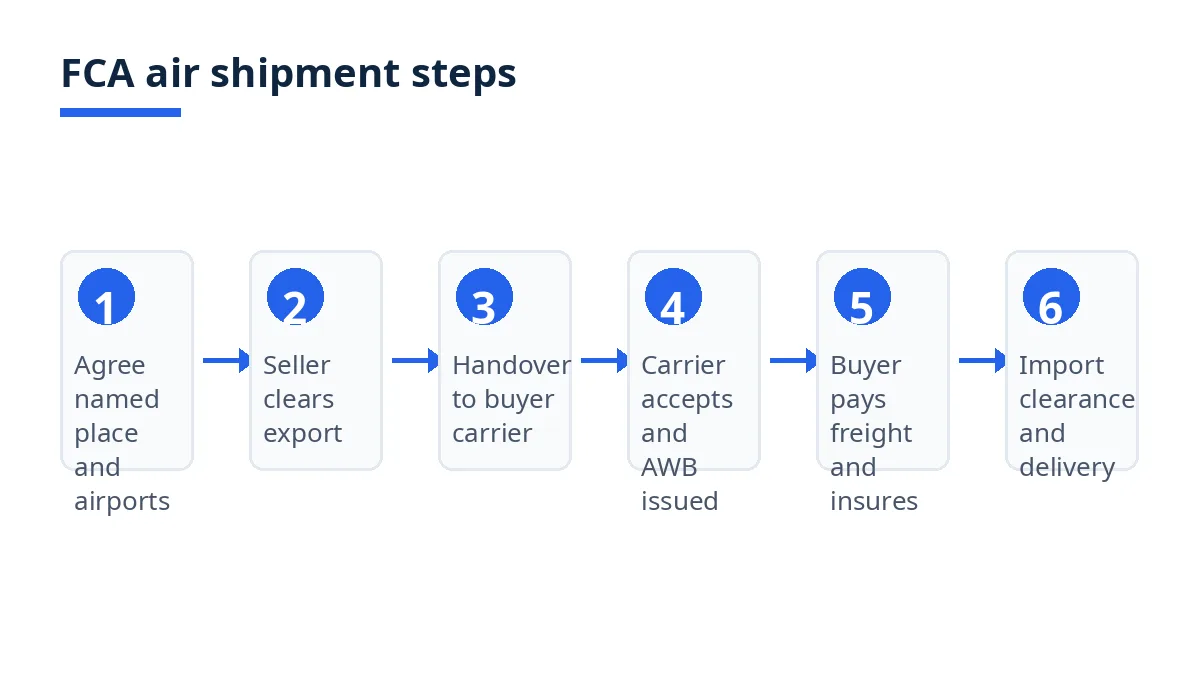
Agree the FCA named place in full, and the airports separately. Write the street address of the named place, the departure airport and the destination airport as three separate lines. A city name is not a named place.
Nominate the carrier or forwarder in writing. Name the airline, forwarder or courier, and state who books the flight, who pays the freight, and whether it is prepaid or collect. FCA can be used for all modes of transport, including air.4
Confirm export clearance and the shipper name before the goods move. The seller clears the goods for export under FCA. Agree who is named as shipper on the air waybill, because the carrier and customs will work from that document.
Deliver, load or present as the variant requires. At the seller's premises, the seller loads the buyer's transport. At another named place, the seller delivers the goods ready for unloading. Keep the handover receipt with the booking reference.
Tender, screen and accept the cargo. The carrier or forwarder tenders the goods to the airline, subject to security screening and the flight cut-off. Confirm the cut-off, the screening route, and any dangerous-goods declaration before the goods reach the terminal.
Fly, track and clear import. Track by air waybill number, and have your destination agent ready to clear import, pay duties, and arrange delivery.5
Costs, timelines and documents
What are the typical costs and timelines?
There are no typical air freight costs or transit times a guide can state as fact. Rates depend on chargeable weight, route, flight availability, fuel and security surcharges, and service level. What can be stated is who pays each line under FCA, and that structure is what you should compare across quotations.
Cost line | Who pays under FCA | Note for air freight |
|---|---|---|
Goods and export packing | Buyer pays the goods price; packing as agreed | Packing must suit air handling, screening and stacking |
Loading at the seller's premises | Seller, where delivery is at the seller's premises | Loading is the seller's job in this variant only3 |
Inland transport to the named place | Seller, up to the named place | Beyond the named place, transport is the buyer's cost |
Export clearance | Seller | The seller clears the goods for export under FCA4 |
Terminal handling at origin | Depends on the named place and the carrier contract | State it in writing; do not assume it sits in the freight |
Air freight and origin surcharges | Buyer, from the named place | Prepaid or collect as marked on the air waybill6 |
Cargo insurance | Buyer, if the buyer arranges it | FCA does not oblige either party to insure5 |
Import clearance, duties and taxes | Buyer | Paid at destination, by the buyer or the buyer's agent |
Delivery from the destination airport | Buyer | Confirm whether this is airport only or door delivery |
Example figures: the table above is a cost structure, not a quote. Ask each forwarder for the same lines on the same route and chargeable weight, and compare totals on that basis only. A lower air freight line that excludes origin terminal handling is not a lower total.
For timelines, work backwards from the flight, with dated milestones for goods ready, clearance, handover, acceptance before cut-off, and departure. A missed cut-off costs a whole flight cycle.
Which documents are needed?
The document set has two layers: sale and export, and carriage. Keep the same names, goods description, piece count and weights on every paper.
Commercial invoice, with a detailed goods description, signed by the exporter.
Packing list, with quantity, weight and packing information.
Export contract or purchase order, where there is no export letter of credit.
EXP form certified by an authorized dealer, for Bangladesh exports.
Certificate of origin, where the destination requires it.
Bill of Export, approved before loading.
Air waybill, paper or electronic, issued on acceptance by the carrier.
Any product document the destination or airline requires, such as a dangerous-goods declaration.
The air waybill is the air cargo contract. It serves as a receipt of goods by the airline, a contract of carriage between shipper and carrier, and a document for customs and tracking, and it contains shipper and consignee details, airports, goods description, weights and charges.6 It is non-negotiable, so it does not transfer ownership the way a sea bill of lading can.
For Bangladesh, goods shall not be allowed to load or ship for export unless an export declaration, known as the Bill of Export or Shipping Bill, is submitted to Customs in the prescribed format and approved by the Customs authority.7
Bangladesh-specific rules and tips
Name the airport terminal, not only Dhaka. State the departure airport and, where it matters, the cargo terminal or forwarder warehouse at that airport. For most Bangladesh air exports the departure airport is Hazrat Shahjalal International Airport in Dhaka, but the airport name alone does not say whether delivery is at a factory in Gazipur, a forwarder warehouse near the airport, or the terminal itself. Write all three lines: named place, departure airport, destination airport.
Put export clearance and the Bill of Export in the contract. Under FCA the seller clears export, which removes the main filing problem that makes EXW awkward for a foreign buyer with no Bangladesh presence. Still, name the seller's export documents in the contract, and confirm the Bill of Export route, EXP form and certificate of origin where required, before the goods move.7
Confirm screening, cut-off and chargeable weight early. Ask the forwarder for the terminal cut-off, the screening route, and how chargeable weight is calculated from packed carton weights and dimensions. Carton marks, piece count and weights must match the booking and air waybill exactly, or a mismatch at acceptance can hold the cargo while the flight departs.
Use FCA at the airport for samples and urgent replenishment, and check courier terms for parcels. A sample or urgent top-up that must fly this week fits FCA at the departure airport well, because the seller clears export and the buyer controls the flight. A courier parcel fits FCA at the seller's premises where the courier collects, provided the contract says who pays the courier charge. Do not assume a courier door-to-door price already includes import duties; under FCA, import clearance and duties stay with the buyer.
Mistakes and red flags
What are the most common mistakes?
Writing only a city as the named place. "FCA Dhaka" does not say whether delivery is at the factory, the forwarder warehouse or the airport terminal, and each answer changes who loads, who pays inland transport, and who bears risk on that leg. Write the full address, and the airports as separate lines.
Assuming the seller unloads at the airport terminal. At a named place other than the seller's premises, the goods are delivered when they arrive ready for unloading, and the seller does not unload.3 Assign unloading and terminal handling in writing before dispatch.
Using a sea term for an air shipment. FOB, CFR and CIF belong to the sea and inland waterway group, and FOB risk transfer turns on loading on board a vessel.2 Writing FOB on an air contract leaves the risk transfer point without a matching event at the airport. Use FCA, CPT, CIP, DAP, DPU or DDP for air freight instead.
Leaving insurance to assumption. FCA does not oblige either party to insure, while CPT also leaves insurance to the buyer, and CIP obliges the seller to buy insurance for the buyer's benefit.5 Under CIP the seller must obtain Clause A cover, or equivalent, for at least 110 percent of the contract price.5 If you want seller-arranged insurance, switch to CIP in writing.
Comparing an FCA price with a CPT or CIP price as if they were the same. An FCA price stops at the named place, while CPT and CIP prices include carriage to the named destination, and CIP also includes insurance.5 Compare prices only after adding the same freight and insurance lines to each quotation.
Treating the air waybill as proof of ownership or payment. The air waybill is a receipt and a contract of carriage, and it is non-negotiable.6 Only the named consignee collects the goods, and payment still needs its own terms. Check piece count and condition on arrival and record any damage against the air waybill number at once.
Checklist
Before you confirm an FCA air shipment, every line should be answered in writing.
FCA named place stated with a full street address, not only a city; departure and destination airports stated separately.
Carrier, forwarder or courier nominated, with booking party and freight payment terms stated.
Export clearance assigned to the seller, with the Bill of Export, EXP form and certificate of origin route confirmed.7
Loading, or unloading and terminal handling at another named place, assigned and paid for.
Shipper and consignee names on the air waybill agreed, and the lane confirmed as paper or electronic.6
Invoice, packing list and contract matched on names, description, pieces and weights; chargeable weight agreed from packed weights and dimensions.
Cargo insurance decided in writing before handover, or the term changed to CIP.5
Flight cut-off, screening route and dangerous-goods status confirmed before the terminal; import clearance and delivery at destination assigned to the buyer's agent.
How Exportain helps
On Exportain, browse suppliers and post a request for quotation on the RFQ board with the FCA named place, departure airport, destination airport and delivery term stated, so suppliers quote on the same basis. State "FCA" plus the full named place address in the RFQ itself, and ask each reply to confirm who files export clearance, who unloads, and whether terminal handling sits inside the quoted freight.
When you compare replies, compare them on the same lines: FCA price to the named place, air freight from there, insurance if arranged, and import clearance at destination. A reply that quotes FCA at the factory and one that quotes FCA at the airport terminal are different offers, even when both say FCA.
Read the Incoterms guide for shipments from Bangladesh for the full set of 11 rules, and the FCA documents checklist for the export set. If you are weighing FCA against buyer collection, read the EXW air freight guide.
FAQs
What should I know first about FCA?
Know first that FCA is an any-mode rule, so it fits air freight and courier shipments, and that the named place decides the rest. The seller clears export and delivers to the carrier you nominate at that place, and risk passes at handover.1 4
What are the typical costs and timelines?
There are no typical air freight costs or transit times to rely on, because rates depend on chargeable weight, route, flight availability and surcharges. Under FCA you pay air freight, insurance if you arrange it, and import clearance and duties from the named place onward.5
Which documents are needed?
The sale and export set is the commercial invoice, packing list, export contract or purchase order, EXP form certified by an authorized dealer, certificate of origin where required, and the Bill of Export approved by Customs before loading.7 The carriage document is the air waybill, which acts as receipt, contract of carriage and tracking document.6
What are the most common mistakes?
The most common mistakes are naming only a city instead of a full named place, assuming the seller unloads at an airport terminal, using a sea term such as FOB for an air shipment, leaving insurance to assumption, and comparing FCA, CPT and CIP prices without adding the same freight and insurance lines.2 5
Next steps on Exportain
Post your FCA named place, departure airport and destination airport on the RFQ board, so quotations arrive on the same FCA basis. Before you sign, read the Incoterms guide for shipments from Bangladesh and the FCA documents checklist.
Sources
- Incoterms® 2020. International Chamber of Commerce (ICC) (accessed )
- Air Freight Incoterms: Use FCA, Not FOB. Ovrseas (accessed )
- What are Incoterms?. DHL (accessed )
- FCA (Free Carrier). Flexport (accessed )
- CPT & CIP Incoterms 2020 explained: Key differences. ICC Academy (accessed )
- Air Waybill (AWB): Meaning, Number, Types, and Examples. Freightos (accessed )
- Customs Clearance Procedures for Export. Bangladesh Customs, National Board of Revenue (accessed )
About the author
Sourcing from Bangladesh?
Post a request for quotation and suppliers on Exportain can send you their quotes directly.
Post an RFQ