Can You Use EXW for Air Freight? Rules, Alternatives and Examples
Yes, EXW can be used for air freight, but it is often the wrong fit: the buyer must arrange export clearance, airport delivery and the flight from a country where they may have no local presence. FCA at the departure airport usually gives the same buyer control with the seller handling export clearance.
Short answer
Yes, EXW can be used for air freight, because it applies to any transport mode, but it is often a poor fit: the seller only places goods at the buyer's disposal at a named place, without loading or export clearance. The buyer must arrange airport delivery, export filing, the air waybill and the flight. FCA at the departure airport usually keeps the same flight control with the seller clearing export.
On this page
Key takeaways
EXW is allowed for air freight, but the seller only places goods at the buyer's disposal at a named place, without loading or export clearance.
The buyer must arrange loading, inland transport to the airport, export clearance, the air waybill and the flight, which can stall a shipment where the buyer has no local filer.
FCA at the departure airport is usually the better term for the same deal, because the seller clears export and delivers to the carrier while the buyer keeps control of the flight.
Name the seller's premises, the departure airport and the loading party separately in the contract, and confirm the export filer before signing.
The air waybill is non-negotiable and does not transfer title, so payment terms need their own instrument, separate from the carriage document.
Yes, you can use EXW for air freight, because EXW is one of the Incoterms 2020 rules that can be used for any mode of transport. The question that matters is not whether the term is allowed for air cargo, but whether your side can actually do the jobs EXW assigns to the buyer at the airport of departure. Under EXW, the seller places the goods at your disposal at a named place, usually the seller's premises, and does not load them and does not clear them for export.1 For an air shipment, that leaves the buyer to arrange loading, inland transport to the airport, export clearance, the air waybill and the flight, and then import clearance at destination. If you have a forwarder who can file export clearance in the seller's country and take the goods at the airport, EXW can work. If you do not, the shipment can stall before it ever reaches an aircraft, and FCA at the departure airport is usually the better term.
The Incoterms 2020 rules are the International Chamber of Commerce rules that allocate cost, risk and obligations between seller and buyer, and there are 11 rules in the current edition.2 EXW places the minimum obligation on the seller in terms of risk and cost, and the buyer takes over once the goods are made available.1 The aircraft does not change who files the export declaration or who bears the risk while cartons wait at a cargo terminal.
Why this matters for buyers and sellers
For a seller, EXW looks simple, because the job ends at the factory gate. For a buyer, the same term moves every airport problem onto the buyer's side, where timing is tightest: air freight is chosen for speed and urgent goods, so a delay at clearance or acceptance costs more than on a sea shipment.
Three airport facts make EXW awkward for air cargo. First, export clearance must happen before loading, and a foreign buyer may not be able to file it. The ICC Academy notes that a seller may be considered the exporter of record if the buyer is not also established in the seller's country, and traders are strongly encouraged to consider FCA instead of EXW where goods cross a border.1 Second, the air waybill needs a shipper who can give the carrier accurate data on acceptance. It is the contract of carriage under IATA Resolution 600a and 600b, and the electronic air waybill is its electronic form.3 Third, air cargo passes through security screening with fixed cut-off times, so a late truck or missing document can mean a missed flight.
EXW therefore suits a specific buyer: one with a named forwarder at origin who can collect, clear, screen and tender the goods. For every other buyer, FCA at the airport keeps the same flight control with one fewer border problem.
Step-by-step: how it works
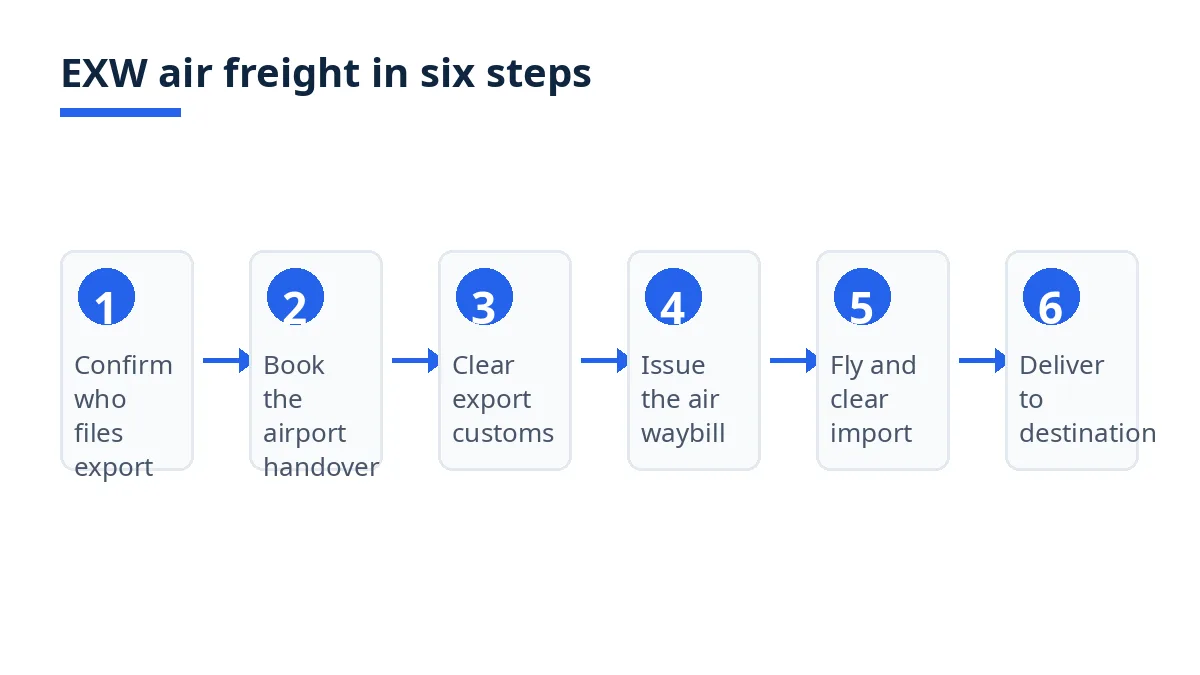
Name the place and the airport in writing. State the EXW named place as the seller's premises with a full address, and separately state the departure and destination airports and who books the flight.
Confirm who files export clearance before you sign. Ask, in writing, who submits the export declaration and acts as exporter of record, and what the seller will provide. If no one on your side can file, switch to FCA at the airport.
Appoint the origin agent and the carrier. Your forwarder collects the goods, moves them to the airport cargo terminal, and tenders them to the airline or ground handler. Confirm the terminal, cut-off and screening requirements.
Agree loading, packing and marking. Under EXW the seller is not obliged to load the collecting vehicle, so state who loads and pays, and how goods are packed and marked. Carton marks and weights must match the booking and air waybill exactly.
Clear export and obtain the air waybill. Export clearance comes first, then carrier acceptance. The air waybill is a non-negotiable receipt, contract of carriage and delivery instructions, and it does not transfer title.4 Check shipper, consignee, airports, weights and charges before departure, as corrections after acceptance are harder.
Fly, track and clear import. The buyer pays the air freight, tracks by air waybill number, and clears import and pays duties at destination. Import clearance stays with the buyer under both EXW and FCA.1
Take delivery and close the file. Confirm piece count and condition on arrival, and record any damage against the air waybill number at once.
Costs, timelines and documents
What are the typical costs and timelines?
There are no typical air freight costs or transit times to state as fact, as rates depend on chargeable weight, route, flight availability and surcharges. What can be stated is the structure: who pays each line under EXW.
Cost line | Who pays under EXW | Note for air freight |
|---|---|---|
Goods and export packing | Buyer pays the goods price; packing as agreed | Packing must suit air handling and screening |
Loading at the seller's premises | Buyer, unless the contract says otherwise | The seller is not obliged to load under EXW1 |
Inland transport to the airport | Buyer | Includes terminal handling at origin |
Export clearance and any export charges | Buyer | The filing problem is the main EXW risk for air cargo |
Air freight and origin surcharges | Buyer | Prepaid or collect as marked on the air waybill4 |
Cargo insurance | Buyer, if the buyer arranges it | EXW does not oblige either party to insure |
Import clearance, duties and taxes | Buyer | Paid at destination |
Delivery from the destination airport | Buyer | Confirm whether this is airport-to-door or airport only |
Example figures: the table above is a cost structure, not a quote. Ask each forwarder for the same lines on the same route and chargeable weight, and compare totals on that basis only.
For timelines, work backwards from the flight, with dated milestones for goods ready, export clearance complete, cargo accepted before cut-off, and departure. A missed cut-off means waiting for the next available flight.
Which documents are needed?
The document set has two layers: the sale and export layer, and the carriage layer. Keep the same names, weights and goods description on every paper.
Commercial invoice, with a detailed goods description, signed by the exporter.
Packing list, with quantity, weight and packing information.
Export contract or purchase order, where there is no export letter of credit.
EXP form certified by an authorized dealer, for Bangladesh exports, to support realization of export proceeds.
Certificate of origin, issued by the Export Promotion Bureau or a Chamber of Commerce and Industry, where the destination requires it.
Bill of Export, the export declaration submitted to Customs and approved before loading.
Air waybill, paper or electronic, issued on acceptance by the carrier.
Any product document the destination or airline requires, such as a dangerous-goods declaration.
For Bangladesh, goods may not be loaded for export unless the export declaration, the Bill of Export, is submitted to Customs in the prescribed format and approved, and the declaration states the goods description, value, exporter, foreign buyer and transport operator.5 The documents enclosed with it include the export letter of credit or, where there is none, the export contract or purchase order, the commercial invoice, the packing list, the EXP form certified by an authorized dealer, the certificate of origin, the VAT registration certificate and the taxpayer identification number.5 Under EXW, the buyer must still make sure that set exists and is approved, even though the seller holds most of the papers, so the seller's cooperation must be agreed in the contract.
The air waybill carries shipper and consignee details, airports, goods description, weights, handling instructions, rates and charges, and the carrier's acceptance signature.4 The electronic air waybill is an electronic shipment record under IATA Resolution 672, so confirm whether the lane runs on paper, electronic or both.3
Bangladesh-specific rules and tips
Settle the exporter-of-record question first. In a Bangladesh EXW air shipment, the practical question is who can stand behind the Bill of Export and the EXP form. A buyer with no Bangladesh presence should not sign EXW hoping the seller's staff will file as a favour. Put the filing party and the seller's documents in the contract, or change to FCA at the airport, where the seller clears export.1
Name the airport, not just the city. State the departure airport in the contract and booking. For most Bangladesh air exports it is Hazrat Shahjalal International Airport in Dhaka. Bangladesh first achieved EU third-country validated regulated agent status for that airport in 2017, allowing direct shipments to the European Union and the United Kingdom, with screening by explosive detection systems, X-ray, trace detection and detection dogs.6
Build screening and cut-off into the plan. Ask the forwarder for the terminal cut-off and screening route for your product, and confirm dangerous-goods status in writing before the goods reach the terminal.
Mistakes and red flags
What are the most common mistakes?
Signing EXW without an origin filer. This is the most common and most expensive mistake in EXW air freight. If no one on the buyer's side can file export clearance in Bangladesh, the goods wait at the factory or terminal while the flight leaves. FCA at the airport removes this failure mode, because the seller clears export.1
Writing the named place as an airport when the seller is inland. EXW names the seller's premises, not the airport. If the contract says "EXW Dhaka Airport" but the seller is in Gazipur, the parties have not agreed who moves the goods to the airport, who bears the risk on that leg, or who loads. Name the premises for EXW, and name the airport separately, or use FCA at the airport instead.
Assuming the seller will load the truck. Under EXW the seller places the goods at the buyer's disposal ready for loading, and loading is at the buyer's expense and risk.1 State loading in the contract, or the collection slot can be lost for want of labour or equipment.
Treating the air waybill as proof of ownership. The air waybill is non-negotiable and does not confer title, and only the named consignee can collect the goods.4 Payment terms need their own instrument, separate from the air waybill.
Comparing an EXW price with an FCA price. An EXW price covers only the goods and their packaging, while an FCA price also covers loading at the seller's premises where delivery is there, and the cost of export formalities.1 Compare prices only after adding the same origin lines to each quotation.
Checklist
Before you confirm an EXW air shipment, every line should be answered in writing.
EXW named place stated with the seller's full premises address.
Departure airport and destination airport stated separately from the named place.
Export filer and exporter of record named, with the seller's supporting documents listed.
Origin agent or forwarder appointed, with terminal, cut-off and screening route confirmed.
Loading at the seller's premises assigned and paid for in the contract.
Air waybill shipper and consignee agreed, and the lane confirmed as paper or electronic.3
Commercial invoice, packing list, EXP form, certificate of origin and Bill of Export route confirmed.5
Chargeable weight agreed from packed carton weights, not product weights alone.
Cargo insurance decided by the buyer, in writing, before collection.
Import clearance, duties and delivery at destination assigned to the buyer's agent.
If any line above has no named party, change the term to FCA at the departure airport before signing.
How Exportain helps
On Exportain, browse suppliers and post a request for quotation on the RFQ board with the departure airport, the destination airport and the delivery term stated, so suppliers quote on the same basis. The buying guide sets out posting an RFQ with quantity, destination, Incoterm and deadline, and comparing quotations on those terms.7 State "EXW seller's premises" or "FCA departure airport" in the RFQ itself, not only in later messages, and ask each reply to confirm who files export clearance. When you accept a quotation, Exportain creates one order and issues one proforma invoice from the accepted terms, including quantity, unit price, currency and Incoterm as quoted.8
Read the badges for what they record. Exportain Verified means Exportain has checked identity, phone, email and business registration, and Export Verified means it has checked the Export Registration Certificate.8 Factory Verified means it has reviewed photos of the manufacturer factory, while Trading Company Verified means it has reviewed photos of the trading company office or warehouse.8 Verification is a document review by staff, not a factory inspection, and a badge is not a guarantee of production capacity, product quality or delivery.8 Test document supply and on-time presentation by sample approval and by the contract terms above. See the EXW guide, the Incoterms guide for shipments from Bangladesh and the EXW documents checklist.
FAQs
What should I know first about EXW?
Know first that EXW is allowed for air freight but assigns export clearance, airport delivery and the flight to the buyer, while the seller's job ends at the named place, without loading or export clearance.1 Confirm who files export clearance and who is named as shipper on the air waybill; if either is unclear, use FCA at the airport.
What are the typical costs and timelines?
There are no typical costs or timelines to quote, as air freight depends on chargeable weight, route and flight availability. Under EXW the buyer pays loading, transport to the airport, export clearance, air freight, insurance if arranged, import clearance and duties, and delivery. Work backwards from the flight cut-off, with milestones for goods ready, clearance complete and cargo accepted.
Which documents are needed?
The sale and export set is the invoice, packing list, export contract or purchase order, EXP form for Bangladesh exports, certificate of origin where required, and the approved Bill of Export.5 The carriage document is the air waybill, paper or electronic, acting as receipt, contract and delivery instructions.4
What are the most common mistakes?
The most common mistakes are signing EXW without an export filer, naming an airport as the EXW place when the seller is inland, assuming the seller will load, treating the air waybill as proof of ownership, and comparing EXW and FCA prices without adding the same origin lines.1 4 Name the filer, premises, airport and loading party in the contract first.
Next steps on Exportain
Browse suppliers and post your departure airport, destination airport and delivery term on the RFQ board, so quotations arrive on the same EXW or FCA basis. Before you sign, read the EXW guide and the landed cost guide to build the same origin lines into every quotation you compare.
Sources
- FCA & EXW Incoterms® 2020 explained: Key differences. ICC Academy (accessed )
- Incoterms® 2020. International Chamber of Commerce (ICC) (accessed )
- e-AWB Implementation Playbook. International Air Transport Association (accessed )
- Air Waybill (AWB) Guide: Importance in Air Freight. FreightAmigo (accessed )
- Customs Clearance Procedures for Export. Bangladesh Customs, National Board of Revenue (accessed )
- Bangladesh expands export cargo screening capacity at airports. The Business Standard (accessed )
- How to source and buy from Bangladesh. Exportain (accessed )
- Trust & Safety Center. Exportain (accessed )
About the author
Sourcing from Bangladesh?
Post a request for quotation and suppliers on Exportain can send you their quotes directly.
Post an RFQ