FOB Buyer Cover: Who Should Insure Cargo Once It Is On Board?
Under FOB, risk passes when goods are on board the vessel, and neither party must insure. This guide shows buyers how to arrange cover from that point, set the insured value, and choose a cargo clause.
Short answer
Under FOB, neither the seller nor the buyer is obliged to insure the cargo, and no minimum cover applies. The seller bears the risk until the goods are on board the vessel, and the buyer bears it from that moment onward, so the buyer should arrange voluntary cover from the on-board point, with a stated Institute Cargo Clause and a sum insured covering invoice value, freight, duty and margin.
On this page
Key takeaways
FOB imposes no insurance obligation on either party: cover is voluntary, and each party should insure the leg for which it bears the risk.
The seller bears the risk through loading; the buyer bears it from the on-board moment onward, so buyer cover must be arranged before loading with the attachment wording checked.
FOB sets no sum insured: build the insured value from invoice value plus freight, port charges, duty where permitted, and a stated margin, and record the basis in the schedule.
Institute Cargo Clauses (A), (B) and (C) set the scope of cover: Clause (A) is broadest, Clause (C) is narrowest and excludes theft and water entry.
FOB is for sea and inland waterway transport only, so a factory-handover container move or an air shipment needs FCA, and a changed destination must be notified to the insurer promptly.
A container hangs over the rail at Chattogram, then settles into the hold. Until the goods are on board the vessel, the seller bears the risk of loss or damage. From the on-board moment onward, the buyer bears it. FOB insurance is the voluntary cover a buyer arranges for the second half of that journey, because FOB imposes no insurance duty on either party.
The practical question is when cover should start, what value it should carry, and which clause wording fits the cargo. This guide follows the on-board hinge from the factory gate to the final warehouse.
Why this matters for buyers and sellers
FOB, Free On Board, is one of the 11 rules in Incoterms 2020, and the rules give a clear allocation of cost, risk and obligations for each rule.1 Under FOB the seller delivers the goods on board the vessel nominated by the buyer at the named port of shipment, and the risk of loss or damage passes when the goods are on board.2 The insurer If states the position in plain terms: both the buyer and the seller insure their respective legs of the transportation, if they so desire.2 FOB is for sea and inland waterway transport only, so a shipment by air needs a different rule, normally FCA.2
The neighbouring sea rules show why the split matters. FAS transfers risk alongside the vessel, before loading. CFR shares the FOB risk point but has the seller pay the freight, with still no insurance duty. CIF shares the same risk point, but the seller there does carry a duty: under CIF, insurance must be covered by the seller in favor of the buyer, complying with at least Institute Cargo Clauses (C).2 See the FOB meaning guide and the Incoterms guide for shipments from Bangladesh.
Rule | Risk passes | Who pays freight | Insurance duty |
|---|---|---|---|
FAS | Alongside the vessel | Buyer | None on either party |
FOB | On board the vessel | Buyer | None on either party |
CFR | On board the vessel | Seller to destination port | None on either party |
CIF | On board the vessel | Seller to destination port | Seller, at least Clause (C) |
For the seller, the pre-loading leg is the exposure: damage on the road, in the port yard, or during the lift falls on the seller until the goods are on board. For the buyer, the exposure starts at a moment the buyer cannot watch, and carrier liability does not close the gap. Ship4WD notes that carrier liability is limited, compensation is often capped well below the cargo value, and many common risks are typically excluded.3
One container point deserves attention first. FOB keeps risk with the seller until the container is on board, yet the buyer's forwarder often takes control of the container at the factory gate. GoFreight warns that this creates a disputed middle leg if the container is damaged on the move to the port, and records the ICC recommendation to use FCA for containerized cargo loaded at the seller's facility.4 If the container is stuffed at the factory, ask the insurer in writing which policy responds before the on-board moment.
Step-by-step: how it works
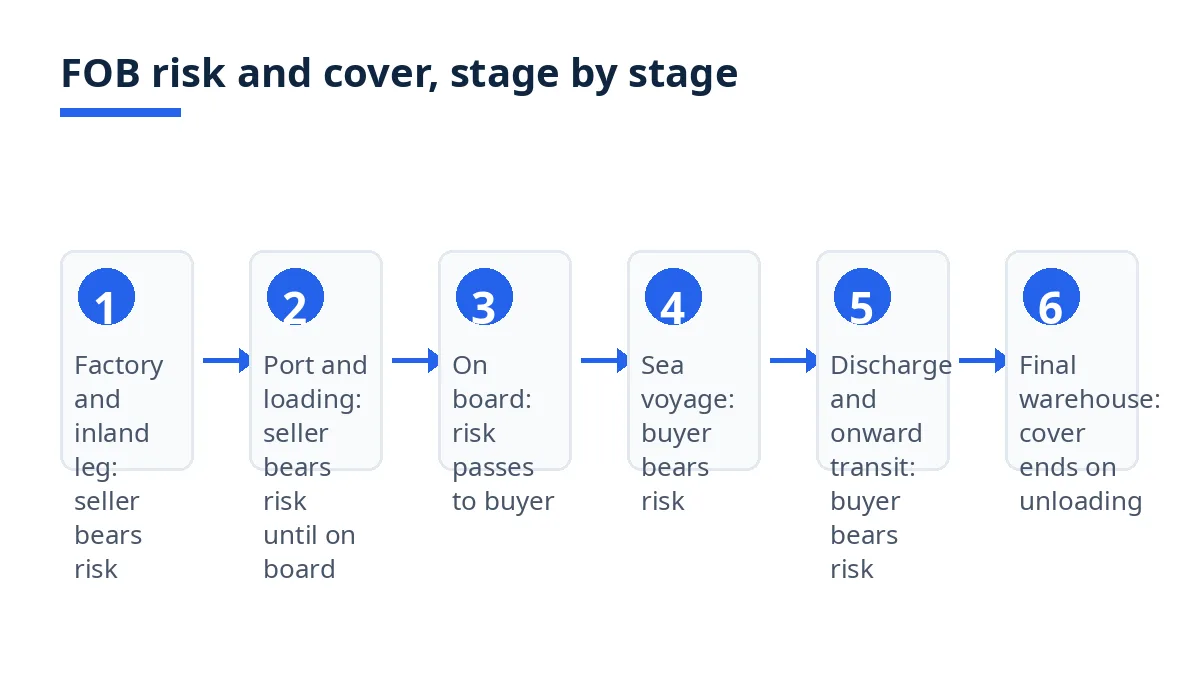
The sequence below follows risk. At each stage, the party who bears the risk is the party with the reason to hold cover.
Confirm the term in full. Write FOB, the named port of shipment and Incoterms 2020 on the contract, quotation and invoice, using the same port name on every document.
Map the seller leg. Record that the seller bears the risk from production through inland transport, export clearance and loading, until the goods are on board.
Arrange the buyer cover before loading. Give the insurer or broker the cargo, packing, route, vessel type, clause letter and insured-value basis, and ask for the premium and the wording in writing.
Check the attachment point in the wording. Under the Clause (C) transit clause, cover attaches when the goods are first moved for immediate loading, continues during the ordinary course of transit, and ends on completion of unloading at the final warehouse, or on expiry of 60 days after discharge overside at the final port of discharge, whichever occurs first.5 Read the equivalent clause in the policy on offer, because it decides whether loading and the port wait sit inside cover.
Nominate the vessel and share the details. Give the seller the vessel nomination, loading point and timing, and ask for written confirmation when the goods are on board. Keep the on-board bill of lading in the shipment file as the record of the risk-transfer moment.
Keep the arrival file ready. On arrival, note damage or shortage on the delivery documents, photograph the goods and packing, preserve the carrier receipt, and notify the insurer within the time the policy allows. The Clause (C) wording requires the assured to take reasonable measures to minimize a recoverable loss and to preserve rights against carriers and other third parties.5
Where the seller agrees to arrange cover as an extra service, record the clause letter, sum insured, premium payer and policy holder in a separate agreement. A verbal assurance does not change the FOB rule.
Costs, timelines and documents
No premium rate is stated here, because no verified rate source sets one. Cover is quoted per shipment, following the clause letter, cargo, packing, route, vessel and the insurer's view of the risk. Compare quotations only on the same clause, value and route.
How to set the insured value
FOB sets no sum insured, so the buyer sets the figure from what would be lost if the goods never arrived. Start with the invoice value, add the freight, loading and port charges and expected duty where the policy permits it, then add a margin for profit or on-costs, and state the basis in the schedule. The 110 percent figure often quoted here is a CIF obligation, not an FOB one: under CIF the seller must purchase insurance with minimum coverage under Clause (C) at 110 percent of invoice value.6 Borrowing it as a working method for a voluntary FOB policy is a choice, not a rule.
Worked example, with illustrative figures only: woven garments invoiced at USD 32,000, plus USD 3,800 of freight, USD 1,200 of destination port charges, USD 2,400 of expected duty, and a 10 percent margin of USD 3,200, give an insured value of USD 42,600. Confirm the duty element with the insurer. At invoice value alone, a total loss would leave freight, duty and margin unrecovered. Check the build-up against the landed cost guide.
Which Institute Cargo Clause fits the cargo
Most marine cargo policies use one of three standard sets of terms, the Institute Cargo Clauses (A), (B) and (C), issued by the Lloyd's Market Association and the International Underwriting Association.3 Clause (A) is the broadest all-risks wording, covering all risks except specific exclusions such as wilful misconduct, ordinary leakage, inherent vice, delay, war, strikes or nuclear incidents.3 Clauses (B) and (C) cover only listed risks. Clause (B) adds earthquake, volcanic eruption, lightning, washing overboard and entry of sea, lake or river water into the vessel.3 Clause (C) is the narrowest standard cover, covering fire or explosion, stranding, grounding, sinking or capsizing, overturning or derailment, collision with an external object other than water, discharge at a port of distress, general average sacrifice and jettison.5
Clause | Scope | Suits best |
|---|---|---|
Clause (A) | All risks except listed exclusions | High-value, fragile or theft-prone cargo |
Clause (B) | Named perils, including water entry and washing overboard | Mid-value cargo where water and handling risks matter |
Clause (C) | Narrowest named perils | Low-value, durable bulk cargo |
War, strikes and terrorism cover sits outside the standard clauses, so ask for the separate clauses in writing.3 Name the cargo, stow and any special condition, such as deck carriage or refrigeration, in the proposal. If the destination changes after cover attaches, notify the insurers promptly for rates and terms to be agreed.5
Timeline and documents to hold
Allow time before the vessel is nominated to give the insurer the cargo and route details, receive the wording, and confirm the loading and on-board periods. Hold in the shipment file: the policy or certificate, the schedule showing the clause letter, sum insured and valuation basis, the invoice, packing list, freight booking, on-board bill of lading once issued, and the insurer's written confirmation of the attachment and termination points. The FOB documents guide sets out the wider set. At claim time, add the survey report, photographs, the delivery receipt with any damage notation, and dated correspondence with the carrier and insurer.
Bangladesh-specific rules and tips
FOB shipments from Bangladesh usually load at Chattogram or Mongla. Name the port and the loading point inside the port in the contract, and confirm with the freight forwarder where goods are placed on board in practice. Where cargo moves on a feeder leg or is transshipped, confirm in writing that the buyer policy spans the feeder leg, the transshipment wait and the main voyage.
Confirm the insurer's position on the port wait in writing, including any time limit and storage condition. The seller needs to know any condition before the goods leave the factory, because the seller bears the risk during that wait. Check any bank or letter-of-credit requirement early: a bank may require a named clause, a minimum sum insured and an assignment of the policy, as a contract term on top of the Incoterm. Agree it before booking, with one set of names across the policy, bill of lading and invoice.
For containers stuffed at the factory, confirm which policy responds before the on-board moment, and consider FCA for that journey. Record the choice in the sales contract, not in messages alone.
Mistakes and red flags
Assuming the seller insured the sea voyage. Under FOB the seller has no obligation to insure for the buyer.2 A buyer who discovers at claim time that no sea policy exists has no FOB term to fall back on.
Treating loading as the buyer's risk. Damage during the lift falls on the seller until the goods are on board. Confirm the attachment wording so the lift is not left in dispute.
Accepting Clause (C) for theft-prone or water-sensitive cargo. Clause (C) is the narrowest standard cover and does not cover theft, pilferage or entry of seawater in the way buyers often assume.3 Choose the clause for the cargo, not for the premium alone.
Using FOB for air freight or for a factory-handover container move. FOB is for sea and inland waterway transport only.2 An air shipment or a container handed over at the factory gate needs a rule whose risk point matches the physical handover, normally FCA.
Setting the sum insured at the invoice value only. Freight, duty and margin are real losses on a total loss. Agree the valuation basis with the insurer and show it on the schedule.
Signing a clean receipt for damaged goods. Do not sign a clean receipt, discard damaged packing, or wait until the goods are sold before telling the insurer. Delay, poor packing and inherent vice are excluded under the standard wording.5
Checklist
FOB, the named port of shipment, the loading point and Incoterms 2020 are stated in the contract, quotation and invoice.
The seller leg to the on-board moment and the buyer leg from that moment are each named, with the insurer for each leg recorded.
The clause letter, sum insured and valuation basis are agreed with the insurer in writing before loading.
The policy wording covers loading, the voyage, discharge and onward transit to the final warehouse.
War, strikes, deck carriage, refrigeration and transshipment conditions are asked about and answered in writing.
Any bank or letter-of-credit insurance term is agreed before booking, with matching names across the papers.
The policy or certificate, schedule, invoice, packing list, freight booking and on-board bill of lading are in the shipment file.
The seller has the vessel nomination and timing, and will confirm in writing when the goods are on board.
How Exportain helps
On Exportain, browse suppliers and post a request for quotation on the RFQ board stating FOB, the named port of shipment and Incoterms 2020. Ask each reply to confirm the loading point and whether the seller will arrange any cover as a separate, priced service. Record the insurance split in the sales contract.
Read the badges for what they record. Exportain verification is a document review by staff, not a factory inspection, and a badge is not a guarantee of production capacity, product quality or delivery.7 Verification is free and never purchased, and membership plans never grant a trust badge.7 Check how to buy on Exportain and the CIF guide before you confirm.
FAQs
What should I know first about FOB?
FOB transfers risk when the goods are on board the vessel, and it imposes no insurance obligation on either party.2 The seller bears the risk through loading, the buyer from the on-board moment onward, and each side should insure its own leg voluntarily. FOB is for sea and inland waterway transport only.
What are the typical costs and timelines?
The premium is a quotation per shipment, following the clause letter, cargo, packing, route and vessel. No single figure applies. Allow time before the vessel is nominated to confirm the loading and on-board periods in the wording. Clause (A) and Clause (C) prices are not comparable, because they buy different cover.
Which documents are needed?
Hold the policy or certificate, the schedule showing the clause letter, sum insured and valuation basis, and the insurer's confirmation of the attachment and termination points. Keep the invoice, packing list, freight booking and on-board bill of lading with them, with matching names across the papers. At claim time, add the survey report, photographs and the delivery receipt with any damage notation.
What are the most common mistakes?
The most common mistake is assuming the other party insured the sea voyage. Under FOB the seller has no duty to arrange cover for the buyer, so an uninsured loss after the on-board moment falls on the buyer.2 Other common errors are accepting Clause (C) without reading its exclusions, setting the sum insured at the invoice value only, and using FOB for air freight.
Next steps on Exportain
Browse suppliers, then post your FOB requirement, named port and loading point on the RFQ board so suppliers confirm the on-board point and insurance split. Before you confirm, read when risk transfers under FOB and check how to buy on Exportain.
Sources
- Incoterms® 2020. International Chamber of Commerce (ICC) (accessed )
- Incoterms delivery clauses 2020. If (accessed )
- What are Institute Cargo Clauses (A, B, and C)?. Ship4WD (accessed )
- FOB Incoterms Explained: A Complete Guide for Importers and Freight Forwarders 2026. GoFreight (accessed )
- Institute Cargo Clauses (C) CL384. Lloyd's Market Association and International Underwriting Association (accessed )
- CIF Incoterms (Cost, Insurance and Freight) Explained. iContainers (accessed )
- Trust & Safety Center. Exportain (accessed )
About the author
Sourcing from Bangladesh?
Post a request for quotation and suppliers on Exportain can send you their quotes directly.
Post an RFQ