Documents Required for FOB Shipments: Complete Checklist
A numbered checklist of every document the seller and buyer must prepare for an FOB shipment out of Bangladesh, with owners, timing and the on-board proof that closes the seller's delivery obligation.
Short answer
For an FOB shipment out of Bangladesh, the seller prepares the contract, commercial invoice, packing list, checking record, Bill of Export with its supporting set including the certified EXP form, certificate of origin and any product certificates, plus proof of loading on board. The buyer nominates the vessel, arranges carriage and insurance, and handles import documents. Both sides check the set for consistency before filing and after loading.
On this page
Key takeaways
Delivery under FOB is complete when the goods are loaded on board the vessel nominated by the buyer at the named port of shipment, and risk transfers at that point.
The seller owns the export set and the proof of loading on board; the buyer owns the vessel nomination, carriage contract, transport document, insurance and import papers.
Under a letter of credit the bill of lading must show the goods shipped on board a named vessel at the stated port, by pre-printed wording or on-board notation.
Check the full set for identical names, quantities, weights, marks, ports and dates before filing and again after loading.
If you buy on FOB terms from Bangladesh, the fob documents required for your shipment split at one point: the goods loaded on board the vessel at the named port of shipment. Before that point the seller prepares the export set and proves loading. From that point the buyer owns the carriage contract, the transport document and the import set. This checklist names each document and who prepares it.
FOB stands for Free On Board. Under Incoterms 2020, the seller delivers the goods on board the vessel nominated by the buyer at the named port of shipment, and risk transfers to the buyer at that point.1 FOB applies only to sea and inland waterway transport, and for goods in containers the FCA rule is typically a better choice.2 Do not use this checklist for air, road or rail shipments.
Why this checklist matters
Under FOB, one document does work no other document can do: it proves the goods were loaded on board. A receipt showing only that the carrier received the goods is not the same proof. Under the Uniform Customs and Practice for Documentary Credits (UCP 600), a bill of lading under a letter of credit must indicate that the goods have been shipped on board a named vessel at the port of loading stated in the credit, by pre-printed wording or by an on-board notation giving the date of shipment.3
Timing matters too. The buyer must inform the seller in time of the vessel name and the loading place and point within the port, and if the buyer fails to do so and the goods cannot be loaded, risk transfers to the buyer.1
Before you start
Agree five things in writing before drafting any document: the exact term, as FOB plus the named port of shipment with the Incoterms 2020 version stated; the vessel nomination procedure; the document list, including letter of credit requirements and product certificates the destination requires; one format rule for the set, with identical names, quantities, weights, marks and numbers on every document; and who files what in Bangladesh, since goods cannot be loaded until a Bill of Export (shipping bill) is submitted and approved through ASYCUDA World.4
Are the fob documents required the same for every shipment?
No. The core set below stays stable, but the origin form, product certificates, import documents and letter of credit wording change with the destination, the product and the payment terms. Confirm items marked "where required" with your forwarder, broker or bank.
The full checklist (numbered, printable)
Items 1 to 8 are normally the seller's side, items 9 to 13 the buyer's side, and items 14 to 17 are joint checks.
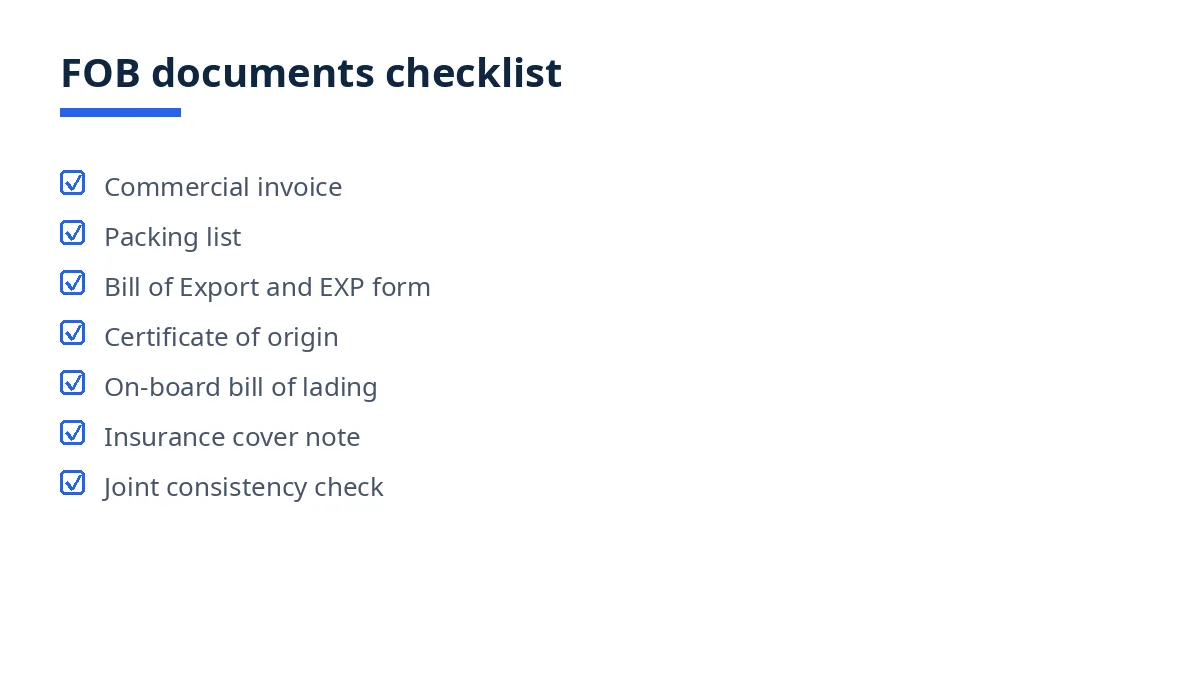
Sales contract or purchase order, seller and buyer. Proves a sale exists on FOB terms at the named port. State the Incoterms 2020 version, port, goods description, quantity and payment terms.
Commercial invoice, seller. Proves the value and goods description customs will assess. It must agree with the contract, packing list and shipping bill on quantity, value and marks, and show the FOB value and term.5
Packing list, seller. Proves how goods are packed, with quantity, weight and packing information per package.5
Checking, packaging and marking record, seller. Proves goods were checked, counted, weighed, marked and packed as the contract requires. Incoterms 2020 groups seller obligations under ten headings, including this one.6
Bill of Export, also called the shipping bill, with its supporting set, seller. Proves Customs accepted the export declaration and goods may load. The set includes the contract or purchase order, invoice, packing list, certified EXP form, certificate of origin, VAT registration and TIN certificates.4
EXP form, certified by an authorized dealer bank, seller. Proves proceeds will be realised through the banking channel. The EXP form is a statutory declaration furnished before shipment, recording commodity, destination, quantity, value, terms of sale and port of shipment.7
Certificate of origin or statement on origin, seller. Proves country of origin for duties and preferential treatment. Export Promotion Bureau (EPB) certificate processes require the filled EXP form and copies of the bill of lading, Bill of Export and invoice.7
Export licence and product-specific certificates, where required, seller. Prove controlled goods, or a product under a destination rule, may lawfully leave and enter. Confirm with your broker whether a phytosanitary, health, inspection or other certificate applies.
Vessel nomination and booking confirmation, buyer. Proves the buyer nominated the vessel and arranged carriage onward. The buyer must give timely notice of vessel name and loading point, or the seller is no longer responsible for loss or damage where goods cannot be loaded.1
On-board bill of lading or sea waybill, buyer through the carrier. Proves the carrier received the goods and they were loaded on board, and states delivery terms at destination. Under FOB the buyer contracts carriage, so the shipper should be the buyer unless the credit or contract states otherwise.1 Check it shows the named vessel, port of loading and shipment date, with no defect notation.3
Proof of loading on board, seller. Proves the seller delivered goods on board. The seller must provide proof at its cost, whether a mate's receipt, another receipt or a transport document such as a bill of lading.1 Agree the form.
Contract of carriage, buyer. Proves terms agreed with the carrier for main carriage to the port of discharge. Keep the booking confirmation with the transport document.
Insurance certificate or cover note, buyer. Proves goods are insured from when the buyer's risk begins. Under FOB neither party must conclude an insurance contract, and the seller must provide information the buyer needs to arrange insurance if requested.8 Start cover on loading.
Import licence and import documents for the destination, buyer. Prove the buyer may lawfully import and clear goods at destination. The buyer accepts responsibility for import formalities and transit-country customs procedures.1
Payment documents, seller and buyer. Prove payment on agreed terms. Under a letter of credit the set must match the credit exactly, including delivery term, port of loading, goods description and transport document wording.3
Delivery and receipt notices, seller and buyer. Prove each side gave notice, and when. The buyer gives notice of vessel, loading point and delivery period; the seller gives notice of loading or of loading not taking place.1
Joint consistency check and final copy file, seller and buyer. Before filing and again after loading, one named person each side checks the set against the invoice: names, quantities, weights, marks, ports, vessel, shipment date and description identical on every document.
Common failures and how to fix them
A received-for-shipment bill is tendered as proof of loading. It shows only receipt, not loading. Ask the carrier for the on-board notation showing the named vessel and shipment date, as UCP 600 requires under a credit.3
The shipper is the seller, although the buyer contracted the carriage. The shipper should normally be the buyer.1
The vessel nomination arrives late, or the vessel is delayed without notice to the seller. Risk and added costs can pass to the buyer even though the goods were never loaded.1
The shipping bill set lacks the EXP form, certificate of origin or a registration document. The standard set includes the EXP form certified by an authorized dealer, the certificate of origin, VAT registration and TIN certificates alongside the invoice and packing list.4
Names, quantities, weights or marks differ across documents. The set then reads as a different shipment. Run the joint check in item 17, by one named person on each side, before filing and again after loading.
The wrong origin form is used for the destination preference scheme. The buyer can lose the duty preference priced into the order.
Insurance starts at the factory or terminal, not on board. The buyer's risk begins on board, and no insurance obligation arises from the Incoterms rule itself.8
FOB is used for container cargo handed to the carrier away from the port. The seller carries risk while the carrier holds the goods before loading, with no clear delivery point.
Downloadable template / summary table
Copy the table into the order file.
Document | Owner |
|---|---|
Sales contract or purchase order | Both |
Commercial invoice | Seller |
Packing list | Seller |
Checking and marking record | Seller |
Bill of Export, shipping bill set | Seller |
EXP form, dealer certified | Seller |
Certificate of origin | Seller |
Export licence, product certificates | Seller |
Vessel nomination, booking | Buyer |
On-board bill of lading or waybill | Buyer, carrier |
Proof of loading on board | Seller |
Contract of carriage | Buyer |
Insurance certificate or cover note | Buyer |
Import licence, import documents | Buyer |
Payment documents | Both |
Delivery and receipt notices | Both |
Joint check and final copy file | Both |
How Exportain helps
Exportain is a B2B marketplace connecting buyers with Bangladeshi suppliers, so document expectations can be agreed at the enquiry stage. Post the FOB named port, goods description and document list, and ask each reply to confirm the on-board proof it will provide, the shipping bill set it will file and the origin form it will supply. Document and photo checks recorded on supplier profiles are not factory inspections or guarantees. Exportain is not a party to the goods contract and does not inspect goods, book freight or clear customs.
FAQs
When should this checklist be used?
Use it at order stage, and again before the Bill of Export is filed.
Who should complete it?
Both sides. The seller owns the export set and proof of loading; the buyer owns nomination, carriage, the transport document, insurance and import papers.
What are the most common failures?
Missing on-board notation, wrong shipper, late nomination, missing EXP form or origin certificate, inconsistent documents, wrong origin form, early insurance start, and FOB for off-port container handover.
Can a third party do it?
Yes. A customs broker or freight forwarder can prepare, file and check the set, and a bank can check the documents against a letter of credit. The seller and buyer still own the obligations.
Next steps on Exportain
Before you confirm an order, read the FOB free on board guide, the guide to Incoterms for shipments from Bangladesh and the landed cost guide, then check the how to buy page. Post your enquiry with the named port and document list on RFQs and ask each reply to confirm its on-board proof and shipping bill set.
Sources
- FOB & FAS Incoterms® 2020 explained: Key differences. ICC Academy (accessed )
- Place of delivery & risk transfer in trade contracts. ICC Academy (accessed )
- The on-board notation rule. Business Standard (accessed )
- Custom Clearance in Bangladesh: Port Procedures and C and F Agent Guide. Bizmend (accessed )
- Essential export documents for shipping from Bangladesh. DHL (accessed )
- What are the Incoterms® rules?. International Chamber of Commerce (accessed )
- Certificate of Origin SOP. Bangladesh Export Processing Zones Authority (accessed )
- FOB - Free on Board | Incoterms. Shipa Freight (accessed )
About the author
Sourcing from Bangladesh?
Post a request for quotation and suppliers on Exportain can send you their quotes directly.
Post an RFQ