

FOB Customs Clearance: Who Handles Export, Import and Duty
Under FOB, export clearance belongs to the seller and import clearance, duties and taxes belong to the buyer, with the split at loading on board. This guide follows the two clearances, the documents each side needs, and the costs.
Short answer
Under FOB, the seller clears the goods for export and delivers them loaded on board the vessel nominated by the buyer at the named port of shipment, where risk passes to the buyer. The buyer contracts the carrier, pays ocean freight, clears the goods for import at destination, and pays all import duties and taxes. FOB applies only to sea and inland waterway transport.
On this page
Key takeaways
Under FOB, the seller clears export customs and loads the goods on board, and the buyer clears import customs and pays duties and taxes, with risk passing at loading.
The buyer must name the vessel and loading point in time; a late nomination can shift risk and added costs to the buyer.
For Bangladesh-origin goods, export clearance means an approved Bill of Export, and certificates move through the Bangladesh Single Window from July 1, 2025.
FOB applies only to sea and inland waterway transport; for air freight or a terminal handover, FCA fits the delivery point the parties can fix.
The FOB price ends at loading, so price the import side separately: freight, insurance, clearance, duty, VAT, and onward transport are buyer lines.
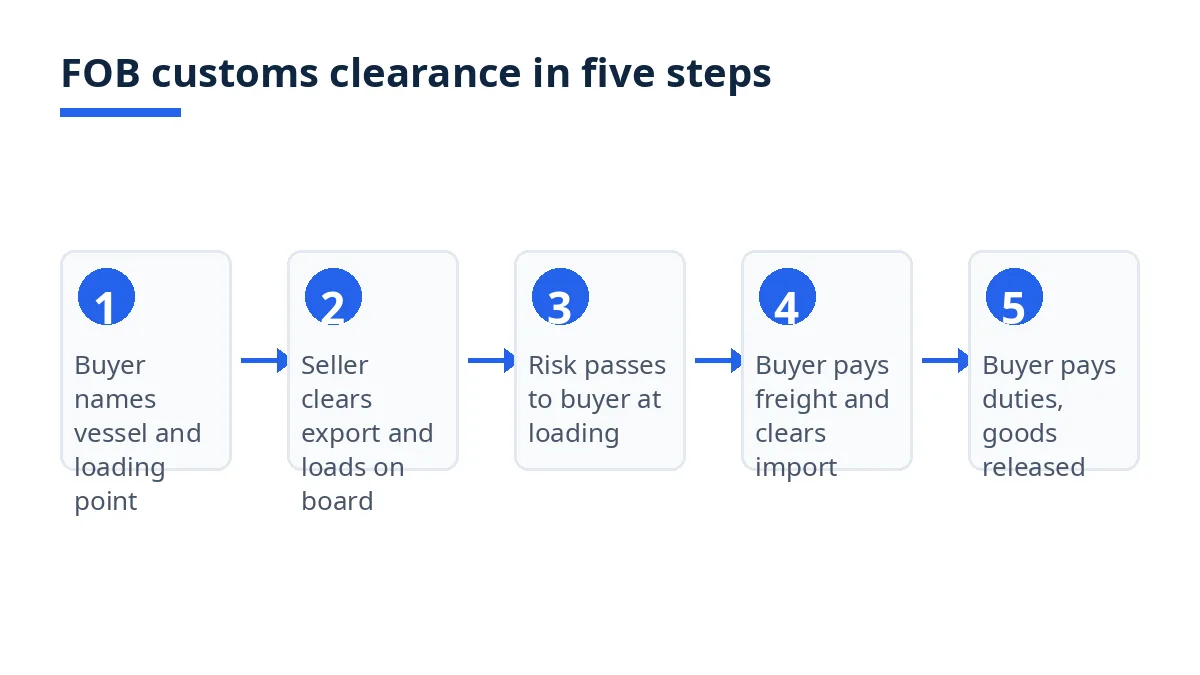
The dividing line under FOB is a physical moment. The seller clears the goods for export and loads them on board the vessel the buyer nominated at the named port of shipment. At that moment, risk passes to the buyer, and import clearance at destination becomes the buyer's work.
The Incoterms 2020 rules allocate cost, risk, and obligations for each rule, with security-related obligations on export and import clearance set out in the clearance articles.1 FOB, or Free On Board, applies only to sea and inland waterway transport: the seller delivers the goods loaded on board the vessel nominated by the buyer at the port of shipment, and risk transfers to the buyer there.2 The FOB meaning guide explains the term itself. This guide stays with the two clearances: what each covers, which documents each side needs, and where buyers lose time at either border. For air freight, or cargo handed to a carrier at a terminal well before loading, compare FCA first.
Why FOB customs clearance matters for buyers and sellers
For the buyer, FOB offers control over the ocean leg: the buyer chooses the carrier, negotiates the freight, and arranges insurance on the buyer's own terms. The price of that control is full ownership of the destination side. The buyer pays ocean freight, marine insurance, import clearance, duties, and destination inland transport, while the seller pays export packaging, export clearance, inland transport to the origin port, origin terminal handling, and loading on board.3 A buyer with no broker instructed before sailing discovers the gap at destination, where storage charges run while papers are sorted out.
For the seller, FOB keeps the export side in familiar hands, but the seller depends on the buyer's timing. The buyer must inform the seller in time of the vessel name and the loading place and point, and if the goods cannot be loaded because the buyer failed to do so, risk and added costs pass to the buyer.2 Each side must assist the other, at the requester's risk and cost, in obtaining documents for the other side's formalities, but assistance never transfers the clearance itself. Write the split into the contract before nomination, naming the port, the rule, and the deadline. See the Incoterms guide.
Step-by-step: how FOB customs clearance works
The sequence below follows one FOB shipment from nomination to release. The two clearances never meet, but information from the first feeds the second.
Stage | Owner | Customs work at this stage |
|---|---|---|
Vessel nomination | Buyer | Name the vessel, loading place, and point in time for loading |
Export clearance | Seller | Complete export formalities and obtain approval before loading |
Loading on board | Seller | Load the goods and notify the buyer that delivery is complete |
Main carriage | Buyer | Contract the carrier and pay ocean freight to destination |
Transit customs | Buyer | Complete transit formalities in any transit country, where required |
Import clearance | Buyer | File the import declaration and present licenses and authorizations |
Duties and taxes | Buyer | Pay import duty, VAT, excise, and other charges before release |
Name the port, the rule, and the nomination window. Write "FOB Chattogram, Incoterms 2020" or the agreed port, never "FOB Bangladesh". Add the delivery period, the nomination deadline, and who pays storage if the vessel is late.2
The seller prepares the export set. The seller, usually through a clearing and forwarding agent, assembles the export declaration and supporting documents. For Bangladesh-origin goods, the declaration is the Bill of Export, and goods cannot be loaded or stuffed until it is submitted and approved.4
Export clearance is approved before loading. The seller completes the export formalities,2 the customs authority approves the declaration, and only then does loading begin. A document query here delays the vessel, not just the paperwork.
The goods are loaded and the buyer is notified. The seller loads the goods on board, and risk transfers to the buyer.2 Keep the proof of loading and the on-board bill of lading with the shipment file.
The ocean leg carries the information the import side needs. The buyer contracts the carrier and pays the freight.2 For container maritime cargo entering the EU, the Entry Summary Declaration must be lodged at least 24 hours before loading commences in the foreign port, so the bill of lading and invoice must reach the lodging party in time.5
The buyer clears import customs and pays before release. At destination, the buyer files the import declaration, presents the licenses, authorizations, and proof of origin required, and pays the duties assessed. In the EU, goods are released for free circulation once all import requirements are met: duties and other charges paid, quota licenses presented, and applicable authorizations and certificates presented.5 Release follows payment, not arrival.
Costs, timelines and documents
What are the typical costs and timelines?
There is no typical FOB clearance cost or timeline a guide can state as fact: charges depend on the product, the ports, the broker, and the destination tariff. What is fixed is the order of work and the side that pays each line. Broker fees follow the side that appointed the broker, so ask for export-side and import-side charges on separate lines.
Example figures: an FOB price of 40,000 for goods loaded on board at Chattogram, with an assumed duty rate of 6 percent on a customs value of 40,000, gives import duty of 2,400. Import VAT, excise, ocean freight, insurance, and broker fees are separate buyer lines. These are example figures only: the 6 percent rate is an assumption, not a real duty rate, and the actual duty comes from the destination tariff for the product's classification. Confirm the rate with the import broker before budgeting. For the full journey calculation, see the landed cost guide.
Timelines run backward from the vessel: nomination deadline, export approval date, then the advance-declaration deadline, at least 24 hours before loading commences in the foreign port for EU-bound container cargo.5 The acceptance date of the import declaration is the date used for calculating import duty, VAT, and excise duty.5
Which documents are needed?
The export set and the import set are different lists, held by different parties. The export set enclosed with the Bill of Export includes the export letter of credit or, where there is none, the export contract, purchase order, or export guarantee; the signed commercial invoice; the packing list; the EXP form certified by an Authorized Dealer; the certificate of origin issued by the Export Promotion Bureau or a Chamber of Commerce and Industry; the VAT registration certificate; and the Taxpayer Identification Number.4 Product-specific certificates may also apply, and they sit on the export side.
For the import side, the buyer needs the import declaration with the commercial invoice, packing list, transport document, and proof of origin where a preferential rate is claimed. In the EU, a proof of origin shall be declared with the customs declaration and presented with it, and certificates of preferential origin allow reduced or nil duties where an agreement applies.5 The buyer also needs the destination customs identifier: in the EU, the EORI number is a unique identifier assigned by a customs authority in an EU country, used in communications with EU customs authorities where an EU-based identifier is required.5 Confirm the identifier and license list with the import broker before the vessel sails.
Bangladesh-specific rules and tips
Bangladesh-origin FOB shipments run through one export gate. Goods cannot be loaded onto a vessel or stuffed into containers for export until a Bill of Export is submitted and approved through ASYCUDA World, and the standard export documents listed above accompany that submission.4 The declaration names the exporter, the foreign buyer, and the transport operator, so keep one legal name for the seller across the trade license, quotation, proforma invoice, and payment account, and check that the buyer's name matches the contract.
Use a licensed clearing and forwarding agent unless the seller has in-house clearance capacity. A C and F agent is a government-authorized customs broker, licensed by Bangladesh Customs, and in practice almost no commercial shipment clears without one.4 Ask the agent to confirm the license is current, and who files the Bill of Export and tracks approval against the vessel cut-off.
Certificates, licenses, and permits for clearance now move through the Bangladesh Single Window. From July 1, 2025, submission of all certificates, licenses, and permits from 19 designated organizations must be done through the Bangladesh Single Window system for import and export customs clearance, and no manual certificates, licenses, or permits are accepted after that date.6 Registration in the system uses a Business Identification Number.6 The revenue authority reported that 85.76 percent were issued in less than an hour, and 94.68 percent in less than a day.6 Those figures describe system issuance times, not a promise for any single application.
Goods entering Bangladesh clear on a Bill of Entry, with a different list that includes the bill of lading and an insurance certificate.4 That list governs the reverse direction, not a Bangladesh-origin export shipment.
Mistakes and red flags
What are the most common mistakes?
Expecting the seller to clear import customs. The seller's clearance duty ends with export formalities and loading.2 Import clearance, duties, and taxes remain the buyer's.
Using FOB for air freight or a terminal handover. FOB applies only to sea and inland waterway transport, and the delivery point is loading on board.2 Where goods travel by air, or a container is handed to a terminal days before the vessel loads, FCA fits the handover the parties can actually fix.
Reading a US domestic FOB term as an Incoterm. "FOB Origin" and "FOB Destination" appear in US purchase agreements, but they are not Incoterms and should not be used in international sales contracts.3 Write "FOB Chattogram, Incoterms 2020" in full.
Leaving the import broker, identifier, and advance-declaration data until arrival. Import release requires duties paid and licenses and authorizations presented,5 and the advance declaration for EU-bound container cargo is due before loading at origin.5
Treating the FOB price as the landed cost. The FOB price ends at loading.3 Duty, VAT, excise, freight, insurance, and destination charges are buyer lines, assessed under destination rules.
Assuming FOB includes insurance. FOB carries no insurance obligation for the seller, and the buyer is not required to buy cover either.3 Arrange marine cover before loading, or the cargo travels the ocean leg uninsured.
Checklist
Before the vessel is nominated, both sides should be able to answer their own half of this list in writing.
Seller side: named port and loading point agreed; Bill of Export set ready, including the EXP form and certificate of origin;4 Single Window filings made where needed;6 export clearance approved before loading;4 notice of delivery prepared.2
Buyer side: vessel nominated in time;2 carrier contracted; import broker instructed, destination identifier ready, and licenses identified;5 seller documents with the lodging party before the loading deadline;5 duty budget set from the destination tariff; marine insurance arranged before loading;3 import declaration ready on arrival.5
Shared: one contract clause naming the rule, the port, and the nomination deadline; one name for each party across every document; and a written record of who pays each charge line, export side and import side separately.
How Exportain helps
On Exportain, browse suppliers and post a request for quotation on the RFQ board stating FOB, the named port, and the clearance split, so suppliers quote on the same delivery point. Ask each reply to confirm in writing that export clearance and loading sit on the seller's side, and that carriage, import clearance, duties, and taxes sit on your side. When you accept a quotation, Exportain creates one order and issues one proforma invoice from the accepted terms.7 Before you confirm, read how to buy.
Read the badges for what they record. Exportain verification is a document review by staff, not a factory inspection and not a check against any government database.8 Exportain Verified means Exportain has checked identity, phone, email, and business registration, and Export Verified means it has checked the Export Registration Certificate.8 Factory Verified means it has reviewed photos of the manufacturer's factory.8 A badge is not a guarantee of capacity, quality, or delivery, and verification does not replace your own clearance checks: confirm the seller's export documents and your import broker before nomination.
FAQs
What should I know first about FOB?
FOB is a sea or inland waterway rule: the seller delivers the goods loaded on board the vessel nominated by the buyer at the named port of shipment, having cleared them for export, and risk transfers to the buyer at that loading point.2 The buyer contracts the carrier, pays ocean freight, clears the goods for import, and pays duties and taxes at destination.3 FOB never applies to air freight. For container cargo handed to a terminal, compare FCA first.
What are the typical costs and timelines?
Costs split at loading: export clearance, inland movement, and loading sit with the seller, while freight, insurance, import clearance, duties, and onward transport sit with the buyer.3 There are no typical figures, because charges depend on the product, the ports, the broker, and the destination tariff. The fixed order is export approval before loading,4 the advance declaration before the loading deadline for EU-bound container cargo,5 and import release only once duties are paid and licenses and authorizations are presented.5
Which documents are needed?
The export set for Bangladesh-origin goods is the Bill of Export with the letter of credit or contract, commercial invoice, packing list, EXP form certified by an Authorized Dealer, certificate of origin, VAT registration, and Taxpayer Identification Number, plus product certificates where required.4 The import set is the destination declaration with the invoice, packing list, transport document, proof of origin where a preferential rate is claimed, licenses, and authorizations, plus the destination customs identifier, such as the EORI number in the EU.5 Each side assists the other at the requester's risk and cost.2
What are the most common mistakes?
The most common mistakes are expecting the seller to clear import customs, using FOB for air freight or a terminal handover, reading a US domestic FOB term as an Incoterm, leaving the import broker and identifier until arrival, treating the FOB price as the landed cost, and assuming FOB includes insurance. Write the split, the named port, and the nomination deadline into the contract, and confirm the duty rate with the import broker before budgeting.
Next steps on Exportain
Browse suppliers, then post your FOB requirement, named port, and clearance split on the RFQ board so suppliers confirm the export side in writing. Before you confirm, read the landed cost guide.
Sources
- Incoterms® 2020. International Chamber of Commerce (ICC) (accessed )
- FOB & FAS Incoterms® 2020 explained: Key differences. ICC Academy (accessed )
- FOB Incoterms Explained: A Complete Guide for Importers and Freight Forwarders 2026. GoFreight (accessed )
- Custom Clearance in Bangladesh: Port Procedures and C and F Agent Guide. Bizmend (accessed )
- Customs clearance documents and procedures. European Commission (accessed )
- NBR makes BSW submission mandatory for customs clearance from July 1. United News of Bangladesh (accessed )
- How to source and buy from Bangladesh. Exportain (accessed )
- Trust & Safety Center. Exportain (accessed )
About the author
Sourcing from Bangladesh?
Post a request for quotation and suppliers on Exportain can send you their quotes directly.
Post an RFQ


