FAS for a Small First Order: Run the Scale-Fit Test First
FAS ends at the side of the ship, so a small importer must arrange loading, freight and insurance from the quayside. This scale-fit test shows when that works for a first order from Bangladesh, and when FCA or FOB is safer.
Short answer
FAS is usually the wrong Incoterm for a small containerised first order from Bangladesh. Under FAS the seller delivers goods alongside the buyer's nominated vessel and the buyer then pays for loading, freight, insurance and import clearance. FAS fits only bulk or break-bulk cargo that can sit alongside a vessel, where the buyer can arrange loading and carriage at the port. For containerised orders, FCA usually fits better.
On this page
Key takeaways
FAS delivery ends alongside the vessel, and the buyer pays for loading, freight, insurance and import clearance from that point.
Containerised cargo delivered to a terminal fails the FAS test, because the goods never reach a point alongside the ship; FCA matches that handover.
FAS fits bulk or break-bulk cargo where the buyer controls the vessel, the loading and the carriage at the port of shipment.
Price the full journey, including loading, freight, insurance and duty, before comparing an FAS price with FCA or FOB, because the headline FAS price is only a partial price.
A small importer who accepts an FAS price for a first order from Bangladesh is usually buying more work than the price suggests. FAS, or Free Alongside Ship, ends the seller's delivery at the side of the ship, and loading, freight, insurance and import clearance after that point become the buyer's job. For most small first orders, which travel in containers, that handover happens in the wrong place. This guide gives you a scale-fit test to run before you quote FAS, so you can see whether your order is one of the narrow cases where FAS fits, or whether FCA or FOB is safer.
The scale-fit test: four questions that decide FAS
Run these four questions in order. FAS fits only when every answer is yes. One no does not mean the order cannot ship. It means FAS is the wrong term for it.
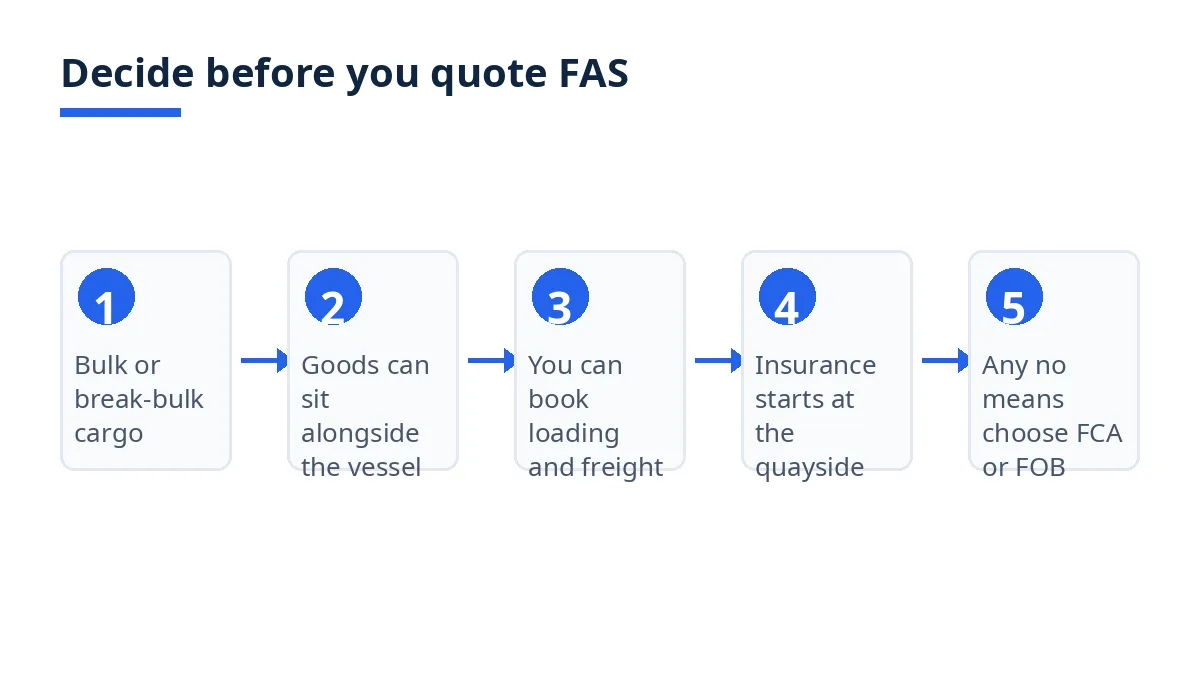
1. Is the cargo bulk or break-bulk that can be placed alongside a vessel? FAS is built for goods delivered directly alongside a ship, typically bulk cargo such as minerals, petrochemical products, crude oil, refined oil, gas, cement, steel, grains and brand-new vehicles.1 A buyer importing bagged cement, loose steel sections or bulk grain can meet this test. A buyer whose goods are packed into a container cannot, because containers are normally delivered to a container terminal rather than alongside the ship.1
2. Can the goods sit alongside the named vessel at the agreed place and point? Under FAS the seller delivers the goods alongside the vessel nominated by the buyer at the port of shipment, and risk transfers at that point.1 The buyer must notify the seller in time of the vessel name and the specific place and point of delivery within the port.1 If the vessel has not arrived, or the berth is not settled, there is no alongside delivery to complete. A first order with no confirmed vessel fails this question until the sailing is fixed.
3. Can you arrange loading, carriage and insurance from the quayside? Under FAS the buyer must appoint the carrier and pay freight, cover loading costs at the port, and handle import formalities and any transit customs.1 The seller has no obligation to load the goods on board. A small importer therefore needs a loading contractor and a carrier booking at the port before the goods arrive there. If you have no one at the port who can load them, FAS leaves the most physical part of the shipment unowned.
4. Does the price still make sense once every buyer cost is added? An FAS price looks low because it stops early. Add loading, ocean freight, marine insurance from the quayside, destination charges, import duty and taxes, and inland delivery before comparing it with an FCA, FOB or CIF price. If the FAS total is higher than an FCA total for the same goods, the lower FAS price was never the cheaper order.
What FAS asks a small buyer to do after the quayside
FAS is one of the four Incoterms rules for sea and inland waterway transport only.1 The Incoterms 2020 rules give a clear allocation of cost, risk and obligations for each of the 11 rules.2 Under FAS, that allocation is short on the seller's side and long on the buyer's side.
The seller must transport the goods to the port, place them alongside the nominated vessel within the agreed period, complete export formalities, and inform the buyer.1 The seller must also assist the buyer, at the buyer's risk and cost, with information the buyer needs to arrange carriage.1 That assistance is not the same as arranging the carriage, which remains the buyer's to conclude, except where the seller makes it at the buyer's expense and risk.3
The buyer must notify the seller in time of the vessel name, loading point and delivery date.3 The buyer must take delivery at the designated place, contract the carrier, pay port-to-port costs, complete import formalities, and bear the cost of loading.1 If the buyer fails to give timely notice and the vessel has closed for cargo, risk and costs can shift to the buyer from the moment of non-compliance.1
Insurance deserves a separate decision. The Incoterms 2020 rules provide for seller-arranged insurance only in the CIP and CIF rules.2 Under FAS, no seller insurance obligation applies, so the buyer should arrange cover that starts when risk transfers alongside the vessel. Waiting until the goods are on board leaves loading uninsured.
Why a containerised first order fails the test
Most small first orders from Bangladesh travel in containers: packed at the factory or a depot, handed to a carrier at a container terminal, and loaded days later. FAS has no delivery point that matches that journey. When goods are containerised, sellers typically deliver them to a container terminal, not alongside the ship.1 In such cases, the FCA rule, Free Carrier, is more appropriate.1
The Export Council of Australia states the same point directly: the use of FAS is not recommended for container transport.3 If the contract says FAS but the goods are delivered to a terminal, the parties have agreed a delivery point that the shipment never reaches, and a later argument will turn on whether delivery happened at all.
FCA fits the container journey because delivery happens when the goods are handed to the buyer's carrier at the named place, which can be the terminal, while the seller still completes export formalities. Compare the terms on the same specification and sailing before you choose. The FCA for small importers guide applies the same first-order questions to FCA, and the Incoterms for shipments from Bangladesh guide sets out all 11 rules side by side.
The narrow cases where FAS can fit a small importer
FAS can fit a small importer when the order is small in commercial terms but large in physical terms. The test is the cargo shape and the buyer's control at the port.
First, a bulk or break-bulk order delivered to the berth. Bagged cement, bulk grain, steel sections and vehicles are the examples the ICC Academy lists for goods suited to delivery alongside the ship.1
Second, a buyer who already has a vessel or a regular carrier call at the port, and can name the vessel and loading point early. That control removes the largest timing risk: goods arriving at a quay with no ship alongside them.
Third, a buyer with a loading contractor and a freight forwarder active at the port. That buyer can take the goods from the quay and load them without asking the seller to do work the term does not assign to the seller. Handling charges and quay-to-ship movement vary with port practice, so the loading point should be determined as clearly as possible.3
Fourth, a buyer who wants the FAS price structure on purpose, because the buyer already holds marine insurance and a freight contract starting at the port of shipment. If none describes your order, do not force FAS to fit.
What to price before you accept an FAS quote
An FAS quotation is a partial price. Price the whole journey on one sheet before comparing it with any other term.
Cost line | Who pays under FAS | Price it before you agree |
|---|---|---|
Goods and delivery alongside the vessel | Seller | The FAS price in the quotation |
Export clearance | Seller | Confirm it is included in the FAS price |
Loading onto the vessel | Buyer | Loading contractor and port handling charges |
Ocean or inland-waterway freight | Buyer | Carrier booking from the port of shipment |
Marine insurance from the quayside | Buyer | Cover from risk transfer, not from loading only |
Destination port and unloading charges | Buyer | Destination terminal and handling charges |
Import clearance, duty and taxes | Buyer | Import formalities and transit customs if any |
Inland delivery at destination | Buyer | Delivery from the destination port to your premises |
Example figures: FAS Chattogram 8,000, loading 600, ocean freight 2,400, marine insurance 180, destination charges 450, inland delivery 320. The comparable delivered cost before duty and taxes is 11,950, so the same goods quoted FCA at 11,200 would be cheaper even though the headline FAS price looks lower. These are example figures only, not market rates.
Two pricing traps follow. The first is comparing an FAS price with a CIF price as if both were delivered prices: under CIF the seller contracts for insurance and pays freight to destination, so the CIF price contains lines the FAS price does not.2 The second is leaving loading out because the factory is near the port. Proximity does not remove the loading operation, and the buyer pays for it under FAS.1 See what an FAS price includes for a fuller breakdown.
Bangladesh specifics: export clearance, documents and vessel timing
Under FAS the seller completes export formalities, and Bangladesh export clearance has its own document set that the seller, or the seller's clearing agent, must complete before the goods can load.1 Goods must not be loaded for export unless an export declaration, known as the Bill of Export or Shipping Bill, is submitted to Customs and approved.4 The declaration specifies the goods, value, exporter, foreign buyer and transport operator.4
The documents enclosed with the Bill of Export include the export letter of credit, or the approved export contract, purchase order or export guarantee where there is no letter of credit, the commercial invoice, the packing list, the EXP form certified by an authorized dealer, the certificate of origin, the VAT registration certificate, and the taxpayer identification number.4 Product-specific certificates may also apply; the seller should confirm them before the sailing date.
Vessel timing is the risk a small importer most often underestimates. The buyer must give the seller the vessel name and delivery point in time, and notify the seller of the delivery date within the agreed period.3 If notice is late, or the vessel closes for cargo early, risk and costs can pass to the buyer even though the goods were never loaded. For a first order, fix the named port, the loading point and the vessel window in writing before production finishes. The FAS customs clearance guide explains who clears export and import customs and who pays duty.
Mistakes that cost small importers most under FAS
Quoting FAS for a container. The goods go to a terminal, the contract names a point alongside a ship, and the two never meet. Use FCA for the container.1
Leaving the vessel, place and point unnamed. A clause naming only a port leaves the seller without a delivery point and the buyer exposed when the vessel is late. Name the port, loading point and vessel, and state how changes will be notified.
Assuming the seller will load the goods. Under FAS the seller delivers alongside the ship, not on board it.1 Book the loading contractor when you book the carrier.
Starting insurance at the wrong point. Risk transfers alongside the vessel.1 Insurance that starts only when the goods are on board leaves loading uncovered. Arrange cover from the moment of risk transfer.
Comparing prices across different terms. An FAS price, an FOB price and a CIF price contain different lines. Compare them only after adding every buyer-paid line to the FAS and FOB prices, using the table in this guide.
Treating a supplier profile or badge as a substitute for port arrangements. Verification on Exportain is a document review by staff, not a factory inspection, and a badge is not a guarantee of production capacity, product quality or delivery.5 A badge does not book a vessel, a loading gang or a carrier.
Checklist: do not sign FAS until every line is answered
Cargo type confirmed: bulk or break-bulk that can be placed alongside a vessel, not a container delivered to a terminal.1
Named port of shipment, loading point within the port, and vessel name agreed in writing, with a notice procedure for changes.3
Loading contractor and carrier booked at the port of shipment, with loading and freight costs priced.1
Marine insurance arranged from the moment risk transfers alongside the vessel, with no gap across loading.2
Export document set confirmed with the seller: Bill of Export, commercial invoice, packing list, EXP form, certificate of origin, VAT registration and taxpayer identification number.4
Full journey priced on one sheet, including loading, freight, insurance, destination charges, duty and taxes, and inland delivery, before comparison with FCA or FOB.
Import clearance and any transit customs assigned to the buyer or the buyer's broker at destination.1
FAQs
What should a small importer know first about FAS?
FAS means the seller delivers the goods alongside the vessel nominated by the buyer at the port of shipment, and risk transfers at that point.1 The seller completes export formalities, while the buyer contracts the carrier, pays freight and loading costs, and handles import formalities.1 The first question is not the price. It is whether the cargo can be placed alongside a vessel and whether the buyer can arrange everything after that point.
What are the typical costs and timelines?
There are no typical costs or timelines that apply to every FAS order. Costs depend on the cargo, the loading operation, the route and the destination, and timelines depend on when the vessel is alongside and when the buyer gives notice of the vessel and delivery point.1 Price every line in the table for the actual shipment, and fix the vessel window in writing before production finishes.
Which documents are needed?
The export set enclosed with the Bill of Export includes the export letter of credit or the approved export contract, purchase order or export guarantee, the commercial invoice, the packing list, the EXP form, the certificate of origin, the VAT registration certificate, and the taxpayer identification number.4 The seller must also provide a document confirming delivery, and assist the buyer, at the buyer's request, risk and cost, in obtaining documents for transit and import clearance.3 Confirm any product-specific certificates with the seller before the sailing date.
What are the most common mistakes?
The most common mistakes are quoting FAS for containerised cargo, leaving the vessel and loading point unnamed, assuming the seller will load the goods, starting insurance only after loading, and comparing an FAS price with a CIF or FOB price without adding the buyer-paid lines.1 Each mistake comes from treating FAS as a delivered price when it is a price that stops at the side of the ship.
Next steps on Exportain
Browse suppliers and post your cargo description, loading point and vessel window on the RFQ board, asking suppliers to quote FAS and FCA or FOB on the same specification. Before you accept a quotation, read the FCA for small importers guide to check whether the container route fits your order better.
Sources
- FOB & FAS Incoterms® 2020 explained: Key differences. ICC Academy (accessed )
- Incoterms® 2020. International Chamber of Commerce (ICC) (accessed )
- FAS - Free alongside ship (Named Place) Incoterms 2020. Export Council of Australia (accessed )
- Customs Clearance Procedures for Export. Bangladesh Customs, National Board of Revenue (accessed )
- Trust & Safety Center. Exportain (accessed )
About the author
Sourcing from Bangladesh?
Post a request for quotation and suppliers on Exportain can send you their quotes directly.
Post an RFQ