Who Handles Customs Clearance Under FAS? Export vs Import Explained
Under FAS, export clearance belongs to the seller and import clearance belongs to the buyer. This guide keeps the two sides separate: documents, costs, and the handover alongside the vessel.
Short answer
Under FAS, the seller clears the goods for export and delivers them alongside the vessel nominated by the buyer at the named port of shipment, where risk passes to the buyer. The buyer then pays for loading and main carriage, clears the goods for import, and pays all import duties and taxes at destination.
On this page
Key takeaways
Under FAS, export clearance belongs to the seller and import clearance, duties, and taxes belong to the buyer, with risk passing when the goods are placed alongside the vessel.
Export clearance must be approved before loading; for Bangladesh-origin goods that means an approved Bill of Export with the invoice, packing list, EXP form, certificate of origin, VAT registration, and TIN.
Import release in the EU follows only once duties and charges are paid and licences and authorisations are presented, and the ENS deadline for container cargo is 24 hours before loading.
Each side assists the other at the requester's risk and cost, but assistance never transfers the clearance itself.
Loading and main carriage are the buyer's work, and FAS is not recommended for container cargo handed to a terminal.
FAS, or Free Alongside Ship, splits customs work down the middle of a shipment. The seller handles the export side, and the buyer handles the import side, with delivery alongside the vessel sitting between the two. This guide keeps those two clearances separate, so you can see who files what, who pays what, and which documents each side needs from the other.
The Incoterms® 2020 rules allocate cost, risk, and obligations for each rule, including security-related obligations on export and import clearance.1 FAS is used only for sea or inland waterway transport, and the seller delivers by placing the goods alongside the vessel nominated by the buyer at the named port of shipment.2
The FAS clearance split at a glance
The split is simple to state and easy to blur in practice. Export clearance belongs to the seller, and import clearance, including duties and taxes at destination, belongs to the buyer.
Stage | Responsible party | What it covers |
|---|---|---|
Export clearance | Seller | Export declaration and formalities at origin |
Delivery alongside the vessel | Seller | Goods placed alongside the buyer-nominated vessel |
Loading on board | Buyer | Loading the goods onto the vessel |
Main carriage | Buyer | Ocean or inland waterway transport to destination |
Import clearance | Buyer | Import declaration and formalities at destination |
Duties and taxes at destination | Buyer | Import duty, VAT, excise where applicable, and other import charges |
Under FAS, risk transfers when the goods are placed alongside the ship indicated by the buyer, and from that point the buyer bears the main transport risk and cost.2 3
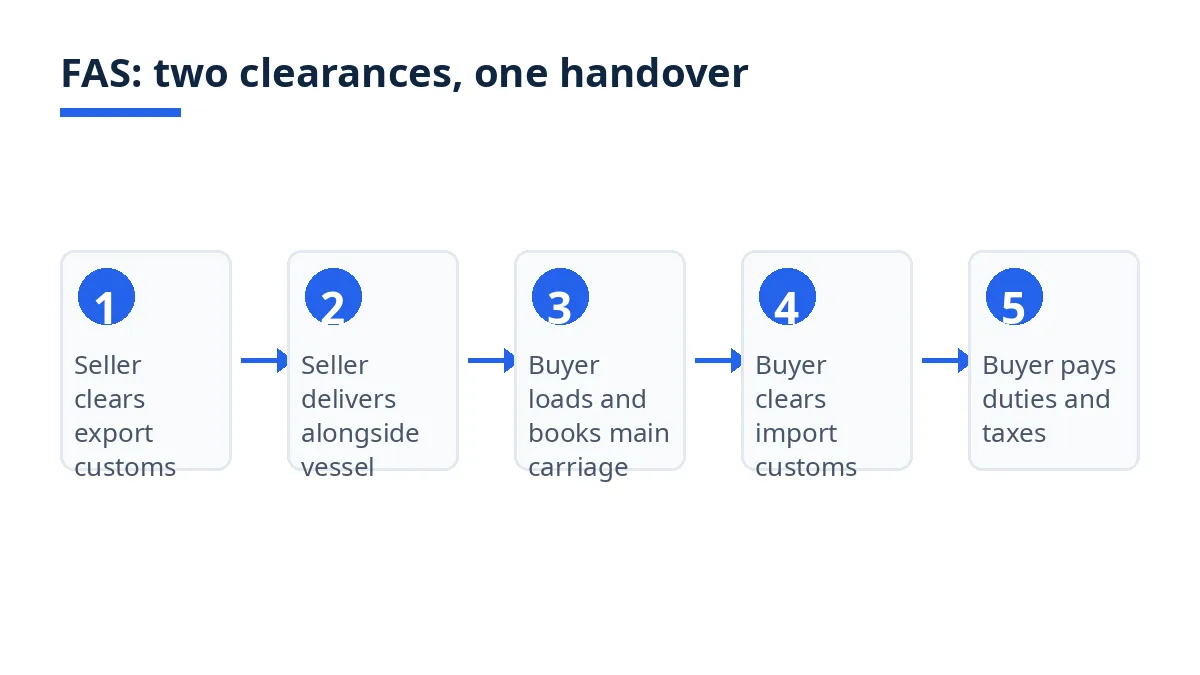
What export clearance under FAS actually covers
Export clearance is the seller's duty to complete the formalities that let the goods leave the country of origin lawfully: the declaration plus the supporting documents the origin customs authority requires, filed before the goods are loaded.
For a shipment from Bangladesh, the origin side has a clear gate. Goods shall not be allowed to load or be stuffed in containers or a ship for export unless an export declaration, known as the Bill of Export or Shipping Bill, is submitted to Customs in the prescribed format and approved by the Customs authority.4 The declaration specifies the description of goods, value, name of exporter, name of the foreign buyer or importer, and name of the transport operator.4
The documents enclosed with the Bill of Export for all export consignments are the export letter of credit or, where there is none, the export contract, purchase order, or export guarantee approved by the negotiating bank; the signed commercial invoice with a detailed description of goods; the packing list with quantity, weight, and packing information; the EXP form certified by an Authorized Dealer; the certificate of origin issued by the Export Promotion Bureau (EPB) or a Chamber of Commerce and Industry; the VAT registration certificate; and the Taxpayer Identification Number (TIN).4 Product-specific certificates may also apply, such as a phytosanitary certificate for agricultural goods.4
Two points are often missed. First, export clearance must be complete before loading, so a late document on the seller's side delays the vessel, not just the paperwork. Second, the buyer still has a supporting role: the buyer must assist the seller, at the seller's request, risk, and cost, in obtaining any documents necessary for the export clearance formalities.2 Assistance is not responsibility, and the seller remains the party who must clear the goods for export.
What import clearance under FAS actually covers
Import clearance is the buyer's duty to complete the formalities that let the goods enter the destination country and be released for use or sale there: the import declaration, any licenses or authorizations the goods require, and payment of the duties and taxes assessed at destination.
In the European Union, the main import procedure is release for free circulation, which fulfills all import formalities so the goods can be sold on the Union market.5 Goods are released once duties and other charges are paid, import licenses for quota goods are presented, and applicable authorizations and certificates are presented.5 The date the customs office accepts the declaration is also the date used for calculating import duty, VAT, and excise duty, where applicable.5
The buyer also needs an EU customs identifier. The Economic Operator Registration and Identification (EORI) number is a unique identifier assigned by a customs authority in an EU country to economic operators, used in communications with EU customs authorities where an EU-based identifier is required, for example in customs declarations.5
Import clearance also has a timing duty before the vessel arrives. The Entry Summary Declaration (ENS) carries advance cargo information for consignments entering the EU so customs can conduct a risk analysis.5 It must be lodged at the first customs office of entry by the carrier, or in some cases by the importer-consignee or a representative.5 For container maritime cargo, the deadline is at least 24 hours before loading commences in the foreign port; for bulk maritime cargo, at least 4 hours before arrival.5 The ENS needs information from exporter documents such as the bill of lading and commercial invoices, so those documents must reach the lodging party in time.5
The mirror-image assistance duty applies on this side too. The seller must assist the buyer, at the buyer's request, risk, and cost, in obtaining any documents necessary for transit and import clearance formalities.2 Assistance does not move responsibility: the buyer remains the party who must clear the goods for import and pay the duties and taxes.
Where the two clearances meet: delivery alongside the vessel
The two clearances never overlap, but they meet at one point: the goods placed alongside the vessel, which is also the risk transfer point. Clearing export customs does not deliver the goods on board, and paying import duty does not undo a missed export document.
Three gaps open up at the handover, each with an owner. Loading is the buyer's work, at the buyer's cost and risk from the alongside point onward.3 Main carriage is contracted by the buyer from the named port of shipment, except where the seller contracts it at the buyer's expense and risk.2 Documents in transit are the seller's advance notice of delivery plus a document confirming delivery at the seller's expense, with assistance at the buyer's request, risk, and cost if that proof is a transport document.2
FAS is also a poor fit for some shipments: it is not recommended for container transport.2 Where goods are handed to a terminal in a container well before loading, the alongside point is hard to pin down. If your cargo moves that way, compare another rule in the Incoterms guide before you fix FAS in the contract. The risk transfer guide explains the alongside point in more detail.
Costs: who pays what at each border
Costs follow the same split as the formalities: the seller bears export clearance and delivery alongside the vessel, and the buyer bears loading, main carriage, import clearance, and duties and taxes at destination. Broker fees follow the side that appointed the broker, so ask for export-side and import-side charges on separate lines.
Example figures: an FAS price of 20,000 for the goods delivered alongside the vessel, with export clearance handled by the seller inside that price. The buyer then pays, as separate lines, 400 for loading, 2,500 for main carriage, and import duty at an assumed 5 percent of the 20,000 customs value, equal to 1,000. Import VAT and any excise are assessed separately under the destination rules. These are example figures only; the 5 percent rate is an assumption, not a real duty rate, and your actual duty comes from the destination tariff for your product's classification.
What are the typical costs and timelines?
There is no typical clearance cost or timeline a guide can state as fact, because each side's charges depend on the product, the ports, the broker, and the destination tariff. The order of work is fixed: export clearance approved before loading,4 the ENS for container maritime cargo lodged at least 24 hours before loading commences in the foreign port,5 and import release only once duties and charges are paid and licenses and authorizations are presented.5 Build your schedule backward from the vessel.
Bangladesh-specific points for the export side
For Bangladesh-origin FAS shipments, name the exporter, the foreign buyer, and the transport operator exactly as they will appear on the Bill of Export, because the declaration carries all three names.4 A mismatch between the proforma invoice and the declaration creates a query where the goods should already be moving. Confirm the EXP form and certificate of origin early: the EXP form must be certified by an Authorized Dealer, and the certificate of origin is issued by the EPB or a Chamber of Commerce and Industry.4 Both sit on the seller's side, so a buyer cannot cure a missing one at destination, and product-specific certificates where obligatory are part of export clearance, not an extra the buyer arranges later.4
Do not confuse the export set with the import set for goods entering Bangladesh, which involves a Bill of Entry and a different list, including the bill of lading and an insurance policy or cover note.4 That list governs goods arriving in Bangladesh, not the export clearance of a Bangladesh-origin FAS shipment.
Mistakes that blur the split
What are the most common mistakes?
Assuming the seller clears import customs. The seller's export work ends at the alongside point. Import clearance, duties, and taxes remain the buyer's.3
Assuming the buyer clears export customs. Nominating the vessel is the buyer's duty, but export clearance stays with the seller; the buyer's only export-side duty is assistance at the seller's request, risk, and cost.2
Pricing loading as a seller cost. Loading follows the alongside point, so it falls to the buyer.3 A quotation that folds loading into the FAS price without saying so creates a dispute at the quay.
Using FAS for container cargo handed to a terminal. FAS is not recommended for container transport.2 When the alongside point cannot be fixed, the split becomes an argument about timing instead of a checklist.
Leaving the import broker and EORI number until arrival. Import release requires duties paid and licenses and authorizations presented.5 A buyer without an EORI number, a broker instruction, or the seller's documents before arrival pays for storage while the split is sorted out.
Treating assistance as responsibility. Each side must assist the other at the requester's risk and cost for the other side's formalities.2 Assistance is a duty to help, not a transfer of the clearance itself.
Clearance checklist
Before the vessel is nominated, both sides should be able to answer their own half of this list in writing.
Seller side: named port and loading point agreed; Bill of Export set ready (letter of credit or contract, invoice, packing list, EXP form, certificate of origin, VAT registration, TIN);4 product-specific certificates in hand where obligatory;4 advance notice of delivery prepared;2 export clearance approved before loading.4
Buyer side: carriage contracted and loading arranged at the buyer's cost and risk;2 3 import broker instructed, EORI number ready, licenses identified;5 seller documents for the ENS with the carrier before the loading deadline;5 duty budget set from the destination tariff; import declaration ready on arrival.5
How Exportain helps
On Exportain, browse suppliers and post a request for quotation on the RFQ board stating FAS and the named port of shipment, so suppliers quote on the same delivery point and clearance split. Ask each reply to confirm in writing that export clearance sits on the seller's side and that loading, main carriage, import clearance, duties, and taxes sit on your side. When you accept a quotation, Exportain creates one order and issues one proforma invoice from the accepted terms.6
Read the badges for what they record. Exportain verification is a document review by staff, not a factory inspection and not a check against any government database.6 Exportain Verified means Exportain has checked identity, phone, email, and business registration, and Export Verified means it has checked the Export Registration Certificate (ERC).6 Factory Verified means it has reviewed photos of the manufacturer's factory.6 A badge is not a guarantee of production capacity, product quality, or delivery.6 Verification does not replace your own clearance checks: confirm the seller's export documents and your import broker before the vessel is nominated. See how to buy, and compare a seller-arranged carriage term in the CIF guide if you would rather not arrange main carriage yourself.
FAQs
What should I know first about FAS?
FAS is a sea or inland waterway rule: the seller delivers by placing the goods alongside the vessel nominated by the buyer at the named port of shipment, and risk transfers at that alongside point.2 The seller clears export customs; the buyer clears import customs, pays duties and taxes, and handles loading and main carriage.3
What are the typical costs and timelines?
Costs split at the alongside point: export clearance and delivery alongside sit with the seller, while loading, main carriage, import clearance, duties, and taxes sit with the buyer. The fixed order is export approval before loading,4 the ENS before the container loading deadline,5 and import release only once duties and charges are paid and licenses and authorizations are presented.5
Which documents are needed?
The export set for Bangladesh-origin goods is the Bill of Export with the letter of credit or contract, invoice, packing list, EXP form certified by an Authorized Dealer, certificate of origin, VAT registration, and TIN, plus product-specific certificates where obligatory.4 The import set is the destination declaration with proof of origin where claimed, licenses, and authorizations, plus the EORI number in the EU.5 Each side assists the other, at the requester's risk and cost, with documents for the other side's formalities.2
What are the most common mistakes?
The most common mistakes are assuming the seller clears import customs, assuming the buyer clears export customs, pricing loading as a seller cost, using FAS for container cargo handed to a terminal, and leaving the import broker and EORI number until arrival. Write the split into the contract before the vessel is nominated.
Next steps on Exportain
Browse suppliers, then post your FAS requirement, named port of shipment, and clearance split on the RFQ board so suppliers confirm the export side in writing. Before you confirm, read the Incoterms guide.
Sources
- Incoterms® 2020. International Chamber of Commerce (ICC) (accessed )
- FAS - Free alongside ship (Named Place) Incoterms 2020. Export Council of Australia (accessed )
- FAS Incoterms 2020: Free Alongside Ship Responsibilities, Risk & Example. SCMANA (accessed )
- Customs Clearance Procedures for Export. Bangladesh Customs, National Board of Revenue (accessed )
- Customs clearance documents and procedures. European Commission (accessed )
- Trust & Safety Center. Exportain (accessed )
About the author
Sourcing from Bangladesh?
Post a request for quotation and suppliers on Exportain can send you their quotes directly.
Post an RFQ