Best Incoterm for Importing Industrial Equipment & Lighting From Bangladesh
No single Incoterm fits every industrial equipment or lighting order from Bangladesh. This guide matches FCA, FOB, CIF, CIP, DAP and DPU to shipment mode, handover point, freight control, insurance and unloading, with Bangladesh export documents and a pre-signing checklist.
Short answer
There is no single best incoterm for importing industrial equipment from Bangladesh. Match the term to the shipment: FCA fits container and terminal handovers when you book freight, FOB fits breakbulk loaded on board, CIF fits seller-arranged sea freight with minimum insurance, CIP fits seller-arranged carriage with broader cover, and DPU fits site delivery where the seller unloads.
On this page
Key takeaways
There is no single best term: the ICC Academy states there is no right or wrong Incoterms rule, only the appropriate rule for the specific circumstances of the transaction.
FCA matches container and terminal handovers when you book freight, and FOB matches breakbulk machinery loaded on board when you book freight.
CIF places seller-arranged sea freight and Clause C minimum insurance inside the price, while risk still passes on board at origin.
CIP places seller-arranged carriage and broader Clause A insurance inside the price, and DPU adds seller unloading at the named destination, which matters for heavy equipment.
If you import transformers, switchgear, generators, industrial motors or LED high-bay lighting, the best incoterm for importing industrial equipment from Bangladesh is not a fixed term. It is the term that matches how your equipment travels, how it is lifted at each end, and where you want risk to sit. This guide works through that match, so you can choose between FCA, FOB, CIF, CIP, DAP and DPU per order.
Why the term matters for industrial equipment orders
Industrial equipment punishes a careless term choice in three ways. First, a machine can be heavy or oversized, so the handover point and unloading duty decide who carries risk during the most dangerous moves. Second, one damaged transformer can carry a high order value, so the level of insurance matters. Third, equipment moves in different ways: a crated machine may travel as breakbulk loaded on board, a container of lighting may be handed to a carrier at a terminal, and a project order may need delivery to a site rather than a port.
The Incoterms rules published by the International Chamber of Commerce (ICC) are a set of eleven three-letter trade terms that clarify the tasks, costs and risks in the delivery of goods, and the current edition entered into force on 1 January 2020.1 Each rule answers three questions: who pays for carriage, who arranges insurance, and where risk passes.
The ICC Academy makes the starting point plain: there is no right or wrong Incoterms rule, only the appropriate rule for the specific circumstances of a trade transaction.2 A term that suits a breakbulk machine can be wrong for a container of lighting or a delivery to a site with no lifting equipment.
The five decision criteria
1. Shipment mode and handover point. Seven rules work for any mode of transport: EXW, FCA, CPT, CIP, DAP, DPU and DDP. Four rules are for sea and inland waterway transport only: FAS, FOB, CFR and CIF.3 Containers are normally handed to the carrier at a terminal before vessel loading, so the any-mode rules often fit that handover better. Breakbulk loaded directly on board is the case the sea-only rules were written around.
2. Load type and handling. FOB, CFR and CIF are written around delivery on board a vessel.3 A sealed container handed over at a terminal changes hands earlier, which is why the any-mode equivalents exist: FCA mirrors FOB, and CIP mirrors CIF with insurance included. The ICC Academy notes that CIP is the appropriate rule when goods are transported in containers or on pallets and when multiple modes are used, while CIF is the appropriate rule for bulk port-to-port transport.2
3. Buyer experience and freight control. If you hold your own freight contracts, a term that leaves main carriage with you, such as FCA or FOB, lets you control routing, vessel choice and freight cost. That matters for oversized equipment, where the carrier must confirm lifting gear and deck or flat-rack space before loading. If you have no forwarder relationship, a term under which the seller arranges carriage, such as CIF, CIP, DAP or DPU, reduces the parties you must manage. Under every option here except DDP, you still clear import and pay duty in your own country.
4. Damage risk and insurance. Under the C terms, cost and risk split at different points, and for high-value equipment this split is the heart of the decision. Under CIF, the seller pays freight to your port, but risk passes on board at origin, and the seller-arranged insurance is minimum cover under Clause C of the Institute Cargo Clauses.2 Under CIP, the seller must obtain broader Clause A cover, the widest level, described by the ICC Academy as all risks or maximum cover.2 Minimum cover is a thin answer for machinery that can be written off by water ingress or a dropped lift. Under FCA and FOB, you arrange your own cover from the handover point.
5. Unloading at destination. Under DAP, the seller delivers the goods ready for unloading at the named place, and unloading stays with you. Under DPU, the seller delivers the goods once unloaded.4 For heavy equipment, that difference is practical: if your site has no crane or heavy forklift capacity, a DAP price can leave a machine on a vehicle with no agreed way off it. If the seller cannot safely unload at your named place, the ICC Academy advises that DAP is the more appropriate choice.4
The main options compared
Term | Mode | Who books main carriage | Insurance duty | Risk passes |
|---|---|---|---|---|
FCA (Free Carrier) | Any mode | Buyer | None on seller | On handover to the carrier at the named place |
FOB (Free On Board) | Sea only | Buyer | None on seller | When goods are on board the vessel |
CIF (Cost, Insurance and Freight) | Sea only | Seller | Seller, minimum Clause C cover | When goods are on board the vessel |
CIP (Carriage and Insurance Paid To) | Any mode | Seller | Seller, Clause A cover | On handover to the first carrier |
DAP (Delivered at Place) | Any mode | Seller | None stated in the rule | At the named destination, ready for unloading |
DPU (Delivered at Place Unloaded) | Any mode | Seller | None stated in the rule | At the named destination, once unloaded |
For a standard order from Chattogram, that comparison usually produces one of four answers. FCA Chattogram terminal suits the buyer who wants freight control with a handover that matches container practice. FOB Chattogram suits breakbulk machinery loaded directly on board under a buyer-booked vessel. CIF named destination port suits the buyer who wants one seller-arranged price to port and accepts minimum insurance. CIP named place suits the buyer who wants seller-arranged carriage with the broader Clause A level, for sea, air or multimodal shipments.2 Where the order must reach a site rather than a port, DAP or DPU keeps risk with the seller to that place, and the choice turns on who unloads.4
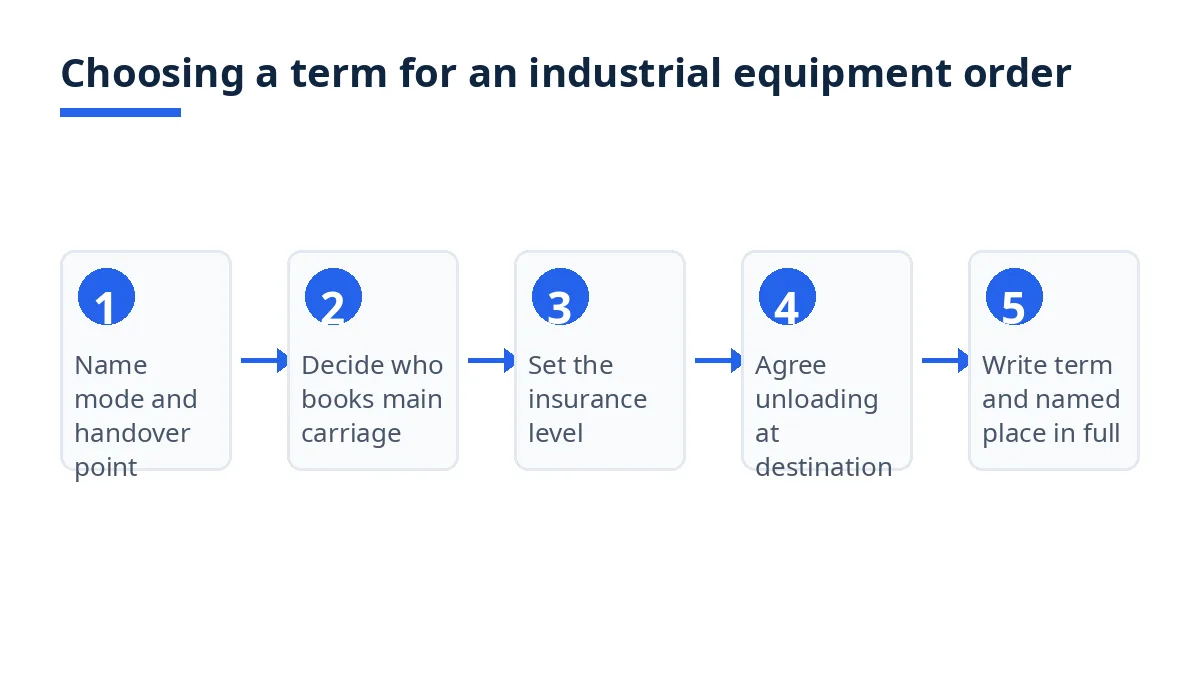
Step by step: how to choose for one order
Write down how the order travels: sea, air or multimodal, container, breakbulk or palletised, and the exact handover place.
Rule out terms that do not fit that mode. Sea-only terms, FAS, FOB, CFR and CIF, drop out for air freight or a terminal handover.3
Decide who books the main carriage. Your forwarder points to FCA or FOB. A seller price to destination points to CIP or CIF. A seller price to your site points to DAP or DPU.
Decide the insurance position. High-value equipment points away from Clause C minimum cover and toward CIP with Clause A cover, or toward your own policy under FCA or FOB.2
Agree who unloads at destination. Choose DPU only where the seller can safely unload at the named place; otherwise choose DAP and name your own lifting arrangement.4
Confirm who clears export and import. Under FCA the seller clears export, one reason it is preferred over EXW: under EXW the seller does not need to load the goods or clear them for export.3
Write the term in full: the three-letter rule, the named place or port, and Incoterms 2020. Ask every supplier to quote on that same term.
Costs, timelines and documents
Costs. The term sets which costs sit inside the seller price. On FCA and FOB, your costs after handover include main carriage, insurance if you buy it, destination handling, import duty and tax, and onward delivery. On CIF and CIP, main carriage and the stated insurance level sit inside the seller price, while destination charges, duty and onward delivery remain yours. On DAP and DPU, carriage to the named place sits inside the seller price, and under DPU the unloading there does too.4 No term here except DDP places import duty on the seller. See landed cost for imports from Bangladesh.
Timelines. This guide states no transit times, because schedules and space for oversized cargo change by route and season. The term sets who books space and who can act when a sailing slips. If the seller books under CIF or CIP, agree when the seller must send the bill of lading and insurance document, because you need both to clear import and to claim if equipment arrives damaged.
Documents. Goods cannot be loaded for export from Bangladesh unless an export declaration, the Bill of Export or Shipping Bill, has been submitted to Customs and approved.5 The documents enclosed with the Bill of Export include the export letter of credit, or where there is none the export contract, purchase order or export guarantee approved by the negotiating bank, a signed commercial invoice with a detailed description of the goods, a packing list, an EXP form certified by an Authorized Dealer, a certificate of origin issued by the Export Promotion Bureau or a Chamber of Commerce and Industry, the VAT registration certificate, and the Taxpayer Identification Number.5 Bangladesh Customs also notes that for some categories, product-wise additional certification or documents are necessary for export.5 Confirm which additional certificates your products need before shipment. Your term does not change that list, but it changes who instructs the clearing agent.
Bangladesh-specific points
Export clearance sits in Bangladesh under every term except EXW, because the Bill of Export is filed with Bangladesh Customs and the declaration states the goods, value, exporter, foreign buyer and transport operator.5 FCA keeps that duty with the seller, the party able to perform it.
Port practice points the same way. Containers are typically handed over at a terminal or off-dock before vessel loading at Chattogram, so an any-mode term can match the real custody change. Breakbulk equipment is different: where a machine is loaded directly on board, the FOB risk point, on board the vessel,3 matches the real handover. For sector background, read the industrial equipment industry in Bangladesh, and for the port-to-port pattern, read CIF shipping terms explained and the FOB definition.
Mistakes and red flags
Choosing CIF for high-value machinery and assuming the insurance is enough. Risk passes on board at origin and the included insurance is Clause C minimum cover.2 If that does not match your order value, choose CIP or buy your own cover.
Using a sea-only term for an air or multimodal shipment. FAS, FOB, CFR and CIF are for sea and inland waterway transport only.3
Using FOB for cargo handed over at a terminal. The risk point under FOB is on board the vessel,3 not the terminal gate. For a terminal handover, FCA states the point you mean.
Agreeing DAP for a site with no lifting capacity. Under DAP the goods arrive ready for unloading and unloading is yours.4 Without a confirmed crane or heavy forklift, the machine has no agreed way off the vehicle.
Choosing DPU without checking the seller can unload safely. The ICC Academy advises the seller to assess whether unloading can be ensured at the named place, and to use DAP where it cannot.4
Accepting EXW for the lowest headline price. Under EXW the seller does not need to load the goods or clear them for export,3 so loading risk, costs and the export filing move to you.
Leaving the named place or the version out. Write the rule, the named place or port, and Incoterms 2020 in full.
Agreeing DDP without checking import ability. DDP places import clearance and duty on the seller in your country. If the seller cannot act as importer, the shipment stalls at arrival. DAP is the usual substitute.4
Checklist before you sign
Shipment mode, load type and handover place written down, and the term matches that mode.
One term chosen, quoted identically by every supplier.
Named place or port and Incoterms 2020 written after the three-letter rule.
Insurance level stated: none, Clause C under CIF, or Clause A under CIP, checked against the equipment value.2
Unloading duty and lifting equipment agreed for the destination, under DAP or DPU.4
Export clearance owner named, with the Bill of Export document set confirmed.5
Import clearance, duty and destination charges budgeted outside the seller price.
Document flow and delivery inspection agreed.
How Exportain helps
Exportain is a B2B export marketplace where buyers find Bangladeshi suppliers, post requests for quotation (RFQs), receive quotations and place orders. On an RFQ for industrial equipment or lighting, state the term, the named place, and your unloading position, and ask each supplier to quote on that basis. Exportain is not a party to the contract for goods, and it does not book freight, arrange insurance or clear customs. Read Incoterms for shipments from Bangladesh for the full set of terms, and the CIF definition for the port-to-port term.
FAQs
What should I know first about Incoterm for Importing Industrial Equipment & Lighting From Bangladesh?
Know first that no single term fits every order. The ICC Academy states that there is no right or wrong Incoterms rule, only the appropriate rule for the specific circumstances of the transaction.2 Start from mode, handover point, who books carriage, insurance level, and who unloads, then pick the term that matches.
What are the typical costs and timelines?
Costs follow the term. FCA and FOB leave main carriage and insurance to you after handover, while CIF and CIP place carriage and a stated insurance level inside the seller price, and DAP and DPU place carriage to the named place inside it, with import duty still yours in most cases. This guide gives no fixed timelines, because schedules and space for oversized cargo vary by route and season.
Which documents are needed?
For export from Bangladesh, the Bill of Export must be submitted and approved before goods are loaded, enclosed with the export letter of credit or approved contract, purchase order or guarantee, the signed commercial invoice, the packing list, the certified EXP form, the certificate of origin, the VAT registration certificate and the Taxpayer Identification Number.5 Some categories need additional product-wise certification.5 At destination you also need the bill of lading or air waybill and, under CIF or CIP, the insurance document.
What are the most common mistakes?
The most common mistakes are using a sea-only term for an air or terminal handover, reading a CIF price as a delivered price, accepting Clause C minimum cover for high-value machinery without checking it,2 agreeing DAP with no lifting arrangement at the site, and leaving the named place or the Incoterms 2020 version out of the contract.
Next steps on Exportain
Set your term using the criteria above, then compare your choice against Incoterms for shipments from Bangladesh and check your full arrival cost with landed cost for imports from Bangladesh before you confirm the order.
Sources
- Incoterms® rules. International Chamber of Commerce (ICC) (accessed )
- CIF & CIP Incoterms 2020 explained: Key differences. ICC Academy, (accessed )
- Customs valuation: Incoterms. HM Revenue & Customs (GOV.UK) (accessed )
- DAP & DPU Incoterms 2020 explained: Key differences. ICC Academy, (accessed )
- Customs Clearance Procedures for Export. Bangladesh Customs, National Board of Revenue (accessed )
About the author
Sourcing from Bangladesh?
Post a request for quotation and suppliers on Exportain can send you their quotes directly.
Post an RFQ