

Sustainable Footwear From Bangladesh: Certifications and Green Factories
Sustainable footwear from Bangladesh, judged on evidence: EPB export data, LWG tannery audits, OEKO-TEX and GRS checks, EU rules and a step-by-step buying process.
Short answer
Sustainable footwear from Bangladesh means footwear whose sustainability claims rest on checkable evidence: leather from a tannery audited under the Leather Working Group standard, textile or synthetic components tested for harmful substances, recycled inputs tracked through a certified chain of custody, and a factory that can show its environmental system. Buyers should verify each certificate by holder, site, scope and expiry, then test the finished shoe against the chemical limits and labelling rules of the destination market.
On this page
Key takeaways
Sustainability in footwear is an evidence question: name the standard behind each claim and check the certificate holder, site, scope and expiry date.
For leather shoes, the tannery behind the factory is the central check: the LWG audit scores tannery environmental performance, with Gold at 85 per cent, Silver at 75 per cent and Bronze at 65 per cent.
EPB series put leather footwear at $620.17 million and non-leather footwear at $494.28 million in the first 11 months of FY2024-25, so both material routes operate at export scale.
Recycled content and chemical safety are separate checks: GRS covers recycled chain of custody, while OEKO-TEX standards cover harmful-substances testing of the named article or material.
EU market law applies on top of every certificate, including the chromium VI limit of 3 mg/kg for leather articles and material labelling for the upper, lining and sock, and outer sole.
Sustainable footwear from Bangladesh is not a single product or a single certificate. It covers leather shoes made with leather from audited tanneries, non-leather shoes made with recycled or lower-impact inputs, and ordinary lines where the factory can document its chemical controls, waste handling and material labelling. Buyers searching for sustainable footwear Bangladesh suppliers usually need the same thing: a shoe that meets their market rules, backed by evidence they can check, at a specification they can repeat. This guide explains how to judge that evidence.
Key points to take away
Sustainability in footwear is an evidence question. Ask which named standard sits behind each claim, who issued the certificate, which site and material it covers, and when it expires.
For leather, the central check is the tannery behind the shoe factory. The Leather Working Group (LWG) audit assesses a tannery's environmental performance, and a well-run shoe factory can still use leather from a tannery you would not accept.
For textile and synthetic uppers, recycled content and chemical safety need separate proof. Neither check replaces the other.
Bangladesh sells both leather and non-leather footwear at export scale, so a sustainability brief does not force one material. It forces you to specify material, standard and test plan in writing.
Market rules decide the floor: chemical limits, material labelling and incoming European Union (EU) sustainability rules apply whether or not a supplier uses the word sustainable.
Market overview with latest data
Read the figures as separate series, because the published categories do not cover the same products. The broad EPB leather series, reported by New Age, covers leather and leather goods: earnings rose by 10.19 per cent to $1.14 billion in the financial year 2024-25 (FY25), after $1.03 billion in FY24, with $1.17 billion in FY23, $1.24 billion in FY22 and $1.03 billion in FY21 in the same series.1
The footwear split is reported separately. EPB data reported by Apparel Resources for the first 11 months of FY2024-25 (July to May) put leather footwear at $620.17 million, up 28.96 per cent year on year, and non-leather footwear at $494.28 million, up 30.25 per cent from $379.48 million a year earlier.2 In an EPB series reported by Prothom Alo, non-leather footwear exports for the full FY2024-25 were $520 million worldwide, of which $19.5 million went to the United States, and most Bangladeshi non-leather producers export to EU countries.3
Series (named, with period) | Figure | Scope |
|---|---|---|
EPB leather and leather goods, FY25 (full year) | $1.14 billion, up 10.19 per cent on FY24 | Leather and leather goods; not a footwear total |
EPB leather footwear, July to May FY2024-25 (11 months) | $620.17 million, up 28.96 per cent | Leather footwear only |
EPB non-leather footwear, July to May FY2024-25 (11 months) | $494.28 million, up 30.25 per cent | Non-leather footwear only |
EPB non-leather footwear, FY2024-25 (full year) | $520 million worldwide; $19.5 million to the United States | Separate series; do not add to the 11-month figures |
Two points matter for a buyer. Leather footwear is the larger line in the 11-month series, so tannery evidence still decides most sustainability questions in this category, while non-leather footwear grows at a similar rate from a lower base.2 And the leather series has moved around $1 billion for several years; the New Age report records industry criticism that compliance gaps, including the capacity of the central effluent treatment plant at the Savar tannery estate, hold the sector back.1 Verify the individual tannery and factory: buyers in the reporting were described as withholding orders where environmental compliance, including LWG certification, was missing.3
Main products and production clusters
The Leathergoods and Footwear Manufacturers and Exporters Association of Bangladesh (LFMEAB) describes itself as the trade body for manufacturers and exporters of leather products, footwear, synthetic products and allied factories in Bangladesh, and states that compliant and sustainable practice helps the sector attract customers and investment.4 Treat association aims as context: your order depends on the named factory, its material sources and its current certificates.
Main products
Leather footwear. Dress shoes, casual shoes, boots, sandals and leather sneakers. The questions sit upstream: which tannery supplied the leather, how it is audited, and whether the leather passes your chemical limits.
Non-leather and synthetic footwear. Sports-style shoes, sneakers, canvas and textile-upper shoes, sandals and moulded footwear. The questions sit in the materials: whether recycled content is certified, whether textile components are tested for harmful substances, and whether the material label is accurate.
Espadrilles and jute-linked footwear. The LFMEAB member list includes factories categorised for espadrilles, and at least one member categorised for footwear and leather goods built around jute and leather.5 For children's footwear, state the age group in your brief: certification systems assess skin contact by product class, with the strictest class for the youngest children.
Production clusters
The LFMEAB member list published on the Bangladesh Trade Portal shows footwear factory addresses concentrated around Dhaka, with repeated entries in Gazipur (including Kaliakoir, Tongi and Joydevpur), in Savar and Ashulia (including Hemayetpur), in Narayanganj, in Chattogram (including a factory in the Chattogram Export Processing Zone) and in Cumilla.5
Cluster area | What the member list shows | Buyer note |
|---|---|---|
Gazipur, north of Dhaka | Factories at Kaliakoir, Tongi, Joydevpur and Gazipur Sadar | Confirm the exact factory site; head offices are often in Dhaka |
Savar and Ashulia, west of Dhaka | Factories at Hemayetpur, Ashulia and Zirabo | Ask where the leather is tanned, not only where the shoe is made |
Narayanganj, Chattogram and Cumilla | Entries in Narayanganj, a Chattogram EPZ factory, and factories in Cumilla | Options when you want capacity outside the Dhaka groupings |
Use the cluster only to plan visits and logistics. A cluster address is not evidence of sustainability: two factories on the same road can buy leather from different tanneries and hold different certificates.
How to find and verify suppliers
Start from the material brief, not from a supplier list: shoe type, upper and sole materials, target market, required standards and tests. Build the shortlist from LFMEAB membership, from the Bangladeshi suppliers listings on Exportain, and from your own trade contacts. On Exportain, supplier profiles carry document and photo review badges; the badges record that documents and photos were reviewed, and they are not factory inspections, certifications or guarantees. Exportain is a B2B marketplace and is not a party to your goods contract, so your verification, sampling and inspection steps remain yours.
A verification sequence that works
Confirm the factory is the manufacturer. Ask for the factory address, the lines it runs (cutting, stitching, lasting, finishing) and which steps are subcontracted. Compare the answer with the member-list factory address where one exists.5
Trace the leather, if the shoe is leather. Ask which tannery supplies the upper leather and for its current LWG certificate, showing site name, medal rating and expiry date. LWG certification is valid for 24 months for leather manufacturing facilities, so an expired certificate is a failed check.6
Check every certificate the same way. Record standard name, certificate holder, site address, scope, issuing body and expiry date. A certificate for a head office, a different factory or a different material does not cover your order.
Ask for recent test reports against your market rules, on the same material and colour family as your order, from a laboratory you recognise. An old report on a different leather is not evidence for your shipment.
Approve a sample made from production materials. A sample in substitute materials proves the pattern, not the material claim. State in writing that bulk must use the sampled materials and sources.
Put the evidence file in the order. Attach certificate copies, material sources, the test plan and labelling artwork to the purchase order.
Red flags are consistent: a supplier who names a standard but will not show the certificate, a tannery name that changes between quotation and sample, a recycled claim with no chain-of-custody document, and a price that only works with a cheaper substitute material.
MOQ, pricing and lead times
No MOQ, price or lead time for this category is published in the sources used here, and any figure a supplier gives you applies only to that factory, style and material. All three are set by the same variables.
What sets the MOQ
Material minimums. Leather is bought by area and grade, and a tannery or merchant sets its own minimum for a colour and finish. Certified recycled inputs are bought through a certified chain, which can raise the practical minimum for a small run.
Colour and size breakdown. An MOQ per style is different from an MOQ per style, per colour and per size run. Ask which one applies, and give your size ratios with the enquiry.
Component minimums. Soles, moulds, lasts, printed boxes and woven labels each carry their own minimums. Example figures, for illustration only: a factory might quote an MOQ of 600 pairs per style and colour for a leather shoe, and a lower figure for a repeat order in a stock material.
What sets the price
Ask for an open cost breakdown: upper material, other components, labour and making, testing and certification costs where charged, packing, and the export price basis. Sustainability choices change price through identifiable lines: audited-tannery leather costs what that tannery charges, certified recycled inputs carry chain-of-custody cost, and testing adds laboratory fees per material and colour. The table below is a worked example with example figures only: the structure of a landed cost comparison, not a quotation or current market prices.
Cost line (example figures) | Per pair |
|---|---|
FOB unit price, leather shoe, audited-tannery leather (example) | $12.00 |
International freight and insurance allocated per pair (example) | $1.80 |
Import duty per pair (example; read the actual rate for your code and origin) | $0.00 to $2.40 |
Port, clearance and local delivery allocated per pair (example) | $0.90 |
Landed cost per pair in this example | $14.70 to $17.10 |
Exportain's trade intelligence pages and the how to import from Bangladesh guide help frame the wider budget, but your duty line must come from your confirmed code and origin, as the shipping section explains.
What sets the lead time
Lead time is a chain, not a single number: material production or purchase (including tannery time for leather), component delivery, sampling and approval, bulk production, inspection, and transport. Certified materials can sit on longer chains, because the certified input must be available in your colour and quantity before cutting starts. Ask for lead time in stages, with the start date of each stage and the event that releases it.
Quality, certifications and compliance
Separate the four kinds of evidence, because buyers often accept one as if it were another: a tannery audit covers leather production, a product standard covers the tested article, a recycled-content standard covers chain of custody, and a management-system standard covers the factory's environmental system. Your market's law sets limits that none of these certificates can waive.
Leather: the Leather Working Group (LWG)
The LWG Audit, first launched in 2005, is described by the Leather Working Group as an international certification standard for environmentally and socially accountable leather manufacturing: an assessment of how a tannery measures, controls and reports the impact of its operations.6 Its 17 sections include water and energy usage, environmental management, chemical management, waste management and effluent treatment, and health and safety.6 Manufacturers are scored against thresholds of 85 per cent for Gold, 75 per cent for Silver, 65 per cent for Bronze and 50 per cent for Audited, and the final medal is the level of the lowest-scoring category, not the average.6 Traceability back to the slaughterhouse is rated separately, as physical and documentation percentages.6 Two limits matter: LWG states that certification does not guarantee no restricted substance failures in a final product, and that the audit is not an assessment of legal compliance and does not grant an operating permit.6 You still test the finished leather or shoe against your market limits.
Product safety: OEKO-TEX standards
OEKO-TEX describes its LEATHER STANDARD as a certification tailored to leather articles tested for harmful substances, which can be awarded for semi-finished leather, finished leather, leather fibre materials, finished articles and accessories, and its STeP certification as a certification for production facilities that manufacture textile and leather articles under sustainable production conditions.7 For mainly textile footwear, OEKO-TEX STANDARD 100 is the label for textiles tested for harmful substances from yarn to finished product; every thread, button and accessory is tested against a list of over 1,000 harmful substances, and the stricter product classes apply as skin contact becomes more intensive, with Product Class 1 covering products for babies and children up to 3 years.8 LWG speaks for the tannery's environmental performance; an OEKO-TEX product certificate speaks for the testing of the article or material named on it.
Recycled content: the Global Recycled Standard (GRS)
For non-leather footwear and textile components, the Global Recycled Standard (GRS) is, in Textile Exchange's description, a full product standard to verify and track recycled raw materials through the supply chain.9 It also includes processing criteria to prevent the use of potentially hazardous chemicals, verifies social or environmental production at the facilities, and uses the chain of custody requirements of the Content Claim Standard.9 Ask for the GRS scope certificate of each facility in the chain and the transaction documentation for your lot: a claim for the upper does not cover the sole, lining or packaging unless those items are inside the certified chain as well.
Factory systems: ISO 14001
ISO 14001 is the internationally recognised standard for environmental management systems (EMS). ISO states that it provides a framework for organisations to design and implement an EMS and continually improve their environmental performance, covering resource use and waste management through to monitoring performance.10 A certified factory can show a managed system for its own site: environmental policy, legal register, waste and energy records and audit cycle. That supports a green factory claim about the shoe factory itself, but says nothing about the tannery behind the leather or the recycled content of an upper, so read it beside the material certificates.
Chemical limits: REACH and restricted substances
Product law sets the limits your testing must meet. Guidance on leather goods published by Business Companion states that leather articles or articles containing leather parts that come into contact with the skin must not be placed on the market where they contain chromium VI at concentrations equal to or greater than 3 mg/kg (0.0003 per cent by weight) of the total dry weight of the leather, and that azo dyes releasing listed aromatic amines above 30 mg/kg must not be used in articles such as footwear that may come into direct and prolonged contact with the skin.11 The same guidance restricts dimethyl fumarate (DMF) in leather products to 0.1 mg/kg.11 LWG thresholds point the same way: chromium VI must be below 3 mg/kg for Gold and Silver certification, and any level above 3 mg/kg is an automatic failure.6
Material labelling for the EU
For consumer footwear sold in the EU, Directive 94/11/EC labelling, summarised by EUR-Lex, requires information on three components: the upper, the lining and sock, and the outer sole.12 Only materials covering 80 per cent or more of the surface area of the upper, the lining and sock, and 80 per cent or more of the volume of the outer sole need to be labelled; where no single material reaches 80 per cent, the label gives the two main materials.12 The label may be written or a pictogram, must be visible, securely attached and accessible, and must appear on at least one shoe of the pair; for imported footwear, the person who first places it on the EU market is responsible for the label and its accuracy.12 Approve the label artwork with the same care as the shoe: a claim that contradicts it is a labelling failure.
Where EU sustainability rules are heading: ESPR and the Digital Product Passport
The Ecodesign for Sustainable Products Regulation (ESPR) establishes the EU framework for setting sustainability requirements for products placed on the EU market, promoting more durable, repairable and resource-efficient products.13 The Commission adopted the ESPR and Energy Labelling Working Plan 2025-2030 in April 2025; the first priorities include textiles, furniture, tyres, mattresses, iron and steel, and aluminium, and a key element of the ESPR is the Digital Product Passport, which will improve access to information on product sustainability, durability, repairability and material composition throughout the value chain.13 Footwear-specific requirements will come through that product-by-product process, not from the framework alone, so keep material, supplier and certificate records per style in product-passport-ready form.
Deforestation rules: what changed for leather
The EU Deforestation Regulation (EUDR) aims to ensure that products placed on or exported from the EU market do not contribute to deforestation or forest degradation, and it covers seven commodities: cattle, cocoa, coffee, palm oil, rubber, soy and wood, plus derived products.14 On 13 July 2026, the Commission adopted a Delegated Act that removes cattle hides, skins and leather from the scope of the Regulation, following stakeholder consultation and public feedback; the Regulation itself will apply from 30 December 2026 for large and medium-sized operators.14 Do not build an EUDR due diligence file for the leather itself on the basis of the original product list. Two cautions apply: other materials in a shoe or its packaging can still fall inside the scope, so check the full product, and removal from a legal scope is not a sustainability finding about any tannery. Your LWG traceability checks remain a commercial decision.6
Shipping, Incoterms and duties
Footwear ships mainly by sea from Chattogram, with air freight for samples and urgent small orders. Agree the Incoterms 2020 rule by name and place (for example, FOB Chattogram or CIF destination port), and state who arranges and pays for freight, insurance, export clearance and import clearance under that rule. FOB gives the buyer control of the main carriage and freight cost; CIF can simplify a small order at the price of less control over carrier and insurance cover. Read the Incoterms guide for shipments from Bangladesh before you choose.
Duty depends on destination, commodity code and origin. As a least developed country, Bangladesh benefits from the EU's Everything But Arms (EBA) arrangement under the EU Generalised Scheme of Preferences, which grants duty-free, quota-free access to the EU for exports of all products except arms and ammunition; the European Commission records €19 billion in Bangladeshi exports benefiting from these preferences in 2024, at a 96 per cent utilisation rate.15 Duty-free access is a preference, not an automatic outcome: the shipment must meet the EBA rules of origin, travel with the correct origin proof, and be claimed correctly on entry. For the United States, the United Kingdom and the UAE, read the duty beside your confirmed code in that market's tariff, on your entry date.
The code itself comes from the Harmonized System. The World Customs Organization (WCO) describes the HS as a multipurpose international product nomenclature comprising more than 5,000 commodity groups, each identified by a six-digit code, used by more than 200 countries and economies as a basis for customs tariffs.16 Footwear sits in HS Chapter 64, and the six-digit line turns on the upper and sole materials, one more reason the material brief and the material label must agree. Confirm the full national code for your exact shoe before you price the order: the eight- or ten-digit extension is set by the importing country.
Packing deserves a line in the order: pairs per carton, carton dimensions and gross weight, moisture control agreed with the factory (subject to the DMF limit above), and labels approved before packing. A pre-shipment inspection against the approved sample and the evidence file closes the loop between the brief and the goods that ship.
Step-by-step buying process
The diagram below summarises the process.
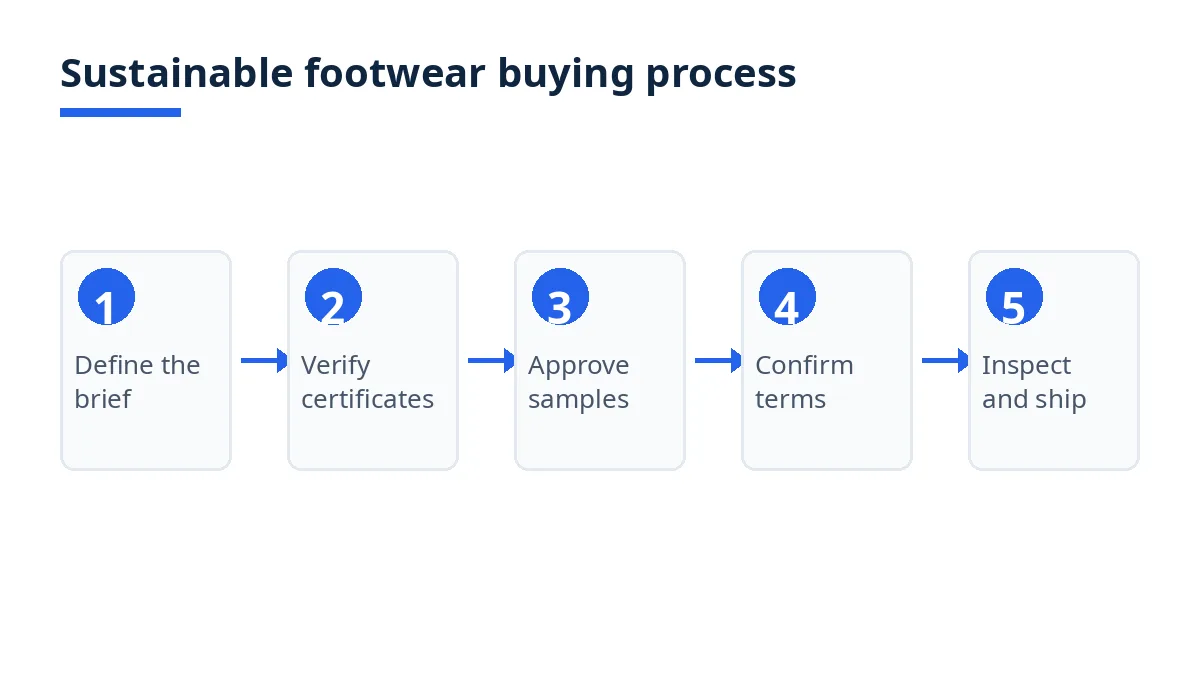
Define the brief. Write the shoe specification, materials, target market, required standards (an LWG-rated tannery for leather, or GRS chain of custody for a recycled upper), the chemical test plan and the labelling artwork.
Verify certificates. Shortlist factories from LFMEAB membership, Exportain supplier listings and your own contacts, then run the verification sequence above: factory identity, tannery source, certificate scope and validity, and test reports.4
Approve samples. Order samples in production materials and sources, approve the sample, label and packaging together, and record the sealed reference for bulk.
Confirm terms. Agree the MOQ per style and colour, the cost breakdown, the Incoterms rule and named place, payment terms, the staged lead time and inspection rights, all in writing. Post the requirement as a free RFQ at Exportain RFQs for comparable quotations against the same brief.
Inspect and ship. Book a pre-shipment inspection against the sealed sample and the order file, check cartons for label and packing, and release shipment only when the inspection and the document set (invoice, packing list, transport document and origin proof) agree with the order.
Related guides
Leather goods sourcing guide — how leather supply chains in Bangladesh are organised.
Sustainable leather goods in Bangladesh — the companion pillar on leather goods certifications and green factory evidence.
How to import from Bangladesh — the general import process and documents behind the footwear steps above.
Incoterms for shipments from Bangladesh — FOB, CIF and the other rules in full, with the cost and risk split.
FAQs
Is Bangladesh a good place to source footwear?
Bangladesh is a good place to source footwear when your brief matches its factories' export production and you verify the individual supplier. EPB series show leather footwear at $620.17 million and non-leather footwear at $494.28 million in the first 11 months of FY2024-25, so both material routes have an established export base.2 The sustainability case is decided per order: the tannery audit, product tests and certificate file for your factory carry more weight than any country-level claim.
What is the typical MOQ?
No typical MOQ is published for this category in the sources used here, because each factory sets its minimum per style, material and colour. Ask whether the quoted MOQ is per style, per colour or per size run, and what changes it (a stock material, a repeat order, shared components). Your binding figure is the one in your written quotation.
How long is the lead time?
Lead time is quoted per order, in stages, because it depends on material availability, sampling approvals, production and transport. Certified inputs must be secured before cutting, so a sustainability brief can lengthen the material stage even when production is fast. Ask for the stage dates (materials, sampling, production, inspection, shipment) and treat a single undated delivery promise as an incomplete quotation.
Which certifications matter?
The certifications that matter match your material and your market. For leather uppers, the tannery's LWG audit and medal rating matter, and the audit does not replace finished-product chemical testing.6 For leather articles and textile uppers, OEKO-TEX LEATHER STANDARD and STANDARD 100 cover harmful-substances testing of the named article or material.7 For recycled inputs, GRS covers recycled content verification and chain of custody.9 For the factory's own environmental system, ISO 14001 is the relevant standard.10 Market law, including the chromium VI limit and EU material labelling, applies on top of all of them.11
Next steps on Exportain
Browse Bangladeshi suppliers to build a shortlist, then post a free RFQ at Exportain RFQs with your material brief, target market and certificates attached. For the wider import framework, read how to import from Bangladesh.
Sources
- Leather, leather-goods exports see 10pc growth. New Age (accessed )
- Bangladesh's synthetic footwear exports up 30% in first 11 months of FY '24. Apparel Resources (accessed )
- Non-leather shoe exports to US triple in July amid tariff shifts. Prothom Alo, (accessed )
- President's Message - LFMEAB. Leathergoods and Footwear Manufacturers and Exporters Association of Bangladesh (LFMEAB) (accessed )
- LFMEAB Member List. Bangladesh Trade Portal (accessed )
- Certification - Leather Working Group. Leather Working Group (accessed )
- OEKO-TEX - for more sustainability in the textile and leather industry. OEKO-TEX (accessed )
- OEKO-TEX Standard 100. OEKO-TEX (accessed )
- What is the Global Recycled Standard (GRS)?. Textile Exchange (accessed )
- ISO 14001:2026 - Environmental management systems. International Organization for Standardization (accessed )
- Leather goods | Business Companion. Business Companion (accessed )
- Footwear labelling. European Commission, EUR-Lex (accessed )
- The Ecodesign for Sustainable Products Regulation moves into implementation. European Commission, (accessed )
- Commission updates product scope and tools to support EUDR. European Commission, (accessed )
- EU trade relations with Bangladesh. European Commission, (accessed )
- What is the Harmonized System (HS)?. World Customs Organization (accessed )
- quality control
- Bangladesh Export Data
- Supplier Sourcing
- Leather footwear
- Footwear Bangladesh
- Non-leather footwear
- Sustainability certifications
About the author
Sourcing from Bangladesh?
Post a request for quotation and suppliers on Exportain can send you their quotes directly.
Post an RFQ


