Sustainable Cosmetics, Toiletries & Chemicals From Bangladesh: Certifications and Green Factories
Chemical products exports were USD 368.32 million in FY2024-25 on the wider EPB series, not a cosmetics-only total. This guide tests green claims by certificate scope, formula evidence, factory GMP and destination law.
Short answer
Sustainable cosmetics from Bangladesh should be bought on documented evidence, not on label claims. Buyers should confirm the DGDA licence for the exact product, the COSMOS signature and scope or the ISO 16128 calculation behind any natural percentage, ISO 22716 factory practice, and the EU safety report or US MoCRA listing for the destination market, while checking that imported inputs, which form about 90 percent of raw materials, support the origin and duty position.
On this page
Key takeaways
Chemical products exports were USD 368.32 million in FY2024-25 on the wider EPB Chapters 28-38 series, which is not a cosmetics-only total, so no cosmetics-only export figure is stated in this guide.
About 90 percent of cosmetic raw materials in Bangladesh are imported, so a green claim must be proved on ingredient origin and certification, not only on the location of the filling line.
COSMOS-ORGANIC requires at least 20 percent of the total formula from certified organic agriculture and 95 percent of physically processed agro-ingredients organic, while COSMOS-NATURAL carries no organic minimum.
ISO 16128 supplies the calculation method for natural and organic content, ISO 22716 supplies the factory GMP framework, and EU and US law supply the market-access files that neither standard replaces.
There is no industry-wide MOQ, price or lead time for Bangladeshi cosmetics; all three are quoted per factory, per formula and per order, with the imported-input stage the least predictable part of the lead time.
A buyer ordering a sustainable cosmetic from Bangladesh buys three separate promises at once: that the formula matches the green claim on the label, that the factory that made it runs a clean and controlled operation, and that the pack and the paperwork will survive the destination market's rules. Each promise needs different evidence. This pillar guide is for importers, brands, private-label buyers and sourcing agents in the United States, the United Kingdom, the European Union and the United Arab Emirates testing all three before ordering.
Market overview with latest data
Read the export record with its limits stated plainly. The Export Promotion Bureau (EPB) does not publish a cosmetics-only export total in the sources used here. The closest official series is the EPB principal-commodity line for chemical products, which covers Harmonized System Chapters 28 to 38 and therefore mixes cosmetics with industrial chemicals and other chemical goods. On that series, chemical products exports were USD 280.58 million in FY2020-21, USD 364.07 million in FY2021-22, USD 302.76 million in FY2022-23, USD 349.73 million in FY2023-24 and USD 368.32 million in FY2024-25, a rise of 5.32 percent in the latest year.1
The domestic market is large, and the press figures for it disagree, so keep them as separate reports. Reporting on Cosmetica Dhaka 2025 put the market for cosmetics, toiletries and personal hygiene products at over BDT 350 billion, with consistent double-digit growth as described by the chief executive of Square Toiletries Ltd.2 Reporting on the toiletries and personal hygiene segment put industry-insider estimates of annual turnover at over Tk 200 billion, equivalent to nearly USD 1.8 billion, with local and multinational companies occupying about 70 percent of the market, imports covering the remaining 30 percent, and local brands accounting for around 30 percent of that 70 percent share.3 The general secretary of ASBMEB put the annual market for cosmetics and skincare products at over Tk 24,000 crore in a separate interview.4
One fact recurs across all three reports and shapes the sustainability question directly: about 90 percent of raw materials are imported.2 3 A Bangladesh-made cosmetic is therefore usually a Bangladesh-formulated and Bangladesh-filled product built on imported actives, fragrance oils, emulsifiers and packaging components. The buyer needs the origin and certification of the imported ingredients, not only the location of the filling line.
The regulatory frame around the sector changed in 2023, and that change is the first filter for any supplier conversation. The Drug and Cosmetics Act 2023 moved responsibility for cosmetics from the Bangladesh Standards and Testing Institution (BSTI) to the Directorate General of Drug Administration (DGDA), and licences and cosmetic registration certificates are now required to produce, distribute, import or export cosmetics.5 Reporting on the passage of the bill confirms that a licence from the drug administration became essential for selling, importing and manufacturing cosmetics, with quality control of cosmetic products moving from BSTI to the Directorate of Drug Administration.6 The ASBMEB account of the older BSTI route describes a lopsided process: a Certification Mark licence for imported products obtainable in 3 to 5 working days, against a minimum of 38 working days, sometimes 44 to 46 working days, for domestically produced goods.4 Ask which licence route a supplier's current products hold, because a factory describing only the pre-2023 BSTI route may not have completed the DGDA transition for its export lines.
The association also flags two structural warnings to price into any programme: the export process for cosmetics and personal care products is described as extremely complex and time-consuming, with limited tax exemptions, subsidies and cash incentives for cosmetic exports, and there is no requirement for international quality standards such as Good Manufacturing Practices (GMP), which it links to substandard products reaching the market.4 That is the association's assessment, not a statement that every factory lacks GMP, but it explains why domestic market presence is not evidence of export-grade quality systems.
Main products and production clusters
The exportable offer falls into four groups, each carrying a different certification load. Skin care is the core private-label opportunity: creams, lotions, serums, face washes and sunscreens, including herbal and nature-based lines that trade reporting identifies as a growing focus for local producers.3 Hair care covers shampoos, conditioners, oils and treatments, a segment where small sachet packs priced between Tk 2.0 and Tk 5.0 opened low-income demand domestically.3 Toiletries and hygiene cover soaps, handwash, sanitisers, toothpaste, shaving preparations, deodorants and feminine hygiene products, the everyday lines where domestic manufacturers named in trade reporting, including Square Toiletries, Keya Cosmetics, Kohinoor Chemical, ACI Limited and Bashundhara Toiletries, compete directly with multinationals.3
Classification follows the Harmonized System. Cosmetic and toilet preparations sit in Chapter 33, and the chapter notes confirm that headings 3303 to 3307 apply to products put up in packings of a kind sold by retail, while soap and other products of heading 3401 are expressly excluded from Chapter 33.7 The headings a buyer will use most often are:
HS heading | What it covers | Typical Bangladesh products |
|---|---|---|
3303 | Perfumes and toilet waters | Fragrances and toilet waters |
3304 | Beauty or make-up preparations and preparations for the care of the skin, including sunscreen preparations | Skin creams, lotions, serums, face wash, sunscreens |
3305 | Preparations for use on the hair | Shampoos, conditioners, hair oils and treatments |
3306 | Preparations for oral or dental hygiene | Toothpaste and oral care preparations |
3307 | Pre-shave, shaving or after-shave preparations, personal deodorants, bath preparations and other toilet preparations | Shaving foam, deodorants, bath and hygiene preparations |
3401 | Soap and organic surface-active products in bars, cakes or moulded pieces | Bar soaps and soap noodles as an input |
Agree the six-digit subheading with the supplier and the destination broker for each product before ordering, because the subheading is what the origin evidence and the safety file must match.
On clusters, the sources used here do not support a district-level cosmetics cluster map. What they support is a Dhaka-centred picture: the market reporting, the trade show, the association and the named producers all sit in the Dhaka commercial orbit.2 3 Match the supplier type to the product instead: a large toiletries manufacturer for high-volume lines, and a smaller herbal or private-label unit for a short-run natural skin care line, provided its GMP and testing file holds up under the checks below.
How to find and verify suppliers
Find suppliers through more than one channel: association contacts and the producer names in trade reporting, Bangladesh export data, Exportain trade intelligence, and Bangladeshi suppliers listings by product.
Verification has four layers, all checked before price is discussed in detail:
Bangladesh licence file. The DGDA licence and cosmetic registration certificate for the exact product, under the Drug and Cosmetics Act 2023, which requires licences and registration certificates to produce, distribute, import or export cosmetics.5 Confirm the licence covers the product form you are buying, not only the factory.6
Factory quality system. ISO 22716 GMP documentation, or an equivalent documented GMP system, covering production, control, storage and shipment, with batch records and complaint and recall procedures.8 The absence of a mandatory GMP requirement in Bangladesh, as described by ASBMEB, makes this a buyer-imposed check rather than a licence check.4
Claim file per product. For every green claim on the label, the certificate, its scope, its expiry date and the calculation behind the percentage claimed. The certification section below gives the exact thresholds to test for COSMOS and ISO 16128 claims.9 10
Batch evidence. A certificate of analysis for the production batch, microbiological limits results, stability data for the shelf life claimed, and preservative efficacy evidence, because a natural formula with a weak preservation system fails even when its ingredient story is accurate.9
On Exportain, read badges for what they are. Supplier profiles carry document and photo review badges: verification is free, Exportain staff review every submission, and the review is a document and photo review, not a factory inspection, while membership plans never grant a trust badge.11 A badge is not a factory inspection, a certification or a guarantee, and Exportain is not a party to the contract for goods between buyer and seller. Use the badge as a first filter, then run the four checks above yourself.
Three red flags end a conversation early: a COSMOS, organic or natural claim without a certificate scope for the exact formula, a firm price quoted before the full formula, pack and destination market have been seen, and no DGDA licence stated for the product.5
MOQ, pricing and lead times
There is no industry-wide MOQ, standard price or standard lead time for cosmetics from Bangladesh, and no official body publishes one. All three are quoted per factory, per formula and per order, against a written specification.
MOQ. The minimum order quantity is set by the batch and filling line, not by the buyer's carton count. A cream or lotion order carries a mixing-vessel minimum per formula; a shampoo order carries a filling-line minimum per pack size; a private-label order carries additional minimums per printed pack and per label design. State your target quantity per formula, per pack size and per design in your enquiry, and ask the factory to quote its MOQ on the same basis, so two factories answer the same question. Sachet formats, which trade reporting shows opening low-income demand domestically at Tk 2.0 to Tk 5.0 per pack, carry their own high-speed filling minimums and should be quoted as a separate format, not as a smaller version of a bottle order.3
Pricing. Your unit price is built from imported raw materials first, because about 90 percent of raw materials are imported and currency movement therefore feeds straight into cost.2 3 Add formula and making costs, preservation and stability testing, certification audit costs where a certified claim is sold, primary and secondary packing, and export costs to the agreed Incoterm point. One cost lever named in trade reporting is the duty on soap noodles, a key soap ingredient, currently taxed at 25 percent, with an industry proposal to reduce it to 5.0 percent; that proposal is an industry ask, not a policy in force, so do not price it as a saving until it changes.3 Compare quotes only at the same Incoterm and specification, and ask each factory to state the raw material origin, the price-validity period and the certification scope included, because a quote that excludes the audit and testing file is not cheaper, it is incomplete.
Example figures. For illustration only: a specification for 10,000 units of a 200 ml herbal shampoo in a private-label bottle is quoted by two suppliers at FOB Chattogram. Supplier A quotes USD 1.20 per unit itemised as formula and making USD 0.70, bottle and cap USD 0.30, label and carton USD 0.10 and packing and export costs USD 0.10. Supplier B quotes USD 0.95 per unit with no itemisation. The worked totals are USD 12,000 from Supplier A and USD 9,500 from Supplier B.
Lead times. A lead time is a chain, not a single number: raw material import and clearance, formula and sample approval, stability and microbiological testing, certification audit where a certified claim is sold, production, filling, labelling, inspection and booking, then transit. The imported-input share makes the first stage the longest and least predictable. Ask for the lead time broken into its stages, with the imported-input stage stated separately, and agree what starts the clock, normally written order confirmation plus approved sample, not the first enquiry. Where a COSMOS audit is part of the programme, allow for the audit cycle as its own stage.9
Quality, certifications and compliance
Quality in sustainable cosmetics is decided by four files: the destination market's product law decides whether the product may be sold at all, the certification file decides whether the green claim is true, the factory GMP file decides whether every batch matches the approved formula, and the buyer's own specification and testing decides whether the product performs and keeps for its claimed shelf life.
COSMOS, the third-party certification to test first. COSMOS is the internationally recognised certification framework for organic and natural cosmetics, managed by the Brussels-based non-profit association COSMOS-standard AISBL, with certification conducted by authorised bodies after document review and a site audit, and annual audits maintaining compliance.9 Its two finished-product signatures work differently, and the difference is the most common source of label error. COSMOS-ORGANIC requires at least 20 percent of the total formula by weight, including water, to come from certified organic agriculture, and at least 95 percent of physically processed agro-ingredients to be organic, with a reduced 10 percent minimum for rinse-off products, non-emulsified aqueous products and products with at least 80 percent minerals or mineral-origin ingredients.9 COSMOS-NATURAL has no minimum percentage of certified organic ingredients: it requires that all ingredients meet the standard's natural-origin and processing rules and that the prohibited list is respected.9 The prohibited list across both signatures includes parabens, silicones, polyethylene glycols, synthetic fragrances, synthetic colorants and petrochemical-derived ingredients, with very limited exceptions for specified preservatives, and no more than 2 percent of the total product by weight may consist of petrochemical moieties from those permitted exceptions.9 Ask for the certificate, confirm the signature and that the formula is inside the certified scope, and confirm the version, since COSMOS v4.2 became applicable on 1 September 2025.9
ISO 16128, a calculation method, not a certificate. ISO 16128 is the international standard with technical guidelines for calculating natural indices for ingredients and finished products, defining natural, natural-derived, organic and organic-derived ingredients and quantifying the percentage of naturalness and organic content in a finished product.10 Each ingredient is assigned a naturalness score from its category, and the formulation total is calculated from those scores.10 Treat a bare ISO 16128 percentage as a calculation the supplier performed, and ask for the ingredient-by-ingredient calculation behind it. A percentage calculated under ISO 16128 is not, on its own, a third-party certification, and it does not replace a COSMOS audit or a destination-market safety assessment.
ISO 22716, the factory GMP file. ISO 22716 provides internationally recognised Good Manufacturing Practices for the cosmetic industry, covering production, control, storage and shipment, and applies to manufacturers, contract manufacturers and private labellers, importers and exporters, packaging facilities, warehouses and distributors.8 Its clauses run from personnel and premises through raw materials, production, finished products, quality control, waste management, subcontracting, complaints and recalls, change control, internal audit and documentation.8 Certification is voluntary, but it is often required by clients and retailers, especially for export into regulated markets.8 For a green factory claim, read the waste clause beside the hygiene clauses: ISO 22716 documents waste handling and a quality system, but on its own it is not an environmental certification, and a claim about energy, water or carbon needs its own metered evidence.
Destination-market law. In the European Union, Regulation (EC) No 1223/2009 requires that, before a cosmetic product is placed on the market, the responsible person ensures it has undergone a safety assessment and that a cosmetic product safety report is set up, taking into account the intended use and the anticipated systemic exposure to individual ingredients, with the assessment carried out by a person holding a diploma in pharmacy, toxicology, medicine or a similar discipline.12 A Bangladesh manufacturer without an EU establishment cannot act as its own responsible person, so that appointment, the product information file and notification must be settled before shipment. In the United States, the Modernization of Cosmetics Regulation Act (MoCRA) requires facility registration and product listing, with the responsible person, defined as the manufacturer, packer or distributor whose name appears on the label, submitting both, and the Food and Drug Administration began enforcing those requirements on 1 July 2024, with submissions made through the Cosmetics Direct portal.13 A product that is also defined as a drug is outside that registration and listing requirement, so a medicated claim changes the regulatory route and must be classified before the label is printed.13 For the United Kingdom and the United Arab Emirates, read the duty and product rules beside the confirmed six-digit code for the entry date; this guide states no rate or rule for them, because cosmetic rules and tariffs vary by product.
Your own quality system. Write the specification so an inspector can measure it: full formula with ingredient percentages, preservative system, pH range, viscosity range, microbiological limits, pack and label artwork, and the certification signature claimed per product. Approve a pre-production sample and a counter-sample, set the inspection point before cartons are sealed, and test production-representative goods, not showroom samples, for microbiological limits, preservation efficacy and stability over the claimed shelf life. Where the claim is herbal or natural, require the supplier to name the botanical source and processing route for each hero ingredient.
Shipping, Incoterms and duties
Cosmetics from Bangladesh normally leave by sea from Chattogram, the country's main seaport. Packing drives freight cost and damage risk, so confirm bottle, carton and pallet dimensions and units per carton in the specification, because those numbers set freight cost per unit under any Incoterm.
Incoterms® 2020 is the current edition of the ICC rules, in force since 1 January 2020: eleven three-letter trade terms that clarify the tasks, costs and risks involved in the delivery of goods from sellers to buyers, recognised as the global standard for interpreting the most common terms in foreign trade.14 The four rules you will meet most often on cosmetics orders work as follows:
Rule | Who arranges and pays main freight | Where risk passes to the buyer | Practical note for cosmetics |
|---|---|---|---|
EXW (Ex Works) | Buyer | At the seller's premises | Buyer carries export clearance workload; rarely suitable for a first order |
FOB (Free On Board) | Buyer | When goods are on board the vessel at the named loading port | The common Bangladesh term; name the port, for example FOB Chattogram, Incoterms® 2020 |
CIF (Cost, Insurance and Freight) | Seller, plus minimum insurance | When goods are on board at the loading port | Seller's freight is convenient, but risk still passes at loading, not at arrival |
DAP (Delivered at Place) | Seller | At the named destination place, ready for unloading | Buyer still clears import and pays duty unless the contract says otherwise |
Always write the rule with its named place and edition, for example "FOB Chattogram, Incoterms® 2020".
Duties are decided by the heading from the products table, the origin of the goods and the destination's preference scheme, in that order. As a least developed country, Bangladesh benefits from the Everything But Arms (EBA) arrangement under the EU's Generalised Scheme of Preferences, which grants duty-free, quota-free access to the EU for exports of all products except arms and ammunition, and 91 percent of Bangladesh's exports to the EU enter duty- and quota-free.15 Bangladesh is the largest beneficiary under the EBA arrangements, with EUR 19 billion in exports benefitting from these preferences in 2024 at a 96 percent utilisation rate.15 Cosmetics that meet the EBA rules of origin and are shipped with the required proof of origin therefore enter the EU without customs duty while Bangladesh holds that status. Two cautions apply: preference is a property of the consignment, not the country, so if the origin evidence fails, the standard third-country duty applies, and a formula built on 90 percent imported raw materials needs careful origin work before any duty saving is assumed.2 EBA status is tied to least developed country status and to the framework in force at the entry date, so confirm the scheme for the shipment date. For the United States, the United Kingdom and the UAE, read the duty beside your confirmed six-digit code for the entry date; this guide states no rate for them, because cosmetic rates vary by heading.
Step-by-step buying process
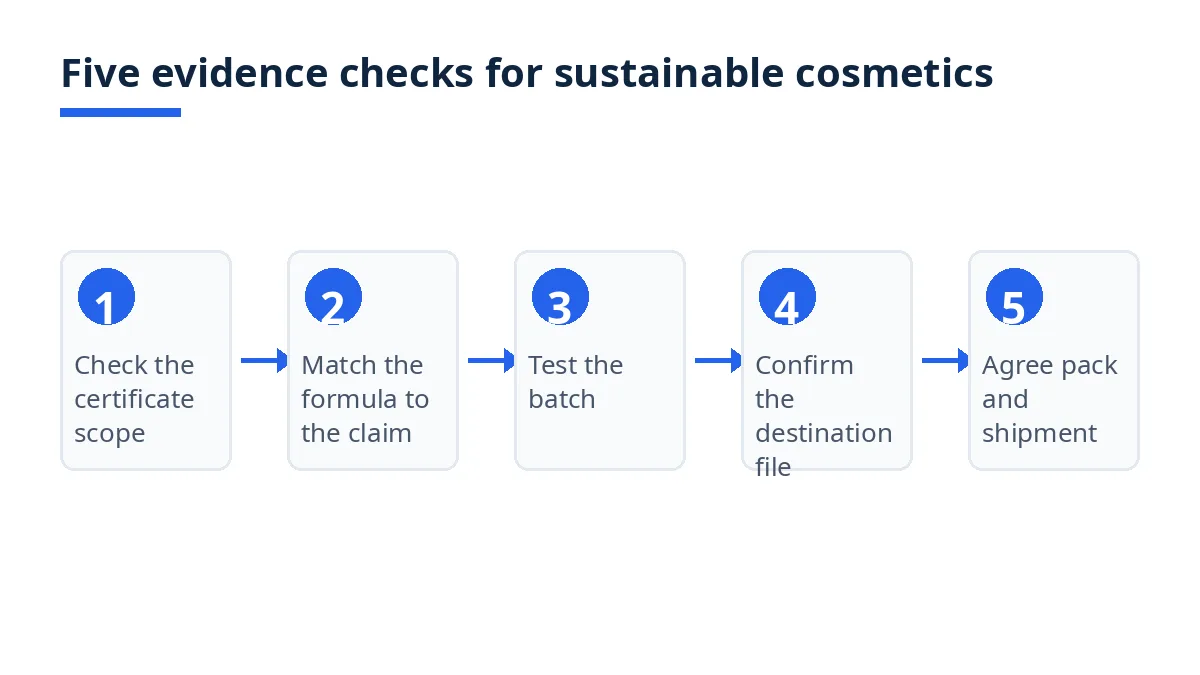
Define the claim before you shop for it. Write the product before you contact a factory: HS heading, formula type, certification signature claimed, pack size and format, target quantity, and destination market.7 9
Shortlist and verify suppliers. Build a shortlist from association contacts and supplier listings, confirm the DGDA licence covers the product, then run the four-layer document checks above.5 11
Sample and test. Order samples against the specification, test production-representative goods for microbiological limits, preservation efficacy and stability, and approve a counter-sample.9 8
Agree commercial terms in writing. Fix MOQ per formula and design, itemised unit price with its validity period, the Incoterm with its named place, the staged lead time and its start point, payment terms and the inspection point.14
Produce, inspect and ship. Monitor the imported-input stage first, inspect finished goods against the approved counter-sample and certification scope, then ship with the origin evidence and destination safety file.12 15
Related guides (links to cluster articles)
Read how to import from Bangladesh for the general import sequence, the sustainable packaging guide for the pack evidence beside a green formula, the sustainable handicrafts guide for how a neighbouring sustainability pillar tests material-origin claims, and Bangladesh export data for category scale. The guide to Incoterms for shipments from Bangladesh works through the delivery terms in more detail.
FAQs
Is Bangladesh a good place to source cosmetics, toiletries & chemicals?
Bangladesh is a credible sourcing option for high-volume toiletries, private-label skin and hair care and herbal lines where the formula, the certification scope and the destination safety file are managed actively. The domestic market is large on industry estimates, the producer base includes established toiletries manufacturers, and the 2023 Act gives the sector a DGDA licensing frame.2 3 5 The constraints to price in are the 90 percent imported-input share, the association's account of a complex export process with limited incentives, and the absence of a mandatory GMP requirement, which together mean the buyer must impose the quality and certification checks itself.2 4 Source factory by factory and formula by formula, not on the country label.
What is the typical MOQ?
There is no published typical MOQ for cosmetics from Bangladesh, and no official body sets one. Each factory quotes its MOQ from its batch and filling line: a mixing-vessel minimum per formula, a filling-line minimum per pack size, and further minimums per printed pack and label design on private-label orders. State your target quantity on the same basis in your enquiry, so quotes can be compared directly.
How long is the lead time?
There is no standard lead time: yours is the sum of its stages, raw material import and clearance, formula and sample approval, stability and microbiological testing, certification audit where a certified claim is sold, production, filling, labelling, inspection and booking, and transit. The first stage is the least predictable, because about 90 percent of raw materials are imported.2 Ask for the stages separately and agree in writing what starts the clock.
Which certifications matter?
The requirements that matter are the ones your destination market and your buyers require for the exact product. For a certified organic claim, the operative standard is COSMOS: COSMOS-ORGANIC requires at least 20 percent of the total formula from certified organic agriculture and at least 95 percent of physically processed agro-ingredients organic, while COSMOS-NATURAL carries no organic minimum but enforces the natural-origin and prohibited-substance rules.9 For a natural-content percentage, ISO 16128 supplies the calculation method for natural and organic indices, not a third-party certificate.10 For factory practice, ISO 22716 supplies the GMP framework for production, control, storage and shipment.8 On top of those files sit the destination laws: the EU safety assessment and safety report under Regulation (EC) No 1223/2009, and US facility registration and product listing under MoCRA.12 13
Next steps on Exportain
Browse Bangladeshi suppliers by cosmetics product, use Exportain trade intelligence to check the market picture behind this guide, and post a free RFQ at Exportain RFQs with your formula type, certification signature, target quantity and destination market.
Sources
- Bangladesh Export Statistics 2024-2025. Export Promotion Bureau (EPB) (accessed )
- Bangladesh's Cosmetics Market Hits BDT 350 Billion Amid Heavy Reliance on Imports. Voice7 News (accessed )
- Local toiletry, hygiene items replacing imports steadily. The Financial Express (accessed )
- Regulatory gaps hold back global competitiveness. The Daily Star, (accessed )
- The Drug and Cosmetics Act 2023, Act No. 29 dated 18 September 2023. VDB Loi, (accessed )
- Drugs and Cosmetics Bill passed with provision for life term. The Business Standard, (accessed )
- Harmonized System. World Customs Organization (accessed )
- ISO 22716 - Cosmetics - Good Manufacturing Practices (GMP). Pacific Certifications, (accessed )
- COSMOS Standard: Organic and Natural Cosmetics Certification Explained. Contract Laboratory, (accessed )
- ISO 16128: Standard for Natural and Sustainable Cosmetics. Gruppo FarmaImpresa (accessed )
- Supplier verification: Earn trust badges buyers can see. Exportain (accessed )
- Regulation (EC) No 1223/2009 of the European Parliament and of the Council of 30 November 2009 on cosmetic products (recast). legislation.gov.uk (accessed )
- FDA Issues Final Guidance on Facility Registration and Product Listing Under MoCRA. Crowell & Moring, (accessed )
- Incoterms® rules. International Chamber of Commerce (ICC) (accessed )
- EU trade relations with Bangladesh. European Commission, (accessed )
- Incoterms
- quality control
- Bangladesh Export Data
- Category Pillars
- Supplier Sourcing
- Cosmetics Bangladesh
- Sustainable cosmetics
About the author
Sourcing from Bangladesh?
Post a request for quotation and suppliers on Exportain can send you their quotes directly.
Post an RFQ