Sustainable Handicrafts & Eco Products From Bangladesh: Certifications and Green Factories
Handicraft exports were USD 37.68 million in FY2024-25 and USD 32.13 million in FY2025-26 on EPB data. This pillar guide covers eco materials, WFTO and GOTS evidence, green production checks, supplier verification, MOQ, compliance, Incoterms and duties.
Short answer
Sustainable handicrafts from Bangladesh are bamboo, cane, seagrass, hogla, water hyacinth, jute, terracotta and embroidered textile goods made mainly by home-based artisans. Handicraft exports were USD 37.68 million in FY2024-25 and USD 32.13 million in FY2025-26 on EPB data. Buyers source them by naming the material, checking WFTO or GOTS evidence where claimed, testing samples, and agreeing MOQ, price, Incoterm and lead time per order.
On this page
Key takeaways
Handicraft exports were USD 37.68 million in fiscal year 2024-25 and USD 32.13 million in FY2025-26 on the EPB fiscal-year series, after USD 42.83 million in FY2021-22, USD 29.71 million in FY2022-23 and USD 34.96 million in FY2023-24.
Bangladesh Bank records handicraft export receipts of USD 39.4 million for 2024-25 on its separate receipts series; the Bank states its receipts differ from EPB and BBS customs-based data on timing, valuation and coverage, so the two series are never blended.
The BBS 2022 survey counted 73,542 handicraft establishments, 97.6 percent of them household-based, engaging 148,656 people; women own 51.2 percent of establishments and about 44 percent of establishments are bamboo and cane based.
WFTO Guaranteed status assures an organisation's practices under the Guarantee System and is not a product certification; GOTS covers textile lines only, with organic at 95 percent minimum organic fibre and made with organic materials at 70 percent minimum.
LEED counts for garment factories, 273 certified in January 2026, must not be transferred to home-based handicraft chains; there is no industry-wide MOQ, price or lead time, and all three are quoted per exporter and per product against a written specification.
Sustainable handicrafts and eco products from Bangladesh are a narrower buying question than the general handicrafts category. A seagrass basket, a rug made from recycled sari and jute, a nakshi kantha throw and a terracotta tile share a country of origin, but they do not share a material, a production route or a certification file. This pillar guide is for importers, retailers, brands and sourcing agents in target export markets who want to buy on a documented sustainability basis rather than on a label claim.
Market overview with latest data
On the Export Promotion Bureau (EPB) fiscal-year series, handicraft export earnings were USD 42.83 million in FY2021-22, fell to USD 29.71 million in FY2022-23, recovered to USD 34.96 million in FY2023-24 and USD 37.68 million in FY2024-25, then fell again to USD 32.13 million in FY2025-26, a fall of about 15 percent on the year.1 The fiscal year runs from July to June. The causes named for the FY2025-26 contraction are weaker global demand, rising input and freight costs, reduced cash incentives and limited access to finance, alongside limits in design and development, stronger regional competition and a growing scarcity of skilled workers.1 The EPB total covers the whole category, not a certified or eco-only subset, and no eco-only export total is published in the sources used here.
Bangladesh Bank publishes a different number for the same year, and the difference is methodological, not an error to average away. In its Annual Export Receipts for 2024-25, Bangladesh Bank records handicraft export receipts of USD 39.4 million, up 14.3 percent on the year before.2 That is a receipts series, recording foreign exchange as proceeds are received through authorised dealers. Bangladesh Bank states that its receipts data may differ from customs-based data compiled by the Bangladesh Bureau of Statistics (BBS) and the EPB because shipment recording and receipt of proceeds happen on different dates, and because valuation and coverage differ.2 Use the EPB series for shipment trend and the Bangladesh Bank series for receipts, and never blend them into a single total. The Bangladesh Foreign Trade Institute (BFTI) reports handicraft exports of US$29.75 million for FY2022-23, close to but not identical with the EPB figure of USD 29.71 million for the same year.3
The production base is household production, not factory production, and that fact shapes every sustainability claim in this guide. The BBS Survey on Handicraft Establishment Bangladesh 2022, reported by BFTI, counted 73,542 establishments, of which 97.6 percent are household-based, engaging 148,656 people, 95.8 percent of them in household-based businesses.3 Women own 51.2 percent of establishments and make up 55.8 percent of the people engaged, and about 44 percent of establishments are bamboo and cane based.3 A PKSF workshop presentation in December 2025 gave the same picture in rounded form: around 148,000 artisans, 56 percent of them women, with 95.8 percent of production home-based.4
Two wider figures need careful handling. Banglacraft, the Bangladesh Handicrafts Manufacturers and Exporters Association, puts the domestic market at around Tk 10,000 crore and the export market at around 50 countries across North America, Europe and the Middle East.5 Those are the association's own figures, and its employment claims run far above the BBS survey count, so use the BBS survey for capacity planning. On policy, handicrafts are a special development sector in the Export Policy 2021-24 and the National Industrial Policy 2022, while the National Handicraft Policy 2015 has not been implemented, according to BFTI.3 BFTI reports an 8 percent cash incentive under the Bangladesh Bank circular for FY2023-24, while Banglacraft, speaking through the FY2025-26 reporting, says incentives have been slashed from 20 percent to 6.0 percent.3 1 The figures belong to different periods and speakers, so ask which rate applies to your line.
Main products and production clusters
The eco offer in Bangladesh is best grouped by material, because the sustainability evidence follows the material, not the finished shape. Bamboo and cane are the historic base, and about 44 percent of BBS-surveyed establishments are bamboo and cane based, but supply of cane and bamboo is declining.3 1 The growth materials are the substitutes producers are turning to: hogla leaves, water hyacinth, coconut fibre and date palm leaves.1 Banglacraft's senior vice president is quoted in the FY2025-26 reporting as saying hogla has now become one of the major raw materials, and that using water hyacinth helps to clean water bodies while turning a discarded plant into useful products.1
Product family | Typical Bangladesh products | Sustainability evidence to ask for |
|---|---|---|
Bamboo and cane | Baskets, storage, trays and mats under Chapter 46 | Material by name, drying and moisture control |
Other natural fibres | Seagrass, hogla, water hyacinth, coconut fibre and date palm baskets, bags and home decor | Named fibre, harvest source, substitution disclosed |
Recycled and reclaimed inputs | Rugs and home goods from recycled sari, waste jute and other reclaimed textiles | Input composition by percentage, cleaning route, dye system |
Clay and terracotta | Terracotta tiles, clay products and pottery | Wall thickness and packed sample |
Textile handicrafts | Nakshi kantha, jamdani, shataranji and handloom home textiles | Fibre composition, dye system, organic or fair trade evidence where claimed |
Handicrafts do not sit in one chapter of the Harmonized System, because the system follows material and stage of manufacture. The core basketware chapter is Chapter 46, manufactures of straw, of esparto or of other plaiting materials; basketware and wickerwork. Heading 46.01 covers plaits and similar products, including mats, matting and screens of vegetable materials, and heading 46.02 covers basketwork and wickerwork made directly to shape, including 4602.11 of bamboo, 4602.12 of rattan, 4602.19 of other vegetable materials and 4602.90 other.6 Beyond Chapter 46, jute bags and rugs, terracotta tiles, carpets and mats, and nakshi kantha classify in other chapters by material and construction.3 BFTI lists insufficient HS code-wise identification among the sector's weaknesses, and Banglacraft makes the same point: the recorded export total understates the sector because not every line has a clean code.3 5
Clusters in this industry are craft geographies, not industrial estates. SME mapping counts 38 handicraft clusters among the 177 SME clusters in Bangladesh.3 For a sustainability buyer, the cluster question is practical: which district's artisan groups make your product, what material grows or is collected there, and which stages, such as dyeing, finishing and packing, happen in the exporter's own unit rather than in homes.
How to find and verify suppliers
Find suppliers through more than one channel so you can cross-check what an exporter tells you. Start with Banglacraft and the fair trade network below, add Bangladesh export data and Exportain trade intelligence for context, then work Bangladeshi suppliers listings by product family and material, and ask each candidate for its export markets and reference products in your heading.
The fair trade network is the most useful first filter for a sustainability programme, provided you understand what it does and does not prove. ECOTA, the fair trade forum whose full name is Effort to Create Opportunity for Trade Advancement, states that it has supported makers of handmade products since 1990 and that it supports over 150,000 artisans, 50 percent of whom are women from disadvantaged backgrounds, across 62 artisan groups.7 Those are ECOTA's own figures, and they describe the network, not any single supplier's order. ECOTA links members to buyers through its connection with the World Fair Trade Organization (WFTO).7 Four Bangladeshi handicraft producers and organisations were reported in 2016 as recognised by WFTO as guaranteed fair trade organisations: Hathay Bunano, Thanapara Swallows Development Society, Prokritee and Base Bangladesh.8 Prokritee supported more than 1,500 artisans making goods from renewable sources such as recycled sari and waste jute.8 Treat the 2016 figures as dated reporting, and check any organisation's current status before relying on it.
The WFTO Guarantee System itself needs a precise reading. It is not a product certification system. It is an assurance mechanism that fair trade is implemented in the supply chain and practices of the organisation, built from a membership admission procedure, a Self Assessment Report, a Monitoring Audit, a Peer Visit and a Fair Trade Accountability Watch through which the public can report compliance issues.9 Members that pass the process attain Guaranteed Fair Trade Organisation status and may use the WFTO Label on their products.9
Ask for, and read, the following before you discuss price in detail:
Trade licence and export registration in the company's own name, and association or network membership where claimed, checked against the network's current list.7
The production map behind the offer: which products are made by which artisan groups, in which districts, and which stages, such as dyeing, finishing and packing, are done in the exporter's own unit.3
The material file for your product: fibre or plant material by name, harvest or reclaimed source where a claim is made, and disclosure of any substitution, such as hogla for cane.1
The certification file for your product, not only for the organisation: the scheme, the scope, the certificate number and expiry, and whether it covers the unit and the product line in your order.9 10
Test reports for the exact construction you plan to buy, including the chemical evidence in the compliance section where dyed textiles will touch skin.
On Exportain, read badges for what they are. Supplier profiles carry document and photo review badges: the badge records that documents and photos were reviewed by Exportain staff, verification is free, and membership never grants a badge.11 A badge is not a factory inspection, a certification or a guarantee. Exportain is a B2B marketplace and is not a party to the contract for goods; it does not inspect goods, book freight or clear customs.11 Use the badge as a first filter, then run the document checks above. Two red flags end a conversation early: an exporter that quotes a firm bulk price before seeing your full specification is not pricing your product, and an exporter that cannot describe its artisan network, when 97.6 percent of establishments are household-based, has not answered the first capacity question.3
MOQ, pricing and lead times
All three are quoted per exporter, per product and per order, against a written specification.
MOQ. The minimum order quantity is set by the production unit, which in this sector is the artisan group, not the machine. A basket order carries the minimum the exporter can place with a weaving group for one design, size and material; a nakshi kantha order carries the embroidery group's minimum per design and size; a dyed order carries the dye-lot minimum per colour. A certified line can add a further floor from the dye lot, the organic lot or the fair trade group's production run.
Pricing. Your unit price is built from raw material, hand labour, dyeing and finishing where they apply, inspection and rejection allowance, packing, and export costs to the agreed Incoterm point. Two inputs are moving: cane and bamboo supply is declining, pushing substitution toward hogla, water hyacinth, coconut fibre and date palm, and production remains largely manual, which Banglacraft contrasts with competitors in China, Vietnam and India that use small tools alongside handwork.1
Example figures. For illustration only: a specification for 2,400 rugs made from recycled sari and jute in one size is quoted by two exporters at FOB Chattogram. Exporter A quotes USD 9.60 per rug itemised as material and weaving USD 6.80, finishing and inspection USD 1.30 and packing and export costs USD 1.50. Exporter B quotes USD 8.90 with no itemisation. The worked example totals are USD 23,040 from Exporter A and USD 21,360 from Exporter B. The example shows the method, not a market price: the buyer asks Exporter B for the same itemisation and the recycled-content percentage behind the quote before treating the USD 1,680 gap as a saving.
Lead times. A lead time is a chain, not a single number: raw material purchase and preparation, weaving or embroidery, collection from home-based producers, finishing, inspection, packing and booking, then transit. The collection stage is specific to this sector: output is gathered from households, and 95.8 percent of the people engaged work in household-based businesses.3 A certification step can add its own stage, so ask for the lead time broken into stages and agree what starts the clock, normally written order confirmation plus approved sample, not the first enquiry.
Quality, certifications and compliance
Quality in sustainable handicrafts is decided by four layers: destination product law, any scheme your buyer programme names, the material evidence for your eco claim, and your own specification and testing. Handmade production varies by maker; Banglacraft itself describes each handcrafted product as distinct because each craftsperson works differently.5 Your specification therefore defines the acceptable range, not a single perfect sample: dimensions with tolerances, material by name, weave or stitch density, colour references, finish, moisture and packing, all written so an inspector can measure them.
Green factories, read correctly. Bangladesh has a large LEED-certified garment factory base: three more garment factories received LEED certification from the US Green Building Council in January 2026, taking the total number of LEED-certified garment factories in Bangladesh to 273, including 115 Platinum and 139 Gold certified units.12 Those are ready-made garment factories, not handicraft units, and the count must not be transferred to handicrafts. Handicraft production is home-based, so the building that matters for your order may be a small finishing, dyeing or packing unit, not a large factory floor. If a supplier claims a green factory, ask for the certificate itself: the rating, the building and the unit it covers, and whether your product passes through that unit.
Fair trade evidence. BFTI recommends encouraging World Fair Trade certification as one route to sustainable export growth, and Banglacraft notes that fairly produced goods do not necessarily have to be fair-trade certified, with adherence to fair trade principles often sufficient for buyers.3 5 If your programme names WFTO Guaranteed status, write it into the order as your requirement, with the organisation's current status checked, remembering that the Guarantee System assures the organisation's practices rather than certifying a single product.9 If your programme accepts adherence to fair trade principles without certification, write down which principles and what evidence the exporter will supply for your order.
Organic textile evidence. For textile handicrafts such as nakshi kantha and other cotton or wool lines, the Global Organic Textile Standard (GOTS) is the scheme buyers most often name. GOTS certification through a certification body allows organic textiles to be marketed with the GOTS logo, with two levels: Level 1 organic textiles at 95 percent minimum fibres from organic agriculture and 5 percent maximum synthetic or artificial fibres, and Level 2 at 70 percent minimum fibres from organic agriculture.10 GOTS guarantees environmentally friendly production and processing, respect and improvement of working conditions, promotion of fibres from organic agriculture, and prohibition of hazardous inputs such as toxic heavy metals and aromatic solvents.10 GOTS applies to products composed of fibres, wool, fabrics, clothes and upholstery fabrics except leather products.10 Two limits follow. First, GOTS covers textile lines only: it does not certify a bamboo basket, a terracotta tile or a metal craft. Second, the label grade must match the fibre content: a product at 70 percent organic fibre is labelled as made with organic materials, not as organic.
EU fibre labelling and chemical limits. Regulation (EU) No 1007/2011 governs textile fibre names and the labelling and marking of fibre composition for textile products placed on the EU market.13 Nakshi kantha, jamdani, shataranji and other textile handicrafts sold to consumers in the EU need their fibre composition stated with the fibre names the regulation lists, on packaging, labels and markings, in a form that is easily legible, visible and clear.13 Annex XVII to the REACH Regulation, entry 72, restricts carcinogenic, mutagenic and reproductive-toxic substances in clothing, other textiles that come into contact with human skin, and footwear, and has applied since 1 November 2020.14 The restricted groups include heavy metals, phthalates, polycyclic aromatic hydrocarbons, formaldehyde and certain azo dyes, and the listed limits include extractable cadmium, chromium VI, arsenic and lead at 1 mg/kg each and formaldehyde at 75 mg/kg.14 A natural dye claim does not remove this file: require a test report for production-representative goods from a laboratory accredited for those methods.
Natural materials and claim discipline. Put the question to your supplier and broker in writing before production: what drying, treatment and packing the exporter applies, and how each is evidenced. The rule that ties this section together is simple: state the documented fact, not the aspiration. A basket made from water hyacinth is described by that material fact, with its source stated.1 A claim that goes beyond its evidence should be removed from artwork and listings before shipment.
Shipping, Incoterms and duties
Handicrafts from Bangladesh normally leave by sea from Chattogram, the country's main seaport. Packing drives the freight economics more than weight does: baskets, mats and home decor are bulky relative to value, terracotta is the reverse, and a mixed order can contain both. Confirm packed carton dimensions, pieces per carton and gross weight per carton in the specification, because those numbers set your freight cost per unit under any Incoterm. State the packing material in the same specification.
Incoterms® 2020 is the current edition of the ICC rules, in force since 1 January 2020. The rules are eleven three-letter trade terms that clarify the tasks, costs and risks involved in the delivery of goods from sellers to buyers, and they are recognised as the global standard for interpreting the most common terms in foreign trade.15 The four rules you will meet most often on handicraft orders work as follows:
Rule | Who arranges and pays main freight | Where risk passes to the buyer | Practical note |
|---|---|---|---|
EXW (Ex Works) | Buyer | At the seller's premises | Buyer carries export clearance workload; rarely suitable for a first order |
FOB (Free On Board) | Buyer | When goods are on board the vessel at the named loading port | The common Bangladesh term; name the port, for example FOB Chattogram, Incoterms® 2020 |
CIF (Cost, Insurance and Freight) | Seller, plus minimum insurance | When goods are on board at the loading port | Risk still passes at loading, not at arrival |
DAP (Delivered at Place) | Seller | At the named destination place, ready for unloading | Buyer still clears import and pays duty unless the contract says otherwise |
Duties are decided by the heading, the origin of the goods and the destination's preference scheme, in that order. As a least developed country, Bangladesh benefits from the Everything But Arms (EBA) arrangement under the EU's Generalised Scheme of Preferences, which grants duty-free, quota-free access to the EU for all products except arms and ammunition, and 91 percent of Bangladesh's exports to the EU enter duty- and quota-free.16 Bangladesh is the largest beneficiary under the EBA arrangements, with EUR 19 billion in exports benefitting from these preferences in 2024 at a 96 percent utilisation rate.16 Handicraft goods that meet the EBA rules of origin and ship with the required proof of origin therefore enter the EU without customs duty while Bangladesh holds that status. Preference is a property of the consignment, not the country: if the origin evidence fails, the standard duty for the heading applies. A mixed order can also carry several headings, Chapter 46 basketware beside textile and clay lines, so the duty check runs per line, not per order.6
Step-by-step buying process
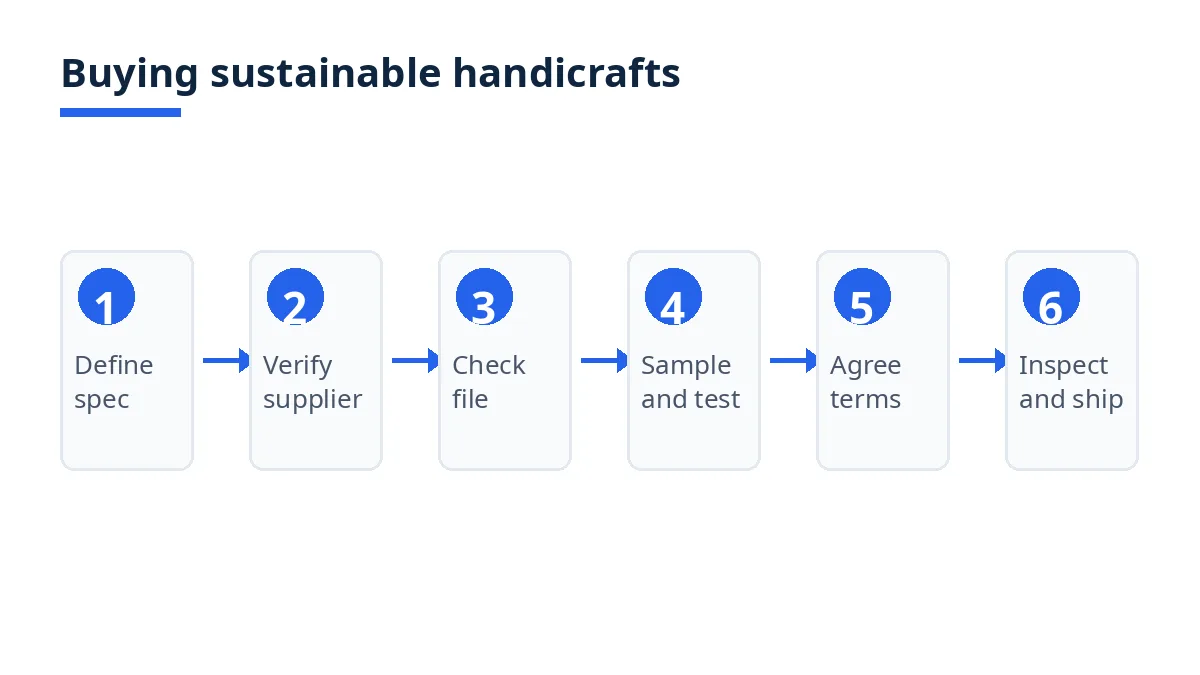
Define the specification. Write the product before you shop for it: material by name, HS heading, dimensions with tolerances, weave or stitch standard, colour and finish, dye system, packing per carton and destination market.
Shortlist and verify suppliers. Build a shortlist from association and fair trade network lists and supplier listings, confirm who makes the goods and which stages the exporter performs itself, then run the document checks in the verification section.7 11
Check the sustainability file. Confirm the scheme, scope, certificate and expiry for any certification claim and the material evidence for any eco claim.9 10 13
Sample and test. Order samples against the specification, including a packed sample for fragile or bulky goods, test production-representative dyed textiles for the chemical limits where they apply, and approve a counter-sample in writing.14
Agree commercial terms in writing. Fix MOQ per product and design, itemised unit price with its validity period, the Incoterm with its named place, the staged lead time and its start point, payment terms and the inspection point, all in the purchase order.15
Produce, inspect and ship. Inspect finished goods against the approved counter-sample and specification, then ship with the origin evidence your duty position depends on.16
Related guides (links to cluster articles)
Read how to import from Bangladesh for the general import sequence, the handicrafts industry in Bangladesh pillar for the wider category behind this sustainability guide, and the jute products industry in Bangladesh pillar for the jute lines inside many eco ranges. Bangladesh export data sets the handicraft figures against the wider export picture.
FAQs
Is Bangladesh a good place to source handicrafts & eco products?
Bangladesh is a credible sourcing option for bamboo and cane basketware, natural-fibre home goods, recycled-input rugs, jute goods, terracotta and embroidered textiles where specification, material and compliance are managed actively. The base is large and household-based: 73,542 establishments engaging 148,656 people on the BBS 2022 survey, with handicraft exports of USD 37.68 million in FY2024-25 on the EPB series.3 1 The sustainability file is real but uneven: fair trade networks and organic textile certification exist for the lines they cover, while LEED green-factory counts belong to the garment sector and must not be borrowed for handicrafts.9 10 12 Price in the fall to USD 32.13 million in FY2025-26, declining cane and bamboo supply, and largely manual production.1
What is the typical MOQ?
There is no published typical MOQ for sustainable handicrafts from Bangladesh, and no official body sets one. Each exporter quotes its MOQ from its production unit: a weaving group's minimum per basket design, size and material, an embroidery group's minimum per nakshi kantha design, or a dye-lot minimum per colour.
How long is the lead time?
There is no standard lead time: yours is the sum of its stages, raw material preparation, weaving or embroidery, collection from home-based producers, finishing, inspection, packing and booking, and transit. The collection stage is specific to this sector, because 95.8 percent of the people engaged work in household-based businesses.3 A certification stage can add time of its own.
Which certifications matter?
The requirements that matter are the ones your market and your buyers require for the exact product. For fair trade, WFTO Guaranteed status assures the organisation's practices under the Guarantee System; it is not a product certification, so the material and test evidence for your consignment stays separate.9 For organic textile handicrafts, GOTS has two label grades: organic at 95 percent minimum organic fibre, and made with organic materials at 70 percent minimum.10 For the EU, fibre labelling under Regulation (EU) No 1007/2011 is a legal requirement for textile products, and REACH Annex XVII entry 72 restricts named chemicals in clothing and skin-contact textiles, with limits including extractable lead at 1 mg/kg and formaldehyde at 75 mg/kg.13 14 A LEED rating evidences a building, and the garment-sector total of 273 certified factories in January 2026 does not evidence a handicraft chain.12
Next steps on Exportain
Browse Bangladeshi suppliers by product and material, use Exportain trade intelligence for the market picture, and read the handicrafts industry in Bangladesh pillar for the wider category. Then post a free RFQ at Exportain RFQs with your specification, material, certification requirements, quantity and destination so exporters quote against the same brief.
Sources
- FY26 handicraft exports fall 15pc amid weak demand. The Financial Express, (accessed )
- Annual Export Receipts of Goods and Services 2024-25. Bangladesh Bank (accessed )
- Handicraft sector of Bangladesh: employment, exports and policy support. Bangladesh Foreign Trade Institute (accessed )
- Strategic policy measures needed to tap billion-dollar global handicrafts market: Speakers. Bangladesh Sangbad Sangstha (BSS), (accessed )
- Handicrafts advancement and export potentiality from Bangladesh. Bangladesh Handicrafts Manufacturers and Exporters Association (Banglacraft) (accessed )
- Chapter 46: Manufactures of straw, of esparto or of other plaiting materials; basketware and wickerwork. Sri Lanka Customs (accessed )
- Why ECOTA. ECOTA Fair Trade Forum (accessed )
- Bangladeshi handicrafts get global recognition. The Daily Star, (accessed )
- The WFTO Guarantee System. WFTO Europe (accessed )
- Organic textile certification (GOTS). Ecocert (accessed )
- Supplier verification: Earn trust badges buyers can see. Exportain (accessed )
- 3 new factories get LEED certification, one scores highest in the world. The Business Standard, (accessed )
- Regulation (EU) No 1007/2011 on textile fibre names and related labelling and marking of the fibre composition of textile products. European Union, (accessed )
- Restriction on CMRs in clothing, textiles and footwear published. TÜV SÜD (accessed )
- Incoterms® rules. International Chamber of Commerce (ICC) (accessed )
- EU trade relations with Bangladesh. European Commission, (accessed )
- Incoterms
- quality control
- Bangladesh Export Data
- Category Pillars
- Supplier Sourcing
- Handicrafts Bangladesh
- Eco products
About the author
Sourcing from Bangladesh?
Post a request for quotation and suppliers on Exportain can send you their quotes directly.
Post an RFQ