Sustainable Packaging, Paper & Printing From Bangladesh: Certifications and Green Factories
Paper and paper products exports were USD 285.83 million in FY2024-25 on the EPB series, then USD 249.01 million in FY2025-26. This buyer guide tests green packaging claims from Bangladesh: fibre certification, recycled content, EU packaging rules and food-contact compliance.
Short answer
Buyers test sustainable packaging from Bangladesh by checking the claim, not the label: FSC or PEFC chain of custody scope for the supplying site, the recycled-content percentage and its calculation method, EU Packaging and Packaging Waste Regulation recyclability for the finished pack, and food-contact compliance where food is involved. Paper and paper products exports were USD 285.83 million in FY2024-25 on the EPB series.
On this page
Key takeaways
Paper and paper products exports were USD 285.83 million in FY2024-25 on the EPB fiscal-year series, then USD 249.01 million in FY2025-26, after growth from USD 71.44 million in FY2020-21; the EPB series must not be blended with industry capacity counts or association-wide totals.
A green claim must name its route: certified virgin fibre proved through FSC or PEFC chain of custody, or recovered fibre proved through a stated recycled-content percentage and calculation method; the two routes are not interchangeable.
Under Regulation (EU) 2025/40, all packaging placed on the EU market must be recyclable, with recyclability grades from 2030 and recycled-at-scale requirements from 2035, so coatings, laminations and inks decide the claim as much as the board does.
Bangladesh banned thin plastic bags in 2002 and renewed the polythene crackdown in October 2024, but reporting records weak enforcement, so a substitute pack must be tested for its actual use rather than assumed to displace plastic.
There is no industry-wide MOQ, price or lead time for sustainable packaging from Bangladesh; all three are quoted per supplier, per product and per claim against a written specification.
A green claim on a carton, bag or printed pack is a promise about where the fibre came from, what share of it is recycled or certified, and what the pack can do at the end of its life. This guide is for buyers in the United States, the United Kingdom, the European Union and the United Arab Emirates who need to test those promises before ordering packaging from Bangladesh. It starts from the claim and works backward to the evidence: the certificate, the scope, the sales document, the test report and the destination rule the claim must satisfy.
Market overview with latest data
Read the export record through a sustainability lens first. On the Export Promotion Bureau (EPB) fiscal-year series, which runs from July to June, export earnings from paper and paper products were USD 71.44 million in FY2020-21 and reached USD 285.83 million in FY2024-25, after USD 105.1 million in FY2021-22, USD 229.41 million in FY2022-23 and USD 273.06 million in FY2023-24.1 That growth was built on converted products: the export basket predominantly consists of tissue paper, toilet tissue, paper cups, paper bags and cartons, shipped to more than 50 nations including the United States, the United Kingdom, Malaysia and South Korea.1 For a green buyer, the basket matters because tissue, cups and bags are the formats where fibre origin, recycled content and food-contact questions arise on almost every order.
The downturn that followed is also a sustainability signal. Earnings fell to USD 249.01 million in FY2025-26, down 12.88 percent from USD 285.83 million in FY2024-25, and July to August FY2026-27 receipts were USD 35.76 million, down 22.80 percent from USD 46.32 million a year earlier.2 Industry sources cited in that reporting attribute the decline mainly to rising production and operating costs, energy supply problems and global supply chain disruption.2 The earlier reporting adds two structural points for supplier talks: Bangladesh is largely dependent on pulp imports for the sector, and large mills predominantly operate captive power plants that rely on gas, leaving them exposed to gas price rises and supply inconsistency.1 A supplier whose fibre is imported pulp and whose power is captive gas cannot present its pack as low-impact on location alone. Ask where the pulp comes from and what share of the board is recovered fibre, and treat answers that stop at the word green as unanswered.
Keep three counts apart, because blending them is the most common way a green story goes wrong. The EPB series above covers paper and paper products as the EPB reports them. A second, industry-source count puts registered private paper mills at 105, of which around 70 are currently operational, with estimated annual production capacity of about 1.6 million tonnes against domestic demand of around 0.6 million tonnes.1 That capacity count says nothing about how much of the board is certified or recycled. A third count, announced by the packaging association itself, is wider still: the Bangladesh Garments Accessories and Packaging Manufacturers and Exporters Association (BGAPMEA) announced record export earnings of USD 7.45 billion in FY2024-25 for the accessories and packaging sector as a whole, with around USD 1 billion from direct exports, and said the association represents more than 2,000 member factories.3 That figure covers accessories and packaging together, not paper packaging alone, so it cannot evidence the size of the green paper offer. The government declared paper and packaging the Product of the Year 2026 at the Dhaka International Trade Fair in January 2026, a policy signal, not a certification of any individual supplier.1 Promotion, capacity and certification are three different facts.
Main products and production clusters
The green question changes by format, so sort the offer by what each format can honestly claim. Corrugated shipping cartons are the working format for most export programmes. Their green levers are board grammage, the share of recovered fibre in liner and fluting, and whether the pack ships flat to cut freight volume. A lighter board that still passes strength testing is a genuine saving; a lighter board that fails in transit and forces re-packing is not. Folding cartons for food, pharmaceutical, cosmetic and consumer goods carry the heaviest claim load, because print, lamination and coatings decide whether the pack can be recycled in the destination system. A folding carton with a plastic lamination the buyer cannot separate is a weaker recyclability story than an unlaminated carton, whatever the artwork says. Paper bags are the substitution format: they replace a plastic bag only when the bag actually performs for its use, with handles, gussets and wet strength to match. Cups need a food-contact file, labels need adhesive and substrate detail, and tissue needs fibre-origin detail rather than a colour cue.
Two material routes run through all of these formats, and the buyer should name which route each order takes. The virgin route starts with imported pulp, because Bangladesh depends heavily on pulp imports.1 Its green evidence is forest certification of the pulp source, carried through chain of custody to the converter. The recovered route starts with waste paper, local and imported, turned back into board. Its green evidence is recycled-content accounting: what percentage, measured how, and stated where. The two routes are not interchangeable claims. A pack made from recovered fibre is not certified forest fibre, and a pack made from certified virgin fibre is not recycled. The specification should state the route, the percentage or certificate, and the document that proves it, before any artwork is approved.
How to find and verify suppliers
Find suppliers by claim first and by product second. Start with the claim your destination market or your customer requires: a named forest scheme, a recycled-content percentage, a food-contact declaration, or a recyclability position under the destination packaging rules. Then shortlist converters whose certificate scope covers that claim for that product. Work Bangladeshi suppliers listings and Exportain trade intelligence by product, but filter every candidate through the certificate check below before discussing price.
Ask for, and read, the following for each claim on the order:
The certificate itself, in the supplying company's own legal name, with its number, expiry date and product scope. A certificate held by a parent company, a sister plant or a paper merchant does not cover a converter's output unless the scope says so.
The chain of custody position behind the claim. Forest Stewardship Council (FSC) chain of custody certification verifies that FSC-certified material has been identified and separated from ineligible and unacceptable material as it makes its way along the supply chain from the forest to the market.4 Ask how certified material is identified and separated at the supplier's own site, not merely that a certificate exists somewhere in the chain.
The parallel scheme position where the buyer accepts it. PEFC chain of custody certification is assessed by a certification body against the chain of custody standard, including a site visit, and a certificate is valid for a maximum of five years with annual surveillance audits.5 FSC and PEFC are different schemes, so a buyer who specified one should not accept the other without checking the customer's own vendor rules.
The sales-document claim for your order. The claim on the invoice, delivery note or packing list must match the certificate scope and the product shipped. A claim that appears on a sample but disappears from the commercial documents is not a claim you can defend to your customer.
The recycled-content method where recycled content is claimed. Ask what percentage is claimed, whether it is calculated by weight, and whether the accounting separates certified, controlled and recycled inputs. A percentage without a method is a marketing number, not a specification.
The food-contact or destination-rule file where the pack touches food or enters a regulated market, covered in the compliance section below. A fibre certificate does not answer a food-contact question, and a food-contact declaration does not answer a fibre question.
Four red flags end a green conversation early. A supplier that uses the words eco, green or biodegradable without naming a scheme, a standard or a test has made no verifiable claim. A supplier that shows a forest-scheme logo on artwork before showing the certificate behind it has the order of proof backward. A supplier that cannot state the certified or recycled share for the exact board grade on your order, as opposed to the mill's general range, has not answered the order question. And a supplier that treats a marketplace badge as a sustainability certificate has confused two different reviews. Run the certificate checks above yourself or through an inspection firm you appoint, even where a badge is present.
MOQ, pricing and lead times
There is no industry-wide MOQ, price or lead time for sustainable packaging from Bangladesh. All three are quoted per supplier, per product and per order, against a written specification that includes the green claim.
MOQ. The minimum order quantity for a green order is set by the claim as well as by the production stage. A certified-fibre order carries the board lot and chain of custody batch minimums for that fibre. A recycled-content order carries the recovered-board lot minimums for that grade. A printed order carries plate, die and print-run minimums per design and colour count. State your target quantity per product, per size, per design and per claim in your enquiry, and ask the supplier to quote its MOQ on the same basis.
Pricing. Your unit price is built from board grade and grammage, the fibre route and its certification or recycled-content position, print colours and plates, die and tooling, converting and gluing, coatings or laminations, packing, and export costs to the agreed Incoterm point. Because Bangladesh depends heavily on imported pulp and board inputs, board prices move with import and energy costs, and exporters cite rising input, energy and freight costs as the pressure on margins.1 2 Compare quotes only at the same Incoterm, the same board grade and grammage, and the same claim wording.
Example figures. For illustration only: a specification for 5,000 recycled-content kraft carrier bags, with a stated 70 percent recycled content by weight and a single-colour print, is quoted by two suppliers at FOB Chattogram. Supplier A quotes USD 0.62 per bag itemised as board USD 0.34, converting and printing USD 0.18 and packing and export costs USD 0.10. Supplier B quotes USD 0.54 per bag with no itemisation and no recycled-content method stated. The worked totals are USD 3,100 from Supplier A and USD 2,700 from Supplier B. The example shows the method, not a market price: the buyer asks Supplier B for the same itemisation, the board grade and grammage, and the recycled-content calculation, before treating the USD 400 gap as a saving, because an unitemised gap is usually a lower recycled share, a lighter board or an unproven claim.
Lead times. A lead time for a green order is a chain with two extra links: fibre or board sourcing against the claim, and claim documentation. The chain runs from board purchase and delivery, through printing, converting, claim paperwork, inspection and booking, then transit. Where certified or recycled board is bought per job, the board stage is the long pole. Ask for the lead time broken into its stages, with the board and claim-paperwork stages stated separately, and agree what starts the clock, normally written order confirmation plus approved artwork, approved sample and agreed claim wording, not the first enquiry.
Quality, certifications and compliance
Quality for a green pack is decided by four files that must agree: the destination packaging rule, the fibre file, the food-contact file where food is involved, and your own specification and testing. Where they disagree, the strictest destination rule governs the order, not the supplier's brochure.
EU packaging rules and the 2030 horizon. The EU Packaging and Packaging Waste Regulation 2025/40 entered into force on 11 February 2025 and will generally apply from 12 August 2026, covering all packaging and packaging waste regardless of material or origin.6 All packaging must be recyclable, meaning it must be designed for material recycling and able to be collected, sorted and recycled at scale when it becomes waste, with the recycled-at-scale requirement entering into force in 2035, and recyclability performance grades applying from 2030 with stricter obligations from 2038.6 The practical consequence is that the design decision sits with the buyer and the converter together: a multi-material laminate, a coating or an ink system that blocks recycling in the destination system can fail the pack even where the board itself is certified. Ask the converter to state, in writing, how the finished pack as designed is meant to be recycled in the destination market. Do not accept a recyclable claim that refers only to the board.
Fibre certification, stated only as far as the schemes support it. FSC chain of custody certification verifies that FSC-certified material has been identified and separated from ineligible and unacceptable material along the supply chain from the forest to the market, and the material in the chain may also include reclaimed material and material assessed as a low risk of coming from unacceptable sources.4 That wording sets the limit of the claim: chain of custody proves identification and separation through the chain, not carton strength, food-contact safety or finished-pack recyclability. PEFC certification follows the same logic through its own scheme: a certification body assesses the chain of custody system, including a site visit, the certificate lasts a maximum of five years, and annual surveillance audits confirm continued compliance.5 Record which scheme the buyer specified, and where a customer accepts both, record that acceptance in writing. A claim that names neither scheme, or switches schemes between sample and shipment without notice, should be treated as a failed claim and re-quoted.
Bangladesh plastic rules and the substitution test. Bangladesh banned thin plastic bags in 2002, renewed a crackdown on polythene bags in supermarkets and grocery stores from October 2024, and in October 2025 banned three single-use plastic items, including straws and cotton buds, within the Secretariat.7 The same reporting records that enforcement has been weak, that polythene returned to markets after enforcement actions, and that the diversified jute sector argues the gap is coordination, transition support for plastic producers and public awareness, not intent.7 For a buyer, the lesson is direct: a substitute that is not available at the required quality, quantity and price will not displace plastic in practice, and a claim that a market has gone plastic-free should be checked against what is actually sold there. Where a buyer substitutes a plastic pack with a paper or jute pack, test the substitute for its actual use: wet strength, grease resistance, seal performance and shelf life, not only for its material name. The government also allocated Tk 15 crore for Dhaka and Tk 10 crore for Chattogram to promote jute bags under a Climate Development Fund project, which the same reporting presents as too small to create lasting change on its own.7
Food-contact packaging. Where paper or board packaging touches food, Regulation (EC) No 1935/2004 requires that materials and articles be manufactured in compliance with good manufacturing practice so that, under normal or foreseeable conditions of use, they do not transfer their constituents to food in quantities which could endanger human health, bring about an unacceptable change in the composition of the food, or bring about a deterioration in its organoleptic characteristics.8 Write the requirement into the purchase specification, require a declaration of compliance and test evidence for the production batch, and confirm which destination-market rules apply for the exact food type and contact condition. A fibre certificate, a recycled-content percentage and a food-contact declaration are three separate documents. An order that needs all three must carry all three.
Your own quality system. Write the specification so an inspector can measure the claim as well as the pack: board grade and grammage, fibre route, certified or recycled share and its method, flute type and box dimensions, print colours and placement, coating or lamination, and the sampling plan. Approve a pre-production sample and a counter-sample, set the inspection point before cartons are bundled and palletised, and test production-representative goods, not showroom samples, for strength, print adhesion, the claim documents for that batch, and food-contact compliance where it applies. If the board source changes mid-order, the claim wording and sales documents must change with it.
Shipping, Incoterms and duties
Shipping a green pack has its own economics, because the claim can be undone by the way the pack travels. Cartons and bags are bulky relative to weight, so confirm bundle or pallet dimensions, pieces per bundle or pallet, and whether cartons ship flat or erected, because those numbers set freight cost per unit and containers per programme. A flat-packed carton that travels well is a genuine saving; over-boxing adds freight, material and waste.6
Incoterms 2020 is the current edition of the ICC rules, in force since 1 January 2020, with eleven rules split between any mode of transport and sea and inland waterway transport only.9 For green packaging orders, the rule choice matters most where containers are involved: a container is normally handed to the carrier at a terminal before it is loaded on board, so a sea-only rule can mistime the risk transfer, and a rule for any mode of transport may match the physical chain better. The rules you will meet most often work as follows:
Rule | Who arranges and pays main freight | Where risk passes to the buyer | Practical note for a green pack |
|---|---|---|---|
FCA (Free Carrier) | Buyer | When goods are delivered to the buyer's nominated carrier | Better match for containerised cartons handed over at a terminal |
FOB (Free On Board) | Buyer | When goods are on board the vessel at the named loading port | The common Bangladesh term; name the port, for example FOB Chattogram |
CIF (Cost, Insurance and Freight) | Seller, plus minimum insurance | When goods are on board at the loading port | Risk still passes at loading, not at arrival |
DAP (Delivered at Place) | Seller | At the named destination place, ready for unloading | Buyer still clears import and pays duty unless the contract says otherwise |
Always write the rule with its named place and edition, for example "FCA Chattogram, Incoterms 2020" for a container order or "FOB Chattogram, Incoterms 2020" for a conventional sea shipment. Exportain does not book freight or clear customs, so the freight forwarder and customs broker are separate appointments to name in the order paperwork.
Duties are decided by the heading for the exact product, the origin of the goods and the destination's preference scheme, in that order. As a least developed country, Bangladesh benefits from the Everything But Arms (EBA) arrangement under the EU's Generalised Scheme of Preferences, which grants duty-free, quota-free access to the EU for exports of all products except arms and ammunition.10 Packaging that meets the EBA rules of origin and is shipped with the required proof of origin therefore enters the EU without customs duty while Bangladesh holds that status. Preference is a property of the consignment, not the country: if the origin evidence fails, the standard third-country duty applies. For the United States, the United Kingdom and the UAE, read the duty beside your confirmed six-digit code in the destination tariff for the entry date; this guide states no rate for them, because packaging rates vary by heading.
Step-by-step buying process
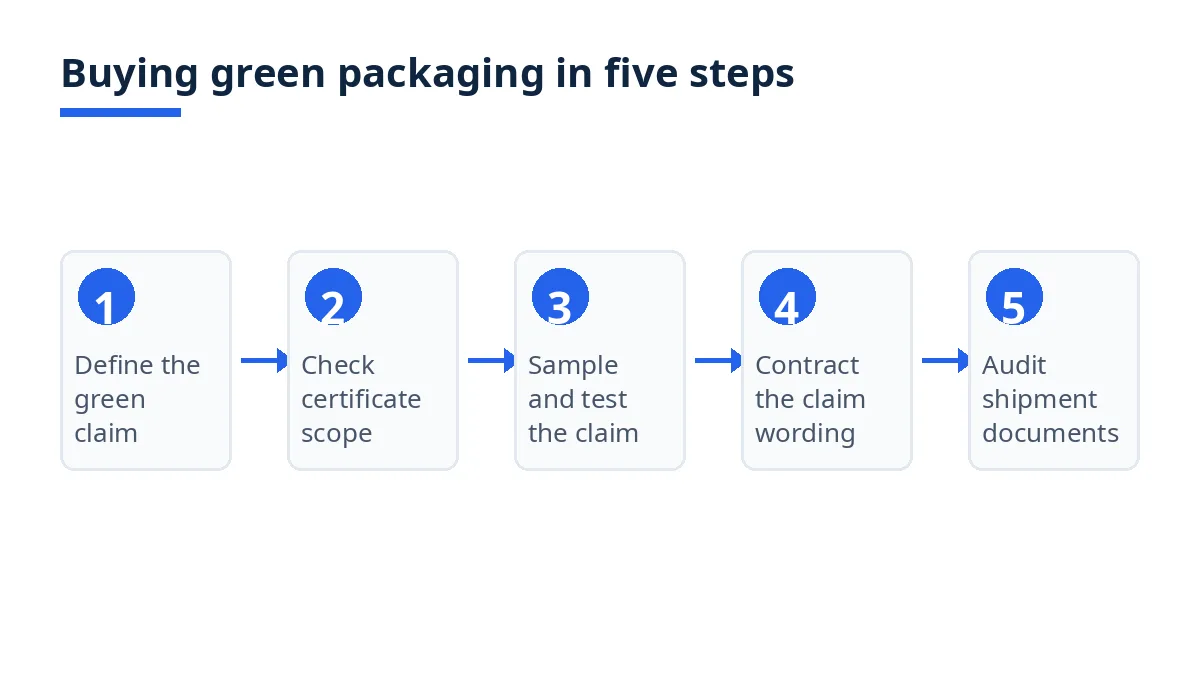
Define the claim before the product. Write the claim first: the scheme or recycled-content percentage, the destination rule it must satisfy, the food-contact position where food is involved, and the exact wording for the pack and the sales documents.
Shortlist and verify suppliers against the claim. Build a shortlist from association lists and supplier listings, confirm the converter is operational and which lines are in-house, then run the certificate checks in the verification section.4 5 On Exportain, read badges for what they are: supplier profiles carry document and photo review badges, and a badge is a document and photo review, not a factory inspection, a certification or a guarantee.11
Sample and test the claim, not only the pack. Order samples against the specification, test production-representative goods for strength, print and food-contact compliance where it applies, and check that the sample's claim documents match the certificate scope for the board used.4 8
Agree commercial and claim terms in writing. Fix MOQ per product, design and claim, itemised unit price with its validity period, the Incoterm with its named place, the staged lead time and its start point, payment terms, the inspection point and the agreed claim wording, all in the purchase order.9
Produce, inspect and ship with the claim file attached. Inspect finished goods against the approved counter-sample and specification, confirm the sales documents carry the agreed claim for that batch, then ship with the origin evidence your duty position depends on.10
Related guides
Read the packaging industry in Bangladesh pillar for the general picture, the jute products industry in Bangladesh pillar for the jute substitution route, how to import from Bangladesh for the import sequence, Bangladesh export data for scale, and Incoterms for shipments from Bangladesh for delivery terms.
FAQs
Is Bangladesh a good place to source packaging, paper & printing?
Bangladesh is a credible sourcing option for green paper packaging where the claim is managed as strictly as the product. Paper and paper products exports were USD 285.83 million in FY2024-25 on the EPB fiscal-year series, then USD 249.01 million in FY2025-26, and the basket of tissue, cups, bags and cartons shipped to more than 50 countries gives a buyer real formats to work with.1 2 The constraints to price in are dependence on imported pulp, gas-exposed mill power, weak enforcement of domestic plastic rules, and the need to re-prove fibre and recycled-content claims on every board lot.1 7 Source claim by claim.
What is the typical MOQ?
There is no published typical MOQ for sustainable packaging from Bangladesh, and no official body sets one. Each supplier quotes its MOQ from its production stage and its claim: a certified-fibre or recycled-board lot minimum, a corrugator and converting minimum per board combination and box size, or a plate, die and print-run minimum per design and colour count. State your target quantity per product, per size, per design and per claim in your enquiry.
How long is the lead time?
There is no standard lead time: yours is the sum of its stages, board purchase and delivery against the claim, plate and die making where they apply, printing, converting, claim paperwork, inspection and booking, and transit. Ask for the stages separately and agree in writing what starts the clock, normally written order confirmation plus approved artwork, approved sample and agreed claim wording.
Which certifications matter?
The requirements that matter are the ones your destination market and your buyers require for the exact product. For fibre sourcing, FSC chain of custody verifies that certified material is identified and separated from ineligible material along the supply chain, and PEFC chain of custody is assessed by a certification body with a site visit, a maximum five-year certificate and annual surveillance audits.4 5 For the EU market, Regulation (EU) 2025/40 requires all packaging to be recyclable, with recyclability grades from 2030 and recycled-at-scale requirements from 2035.6 For food-contact packaging, Regulation (EC) No 1935/2004 requires good manufacturing practice and no transfer of constituents in quantities that could endanger health, change the food unacceptably, or deteriorate its organoleptic characteristics.8 Buyer-named management, environmental or social audits sit on top of the legal and scheme file and do not replace it.
Next steps on Exportain
Post a free RFQ at Exportain RFQs with your specification, your exact green claim wording and your destination market, so packaging suppliers can quote against the same written brief. Browse Bangladeshi suppliers by packaging product to build a shortlist, and use Exportain trade intelligence for the market picture.
Sources
- Export of paper, paper products dips after years of growth. The Financial Express, (accessed )
- Exports of paper, paper products lose steam after three-year growth run. The Financial Express, (accessed )
- Garment accessories sector posts record export earnings. TIMES of Bangladesh, (accessed )
- Chain of Custody Certification. Forest Stewardship Council (accessed )
- How to get PEFC chain of custody certified. PEFC International (accessed )
- The EU Packaging and Packaging Waste Regulation: when will it come into effect and what does it cover?. European Commission (accessed )
- Intent was good, but poor execution failed plastic ban. The Daily Star, (accessed )
- Regulation (EC) No 1935/2004 on materials and articles intended to come into contact with food. European Union, EUR-Lex, (accessed )
- Incoterms 2020. Invest Northern Ireland (accessed )
- EU trade relations with Bangladesh. European Commission, (accessed )
- Supplier verification: Earn trust badges buyers can see. Exportain (accessed )
- Incoterms
- quality control
- Bangladesh Export Data
- Category Pillars
- Supplier Sourcing
- Packaging Bangladesh
- Paper packaging
About the author
Sourcing from Bangladesh?
Post a request for quotation and suppliers on Exportain can send you their quotes directly.
Post an RFQ