The Packaging, Paper & Printing Industry in Bangladesh: Capacity, Clusters and Key Players
Paper and paper products exports were USD 285.83 million in FY2024-25 on the EPB series, after growth from USD 71.44 million in FY2020-21. This pillar guide covers corrugated cartons, paper bags, tissue and printed packaging, clusters, supplier checks, MOQ, compliance, Incoterms and duties.
Short answer
The packaging, paper and printing industry in Bangladesh makes corrugated cartons, folding cartons, paper bags, tissue and printed matter for domestic buyers and export markets. Paper and paper products exports were USD 285.83 million in FY2024-25 on the EPB series. Buyers source it by specifying board grade and print, verifying an operating converter, testing samples, and agreeing MOQ, price, Incoterm and lead time per order.
On this page
Key takeaways
Paper and paper products exports were USD 285.83 million in FY2024-25 on the EPB fiscal-year series, after growth from USD 71.44 million in FY2020-21, before falling to USD 249.01 million in FY2025-26.
Three statistical series must not be blended: the EPB paper and paper products series, industry-source mill capacity of about 1.6 million tonnes against about 0.6 million tonnes of domestic demand, and BGAPMEA's own count of around 1,400 paper packaging factories.
Around 70 of 105 registered private paper mills are reported operational, and BGAPMEA reporting places most accessories and packaging factories in Dhaka, Gazipur, Narayanganj and Chattogram.
There is no industry-wide MOQ, price or lead time for packaging from Bangladesh; all three are quoted per supplier and per product against a written specification.
For food-contact packaging, Regulation (EC) No 1935/2004 requires good manufacturing practice and no transfer of constituents that could endanger health or change the food unacceptably, while FSC chain of custody verifies certified fibre is identified and separated along the supply chain.
The packaging, paper and printing industry in Bangladesh supplies corrugated cartons, folding cartons, paper bags, tissue and toilet paper, paper cups, labels and printed matter to domestic buyers and to export markets. This pillar guide is for importers, brands, retailers and sourcing agents in the United States, the United Kingdom, the European Union and the United Arab Emirates weighing Bangladesh as a packaging origin. It covers the latest export data, products and clusters, supplier checks, MOQ, pricing and lead times, compliance, shipping, Incoterms and duties, and a step-by-step buying process.
Market overview with latest data
Paper and paper products are a small but fast-growing part of Bangladesh's export basket, and the recent record is growth followed by a downturn that buyers should read carefully. On the Export Promotion Bureau (EPB) fiscal-year series, which runs from July to June, export earnings from paper and paper products were USD 71.44 million in FY2020-21, then USD 105.1 million in FY2021-22, USD 229.41 million in FY2022-23, USD 273.06 million in FY2023-24 and USD 285.83 million in FY2024-25.1 Keep this EPB series separate from other counts in this guide: it covers paper and paper products as the EPB reports them, not the wider packaging sector counted by industry associations.
The downturn is visible in the same EPB reporting. Earnings in July to May of FY2025-26 were USD 232.25 million, down 14.44 percent from USD 271.46 million in the corresponding period of FY2024-25, and May earnings fell by around 23.8 percent year on year, to USD 18.36 million from USD 23.9 million.1 A later EPB-based report put full FY2025-26 earnings at USD 249.01 million, down 12.88 percent from USD 285.83 million in FY2024-25, with July to August FY2026-27 receipts down 22.80 percent to USD 35.76 million from USD 46.32 million a year earlier.2 Industry sources cited in that reporting attribute the decline mainly to rising production and operating costs, energy supply problems and global supply chain disruption, with higher freight charges squeezing exporter margins.2 An executive quoted in the earlier reporting added that Bangladesh is largely dependent on pulp imports, and that large mills running captive gas-fired power plants are exposed to gas price rises and supply inconsistency.1
Capacity figures come from a different basis and must not be blended with the EPB export series. According to industry sources reported in September 2026, Bangladesh has 105 registered private paper mills, of which around 70 are currently operational, with estimated annual production capacity of about 1.6 million tonnes against domestic demand of around 0.6 million tonnes.2 The same reporting puts the domestic paper market at around Tk 55 billion, growing at more than 5.0 percent a year on average in recent years, with cumulative investment of roughly Tk 700 billion.2 Registered capacity is therefore not the same as running capacity: a mill count that includes idle plants overstates what a buyer can actually order.
A third, still broader count comes from the packaging association itself and must be kept separate from both series above. The Bangladesh Garments Accessories and Packaging Manufacturers and Exporters Association (BGAPMEA) reported around 1,400 paper packaging factories in operation across the country, supplying packaging worth approximately USD 8 billion a year to the domestic market and exporting goods valued at about USD 1.6 billion a year to destinations including India, Pakistan, Morocco, Tunisia, Spain, the United States and the Middle East.3 That BGAPMEA figure is the association's own count of paper packaging factories, a wider scope than the EPB paper and paper products series, and the two totals cannot be added together or compared as if they measured the same thing. The government declared paper and packaging the Product of the Year 2026 at the Dhaka International Trade Fair in January 2026, a recognition the EPB reporting also notes.1 3
The export basket behind the EPB series is practical rather than commodity-grade. It predominantly consists of tissue paper, toilet tissue, paper cups, paper bags and cartons, shipped to more than 50 countries including the United States, the United Kingdom, Malaysia and South Korea.1 2 That mix matters to a buyer: Bangladesh's packaging offer is strongest in converted paper products and printed packaging for consumer, food and apparel supply chains, not in bulk pulp or unconverted paper grades.
Main products and production clusters
Packaging, paper and printing products are classified across several chapters of the Harmonized System, because the system follows the stage of manufacture and the degree of printing, not the end use alone. In Chapter 48, a reference to paper includes paperboard irrespective of thickness or weight per square metre, and paper or paperboard printed with motifs, characters or pictorial representations that are not merely incidental to the primary use of the goods falls in Chapter 49, except for the goods of headings 48.14 and 48.21.4 The headings you will use most often are:
HS heading | What it covers | Typical Bangladesh products |
|---|---|---|
4804 | Uncoated kraft paper and paperboard, in rolls or sheets | Kraftliner and sack kraft paper for carton and bag making |
4808 | Corrugated paper and paperboard, whether or not perforated | Corrugated board for shipping cartons |
4819 | Cartons, boxes, cases, bags and other packing containers of paper or paperboard | Corrugated shipping cartons, folding cartons, paper bags and sacks |
4821 | Paper or paperboard labels of all kinds, whether or not printed | Printed labels, tags and stickers |
4901 | Printed books, brochures, leaflets and similar printed matter | Books, catalogues, brochures and leaflets |
4911 | Other printed matter, including printed pictures and photographs | Posters, printed cards, calendars and advertising matter |
Agree the six-digit subheading with your supplier and broker for each product before you place the order, because the heading decides which duty line and which product rules customs applies at destination, and because a printed carton can sit in a different chapter from the unprinted board it is made from.4
The product offer follows the headings. Corrugated shipping cartons are the volume line, made from kraftliner and fluting into single-wall and multi-wall board, printed flexographically or offset, die-cut, glued or stitched, and supplied flat for assembly at the buyer's packing line. Folding cartons are the retail line: printed duplex or grey-back board, cut, creased, glued and packed flat for food, pharmaceutical, cosmetic and consumer goods. Paper bags, including kraft carrier bags, SOS bags and food-service bags, are a separate converting line with their own handle, gusset and print requirements. Tissue and toilet paper, paper cups and plates, and printed labels and tags serve consumer and apparel supply chains, where the label and tag trade overlaps with garment accessories. Commercial printing covers books, brochures, leaflets, posters and calendars, where print quality, colour matching and binding matter more than board strength.
Production clusters in the Dhaka region and at the port. BGAPMEA reporting placed most accessories and packaging factories in Dhaka, Gazipur, Narayanganj and Chattogram, with most manufacturers operating as small and medium enterprises rather than large integrated plants.5 That geography follows demand: Dhaka, Gazipur and Narayanganj sit inside the garment and consumer-goods manufacturing belt, so carton, label and bag converters locate near the factories they supply, while Chattogram sits at the port end of the same chain. Paper mills feed the converters from a wider base, and converters that need imported kraftliner and fluting depend on port access for their main input.
Manufacturer types, rather than named company profiles, are the useful way to read capacity. The first type is the integrated or semi-integrated paper mill, which makes paper and board from imported pulp and recovered fibre and sells rolls and sheets to converters. The second type is the independent converter, which buys board and turns it into corrugated cartons, folding cartons, bags or cups, with printing, die-cutting and gluing lines. The third type is the garment-accessories packaging unit, which makes cartons, labels, tags, polybags and related trims for apparel exporters and works to buyer-nominated specifications. The fourth type is the flexible and printed packaging converter, which laminates, prints and pouches films and paper-based laminates for food and personal care. The fifth type is the commercial printer, which prints books, brochures and advertising matter on sheet-fed or web presses. Match the supplier type to the product stage: a paper mill is the right source for board, and the wrong source for a printed retail carton, while a garment-accessories unit is the right source for an apparel carton programme and the wrong source for a food-grade cup.
How to find and verify suppliers
Find suppliers through more than one channel so you can cross-check what a converter tells you. Start with the BGAPMEA and paper-mill association lists, add Bangladesh export data and Exportain trade intelligence for market context, then work Bangladeshi suppliers listings by product and ask each candidate for its current export markets and reference products in your heading.
Verification is a document exercise first and a visit exercise second. Ask for, and read, the following before you discuss price in detail:
Trade licence and export registration, in the company's own name, plus the factory address and the lines actually installed there.
Association membership, where claimed, and the mill or converter's operating status, against the picture of around 70 operational mills out of 105 registered private mills.2
Export history: anonymised bills of lading or shipment summaries for your target market, showing heading, volume and recency.
The board or paper source behind your product, including liner and fluting grade, grammage and recycled content, because carton strength is decided at board level.
Test reports for the exact construction you plan to buy, including burst, edge-crush and print-rub results where the product needs them, and food-contact evidence where the pack touches food.
Production evidence: converting, printing, die-cutting and gluing capacity per day, and whether printing, lamination or finishing is in-house or subcontracted.
On Exportain, read badges for what they are. Supplier profiles carry document and photo review badges: verification is free, Exportain staff review every submission, and approved checks earn the badges shown on the company page, product listings and quotations. It is a document and photo review, not a factory inspection, and membership plans are a separate product that never grant a trust badge.6 Use the badge as a first filter, then run the document checks above yourself or through an inspection firm you appoint.
Two red flags end a conversation early: a converter that quotes a firm price before it has seen your board grade, print artwork and die-line is not pricing your carton, and a supplier that cannot state whether its mill or converting line is currently operational, when around a third of registered private mills are reported idle, has not answered the first capacity question.2
MOQ, pricing and lead times
There is no industry-wide MOQ, standard price or standard lead time for packaging from Bangladesh, and no official body publishes one. All three are quoted per supplier, per product and per order, against a written specification. What follows is how each of the three is built, so you can compare quotes on equal terms.
MOQ. The minimum order quantity is set by the production stage, not by the buyer's carton count. A board order carries the mill's minimum per grade and grammage; a corrugated order carries corrugator and converting minimums per board combination and box size; a printed folding carton or label order carries plate, die and print-run minimums per design and colour count. State your target quantity per product, per size and per design in your enquiry and ask the supplier to quote its MOQ on the same basis, so two suppliers answer the same question.
Pricing. Your unit price is built from board or paper grade and grammage, the share of imported versus local fibre, print colours and plates, die and tooling, converting and gluing, packing into bundles or pallets, and export costs to the agreed Incoterm point. Because Bangladesh depends heavily on imported pulp and kraft inputs, board prices move with import costs and energy costs, and exporters cite rising input, energy and freight costs as the pressure on margins.1 2 Compare quotes only at the same Incoterm and specification, and ask each supplier to state the board grade, grammage and price-validity period in writing.
Example figures. For illustration only: a buyer's specification for 10,000 printed corrugated shipping cartons is quoted by two suppliers at the same Incoterm, FOB Chattogram. Supplier A quotes USD 0.85 per carton itemised as board USD 0.52, converting and printing USD 0.21 and packing and export costs USD 0.12. Supplier B quotes USD 0.78 per carton with no itemisation. The worked example totals are USD 8,500 from Supplier A and USD 7,800 from Supplier B. The example shows the method, not a market price: the buyer asks Supplier B for the same itemisation, and for the board grade and grammage behind the quote, before treating the USD 700 gap as a saving, because an unitemised gap on a corrugated carton is usually a lighter board or a cheaper print method.
Lead times. A lead time is a chain, not a single number: board purchase and delivery, plate and die making where they apply, printing, converting, inspection and booking, then transit. Where board is imported, the board stage is the long pole, and a supplier that holds board stock can quote a shorter lead time than one that orders it per job. Ask for the lead time broken into its stages, with the board stage stated separately, and agree what starts the clock, normally written order confirmation plus approved artwork and sample, not the first enquiry.
Quality, certifications and compliance
Quality in packaging is decided by three layers: the destination market's product law, the product-specific standard or certification your goods are sold against, and your own specification and testing.
Food-contact packaging. Where paper or board packaging touches food, the EU framework regulation requires that materials and articles be manufactured in compliance with good manufacturing practice so that, under normal or foreseeable conditions of use, they do not transfer their constituents to food in quantities which could endanger human health, bring about an unacceptable change in the composition of the food, or bring about a deterioration in its organoleptic characteristics.7 Write the food-contact requirement into the purchase specification, require a declaration of compliance and test evidence for the production batch, and confirm which destination-market rules apply for the exact food type and contact condition, because food-contact rules for paper and board vary by market and by use.
Fibre sourcing claims. Forest Stewardship Council (FSC) chain of custody certification verifies that FSC-certified material has been identified and separated from ineligible and unacceptable material as it makes its way along the supply chain from the forest to the market.8 The same certification covers single-site, multi-site and group organisations, and certificate holders must implement core labour requirements demonstrable to external auditors.8 An FSC claim therefore needs a certificate scope that covers the supplier's site and product group, and the claim stated on the sales documents for your order. FSC certification on its own says nothing about food safety, recyclability or carton strength, so treat it as a fibre-sourcing claim and test the pack separately.
Your own quality system. Write the specification so an inspector can measure it: board grade and grammage, flute type, box dimensions and tolerances, print colours and placement, glue or stitch method, bundle and pallet packing, and the sampling plan for the order. Approve a pre-production sample and a counter-sample, set the inspection point before cartons are bundled and palletised, and test production-representative goods, not showroom samples, for burst and edge-crush strength, print adhesion and, where it applies, food-contact compliance.
Shipping, Incoterms and duties
Packing drives the freight economics of packaging exports, because cartons and bags are bulky relative to weight. Confirm bundle or pallet dimensions, pieces per bundle or pallet, and whether cartons ship flat or erected, in the specification, because those numbers set your freight cost per unit under any Incoterm.
Incoterms 2020 is the current edition of the ICC rules, in force since 1 January 2020. The rules are eleven three-letter trade terms that clarify the tasks, costs and risks involved in the delivery of goods from sellers to buyers, and they are recognised as the global standard for interpreting the most common terms in foreign trade.9 In your own words, the four rules you will meet most often on packaging orders work as follows:
Rule | Who arranges and pays main freight | Where risk passes to the buyer | Practical note for packaging |
|---|---|---|---|
EXW (Ex Works) | Buyer | At the seller's premises | Buyer carries export clearance workload; rarely suitable for a first order |
FOB (Free On Board) | Buyer | When goods are on board the vessel at the named loading port | The common Bangladesh packaging term; name the port, for example FOB Chattogram, Incoterms 2020 |
CIF (Cost, Insurance and Freight) | Seller, plus minimum insurance | When goods are on board at the loading port | Seller's freight is convenient, but risk still passes at loading, not at arrival |
DAP (Delivered at Place) | Seller | At the named destination place, ready for unloading | Buyer still clears import and pays duty unless the contract says otherwise |
Always write the rule with its named place and edition, for example "FOB Chattogram, Incoterms 2020".
Duties are decided by the heading from the products table, the origin of the goods and the destination's preference scheme, in that order. As a least developed country, Bangladesh benefits from the Everything But Arms (EBA) arrangement under the EU's Generalised Scheme of Preferences, which grants duty-free, quota-free access to the EU for exports of all products except arms and ammunition, and Bangladesh is the largest beneficiary under the arrangement, with EUR 19 billion in exports benefitting from these preferences in 2024 at a 96 percent utilisation rate.10 Packaging that meets the EBA rules of origin and is shipped with the required proof of origin therefore enters the EU without customs duty while Bangladesh holds that status. Two cautions apply. First, preference is a property of the consignment, not the country: if the origin evidence fails, the standard third-country duty for the heading applies. Second, confirm the preference position at the entry date for every destination, because preference schemes and their conditions change. For the United States, the United Kingdom and the UAE, read the duty beside your confirmed six-digit code in the destination tariff for the entry date; this guide states no rate for them, because packaging rates vary by heading.
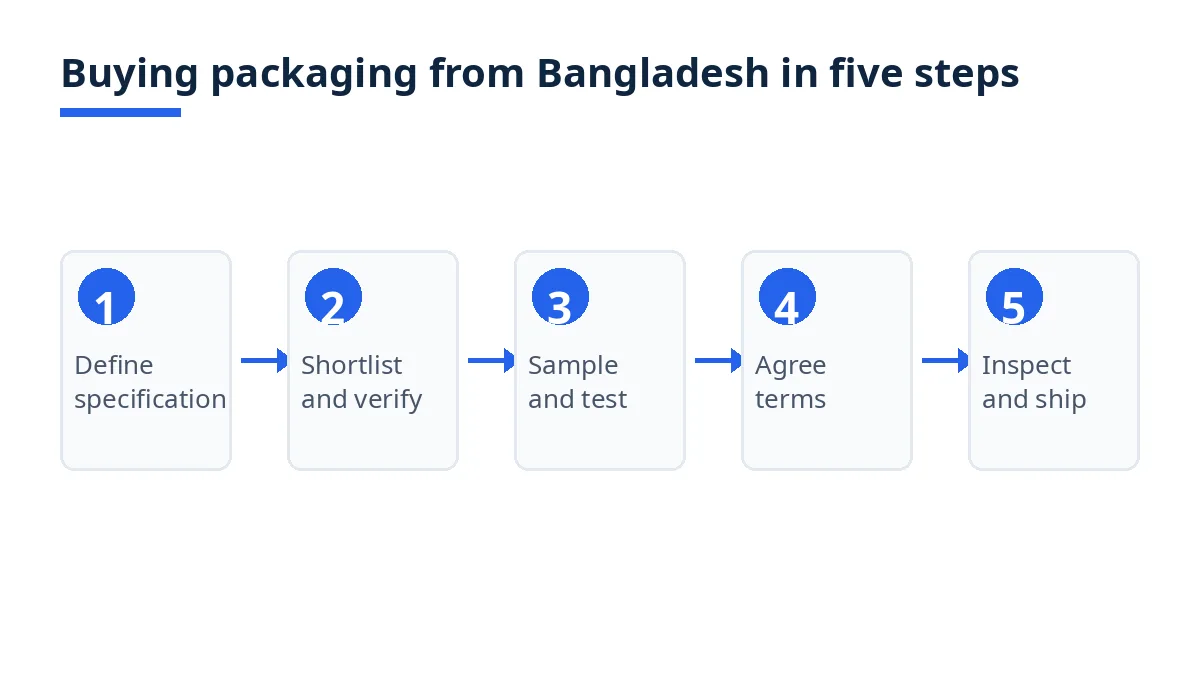
The buying process below pulls these threads together.
Step-by-step buying process
Define the specification. Write the product before you shop for it: HS heading, board grade and grammage, box dimensions and flute, print colours and artwork, packing, target quantity per product and design, and destination market.
Shortlist and verify suppliers. Build a shortlist from association lists and supplier listings, confirm the mill or converter is operational and which lines are in-house, then run the document checks in the verification section.2 6
Sample and test. Order samples against the specification, test production-representative goods for strength, print and food-contact compliance where it applies, and approve a counter-sample in writing.7 8
Agree commercial terms in writing. Fix MOQ per product and design, itemised unit price with its validity period, the Incoterm with its named place, the staged lead time and its start point, payment terms and the inspection point, all in the purchase order.9
Produce, inspect and ship. Monitor the board and printing stages first, inspect finished goods against the approved counter-sample and specification, then ship with the origin evidence your duty position depends on.10
Related guides
Read how to import from Bangladesh for the general import sequence behind the packaging steps above, Bangladesh export data for category scale, and the guide to Incoterms for shipments from Bangladesh, which works through the delivery terms in more detail.
FAQs
Is Bangladesh a good place to source packaging, paper & printing?
Bangladesh is a credible sourcing option for converted paper packaging, cartons, bags, tissue and printed matter where the board grade, print specification and compliance file are managed actively. Paper and paper products exports were USD 285.83 million in FY2024-25 on the EPB fiscal-year series, after growth from USD 71.44 million in FY2020-21, and the export basket is led by tissue, toilet tissue, paper cups, paper bags and cartons shipped to more than 50 countries.1 2 The constraints to price in are the FY2025-26 downturn, dependence on imported pulp and board inputs, and idle capacity among registered mills.1 2 Source converter by converter, not on the country label.
What is the typical MOQ?
There is no published typical MOQ for packaging from Bangladesh, and no official body sets one. Each supplier quotes its MOQ from its production stage: a mill minimum per board grade and grammage, a corrugator and converting minimum per board combination and box size, or a plate, die and print-run minimum per design and colour count. State your target quantity per product, per size and per design in your enquiry, so quotes can be compared directly.
How long is the lead time?
There is no standard lead time: yours is the sum of its stages, board purchase and delivery, plate and die making where they apply, printing, converting, inspection and booking, and transit. Where board is imported, the board stage is the longest stage, and a supplier holding board stock can quote a shorter lead time than one ordering per job. Ask for the stages separately and agree in writing what starts the clock, normally written order confirmation plus approved artwork and sample.
Which certifications matter?
The requirements that matter are the ones your destination market and your buyers require for the exact product. For food-contact packaging, the operative EU framework is Regulation (EC) No 1935/2004: materials must be manufactured under good manufacturing practice and must not transfer constituents to food in quantities that could endanger health, change the food's composition unacceptably, or deteriorate its organoleptic characteristics.7 For fibre sourcing, FSC chain of custody certification verifies that certified material is identified and separated from ineligible material along the supply chain from forest to market, with a certificate scope covering the supplier's site and product group.8 Buyers may also name management, environmental or social audits in their own vendor manuals; those audits sit on top of the legal file and do not replace it.
Next steps on Exportain
Browse Bangladeshi suppliers by packaging product, use Exportain trade intelligence to check the market picture behind this guide, and post a free RFQ at Exportain RFQs with your specification, target quantity and destination market so packaging suppliers can quote against the same written brief.
Sources
- Export of paper, paper products dips after years of growth. The Financial Express, (accessed )
- Exports of paper, paper products lose steam after three-year growth run. The Financial Express, (accessed )
- Paper packaging declared Product of the Year. TIMES of Bangladesh, (accessed )
- Harmonized System: Chapter 48 notes. World Customs Organization (accessed )
- Apparel accessories makers eye doubling exports in four years. The Financial Express, (accessed )
- Supplier verification: Earn trust badges buyers can see. Exportain (accessed )
- Regulation (EC) No 1935/2004 on materials and articles intended to come into contact with food. European Union, EUR-Lex, (accessed )
- Chain of Custody Certification. Forest Stewardship Council (accessed )
- Incoterms® rules. International Chamber of Commerce (ICC) (accessed )
- EU trade relations with Bangladesh. European Commission, (accessed )
- Incoterms
- quality control
- Bangladesh Export Data
- Category Pillars
- Supplier Sourcing
- Packaging Bangladesh
- Paper packaging
About the author
Sourcing from Bangladesh?
Post a request for quotation and suppliers on Exportain can send you their quotes directly.
Post an RFQ