Top Potatoes Manufacturers in Bangladesh: How to Find and Verify Them
Sort potato manufacturers by type, check their cold storage, grading line, papers and shipment history, and test a new firm with a small inspected trial order.
Short answer
To find potato manufacturers in Bangladesh, sort firms by type — grower-packer, cold-storage operator, trader-exporter or processor — then check the variety and end use, chamber capacity and temperature logs, the grading and packing line, and the firm's papers and recent shipments. Ask for a current ERC, trade licence, e-TIN and BIN, and place a trial order with a third-party inspection before paying the balance.
On this page
Key takeaways
Sort potato firms by type first: grower-packer, cold-storage operator, trader-exporter or processor, since each one controls a different part of the lot.
Bangladesh has about 365 private cold stores holding about 3.2 million tonnes against 11.5 million tonnes of production, so secure chamber space is a real constraint.
Hold ware potatoes at 4 to 8 degrees Celsius, seed at 3 to 5 degrees and processing potatoes at no less than 7 to 10 degrees, per FAO guidance.
Check the ERC, trade licence, e-TIN, BIN and chamber membership, with names, addresses and dates matched across every document.
Test a new manufacturer with a trial order and a third-party inspection, paying the balance only after the inspection report arrives.
A potato manufacturer in Bangladesh is rarely one kind of business. Some firms grow the crop and pack it themselves, some run cold stores and assemble loads from many growers, and some trade without owning a field or a chamber. Your job as a buyer is to work out which kind you are dealing with, what that firm can actually handle, and which papers back up its claims.
Bangladesh grows far more potatoes than it eats. Growers lifted 11.57 million tonnes in 2024-25, a record harvest from 4.92 lakh hectares, while home demand sits just above 9 million tonnes, with about 1 million tonnes of that kept back for seed.1 Only about 62,000 tonnes left the country in that year.1
What kinds of potato manufacturers will you meet?
Four shapes of business dominate the trade, and each one carries a different risk.
A grower-packer farms its own land, lifts its own crop and grades and packs on site. It controls variety and harvest timing, but its volume is limited to its own fields.
A cold-storage operator owns chambers and takes in potatoes from growers, traders and other packers. It can build a large lot from many sources and hold it for months, but it may not control what went into the store.
A trader-exporter buys from growers and cold stores, then grades, packs and ships under its own name. It is flexible on volume and variety, but you are relying on its buying judgment and its packing line rather than on its own fields.
A processor turns potatoes into chips, crackers and other products, buying for fry quality.
Ask every candidate which of these it is, and what share of a typical export lot comes from its own fields, its own store, or bought-in stock.
Where do export potatoes come from?
Export lots are drawn mainly from the northern and central growing belts: Rangpur, Thakurgaon, Dinajpur and Joypurhat in the north, Bogura in the centre-north, and Munshiganj near Dhaka, along with Jessore, Rajshahi, Chuadanga, Narsingdi and Meherpur.2
Lifting runs from mid-January into March. After March, everything a buyer receives has spent time in storage. In August 2025, months after lifting ended, cold stores still held 2.9 million tonnes.1
Which varieties should a manufacturer be able to supply?
Match the variety to the end use before you ask for a quotation. Table buyers want a firm, even-skinned tuber that holds up in a retail pack. Fry and crisp buyers want a variety that stays pale in the fryer after months in store. Seed buyers want tubers from a known seed class, not ware potatoes relabelled as seed.
Diamond, Granola and Asterix lead the export trade. In Gopalganj, the Bangladesh Agricultural Development Corporation (BADC) backed a 40-acre export crop split across 20 acres of Diamond, 10 acres of Asterix and 10 acres of Granola, targeting 260 tonnes sorted for export from a crop of more than 400 tonnes.3
Sunshine is a newer export name from BADC, liked by buyers for its size and colour.4 Lady Rosetta and Santana are the processing names to ask about.
Seed is a separate question from ware. BADC produces foundation seed and works through contract growers for certified seed, so ask a seed supplier which class it holds.
How do you judge cold storage capability?
Storage is where most export lots are made or lost. Bangladesh has about 365 privately owned cold stores with combined capacity of about 3.2 million tonnes, against annual production of about 11.5 million tonnes.5 That gap leaves roughly 3.5 million tonnes exposed to spoilage for want of a chamber.5
Judge a store on four points. First, capacity against your order: a chamber that holds 5,000 tonnes can serve a 100-tonne order easily. Second, temperature by end use. The Food and Agriculture Organization puts seed potatoes at 3 to 5 degrees Celsius, ware potatoes at 4 to 8 degrees, and processing potatoes at no less than 7 to 10 degrees, with relative humidity between 90 and 96 per cent.6 Third, curing: fresh wounds heal when tubers spend their first one to two weeks at 13 to 20 degrees Celsius and 90 to 95 per cent humidity.6 Fourth, records: temperature logs, intake dates and lot numbers that let you trace a bag back to one chamber and one intake week.
Ask for the temperature log of the chamber holding your lot for the last four weeks, and see whether the numbers stay inside the band for your end use. Below about 3 degrees, tubers turn sweet, and a processing lot held cold will darken in the fryer.6 Stores must also stay dark, since light turns tubers green and bitter, so a proper store has no windows and light traps on its vents.6
What should the grading and packing line be able to do?
A packing line turns a field crop into a graded export lot, and its limits set the quality you receive. Walk the line, or ask for a video walk-through with the line running.
Sorting comes first: damaged, diseased and green tubers are pulled out before grading. Grading follows, with tubers split into size bands agreed in writing. Packing comes last: bags or cartons carry the variety, the size band, the lot number and the net weight, plus the origin country.
Ask how many tonnes the line can grade and pack in a working day, and how many days your order would take. Ask which size bands it runs and whether it can hold them lot after lot, how defect limits are set and who checks them during the run, and what happens to tubers that fail the grade.
Which documents show a manufacturer can export?
Paperwork does not prove quality, but it does prove that a firm is set up to export legally. Check the dates, and match the names and addresses across the copies.
Document | What it shows | Who issues it |
|---|---|---|
Trade licence | The business is licensed to trade from its stated address, renewed yearly7 | City corporation, municipality or union parishad |
e-TIN certificate | The business is registered for income tax7 | National Board of Revenue (NBR) |
BIN certificate | The business holds a VAT registration number7 | NBR, through the VAT online system |
Export Registration Certificate (ERC) | The business is registered as an exporter, the first step under the Export Policy 2024-278 | Office of the Chief Controller of Imports and Exports (CCI&E) |
Chamber or association membership | The business belongs to a recognised chamber or trade body7 | Chamber of commerce or trade association |
Factory registration | A factory or packing site is registered as an establishment7 | Department of Inspection for Factories and Establishments (DIFE) |
Phytosanitary certificate | The consignment meets the importing country's plant-health rules7 | Plant Protection Wing, Department of Agricultural Extension (DAE) |
Food safety certificate | The food handling meets national safety rules, where needed7 | Bangladesh Food Safety Authority (BFSA) |
Check the ERC first. It is filed online through CCI&E, renewals can run for any full term from one to five years, and the holder should apply at least 60 days before expiry to avoid a penalty.8 Customs lists the ERC and the BIN among its general export documents, alongside the sales contract or letter of credit, the EXP form, the commercial invoice and the packing list.8 If the ERC has lapsed, or the name on it differs from the name on the quotation, stop and ask why.
Confirm the HS code on every document matches: ware potatoes fall under HS 0701.90, and our HS code guide for potatoes explains the classification. Export proceeds must reach Bangladesh within four months of shipment unless Bangladesh Bank allows otherwise.8
How do you check a manufacturer's export track record?
A track record is not a list of countries on a website. It is a set of shipments you can trace. Malaysia takes about 80 per cent of Bangladesh's potato shipments, and the trade reaches 14 countries in total, including Singapore, Nepal, Sri Lanka and several Middle Eastern markets.4
Potato exports through Chattogram port reached 40,543 tonnes in 2024-25, against 11,127 tonnes the year before, and 20,000 tonnes also crossed the Banglabandha land port into Nepal.2 Ask a candidate how many tonnes it shipped in the last two seasons, through which port, and to which markets. Then ask for the bill of lading numbers or the phytosanitary certificate numbers for two recent shipments, with the buyer's name blanked out. A firm with real shipments can produce these.
A seven-step check before you place an order
The diagram below sets out the sequence.
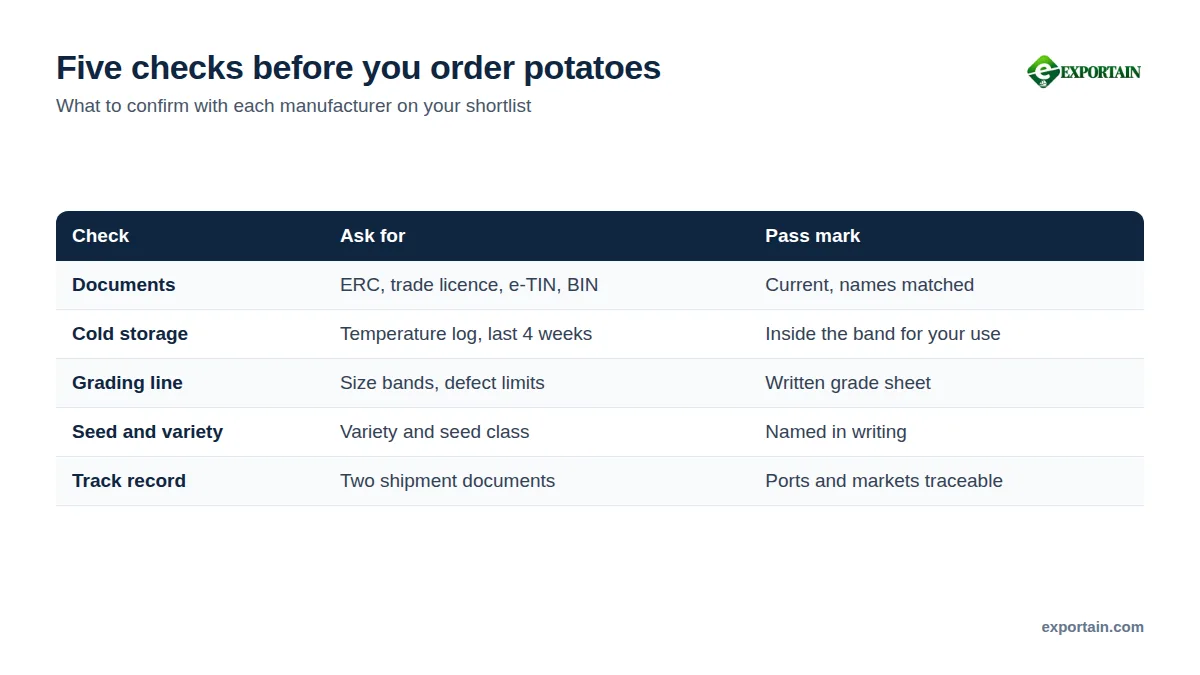
Sort the candidates by type: grower-packer, cold-storage operator, trader-exporter or processor, and keep only the types that fit your order.
Confirm the variety and end use in writing, with the seed class named where seed is involved.
Check the papers: trade licence, e-TIN, BIN, ERC, chamber membership and factory registration, with dates and names matched.
Inspect the store: chamber capacity, temperature logs for your end use, curing practice and lot traceability.
Inspect the grading and packing line: size bands, defect limits, pack sizes and daily throughput.
Test the track record: recent shipment volumes, ports, markets and two traceable shipment documents.
Place a trial order with a third-party inspection at packing or loading, and pay the balance only after the inspection report is issued.
A worked example: testing a new manufacturer with a trial order
Example figures: a buyer in Singapore wants Diamond table potatoes for retail packs and has shortlisted a trader-exporter in Munshiganj. The buyer starts with a trial order of 50 tonnes, split into two loads of 25 tonnes a week apart.
The firm sends its trade licence, e-TIN, BIN, ERC and chamber membership, all current and in the same company name. Its store holds the lot at 4 to 8 degrees Celsius, the band for ware potatoes, and the temperature log for the past four weeks stays inside that band.6
A third-party inspector checks the first load at the packing point against the agreed size band and defect limits, and the buyer pays the balance for that load only after the report arrives. Use our potato quality control checklist to set the inspection points. The second load ships only if the first load's report is clean. For the wider steps around the shipment itself, read our import guide for potatoes, and for inspection setup, see our pre-shipment inspection guide.
Warning signs that should slow you down
Slow down, ask for proof, or walk away when you see these signals.
The firm cannot name its type, its fields, its chambers or its packing line, and answers every question with a general assurance.
The ERC, trade licence or BIN is expired, or the names and addresses differ across documents without explanation.
The firm claims year-round supply of a variety it cannot show in store, or claims a market no other Bangladeshi exporter serves without a shipment document to back it.
The grade is stated only as "good quality" with no size band and no defect limit in writing.
The firm asks for full payment before any inspection, or refuses a third-party inspection at packing or loading.
Next steps on Exportain
Put together a short list of potato suppliers on Exportain, then compare what each one actually runs: its fields or chambers, its grading line, its papers and its recent shipments. Once the list is down to two or three firms, send a request for quotation that states the variety, the end use, the size band, the pack and the delivery month, and ask each firm to answer the seven checks above in writing. Before you pay anything, read our letter of credit guide and our fresh vegetables import guide.
Sources
- Potato output hits historic high, raises concerns of surplus. The Daily Star, (accessed )
- Vegetable exports quadruple amid stable local market. The Business Standard, (accessed )
- BADC promotes cultivation of export quality potatoes in Gopalganj district. FreshPlaza (accessed )
- Potato exports surge fourfold in FY 2025. The Financial Express, (accessed )
- Low-cost attic storage method for potatoes gains ground, 653 units built nationwide. The Business Standard, (accessed )
- Crop handling, conditioning and storage: semi-perishable crops. Food and Agriculture Organization of the United Nations (accessed )
- A guide to trade licences, tax registration and other permits for Bangladeshi businesses. DHL (accessed )
- Start an Export Business in Bangladesh (2026 Guide). Entrepreneurs.bd (accessed )
- export documents
- supplier verification
- Bangladesh exports
- potato manufacturers
- potatoes Bangladesh
- potato exporters
- cold storage
- potato grading
About the author
Sourcing from Bangladesh?
Post a request for quotation and suppliers on Exportain can send you their quotes directly.
Post an RFQ