How to Import Instant Noodles From Bangladesh in 2026: Complete Buyer Guide
Fix the noodle specification first — BDS 1552, Codex limits, seasoning sachets, halal papers and pack format — then order instant noodles from Bangladesh with samples tested before you pay.
Short answer
To import instant noodles from Bangladesh, fix the specification first: BDS 1552:2015 and Codex CXS 249-2006 limits for moisture and acid value, the noodle block weight, the seasoning sachets, the pack format and the halal certificate. Classify the goods under HS 1902.30, check the BSTI mark and the label, approve lab-tested samples, and ship FOB Chattogram or CIF to your port with the invoice, packing list, certificate of origin and halal papers.
On this page
Key takeaways
Agree the specification before the price: BDS 1552:2015, Codex moisture and acid value limits, block weight, seasoning sachets and pack format.
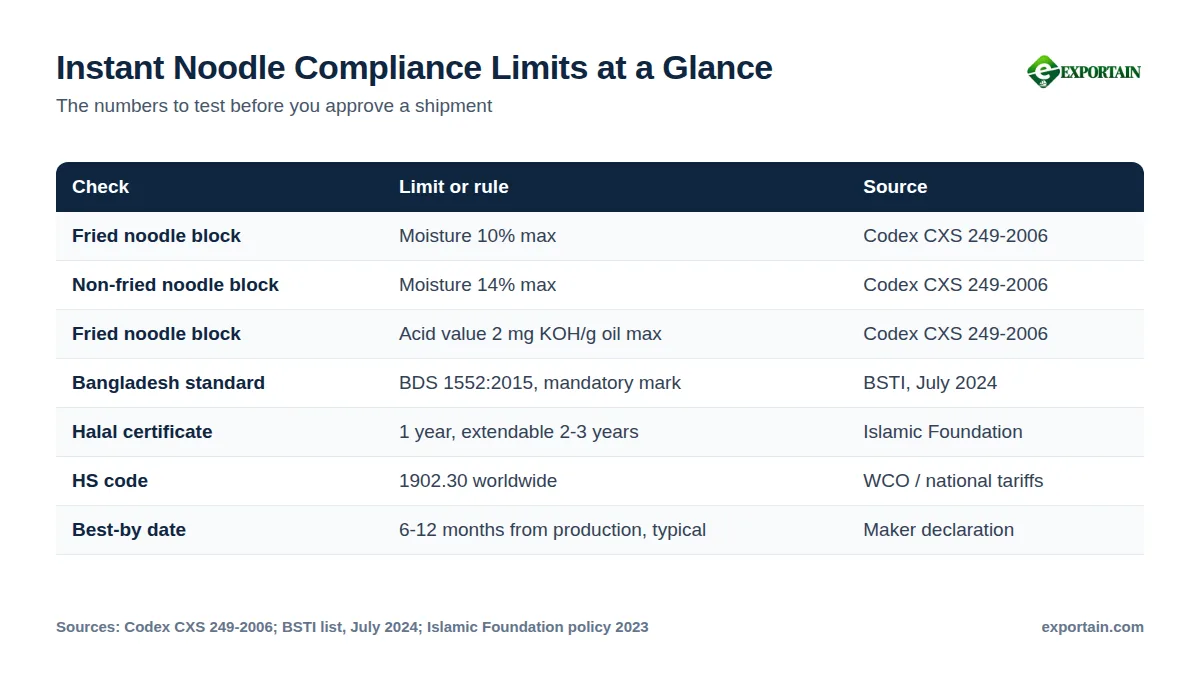
Fried noodle blocks must stay at or below 10 per cent moisture and an acid value of 2 mg KOH/g oil under Codex CXS 249-2006; non-fried blocks allow 14 per cent moisture.
For Muslim markets, get a Bangladesh Islamic Foundation halal certificate that names the exact SKU and flavour, and check its expiry date.
Instant noodles clear customs under HS 1902.30 worldwide, with the seasoning sachets inside the same code.
World demand for instant noodles reached 124.21 billion servings in 2025, up about 0.7 per cent on the year before, according to the World Instant Noodles Association, with China and Hong Kong taking 43.27 billion servings, Indonesia 14.54 billion and India 9.60 billion.1 This guide starts with the specification, the halal papers and the label, before any talk of price.
The specification sheet: agree these numbers before you ask for a price
A noodle order goes wrong most often in the specification, not in the shipping: one maker quotes a 60-gram block and the other an 80-gram block, or one includes an oil sachet and the other does not. Put the items below on a one-page sheet and send it with the request for quotation.
Spec item | State it as |
|---|---|
Noodle block | Fried or air-dried, flour, block weight |
Flavour | Flavour, seasoning weight, oil weight, garnish weight |
Fortification | Nutrient, level per serving, label declaration |
Pack format | Packet, multi-pack, cup, bowl, packets per carton |
Shelf life | Best-before months, life left on arrival |
Label language | Market language plus Bengali where required |
Standard | BDS 1552:2015 and Codex CXS 249-2006 |
Halal | Body, number, expiry date |
Ask for the sheet back with the quotation, signed and dated. The diagram below sets out the compliance limits.
Fried or air-dried: which noodle block suits your market?
Codex treats an instant noodle as a product made from wheat flour, rice flour or other flours and starches, shaped by a pregelatinization step and dried by frying or by another method, in two styles: fried noodles and non-fried noodles.2 A fried block is cooked in hot oil, giving it a springy bite and a fast cooking time, while an air-dried block carries less oil and cooks a little slower, with a firmer bite. Ask which style the maker's line runs, because a factory set up for frying cannot switch to air-drying for one order.
Under Codex, the moisture limit for the noodle block, measured without the seasonings, is 10 per cent for fried noodles and 14 per cent for non-fried noodles, and the acid value limit of 2 mg KOH/g oil applies only to fried noodles.2
How do BSTI and Codex set the limits you test against?
The first is the Bangladesh standard BDS 1552:2015, Instant Noodles (2nd Revision), which sits on the Bangladesh Standards and Testing Institution list of products under the mandatory Certification Marks scheme.3 Ask for the licence number and look for the mark on the pack.
The second is Codex CXS 249-2006, which sets the composition, quality criteria and labelling rules most destination markets recognise.2 Under it, the essential ingredients are flour or starch and water, the block must be free from foreign matter, and the product name is "Instant Noodle(s)", or "Fried Noodle(s)" or "Non-fried Noodle(s)" where the style applies.2 Fortification earns one line on the sheet: BSTI lists standards for fortified wheat atta (BDS 1793:2008), fortified maida (BDS 1794:2008) and fortified rice (BDS 1897:2022), so a maker can build a fortified noodle block where the buyer asks for it.3 Name the nutrient and its level per serving, and have it declared per 100 g on the label.4
What goes into the seasoning sachets, and what must the label say?
A packet is two products in one wrapper: the noodle block and the sachets. Codex covers noodles packed with seasonings, or seasoned noodles with or without garnish in separate pouches.2 A typical set is a powder seasoning sachet, an oil sachet and, in some flavours, a dried garnish sachet. Weigh each sachet in the sample. Monosodium glutamate, INS 621, is listed among the flavour enhancers in the Codex standard, so state your position on added MSG on the sheet, and have the frying oil named in the ingredients.2
The label is where a noodle order is most often held at a border. Under the Bangladesh Safe Food (Packaged Food Labelling) Regulations, 2017, a label must carry the name of the food, the ingredients, the net weight, the batch number, the manufacturer name and address, the manufacture and packaging dates, the expiry or best-before date, the nutrition information and the additives used.4 Food made in Bangladesh is labelled in Bengali, with a foreign language allowed beside it, and food for export is labelled to meet the demand of the buying country or region.4 The regulations also list the allergens that must be declared, including wheat, egg, milk, sulphite at 10 mg per kilogram or more, mustard, sesame and soybean.4 Our biscuits and cookies import guide shows how BSTI marks and label checks work on another packaged food from Bangladesh.
Halal papers for Muslim markets: which certificate, and from whom?
For buyers selling into the Gulf, Malaysia, Indonesia or other Muslim markets, halal is a buying condition, not a marketing line. Bangladesh framed its first policy on halal certification in 2023, under the Bangladesh Islamic Foundation, which issues certificates and the official halal logo on behalf of the government.5 The certificate runs for one year at first and can be extended by two to three years, and the process runs through an application, a factory visit, sample testing and a committee decision, taking about two months.5 The Islamic Foundation had granted certificates to about 179 companies since 2007.5
Two checks matter most. First, the certificate must name the exact product and flavour, because a certificate for chicken masala noodles does not cover a beef flavour or a new shrimp variant. Second, confirm the scope covers the ingredients: no raw material, ingredient or additive that is not halal under shariah may be used, and no halal item may be produced, processed, packaged, stored or transported along with items prohibited by Islamic law.5
Which pack formats travel best, and how long do they keep?
Instant noodles leave Bangladesh as single packets, multi-packs, cups and bowls. Packets stack flat and dense, so a container holds more servings per cubic metre. Cups and bowls need a sturdier outer carton and more container space per serving, and a crushed cup is unsellable, so agree the carton strength and the stacking limit in the order.
Shelf life is set by the maker and printed as a best-before date, typically 6 to 12 months from production, marking peak quality rather than a hard safety line.6 The frying oil is the weak point: over time it oxidises and turns stale or rancid, and heat, light, moisture and oxygen all speed that up.6 The seasoning sachet fails first in damp air, because its salts draw in moisture and the powder clumps and loses strength, and cool, dark and dry storage below 75 degrees Fahrenheit keeps the fats stable.6 Codex requires the packaging to safeguard the hygienic, nutritional, technological and organoleptic qualities of the product.2 Set a minimum remaining shelf life on arrival, and refuse damp or punctured cartons.
How do you find and check a noodle maker in Bangladesh?
Start with the paper, not the price. A maker worth a trial order can show a BSTI certification mark licence for BDS 1552:2015, a halal certificate where your market needs one, a specification sheet, and lab reports for moisture and acid value on a recent batch.3 2 Then order samples in the exact format, flavour and pack size you plan to buy, cook them to the printed directions, weigh the block and each sachet, and read the label against your market rules.
Our guide to finding suppliers in Bangladesh sets out the checks to run on any maker before a first order, and the general guide to importing from Bangladesh covers the wider steps around the order. Agree the minimum order, the price per carton, the lead time, the payment term and the inspection point in the same document as the specification. A letter of credit is the usual payment instrument for a first order.7
How does a noodle order move from sample approval to loading?
A noodle order runs in seven steps.
Send the specification sheet and the request for quotation, with format, flavour, quantity and destination port.
Compare quotations per carton and per serving, not per packet.
Approve the samples: lab test the block for moisture and acid value, cook-test the flavour, and proofread the label.
Freeze the specification in writing, with payment and inspection agreed.
Production runs, with the maker holding back a sealed reference sample.
A pre-shipment check weighs cartons, counts packets and reads the best-before dates.
Loading follows, with documents checked against the goods first.
Keep a sealed sample from the bulk batch yourself. For the delivery term, read our Incoterms guide before you fix FOB Chattogram or CIF to your port.
Which documents travel with a noodle shipment?
The document set for a processed food is short, but every document must carry the same product name, quantity and code, and the invoice must show the Export Registration Certificate number and the HS code.7
Document | What to check |
|---|---|
Commercial invoice | ERC number and HS 1902.30 shown |
Packing list | Carton count, packets per carton, net and gross weight |
Bill of lading or air waybill | Consignee, port, container number |
Certificate of origin | Chamber of Commerce or authorised body |
BSTI papers | Licence number matching the pack |
Halal certificate | Number, expiry date, SKU and flavour |
Inspection certificate | Where the destination asks |
The HS code for instant noodles is 1902.30 worldwide, covering other pasta, and it applies to packet, cup and bowl formats alike.8 The flavour sachets do not change the code, and uncooked pasta sits elsewhere, under 1902.11 or 1902.19.8 National lines add digits: the United States uses 1902.30.1020, the European Union uses 1902 30 10, and the Gulf states moved to 12-digit codes from 1 January 2025.8 The certificate of origin decides the duty and any preferential rate.7
A worked example: one mixed-format order for a Gulf buyer
Example figures: a buyer in the United Arab Emirates places a first order for two formats of chicken masala noodles: 1,200 cartons of 70-gram packets, 24 per carton, and 300 cartons of 80-gram cups, 24 per carton. The packet lot weighs 2,016 kilograms net and the cup lot 576 kilograms net, for 2,592 kilograms in total.
The buyer sends the specification sheet naming BDS 1552:2015 and the fried style, with a halal certificate covering the chicken masala flavour. Samples arrive with lab reports showing moisture and acid value inside the Codex limits for fried noodles, and the buyer approves them in writing.2 The order ships FOB Chattogram under a letter of credit, with a pre-shipment check on carton count, seal condition and best-before dates.7 A trial lot of 1,500 cartons proves the flavour, the label and the halal papers before the buyer commits to a full container.
Where noodle orders usually fail
Most failed noodle orders fail on a detail that was never written down: a short seasoning sachet, a label that names the flavour but not the egg powder in the seasoning, a halal certificate that covers the plain flavour and not the chicken one that shipped, a moisture result above the Codex limit, or an invoice carrying a different HS code from the packing list. Each is caught by the same habit: a written specification, a weighed sample, a label read against the destination rules, and a pre-shipment check.
Next steps on Exportain
Browse the suppliers listed on Exportain for Bangladeshi food makers, then send a request for quotation with your specification sheet, pack format and destination port attached, so each maker prices the same product. Our guide to Incoterms for Bangladesh shipments explains the FOB and CIF choice for a first shipment.
Sources
- Global instant noodle demand tops 124 billion servings, China and Hong Kong lead. The Standard, (accessed )
- Codex Standard for Instant Noodles (CXS 249-2006). Codex Alimentarius Commission (accessed )
- List of Bangladesh Standards (BDS) on Agricultural and Food Products. Bangladesh Standards and Testing Institution, (accessed )
- Bangladesh issues Packaged Food Labelling Act 2017. USDA Foreign Agricultural Service, (accessed )
- Halal products export receives boost with new policy, but more is required. The Business Standard (accessed )
- Can Ramen Noodles Expire?. ChefsResource (accessed )
- Essential export documents for shipping from Bangladesh. DHL (accessed )
- HS Code for Instant Noodles 2025: Global Tariff Guide. FreightAmigo, (accessed )
- Instant noodles
- BSTI BDS 1552
- Codex CXS 249
- halal certification
- HS 1902.30
- Bangladesh food exports
- noodle packaging
- private label noodles
About the author
Sourcing from Bangladesh?
Post a request for quotation and suppliers on Exportain can send you their quotes directly.
Post an RFQ