How to Import Biscuits and Cookies From Bangladesh in 2026
A step-by-step guide to importing biscuits and cookies from Bangladesh: BSTI certification, HS 1905 codes, labelling and allergens, shelf life and packaging, halal rules, documents and landed cost.
Short answer
To import biscuits and cookies from Bangladesh, agree the product, recipe, pack sizes, quantity, price and Incoterm in writing, approve a production sample and the label artwork, and check the supplier BSTI licence for biscuits before production starts. Book a pre-shipment inspection and a laboratory test on the finished lot, ship in a dry container with matching documents, and clear customs against the approved sample.
On this page
Key takeaways
Biscuits earned Bangladesh 88.5 million US dollars in 2024-25, ahead of every other processed food export.
Sweet biscuits fall under HS 1905.31 and waffles and wafers under HS 1905.32.
Biscuits are a mandatory BSTI certification product under BDS 383:2001; check the licence names the factory and is still valid.
The label must declare allergens such as wheat, milk, egg, soya and nuts, emphasised in the ingredient list.
Shelf life is set by the maker from storage tests, so check the remaining life covers freight, clearance and retail sale.
Biscuits and cookies are the most exported processed food from Bangladesh, and they travel well: dry, sealed in retail packs, and needing no cold chain. That makes them a practical first processed-food order, but the work sits in the details — the biscuit standard, the label, the allergen declaration and the shelf life. This guide covers each step, from choosing a product to clearing the shipment at your port.
Why buy biscuits and cookies from Bangladesh?
Biscuits led Bangladesh's processed food exports in the 2024-25 financial year, earning 88.5 million US dollars, ahead of noodles at 38.6 million dollars. Processed foods contributed about 400 million dollars of the sector's roughly 1 billion dollars that year.1 Only about 250 of the country's roughly 1,000 food processing firms export at all.1
The main export markets are the United Arab Emirates, Saudi Arabia, India, the United Kingdom and the United States; Malaysia, Singapore, Canada, the Netherlands, Oman and Qatar also buy.1 If you sell to mainstream retail, ask for a product made to your own recipe and pack sizes rather than a copy of a domestic brand.
What counts as a biscuit or cookie for customs?
Biscuits and cookies fall under heading 1905 of the Harmonized System: bread, pastry, cakes, biscuits and other bakers' wares, whether or not containing cocoa.2 The subheading decides the duty rate, so name it in the contract and the commercial invoice.
| HS subheading | What it covers | | 1905.10 | Crispbread | | 1905.31 | Sweet biscuits | | 1905.32 | Waffles and wafers | | 1905.40 | Rusks, toasted bread and similar toasted products | | 1905.90 | Other bakers' wares |
Sweet biscuits, which cover most cookies, sit under 1905.31; waffles and wafers sit under 1905.32.2 If your product mixes categories, ask your customs broker to confirm the subheading before you order: a wrong code can change the duty and delay clearance.
Which biscuit and cookie types should you order?
Bangladeshi makers produce plain glucose biscuits, cream biscuits, sandwich biscuits, chocolate-coated biscuits, digestive biscuits, wafers, crackers and rusks. Start with one or two types and one recipe, and treat each flavour and pack size as a separate order line, with its own price.
Decide early between the supplier's brand and your own private label. A supplier brand ships faster because the artwork and label already exist, while a private label adds artwork approval and print lead time. Agree the recipe in writing: flour type, fat, sugar, cocoa or chocolate content, flavour, salt level and any added vitamins or minerals. Ask for the specification sheet before you pay anything: ingredients in order, nutrition values per 100 g, net weight per pack, packs per carton and the shelf life assigned.
What does the import process look like, step by step?
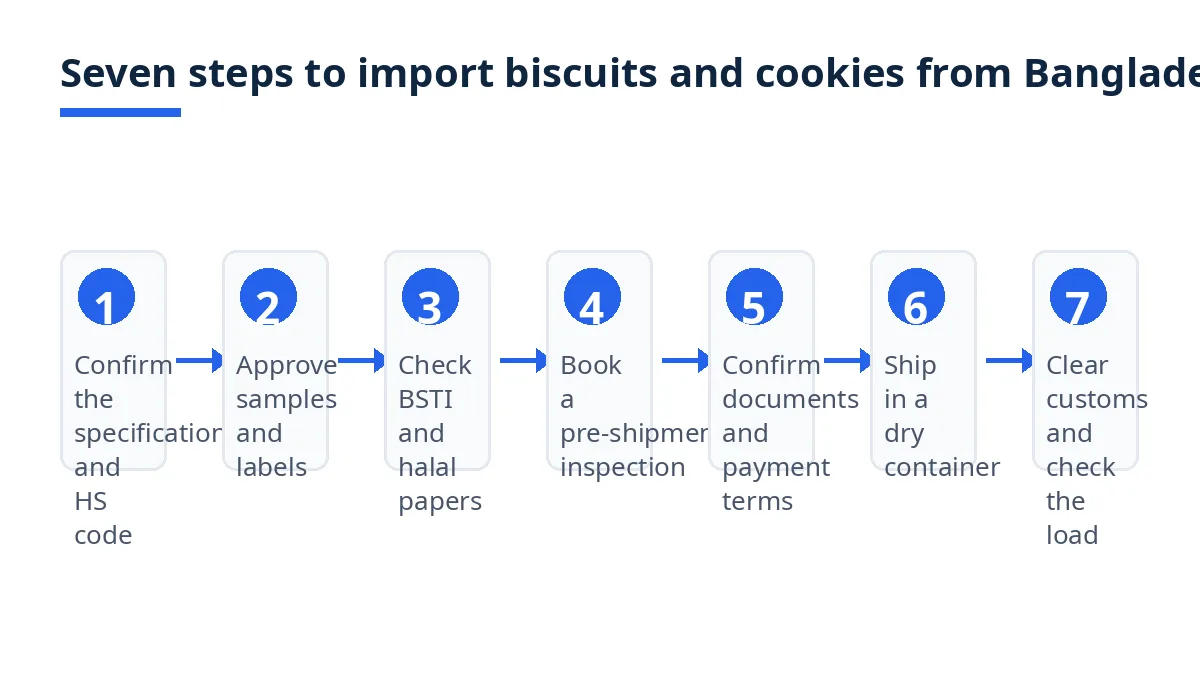
Importing biscuits and cookies from Bangladesh follows seven stages. Label approval and the pre-shipment inspection most often delay a first order.
Confirm that your destination accepts biscuits from Bangladesh and note its labelling and allergen rules.
Agree the product, recipe, pack sizes, quantity, price and Incoterm in writing.
Approve a production sample and the retail label artwork.
Check the BSTI licence and any halal certificate before production starts.
Book a pre-shipment inspection and a laboratory test on the finished lot.
Ship in a dry container, with the documents sent to your customs broker.
Clear customs and check the load against the approved sample before releasing the balance.
What BSTI certification do you need to check?
Biscuits are a mandatory-certification product in Bangladesh. The Bangladesh Standards and Testing Institution (BSTI) lists biscuits under standard BDS 383:2001, wafer biscuits under BDS 1001:2010, and semi-sweet biscuits and cookies under BDS 1708:2002.3 A maker selling biscuits on the domestic market must hold a BSTI Certification Marks licence, and the mark appears on the retail pack.
Ask the supplier for a copy of the current BSTI licence and check that it covers biscuits, names the factory making your order, and is still valid. If the supplier cannot show a licence, look for another maker. The BSTI licence is a Bangladesh requirement: it does not prove the label meets your market's language or allergen rules, so keep the checks separate.
How should the label read?
The label is where most biscuit shipments fail: a pack printed for the Bangladesh market will not meet a foreign retailer's rules. The international baseline is the Codex General Standard for the Labelling of Prepackaged Foods, CXS 1-1985, which covers the food name, ingredient list, allergen declarations, net contents, responsible business details, lot identification, date marking and storage conditions.4
Bangladesh's own rules, the Safe Food (Packaged Food Labelling) Regulations, 2017, issued by the Bangladesh Food Safety Authority under the Food Safety Act, 2013, require the same core items: food name, ingredients in descending order of weight, nutrition information, net weight, manufacture and packaging dates, the expiry or best-before date, the batch number, and the name and address of the maker or marketer.5
Your destination will have its own version of the same list, and it decides whether your goods can be sold. In the European Union, Regulation (EU) No 1169/2011 requires the food name, the ingredient list, allergens emphasised in that list, net quantity, the date marking, storage instructions and the nutrition declaration.6 Its Annex II lists 14 allergens, including cereals containing gluten, eggs, milk, peanuts, soybeans, tree nuts and sesame, each emphasised — usually in bold — wherever it appears as an ingredient.6
Before you approve artwork, check that the food name says what the product is; ingredients are listed in descending order of weight with allergens emphasised; net weight, lot number, maker name and address, and origin are printed; the date marking matches your destination's wording — a best-before date marks the end of the period during which the unopened product keeps its stated qualities, while a use-by or expiry date marks the point after which the product should not be sold or eaten;4 and nutrition values are given per 100 g in the format your market requires. Get the artwork approved in writing by your label reviewer or broker before printing.
How do shelf life and packaging protect the shipment?
Biscuits keep because they are baked to low moisture, usually below 5 percent, and packed in a barrier film that keeps out moisture and oxygen.7 Moisture getting in takes away the crispness, and fat turns rancid in heat and light, so shelf life depends on recipe, packaging film, storage temperature and humidity, and transit time. The maker sets it from storage tests.7
Ask the supplier for the shelf life and the storage conditions it assumes, in writing. Then check the arithmetic: production date plus shelf life must leave enough time for sea freight, customs clearance, warehouse handling and retail sale. If the remaining life is short, order a fresher run. Biscuits ship in dry containers, not reefers.
Ask for these packing points in the contract: retail packs heat-sealed in metallised or laminated film; inner cartons strong enough to stop crushing, with dividers for fragile wafers and cream biscuits; outer cartons marked with product name, flavour, pack count, net weight, lot number and dates.
Do you need halal certification?
Halal certification is not needed for every biscuit order, only when the product is marketed as halal or your buyer or destination market asks for it. Bangladesh's halal certification policy, issued by the Bangladesh Islamic Foundation in 2023, requires businesses that make, export or import goods marketed as halal to hold the certification and use the associated logo.8 The Foundation issues the certificate and logo on behalf of the government, granted for one year, with longer tenure possible where the factory meets the required standards.8
Before you rely on a halal claim, check that the certificate names the factory and product range covering your biscuits, is still valid, and is accepted by your destination's buyers. If no halal claim is made on the pack, no halal certificate is needed, and the pack must not carry a halal logo.
Which documents does the shipment need?
Keep product, quantity, consignee and marks identical on every paper: when the commercial invoice and the packing list disagree, a food shipment is often held at the border. Our export documents guide explains each document.
| Document | Who issues it | What to check | | Commercial invoice | Supplier | Product, recipe, quantity, price and Incoterm — identical to the contract | | Packing list | Supplier | Number of cartons, weights, marks and lot numbers | | Certificate of origin | Chamber of commerce | Needed for preferential duty | | BSTI licence copy | Supplier | Covers biscuits, names the factory, still valid3 | | Halal certificate | Islamic Foundation | Only where the product is marketed as halal8 | | Laboratory test report | Accredited laboratory | Moisture, microbiology and residue tests your market requires | | Bill of lading | Shipping line | Consignee, port, container and seal match the packing list |
When payment runs through a letter of credit, the papers the credit names have to line up with this table. Our how a letter of credit works covers the document check, the charges and the timing.
What does it cost to land biscuits?
Freight, insurance, duty and local handling make up the landed cost, and the duty rate follows your country's tariff for the HS subheading you use. Our how landed cost is calculated walks through the arithmetic step by step.
Example figures for one container: these numbers are illustrative.
| Cost item | Example figures | | 12 tonnes, FOB, at USD 1,400 per tonne | USD 16,800 | | Sea freight, dry container to a Gulf port | USD 1,500 | | Marine insurance at 0.5 percent of goods and freight | USD 92 | | CIF value | USD 18,392 | | Import duty at 5 percent of CIF value | USD 920 | | Port handling, broker and local transport | USD 400 | | Total landed cost | USD 19,712 | | Landed cost per tonne | USD 1,643 |
Here, freight, duty and handling add about USD 243 per tonne to the FOB price. Ask every supplier to quote on the same Incoterm so prices compare like with like.
How do you confirm quality before paying?
Hold back the final payment until the goods have been checked. Write into the contract that an independent inspector examines the finished lot at the factory or during loading, and release the remaining payment once the inspection report arrives. The inspector's checks should cover the pack count, the net weight of sampled packs, seal quality, the label against the approved artwork, and lot numbers with dates. Also ask for a laboratory test on the finished lot: moisture content, microbiology, and any tests your destination requires. Our setting up a pre-shipment inspection covers how to arrange it and what belongs in the report. Our biscuits and cookies quality control checklist lists the checks to put in the contract.
What mistakes do first-time biscuit buyers make?
Ordering by brand name alone, without a written recipe and specification.
Approving label artwork that fails their own market's allergen or language rules.
Accepting a BSTI licence that names a different factory or product.
Taking old stock with a short remaining shelf life.
Shipping in weak cartons, then receiving crushed wafers and broken biscuits.
Settling the whole invoice before the goods are inspected: release the final payment only once the report is in hand.
Next steps on Exportain
Look at makers and their prices on Exportain's supplier directory, then send a request for quotation naming the biscuit type, recipe, pack sizes and the month you want to ship, through the RFQ form. Before ordering for the first time, read buying on Exportain.
Sources
- Agro-food exports grow, but foundations look fragile. Daily Sun, (accessed )
- Classification Detail: HS Code 1905. United Nations Statistics Division (accessed )
- List of Bangladesh Standards (BDS) on Agricultural and Food Products. Bangladesh Standards and Testing Institution (accessed )
- General Standard for the Labelling of Prepackaged Foods (CXS 1-1985). FAO / Codex Alimentarius (accessed )
- Bangladesh issues Packaged Food Labelling Act 2017. USDA Foreign Agricultural Service, (accessed )
- Commission Notice relating to the provision of information on substances or products causing allergies or intolerances. European Commission, (accessed )
- Assessing packaged food durability using environmental simulation models. International Journal of Horticulture and Food Science (accessed )
- First ever policy on halal certification comes to light. The Daily Star, (accessed )
About the author
Sourcing from Bangladesh?
Post a request for quotation and suppliers on Exportain can send you their quotes directly.
Post an RFQ