

Quality Control Checklist for Biscuits and Cookies From Bangladesh
A numbered QC checklist for biscuits and cookies from Bangladesh: appearance and bake, size and weight, texture and taste, fillings, hygiene, lab evidence, labels for the USA, UK, EU and UAE, and packing, with fixes for soft, broken, and mislabelled shipments.
Short answer
Use this biscuits and cookies quality control checklist to check appearance and bake, size, weight and count, texture and taste against the approved sample, fillings and coatings, foreign matter and hygiene, lab evidence where agreed, labels for the USA, UK, EU and UAE, and seals, trays and cartons before shipment. Agree tolerances, defect classes, test methods and acceptance numbers in the purchase order, and draw the sample at random across cartons and flavours.
On this page
Key takeaways
Agree the sample, tolerances, defect classes, test methods and acceptance numbers before inspection, and draw the sample at random across cartons, flavours and production runs.
Judge biscuits and cookies on baked-goods risks first: moisture gain, breakage, filling leakage, coating bloom and seal failure, not only on general appearance.
Check labels per destination market, because allergen emphasis rules and the US major-allergen list differ from EU and UK rules, and sesame is a US major allergen.
Treat the EU acrylamide benchmark for biscuits and wafers as a performance indicator for mitigation review, not as a maximum limit or an automatic pass or fail.
If you buy biscuits and cookies from Bangladesh, this checklist checks a shipment before it leaves the factory. A biscuit is judged after weeks in transit and on a shop shelf, not on baking day: a pack gone soft, a cream sandwich leaked, or a label naming the wrong allergen all show up after shipping. Use it at final inspection, with the approved sample beside you, recording each point as pass, fail, or not applicable.
Why this checklist matters
Biscuits and cookies fail in ways other products do not. Moisture is the main enemy: a biscuit absorbing water loses its snap, a cookie drying out turns hard, and a migrating filling changes texture. Breakage is the second risk, because thin edges or a weak pack break under cartons above. Labelling is the third, because one wrong allergen line can keep a shipment off the shelf.
A written checklist removes interpretation: each point is checked against the approved sample, specification, and destination label artwork. Agree defect classes and acceptance numbers in the purchase order before inspection starts. ISO 2859-1 specifies an acceptance sampling system for inspection by attributes, indexed by the acceptance quality limit (AQL), for lot-by-lot inspection.1
Before you start
Do not begin until references are complete: an approved sample per flavour and variant, the purchase order and specification, the pack and carton specification, and label artwork per destination market (USA, UK, EU, and UAE where covered). Agree the sampling plan in advance, and draw the sample at random across cartons, flavours, and production runs, not from cartons the factory selects.1
Check the label plan before bulk labels are printed, because a label error at final inspection means rework of finished packs. The Codex General Principles of Food Hygiene set out good hygiene practices as the foundation of hazard control, with HACCP added where they alone are not enough.2
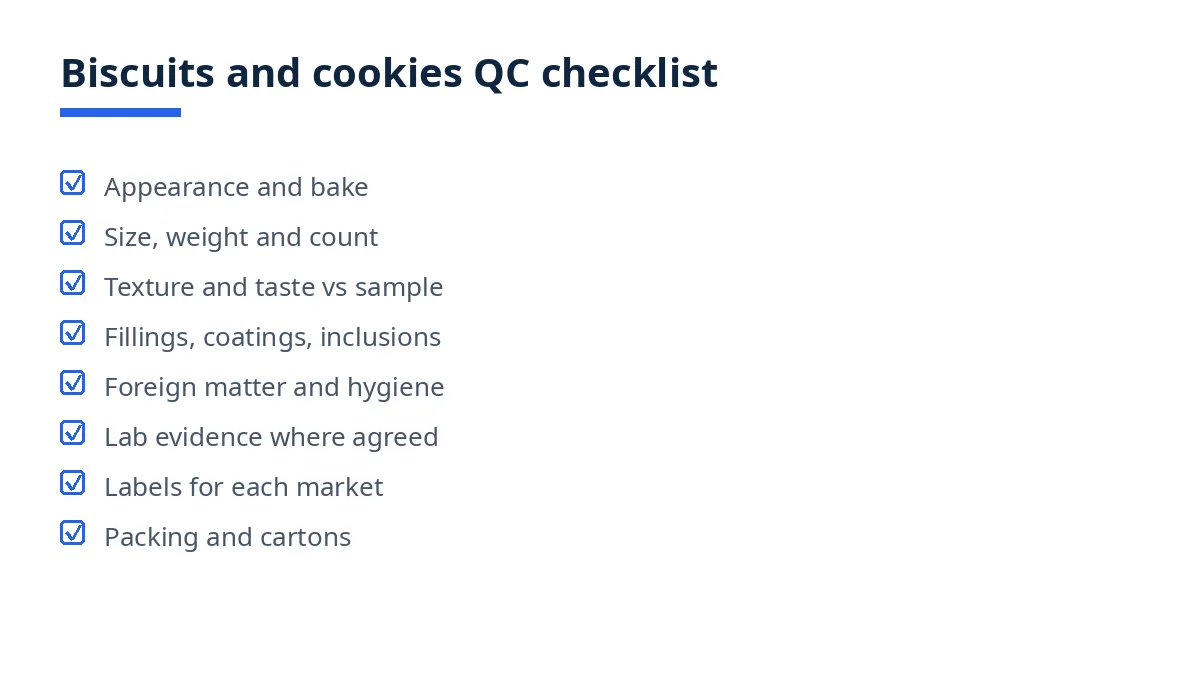
The full checklist (numbered, printable)
Appearance and bake
Check each sampled piece against the approved sample for shape, size, colour, and finish, recording misshapen, unevenly baked, or scorched pieces.
Check top and base: the base must be evenly baked, with no raw or burnt patches, and designs legible and centred.
Check coatings and toppings, such as chocolate, icing, or sesame, for even coverage, adhesion, and no bare patches.
Check for chocolate bloom (a white or grey film) and sugar bloom on coated pieces, and record bloom against the sample, noting storage conditions.
Size, weight, and count
Measure length, width, and thickness against the specification, recording actual values, not pass marks, so lot drift is visible.
Weigh pieces and whole packs against declared net weight, and check the count per pack per flavour.
Check assortment in mixed packs and cartons: each flavour must match the purchase-order ratio, with no substitution.
Texture, moisture, and taste
Break a sampled piece per flavour and check snap or crumb against the approved sample: a bending biscuit, or a cookie crumbling to dust, fails.
Taste sampled pieces against the approved sample for flavour, sweetness, salt, and rancidity, recording any stale, sour, or off flavour, with date and lot.
Check for moisture damage: soft packs, damp cartons, or biscuits that lost crispness point to a seal or storage problem; segregate affected cartons.
Where the specification sets a moisture or water-activity limit, confirm test method and limit were agreed in advance, and check every report names product, flavour, and lot.
Fillings, coatings, and inclusions
Break open sampled filled biscuits, such as cream sandwiches, checking filling for even spread, full edge coverage where required, and no edge leakage.
Check inclusions, such as chocolate chips, nuts, raisins, or oats, for even distribution, correct type, and no cheaper substitution.
Check a filled or coated product holds together in normal handling: filling squeezing out under light pressure, or coating flaking off, fails.
Foreign matter and hygiene
Check sampled packs and open pieces for foreign matter, including metal, plastic, hair, and insect fragments; stop and segregate the lot on any contamination.
Check the production and packing area observed is clean, staff handling open product follow hygiene rules in place, and any pest or hygiene concern is recorded in the report, not verbally.
Check metal-detection or foreign-matter records where required, confirming they cover the lot inspected, not an earlier lot.
Lab evidence where agreed
Where lab evidence is required, confirm each report names product, flavour, lot, test method, and result, and check it against the agreed limit.
For EU shipments, ask for the acrylamide position. Commission Regulation (EU) 2017/2158 covers fine bakery wares, including cookies, biscuits, and rusks, and sets a benchmark level of 350 micrograms per kilogram for biscuits and wafers.3 Benchmark levels there are performance indicators for verifying mitigation measures, not maximum limits, so a result above the benchmark calls for a mitigation review, not an automatic pass or fail.3
Where a nutrition, allergen, or contaminant claim will appear on the pack, check it against agreed evidence, recording any unsupported claim as a failure.
Labels and market rules
Check product name, brand, net quantity, and pack count per label variant against the purchase order, and check spelling in every language.
Check the ingredients list against the approved recipe: under the Codex General Standard for the Labelling of Prepackaged Foods, ingredients are listed in descending order of ingoing weight at manufacture, and allergy-triggering foods are always declared by specified name.4
For the EU and UK, check each Annex II allergen in Regulation (EU) No 1169/2011 is emphasised in the ingredients list by a clearly distinguishing typeset, for example by font, style, or background colour.5
For the USA, check the allergen declaration against the FDA list of nine major food allergens: milk, eggs, fish, Crustacean shellfish, tree nuts, peanuts, wheat, soybeans, and sesame, sesame added effective January 1, 2023.6 The food source name must appear in parentheses after the ingredient or in a "Contains" statement after or beside the ingredients list.6
Check date marking per label variant: the Codex standard defines a best-before date as the end of the period the unopened product remains fully marketable under stated storage conditions, and a use-by date as the end of the period after which it should not be sold or consumed.4 Confirm the date type matches the destination agreement.
Check storage instructions, responsible business name and address, and any origin or market-specific marking, against approved artwork, not a previous shipment's labels.
Check barcodes on sampled packs and cartons: each code must scan, and scanned product, flavour, and count must match pack and purchase order.
Packing and cartons
Check inner pack seals on sampled packs: seals must be complete, with no leaks, weak spots, or crushed areas, because a broken seal admits moisture.
Check inner pack material matches the specification, including any moisture-barrier layer, with no punctures, tears, or line damage.
Check tray, sleeve, and carton packing: pieces must not move enough to break, and named dividers or inserts must be present.
Check carton assortment, count, and markings against the packing list, confirming each carton carries product, flavour, count, lot or date code, and required handling marks.
Weigh and measure sampled cartons, check carton strength by handling, and record any crushed, damp, or burst carton, noting pallet position where relevant.
Check pallet stacking and wrapping where palletised: cartons must not overhang the pallet, and wrapping must not crush the top layer.
Common failures and how to fix them
The most frequent failure is a biscuit gone soft before shipment, usually because a seal failed or pack material does not hold a moisture barrier. Stop, check seals across the lot, and test a pack from each sealing head before sealing more cartons. Next is breakage, from thin edges, loose trays, or cartons stacked too high: re-check tray fit and carton strength on a test carton first.
Uneven bake usually starts at oven temperature or belt speed: re-bake a test batch and compare it with the sample before the bulk run continues. Filling leakage points to quantity, temperature, or placement: adjust one variable at a time and check a test pack after each change. A wrong allergen line is a label-artwork failure: stop packing, correct the artwork, and re-check every label variant against the recipe first.
Above the agreed acceptance level, options are re-inspection after sorting or rework, documented partial acceptance, or rejection. Do not ship failed goods on a promise of later correction.
Downloadable template / summary table
Copy the checklist into your inspection sheet, add specification, tolerances, and acceptance numbers, and record a result per lot.
Section | Checks | Evidence |
|---|---|---|
Appearance and bake | Shape, colour, coating, bloom | Sample comparison |
Size, weight, count | Dimensions, weights, assortment | Measurements |
Texture and taste | Snap, flavour, moisture damage | Tasting notes |
Fillings and inclusions | Spread, leakage, distribution | Opened pieces |
Foreign matter, hygiene | Contamination, records | Records |
Lab evidence | Reports, acrylamide position | Reports per lot |
Labels | Ingredients, allergens, dates, barcodes | Artwork check |
Packing | Seals, trays, cartons, pallets | Seal checks |
How Exportain helps
Exportain is a B2B marketplace connecting buyers with Bangladeshi suppliers of biscuits, cookies, and other food products, so checklist specifications can be agreed at enquiry stage. Browse suppliers, compare offers through RFQs, and plan the check with inspection services when arranging third-party inspection. Supplier profiles show which document and photo checks have been recorded, not factory inspections. Exportain is not a party to the goods contract and does not inspect goods.
FAQs
When should this checklist be used?
Use it at final inspection, when goods are finished and packed. For larger and first orders, also use it during production, while bake, filling, and sealing can still be corrected.
Who should complete it?
The buyer, a local agent, or an independent inspector can complete it, using the approved sample, specification, label artwork, and a random sample.
What are the most common failures?
Soft or stale texture from moisture ingress, breakage, uneven bake, filling leakage, chocolate bloom, and allergen or date-marking errors are the failures found most often.
Can a third party do it?
Yes, if you share approved references, tolerances, and acceptance levels first, and the inspector reports per flavour and lot.
Next steps on Exportain
Before production, agree specification, tolerances, test methods, and label artwork per destination market, then read the AQL acceptance quality limit explainer and the pre-shipment inspection guide, and plan the check with inspection services.
Sources
- ISO 2859-1:1999 - Sampling procedures for inspection by attributes — Part 1: Sampling schemes indexed by acceptance quality limit (AQL) for lot-by-lot inspection. International Organization for Standardization (accessed )
- General Principles of Food Hygiene (CXC 1-1969). Codex Alimentarius Commission (accessed )
- Commission Regulation (EU) 2017/2158 establishing mitigation measures and benchmark levels for the reduction of the presence of acrylamide in food. European Commission (accessed )
- General Standard for the Labelling of Prepackaged Foods (CXS 1-1985). Codex Alimentarius Commission (accessed )
- Regulation (EU) No 1169/2011 on the provision of food information to consumers, Article 21 - Labelling of certain substances or products causing allergies or intolerances. European Union (accessed )
- Food Allergies: What You Need to Know. U.S. Food and Drug Administration (accessed )
About the author
Sourcing from Bangladesh?
Post a request for quotation and suppliers on Exportain can send you their quotes directly.
Post an RFQ


