Private Label Jute Geotextiles in Bangladesh: Brand Guide
A brand owner guide to private label jute geotextiles from Bangladesh: trademark protection, label rules, brand briefs, packaging and checks for a first branded run.
Short answer
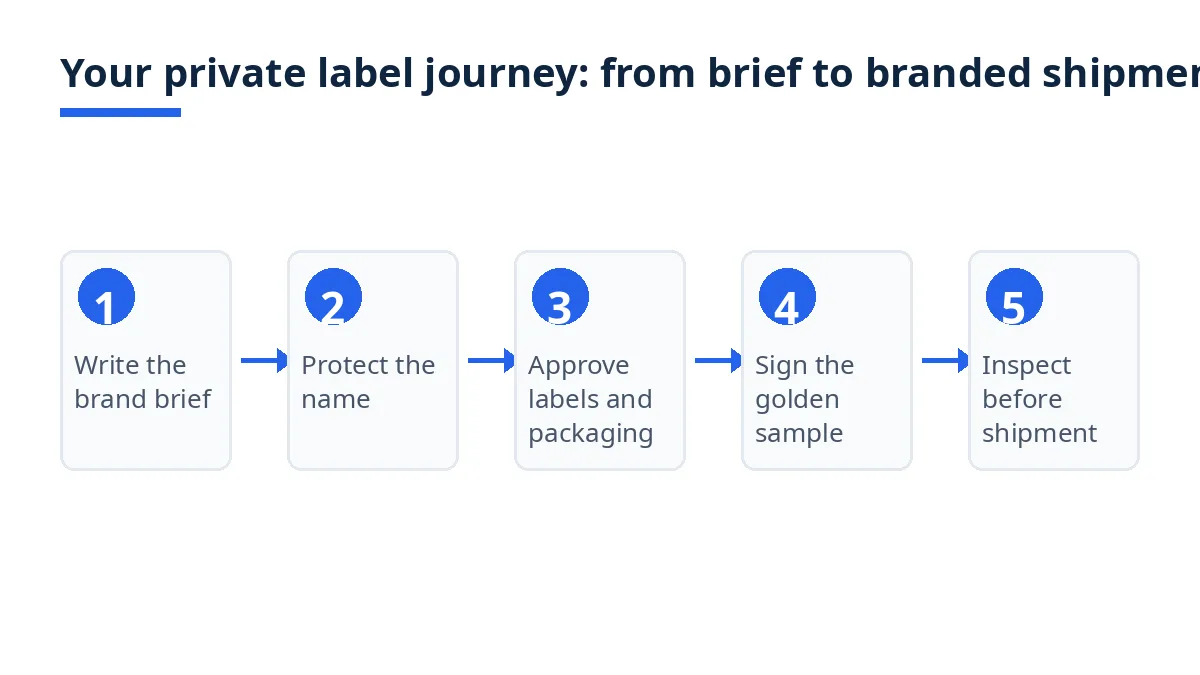
Private label jute geotextiles from Bangladesh are woven or nonwoven jute fabrics made to your specification and sold under your brand, with your labels and packaging. Before you order, protect the name: file your trademark at home and directly with Bangladesh's DPDT, since Bangladesh is not a Madrid System member. Then write a brand brief covering the fabric specification, the label copy for each market, and the packaging, and check the branded goods against a signed golden sample before shipment.
On this page
Key takeaways
Bangladesh is not a Madrid System member, so protect your mark there by filing directly with the DPDT.
EU and US labelling rules both require fibre content, and the US also requires country of origin and the responsible business name.
A brand brief must state GSM, tensile strength, test method, label copy and packaging, with tolerances, before any price is agreed.
Check the branded goods against a signed golden sample and a pre-shipment inspection before the balance is paid.
Private label jute geotextiles put your brand on a product another company weaves. You choose the fabric, the label, the packaging and the specification, and a Bangladeshi mill makes the rolls to your brief. The work that decides whether it succeeds happens before production starts.
Export Promotion Bureau figures put Bangladesh's jute and jute goods earnings at $883.69 million for fiscal 2025-26 — a rise of 7.75 percent against the previous year.1 This guide covers the brand side of the job: the name, the label, the brief, the packaging, the cost of a branded run and the checks that protect your brand at shipment.
What does private label mean for jute geotextiles?
In plain terms, a jute geotextile is a water-permeable fabric woven or felted from jute fibres and laid in or over soil so the ground performs better as an engineering material.2 Under a private label arrangement, the mill weaves that fabric to your specification and puts your brand on the rolls, labels and packaging. You own the brand and the customer relationship; the mill owns the production.
The fabric itself does not change because your name is on it. Open-mesh, woven and nonwoven grades still differ by weight and strength: a widely used woven grade runs at 760 grams per square metre and 20 by 20 kilonewtons per metre, a nonwoven grade at 500 grams per square metre and 4 by 5 kilonewtons per metre, and an open-mesh grade at 500 grams per square metre and 10 by 7.5 kilonewtons per metre.2 Your brand promise sits on top of those numbers, so the specification is part of your brand. The functions your customers buy are the standard ones: separation, filtration, reinforcement, drainage, protection and surface erosion control.3 Your label must describe the function your grade performs, and nothing beyond it.
How do you protect your brand name before you order?
Order nothing branded until you know who owns the name where the goods will sell. A mill that prints your logo does not check whether another business already uses a similar mark.
Register your trademark in your home market first, because the international route builds on it. Under the Madrid System run by the World Intellectual Property Organization (WIPO), you file one international application through your home intellectual property office, based on your home application or registration, your basic mark.4 WIPO checks the formal requirements, records the mark, and notifies the office of each country you designate, which then has 12 or 18 months to grant or refuse protection under its own law.4
Bangladesh needs separate attention. Bangladesh is not a member of the Madrid System, so it cannot be designated in an international registration; you file directly with the Department of Patents, Designs and Trademarks (DPDT), through a Bangladeshi advocate or registered trademark agent.5 Each application covers one class of goods, official fees run in three stages — BDT 5,000 to file, BDT 3,000 for publication and BDT 20,000 for registration, BDT 28,000 per class — and the first term lasts 7 years, then 10 years per renewal.5 If you filed your first application in a Paris Convention or World Trade Organization member less than 6 months earlier, you can claim priority from it.5
Ask the mill in your first conversation whether it has ever printed a similar name or logo for another buyer, and get written confirmation it will not use your brand for any other customer.
What goes on your label, and what must it say by law?
Your label carries your brand and the facts the law of the destination market requires. The legal part differs by market, so finalise the label copy for each destination before the mill prints anything.
In the European Union, Regulation (EU) No 1007/2011 fixes the fibre names you may use and requires the composition on the label.6 Only the fibre names listed in Annex I may be used, and products made of several fibres must be labelled with the name and percentage by weight of every constituent fibre, in descending order.6 The words "100 %", "pure" and "all" are reserved for products of one fibre only.6 Labelling must be durable, easily legible, visible and accessible, securely attached, and in the language of the country of sale.6
In the United States, the Textile Fiber Products Identification Act and the Federal Trade Commission rules require sellers of covered textile products to mark each product with the fibre content, the country of origin, and the identity of the manufacturer or another business responsible for the item.7 For a private label import, your label must carry the fibre content, the origin statement, and either your business name or your registered identification number.
Before printing, check three points with the mill: the fibre name uses Annex I wording for the EU and the generic name for the US; the percentages are by weight, in descending order, and match the production lot test; and the origin statement names the country of last substantial transformation. Selling in several markets means one label per market.
How do you write a brand brief a mill can build to?
Write the brief before you request a quotation: it is the reference the mill works from and the standard the inspector measures the finished rolls by. It has two halves, product and brand, and a mill that receives only one will guess the other.
Product half: state the grade, the weight in grams per square metre with a tolerance, the tensile strength in both directions with the test method, the aperture, the roll width and length, the weave and any treatment. Specify ISO 10319 for tensile strength — the wide-width procedure that records the peak load for each unit of width and the stretch at that peak, applying to both woven and nonwoven grades.8 Ask for the laboratory test report for your grade before you approve a sample, and check that it names the mill, the grade, the lot and the test date.
Brand half: attach the artwork files, the label copy for each market, the label size and position, the packaging design, the carton markings and the colour references. State who approves the printed proof and how many proofing rounds the price includes.
For pricing that sellers can actually quote against, see how to write an RFQ — it covers tiered pricing requests in a form mills can answer. Send the brief as one document and ask the mill to confirm each line in writing; a reply of "we understand" is not a confirmation.
What should your packaging and marking say?
Packaging is part of your brand and part of your compliance: the carton is what the buyer, the warehouse and customs see first, so treat its markings as carefully as the label on the roll.
Put brand, product name, grade, roll size and quantity on every carton, in the same wording as the invoice and packing list. Add the handling marks the product needs and the batch number tying the carton back to the test report. If the destination market requires origin marking on the outer packaging, put it there as well as on the roll label.
Settle the HS code with your customs broker ahead of the first shipment, then use that same code on the invoice, packing list and letter of credit so the paperwork agrees throughout. The classification rules for jute geotextiles are covered in our guide to HS codes.
How much does a branded run cost, and what MOQ should you expect?
A branded run costs more per unit than an unbranded run of the same fabric; the difference comes from set-up, not from the jute. Printing plates, label printing, custom cartons and line-change time between brands are fixed costs spread across your order, so the smaller the order, the more each roll carries.
Ask the mill to quote the branded run as separate lines: fabric, label and packaging, set-up, and samples. Ask whether the sample cost is credited against the bulk order and whether set-up repeats. How minimum quantities are worked out is covered in our guide to MOQ, while calculating landed cost walks through adding freight, insurance and duty to the goods price.
For payment, a letter of credit pays the seller against complying documents, not against inspected goods, so add an independent pre-shipment inspection certificate as a document under the credit. See how a letter of credit works for the mechanics of the instrument. Never agree a branded MOQ by phone: get quantity, unit price, set-up and delivery term in one written quotation.
How do you check the branded goods before they ship?
Check the brand as well as the fabric: a roll that passes its tensile test but carries the wrong label is still a failed shipment.
Start with a golden sample: one finished, branded roll you approve in writing and keep as the reference for the whole order. Every later check compares production rolls against it: weave, weight, label copy, logo colours, packaging and carton markings.
Ask for test data for the production lot before shipment and read the report: it should name the mill, the grade, the lot or roll number, the test date and the method, with numbers that meet your specification. A pass/fail note with no figures attached tells you nothing.
Commission a pre-shipment inspection that checks the finished goods against the golden sample, counts the cartons and checks the container seal, with acceptance limits in the contract. The inspection points for a shipment ready to leave are set out in our jute geotextiles inspection checklist. Exportain badges reflect a desk review of documents and photos rather than a visit to the factory, so your own checks remain essential.
A worked example: costing a first branded run
Example figures. A brand owner orders 5,000 square metres of 500 GSM open-mesh jute geotextile under their own label, quoted FOB Chattogram, using illustrative prices that exclude freight, insurance and duty.
| Item | Example figures | | Area ordered | 5,000 sq m | | Illustrative fabric price | $0.60 per sq m | | Goods value FOB | $3,000 | | Label printing and custom cartons | $450 | | Set-up charge, first run | $300 | | Branded samples | $150 | | Total before freight | $3,900 |
At those prices the fabric costs $3,000, packaging adds $450, set-up adds $300 and samples add $150, so the buyer pays $3,900 before freight. Ask the mill to credit the sample cost on a repeat run and confirm whether set-up repeats.
Which brand-side mistakes should you avoid?
Ordering branded rolls before the trademark is filed. A mill can print any name you give it; it cannot tell you whether that name belongs to someone else.
Approving label copy by email instead of by signed proof. A typo in a fibre percentage or an origin statement is a compliance failure printed on every roll.
Letting the mill choose the fibre name. Marketing names such as "eco-jute" are not fibre names under EU or US rules; the label must use the generic name.6 7
Skipping the golden sample. Without one signed reference roll, every dispute about colour, print quality or packaging is a matter of opinion.
Paying the balance before inspection. A letter of credit pays against documents, and a transfer balance paid before inspection leaves you with no leverage if the branded goods are wrong.
Reusing one label across markets. EU and US rules differ on origin and identity, and a label written for one market can fail in another.6 7
Next steps on Exportain
Begin with the wider jute sourcing guide, then work through the inspection checklist for jute geotextiles to fix the checks for your branded order. Once the brief is complete, post an RFQ on Exportain stating the specification, label copy and packaging needs, and weigh the quotations side by side on identical terms.
Sources
- June exports surge by 25.91%, FY26 earnings hold steady at $48 billion: EPB. United News of Bangladesh (accessed )
- Application of Jute Geotextile in Civil Engineering, Agrihorticulture and Forestry. Sahapedia (accessed )
- ISO 10318-1:2026 - Geosynthetics - Part 1: Vocabulary. International Organization for Standardization (accessed )
- Madrid System: Filing International Trademark Applications – The Process. World Intellectual Property Organization (WIPO) (accessed )
- Bangladesh trademark registration: routes, fees and timeline. J&C IP Agency, (accessed )
- Regulation (EU) No 1007/2011 on textile fibre names and related labelling and marking of the fibre composition of textile products. European Union (EUR-Lex), (accessed )
- Rules and Regulations Under the Textile Fiber Products Identification Act. US Federal Trade Commission, (accessed )
- ISO 10319:2024 — Geosynthetics — Wide-width tensile test. International Organization for Standardization (ISO) (accessed )
About the author
Sourcing from Bangladesh?
Post a request for quotation and suppliers on Exportain can send you their quotes directly.
Post an RFQ