How to Import Fresh Vegetables From Bangladesh in 2026
A step-by-step guide to importing fresh vegetables from Bangladesh: cold-chain temperatures by vegetable, reefer sea vs air freight, phytosanitary rules, grading and packing, documents and landed cost.
Short answer
To import fresh vegetables from Bangladesh, confirm your market accepts the vegetables you want, then agree the product, grade, pack, quantity, price, temperature and Incoterm in writing. Match each vegetable to its cold-chain temperature, pre-cool at the packing house, and choose air freight for leafy greens and other short-life items or reefer sea freight for hardier vegetables to nearby ports. Get a phytosanitary certificate from the Plant Quarantine Wing within 24 hours of shipment, and inspect the load before you pay the balance.
On this page
Key takeaways
Vegetable exports earned USD 88.88 million in FY26, up 9.57 percent on FY25, with July to November FY26 up almost 48 percent year on year.
Leafy greens need air freight and near 0 degrees Celsius; hardier vegetables such as cabbage, pumpkin and gourds can travel by reefer sea freight to nearby ports.
Each vegetable has its own lowest safe temperature: okra and beans 7 degrees Celsius, cucumber and brinjal 10 degrees, pumpkin 13 degrees.
The phytosanitary certificate is valid for 24 hours for perishable goods, so book inspection close to loading.
Most Bangladeshi vegetables sell through ethnic shops in the Gulf, Europe and Southeast Asia, so grade and pack for that retail channel.
Bangladesh grows vegetables that sell well to South Asian and Bangladeshi communities overseas, provided the buyer can handle produce that spoils quickly and needs cooling at every step. What follows covers the whole journey, from choosing vegetables to clearing the load at your port.
What makes fresh vegetables different from other imports?
A vegetable starts losing quality the moment it is picked, and temperature decides how fast. The Food and Agriculture Organization (FAO) notes that the rate of deterioration in perishable produce rises two to three times with every 10 degrees Celsius increase in temperature, and that most perishable goods keep longest near 0 degrees Celsius.1
So buy by harvest week, not by season, and match each vegetable to its own temperature: one reefer holds a single set point.
Bangladesh earned USD 88.88 million from vegetable exports in FY26, up 9.57 percent from USD 81.12 million the year before.2 Between July and November of FY26, exports reached USD 37.48 million, up almost 48 percent on the same months a year earlier.3
Which vegetables can you buy from Bangladesh?
Most Bangladeshi vegetables sell through ethnic shops in the Gulf, Europe and Southeast Asia rather than mainstream supermarkets.2 Gourds, brinjal, chillies, beans and leafy vegetables form the core of that trade.2
Each vegetable has a lowest safe temperature; below it, chilling injury causes pitting, discolouration and faster decay.1 HS Chapter 07 covers edible vegetables, fresh or chilled.4
| Vegetable | HS heading | Lowest safe temperature | | Okra | 0709.99 | 7 degrees Celsius | | Yard-long bean and French bean | 0708.20 | 7 degrees Celsius | | Bitter gourd | 0709.99 | 10 to 12 degrees Celsius | | Cucumber | 0707.00 | 10 degrees Celsius | | Brinjal (aubergine) | 0709.30 | 10 degrees Celsius | | Pumpkin and hard-rind squash | 0709.93 | 13 degrees Celsius | | Spinach | 0709.70 | Near 0 degrees Celsius | | Cabbage and cauliflower | 0704 | Near 0 degrees Celsius |
Bitter gourd keeps for 14 to 21 days in reefers at 10 to 12 degrees Celsius; leafy greens have only days of saleable life near 0 degrees.5 Our HS code guide for fresh vegetables lists the headings for each product.
How does the cold chain work, from field to port?
The cold chain is the unbroken sequence of cooled steps from harvest to your warehouse, only as strong as its weakest link.1 One warm gap, at the farm gate, the packing house or the port, shortens the life of the whole load.
Cool produce to its holding temperature as soon as practical after harvest, using hydrocooling, forced-air cooling or vacuum cooling for leafy vegetables.1 In Bangladesh the cold-chain network is still thin outside Dhaka and Chattogram, reefer vans are scarce, and many exporters move produce overnight from distant districts to reach the port in time.3
Most vegetables need 90 to 98 percent relative humidity in storage and transit, or they wilt and lose weight.1 Leave air spaces between pallets and walls so cooled air circulates, and never overload a cold room or reefer.1
Reefer sea freight or air freight: which should you choose?
Air freight remains the main option for most fresh produce from Bangladesh, because sea freight is limited by how perishable the goods are.2 That is changing for hardier vegetables on short routes: in FY25, maritime shipments through Chattogram nearly quadrupled to more than 58,000 tonnes, with cabbage, taro, pumpkin, gourd and beans in refrigerated containers to Malaysia, Singapore, the UAE and Saudi Arabia.3
| Vegetable type | Usual mode | | Leafy greens | Air | | Okra, bitter gourd, beans | Air to Europe; reefer sea to the Gulf or Southeast Asia | | Cabbage, cauliflower, carrots | Reefer sea | | Pumpkin, gourds, taro | Reefer sea |
Moving vegetables to Europe or North America costs Tk650 to Tk700 per kg, while India manages it for Tk300 or less, and exporters report freight charges about 30 percent above neighbouring competitors.3 2 Get every supplier to price the same vegetables, Incoterm and transport mode, so offers compare equally. With free on board terms, the quoted price ends once the goods are loaded on the vessel or aircraft; with CIF, the supplier also covers freight and insurance as far as your port.
What does the import process look like, step by step?
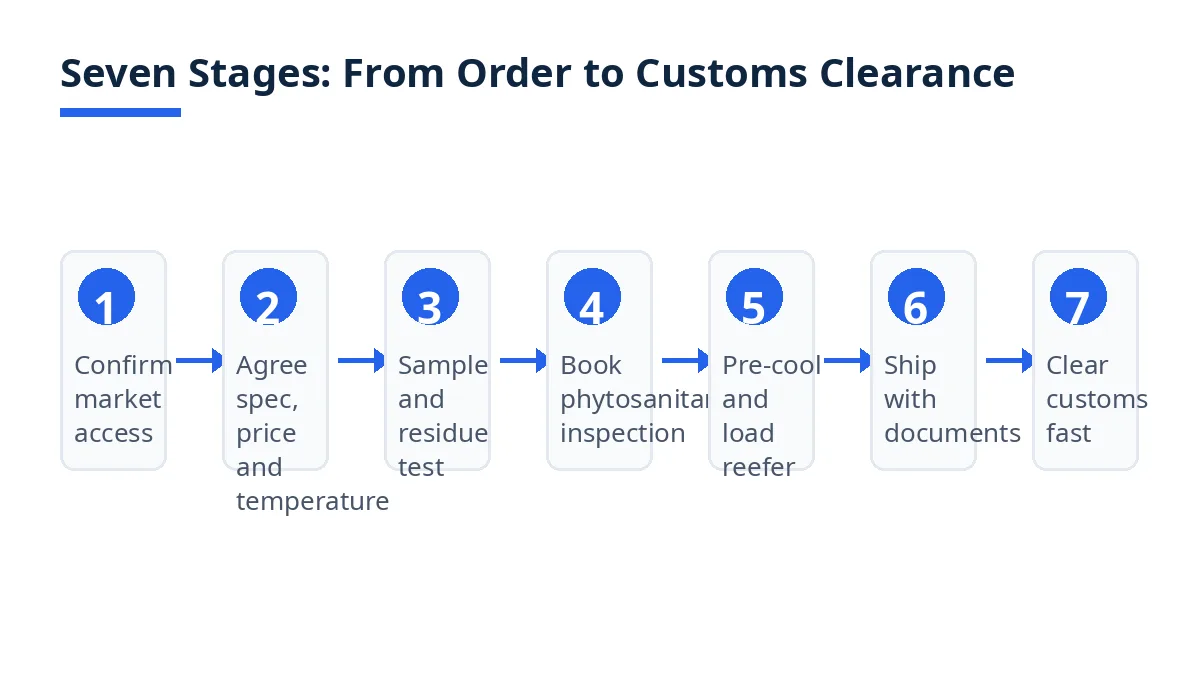
The route from a Bangladeshi packing house to your port runs through seven stages.
Check your country accepts the vegetables you want from Bangladesh, and note its plant-health conditions.
Put vegetable, grade, pack, quantity, price, temperature and Incoterm in writing, and name the inspection place.
Request a sample sent before shipment, plus a residue test result.
Arrange the phytosanitary inspection for a time close to loading.
Pre-cool the produce, load it into an already-cold reefer or aircraft hold, and record pulp temperatures.
Send the documents to your customs broker with the shipment.
On arrival, clear customs and get the vegetables into cool storage straight away.
What does the phytosanitary process require?
Under ISPM 12, the certificate is a paper from the exporting country's plant protection authority stating the lot was checked or tested and meets the receiving country's plant-health rules.6 Its details, consignee, quantity, description and botanical name, must agree with the commercial invoice, packing list and bill of lading, and a hand-written correction after issue voids it.6
In Bangladesh the certificate comes from the Plant Quarantine Wing of the Department of Agricultural Extension. For perishable goods the exporter applies a day or more ahead of shipment, and the certificate then stays good for 24 hours.7 That brief window is the biggest timing hazard in the job: a late vessel or flight can leave the certificate expired.
Under Implementing Regulation (EU) 2019/2072, fresh vegetables under HS headings 0707, 0708 and 0709 are among the plants and plant products needing a phytosanitary certificate to enter the EU.8 Gulf and Southeast Asian markets are more forgiving, but they have tightened their sanitary and phytosanitary requirements in recent years.3
Residue limits are the second compliance risk. Farmers often harvest soon after spraying, without observing the required pre-harvest interval, and pesticide records are rarely kept.2 Ask for a residue test result against your destination's maximum residue limits before confirming the order. The European bans on betel leaf from 2014 to 2021 show what one compliance failure can cost an entire trade.3 Wooden packaging falls under the ISPM 15 treatment mark, not the phytosanitary certificate, so use marked pallets or plastic ones.6
How are vegetables graded and packed for export?
Sort by size, colour, shape and freedom from damage, disease, soil and decay, removing damaged or diseased units before packing.1 Put the grade in the contract as a size range plus a defect allowance for cuts, bruising, wilting, yellowing, soil and rot, never a loose phrase like "good quality". Our quality control checklist for fresh vegetables sets out the checks to write into the contract.
Corrugated fibreboard cartons are the usual export pack, with trays, liners and pads to hold produce still and slow moisture loss.1 Leafy greens and beans travel in ventilated cartons or crates; gourds and pumpkins in crates or sacks; chillies in small ventilated cartons so they do not crush. Label every carton with vegetable, grade, lot number, net weight and country of origin, so any fault at destination can be traced to a single lot. Produce from several farms is often mixed before reaching the packing house, which makes it hard to verify pesticide use, fertiliser use and harvest dates.2
What documents do you need?
All the papers must tell the same story on product, quantity, consignee and marks. When the phytosanitary certificate disagrees with the bill of lading, the load is often stopped at the border, a usual cause of a hold on perishables.6
| Document | Who issues it | What to check | | Commercial invoice | Supplier | Vegetable, quantity, price and Incoterm as in the contract | | Packing list | Supplier | Carton numbers, net and gross weights, marks and lot codes | | Phytosanitary certificate | Plant Quarantine Wing, DAE | Issued no more than 24 hours before shipment for perishables7 | | Certificate of origin | Chamber of commerce | Needed to claim a lower duty rate | | Bill of lading or air waybill | Carrier | Consignee, port, container number, seal as on the packing list | | Residue test report | Accredited laboratory | Results measured against the limits your destination sets |
The supplier also needs an agro-products exporter licence, granted by the Department of Agricultural Marketing and good for a year, as part of its own compliance.7 When payment runs through a letter of credit, the papers named in it must match this list exactly. Our letter of credit explainer sets out the document check and its cost.
How much does it cost to land a shipment?
Freight, insurance, duty and local handling decide the landed cost per kg; duty turns on your country's tariff for each vegetable's HS heading. Our guide to landed cost for imports from Bangladesh covers the whole calculation.
One reefer container shows how the numbers add up. The figures below illustrate rather than quote.
| Cost item | Example figures | | 10 tonnes of mixed gourds and beans, FOB, at USD 800 per tonne | USD 8,000 | | Reefer sea freight to a Gulf port | USD 2,200 | | Marine insurance at 0.5 percent of goods plus freight | USD 51 | | CIF value | USD 10,251 | | Import duty at 5 percent of CIF value | USD 513 | | Port handling, customs broker and local transport | USD 400 | | Total landed cost | USD 11,164 | | Landed cost per tonne | USD 1,116 |
Here, freight, duty and handling add about USD 316 per tonne to the FOB price. The same vegetables flown to Europe would cost far more to land, as air freight alone runs to Tk650 to Tk700 per kg.3
How do you check quality before you pay?
Hold the final payment until inspection. Write into the contract that an independent inspector examines the load at the packing house or during loading, and the remaining money is released only once the inspection report is in hand. The inspector should cover grade, defect share, wilting, pulp temperature and packing, comparing each with the contract. Our guide to pre-shipment inspection shows how to arrange it and what belongs in the report.
Inspect fast at arrival too. Open cartons from several lots, check for wilting, yellowing, soft rot and chilling injury, and compare pulp temperatures with the loading record. Leafy greens show damage within hours, so slow customs clearance can cost you the load.
What mistakes do first-time vegetable buyers make?
Ordering a mixed load at one temperature, then finding leafy greens chilled and gourds warm.
Choosing sea freight for leafy greens or okra on a long route, where shelf life runs out before arrival.
Arranging the phytosanitary inspection too soon. For perishable goods the certificate stays good for only 24 hours, so a late vessel can leave it out of date.7
Taking a loose grade. "Good quality" gives an inspector nothing to measure; a size range and a defect allowance do.
Skipping the residue test, then facing a rejection at the border for limits the supplier never checked.2
Next steps on Exportain
Start with suppliers and prices on Exportain. When ready, send a request for quotation naming vegetable, grade, pack, temperature and shipment week. Before your first order, read the guide to buying on Exportain.
Sources
- The role of post-harvest management in assuring the quality and safety of horticultural produce. Food and Agriculture Organization of the United Nations (accessed )
- Vegetable exports fail to grow due to weak diversification of basket and market. The Business Standard, (accessed )
- Despite growth, why are vegetables struggling to become Bangladesh's next big export?. The Business Standard (accessed )
- Edible vegetables and certain roots and tubers. World Customs Organization (accessed )
- Export of Bitter Gourd From India | Best Shipping Solution. Falcon Freight (accessed )
- Phytosanitary Certificate for Export: What It Is, When You Need One, ePhyto and Common Mistakes. Triplicate, (accessed )
- Import Export Hub | Bangladesh Customs and VAT. Import Export Hub (Bangladesh Customs and VAT), (accessed )
- Commission Implementing Regulation (EU) 2019/2072. European Union (accessed )
- Bangladesh exports
- buyer guide
- Cold chain
- Fresh vegetables
- Air freight
- phytosanitary certificate
- reefer container
- HS code 0709
About the author
Sourcing from Bangladesh?
Post a request for quotation and suppliers on Exportain can send you their quotes directly.
Post an RFQ