Quality Control Checklist for Fresh Vegetables From Bangladesh
A numbered QC checklist for fresh vegetables from Bangladesh: identity and sampling, appearance and size, condition defects, hygiene and residue evidence, packing, labels and cold chain, with fixes for mixed maturity, hidden decay, size drift and label errors.
Short answer
Use this fresh vegetables quality control checklist to check identity and origin, appearance, size and maturity, condition defects, hygiene and residue evidence, packing, labels and cold chain on a shipment from Bangladesh before it ships. Agree the defect classes, sampling plan and acceptance numbers in the purchase order first.

On this page
Key takeaways
Agree the defect classes, sampling plan and acceptance numbers before inspection, and draw the sample at random across cartons, sizes and lots.
Check every piece against the minimum standard first: intact, sound, clean, and free of abnormal moisture, foreign smell and foreign taste.
Apply destination-market rules as attributed figures only: EU class definitions and tolerances where a specific standard applies, and the USDA starting point where no US grade standard exists.
Record hygiene and residue evidence separately from appearance, and state the decision per lot with its re-inspection condition.
Fresh vegetables fail inspections for reasons a buyer can see and measure: mixed sizes in one carton, soft or decayed pieces, soil and pest damage, wrong labels, and packing that cannot survive the journey. This checklist gives an order of work for a shipment from Bangladesh, from the documents agreed before inspection to the decision recorded at the end, for a shipment finished and largely packed.
Why this checklist matters
A shipment is judged piece by piece at destination, and a small share of poor pieces can change how a whole lot is received. The EU general marketing standard applies to all fresh fruit and vegetables: produce must be intact, sound and clean, mature, properly packaged and traceable.1 A broken, rotting, dirty or unidentifiable piece fails before any measurement begins.
Vegetables also carry risks that do not show as a visible defect. The Codex Code of Hygienic Practice for Fresh Fruits and Vegetables covers microbial, chemical and physical hazards along the chain, including pathogens associated with fresh produce.2 A visual check alone cannot clear those risks, so this checklist pairs appearance checks with document and lab-evidence checks.
Before you start
Do not start until the reference set is complete: the purchase order, the approved sample, the size and maturity specification, the packing specification, the defect list and the sampling plan with acceptance numbers. ISO 2859-1 specifies an acceptance sampling system for inspection by attributes, indexed by the acceptance quality limit (AQL), for a continuing series of lots.3 Agree the standard, the inspection level and the AQL for each defect class in the purchase order, and read the AQL acceptance quality limit explainer before you set those numbers.
For the United States, check which produce-safety documents apply. The FDA Produce Safety Rule applies to all produce unless it appears on the rarely consumed raw list or is otherwise described as not covered by the rule.4 That distinction matters for vegetables usually eaten cooked, such as potatoes, compared with vegetables usually eaten raw. Record what documentation was supplied, rather than assuming coverage.
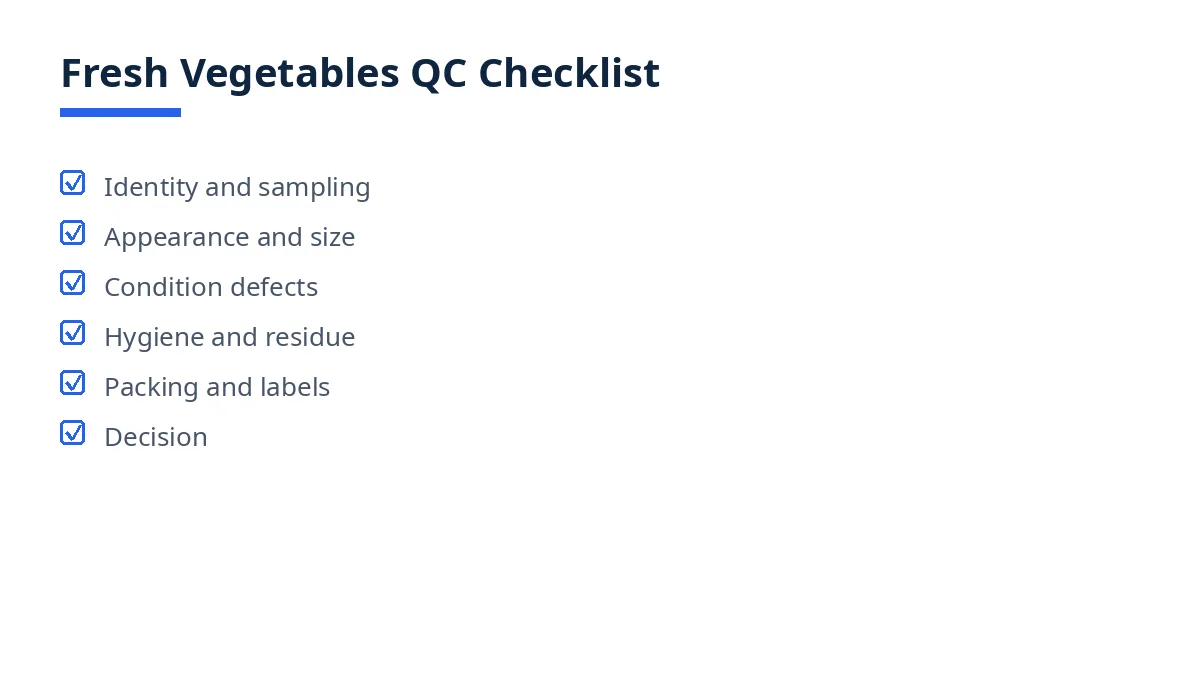
The full checklist (numbered, printable)
Identity, documents and sampling
Confirm the vegetable, variety, size grade and class match the purchase order, carton by carton.
Confirm quantity, by carton and net weight, against the packing list, and note shortages or overages.
Confirm the country of origin marking matches the shipment. In the EU, origin labelling for fruit and vegetables is covered by mandatory origin provisions developed for that sector.5
Draw the sample at random across cartons, covering every size and lot, and photograph the sample set, carton markings and any defect, with the carton number visible.
Appearance, size and maturity
Check every sampled piece against the minimum standard: intact, sound, clean, and free of abnormal external moisture, foreign smell and foreign taste.
Check colour and shape against the approved sample for the variety, and record unripe, overripe or atypical pieces.
Measure length, diameter or weight as the specification requires, using the same measure for every piece, and record actual values, not pass marks alone.
Check size uniformity inside each carton: pieces in one carton should fall in the size range the specification names.
Condition defects: what counts as a failure
Separate defects into classes before counting: critical defects that make a piece unsafe or unusable, major defects that affect saleability, and minor cosmetic defects.
Check for decay, mould, soft rot and water-soaked areas, and remove decayed pieces so they cannot contaminate neighbours during the check.
Check for bruising, crushing, pressure marks, cuts, splits and hail or handling damage, on the face and underside of each piece.
Check for pest damage, live pests, pest eggs and pest residue, and treat any live infestation as a critical defect.
Check for sunscald, frost damage, chilling injury, shrivelling and dehydration, and record the pattern: damage in one carton points to one part of the lot.
Check for soil, stones, leaves and other foreign matter, inside cartons and on the produce surface.
Where a specific marketing standard applies, apply its class definitions. For citrus fruit under Commission Delegated Regulation (EU) 2023/2429, Extra Class means superior quality with only very slight superficial defects, Class I means good quality with only slight defects allowed, and Class II covers fruit meeting the minimum requirements but not the higher classes.6
Where a specific standard applies, apply its tolerances, not your own. For citrus fruit under the same regulation, the quality tolerance is 5 percent for Extra Class, 10 percent for Class I and 10 percent for Class II, with smaller sub-limits for decay.6
For United States destinations without a grade standard, use the USDA figure only as a starting point: the most common shipping-point tolerance is 10 percent for average defects, including 5 percent for defects causing serious damage and 1 percent for decay, unless a standard for a similar commodity is more applicable.7
Hygiene, residue and lab evidence
Check that packing areas, crates and equipment used during the check are clean, and that damaged pieces are kept away from sound pieces.
Check pesticide residue evidence against the destination market. Regulation (EC) No 396/2005 sets maximum residue levels for pesticides in or on food and feed of plant and animal origin.8
Confirm every lab report names the vegetable, the lot, the active substances tested and the limit applied, and covers this shipment, not an earlier season.
Check that no piece carries a chemical smell, and treat an unexplained chemical smell as a critical defect pending evidence.
Record hygiene and residue findings separately from appearance findings, so a clean-looking lot is not recorded as cleared on safety evidence it never supplied.
Packing, labels and cold chain
Check that each carton contains one vegetable, one variety, one size grade and one class, unless the specification allows a mix.
Check carton strength, ventilation and internal protection, and confirm the carton can be stacked without crushing the produce inside.
Check labels for product, quality class where required, country of origin, and net weight or count as the destination market requires. EU package labelling includes product, country of origin and net weight or number of items, with the packer or dispatcher identified.1
Check barcodes and carton numbers against the packing list, and confirm the carton count and sequence match the shipment documents.
Record sampled carton temperatures against the figure named in the purchase order, and note cold-chain breaks: cartons left in sun, unrefrigerated staging or a warm loading area are findings.
Recording the decision
Count defects per class, compare each count with the agreed acceptance number, and record the result per class. Under ISO 2859-1, the acceptance quality limit is the worst tolerable process average for a continuing series of lots, not a target.3
State the decision in one line per lot: accepted, rejected, or accepted after sorting or rework, with the re-inspection condition noted.
List every corrective action with an owner and a date: sort, re-pack, re-label, hold for lab results, or reject.
Keep the checklist, photographs, measurements and lab documents with the shipment file, so the receiver can see what was checked.
Common failures and how to fix them
The most common failure is mixed maturity in one carton: ripe and unripe pieces packed together so the lot ripens unevenly at destination. Stop, re-sort by maturity against the approved sample, and re-check a fresh random sample before the lot is closed. Next is decay hidden at the bottom of a carton or in the center of a bag: decay spreads by contact, so remove decayed pieces, re-inspect the neighbours, and check whether packing or the cold chain allowed moisture to collect.
Size drift and label errors follow the same fix-first pattern. When pieces gradually fall outside the agreed range, re-check the sizing step and correct the grade before more cartons are closed. When origin, class, count or barcode is wrong, re-label the affected cartons and re-check the barcode against the list, rather than correcting only the carton the inspector opened. Above the agreed acceptance level, the options are re-inspection after sorting or rework, documented partial acceptance of the sound portion, or rejection of the lot. Do not ship a failed lot on a promise that the receiver will sort it.
Downloadable template / summary table
Copy this checklist into your inspection sheet, with the size chart, defect classes and acceptance numbers.
Section | Checks | Evidence |
|---|---|---|
Identity and sampling | Variety, quantity, origin, sample | Packing list, photographs |
Appearance and size | Intact, clean, colour, size, maturity | Measurements, sample check |
Condition defects | Decay, bruising, pests, sun and cold damage | Defect counts |
Hygiene and residue | Clean handling, residue documents | Documents, lab reports |
Packing and labels | Carton contents, labels, barcodes | Packing list, temperature |
Decision | Counts against acceptance numbers | Signed decision per lot |
Example figures: 400 cartons sampled across 40 cartons, with defect counts per class. In a real inspection, sample size and acceptance numbers come from the agreed plan, not this example.
How Exportain helps
Exportain is a B2B marketplace connecting buyers with Bangladeshi suppliers of fresh vegetables, so the specification behind this checklist can be agreed at the enquiry stage. Use inspection services when you plan the check, and read the pre-shipment inspection guide for how a final inspection is booked and reported. Supplier profiles show which document and photo checks have been recorded, not factory inspections. Exportain is not a party to the goods contract and does not inspect goods.
FAQs
When should this checklist be used?
Use it at final inspection, when goods are finished, graded and packed. For larger and first orders, also use it during packing, while grading and labelling can be corrected.
Who should complete it?
The buyer, a local agent or an independent inspector can complete it, using the approved sample, size specification, defect list and a random sample.
What are the most common failures?
Mixed maturity, hidden decay, size drift and label errors are the failures found most often, followed by bruising from packing and cold-chain breaks.
Can a third party do it?
Yes, if you share the approved references, defect classes, sampling plan and acceptance numbers first, and the inspector reports against those references rather than a general impression.
Next steps on Exportain
Before production, agree your size specification, defect classes, sampling plan and label wording, then read the AQL acceptance quality limit explainer and the pre-shipment inspection guide, and plan the check with inspection services.
Sources
- EU Marketing Standards for Fresh Fruit and Vegetables and Irish Marketing Standards for Potatoes. Department of Agriculture, Food and the Marine, Ireland (accessed )
- Code of Hygienic Practice for Fresh Fruits and Vegetables CXC 53-2003. Codex Alimentarius Commission (FAO/WHO) (accessed )
- SIST ISO 2859-1:2003 - Sampling procedures for inspection by attributes, Part 1: Sampling schemes indexed by acceptance quality limit (AQL). International Organization for Standardization, (accessed )
- Exemptions Relevant to Produce Farms Under the Produce Safety Rule and the Food Traceability Rule. U.S. Food and Drug Administration, (accessed )
- Origin labelling. European Commission (accessed )
- Commission Delegated Regulation (EU) 2023/2429 - Marketing standard for citrus fruit. European Union (accessed )
- PACA Good Delivery Guidelines. USDA Agricultural Marketing Service (accessed )
- Regulation (EC) No 396/2005 on maximum residue levels of pesticides in or on food and feed of plant and animal origin. European Union (accessed )
- pre-shipment inspection
- quality control
- inspection
- Bangladesh exports
- Acceptance Quality Limit
- Fresh vegetables
About the author
Sourcing from Bangladesh?
Post a request for quotation and suppliers on Exportain can send you their quotes directly.
Post an RFQ