Custom Jute Geotextiles in Bangladesh: From Tech Pack to Bulk
Follow a custom jute geotextile order through a Bangladeshi mill, from tech pack and sampling rounds to bulk weaving, QC gates and final sign-off, so you know what to approve at each stage.
Short answer
A custom jute geotextile order in Bangladesh runs from your tech pack through a feasibility review, loom trial and lab-tested samples, a sealed pre-production sample, bulk weaving with checks at each production stage, and a final inspection before packing and shipment. You approve the fabric at four gates: trial sample, lab results, pre-production sample and top-of-production sample. Each approval is written, dated and kept as the reference for bulk.
On this page
Key takeaways
A custom jute geotextile order runs tech pack, feasibility review, sampling rounds, bulk weaving and final inspection, with a written approval at each gate.
Name ISO 10319 for tensile strength and ISO 12956 for opening size in the tech pack so the mill and the lab test to the same methods.
The pre-production sample is the sealed reference for bulk: nothing is woven in bulk until you approve it in writing.
Agree the QC gates in the order, with the test method and pass limit for each one, from yarn check to final inspection.
Plan the delivery date from the pre-production approval date, not the order date, because bulk lead time runs from that approval.
When you order custom jute geotextiles from Bangladesh, the mill builds a fabric to your specification, not a stock grade. Your tech pack is the working document the factory builds from, and each stage ends with a check you approve in writing. In fiscal year 2025-26, jute and jute goods brought Bangladesh US$883.7 million in export earnings, a rise of 7.75 per cent against the previous year.1 This guide follows that order from the factory floor.
What does OEM mean for a custom jute geotextile order?
OEM, or original equipment manufacturing, means the mill makes the fabric to your specification. You define the construction, the mill weaves it, and the finished rolls match your numbers, not a catalogue grade. A geotextile is a flat, permeable textile of polymer material, made as a nonwoven, knit or weave; jute counts because its fibre is a natural polymer.2 The functions it can serve include separation, filtration, reinforcement, drainage, protection and surface erosion control.2
OEM differs from buying stock fabric in three ways: the mill sets its looms for your construction alone, every property is tested against your numbers, and you sign off at each sample stage before the mill moves on.
What should your tech pack contain?
The tech pack is the single document that states everything the mill needs to weave, treat, test and pack your fabric. A complete pack leaves nothing to guess, because every guess becomes a sample round.
Tech pack item | What to state |
|---|---|
Application | Slope stabilisation, riverbank protection, road sub-grade, or another named use |
Construction | Woven open-mesh or woven tight, ends and picks per decimetre, yarn count |
Mass per unit area | Target grams per square metre, with tolerance |
Tensile strength | Minimum load per unit width, both directions, test method ISO 10319 |
Opening size | Target opening size, test method ISO 12956 |
Roll size | Width and length per roll, with tolerance |
Finish | Natural, rot-retarded or bitumen-treated |
Packing and marks | Roll wrapping, strapping, labels and shipping marks |
Quantity and delivery | Total area, shipment date, destination port, Incoterm |
Name the test method for every property. ISO 10319:2024 sets the wide-width tensile method, recording peak force across the width and stretch at that peak.3 ISO 12956:2019 gives the wet-sieving procedure for finding the characteristic opening size in one layer of geotextile.4
Send the same pack to every mill on your shortlist so quotations can be compared line by line. Check the manufacturer profiles for jute geotextiles before you send a tech pack anywhere.
How does the mill turn your tech pack into a quotation?
Once your pack arrives, the mill runs a feasibility review before it quotes. The review answers four questions: can the looms weave your construction at your width, is the yarn count available, does the treatment line handle your finish, and does your quantity fill a loom run without long idle time. If any answer is no, a careful mill says so and suggests a change, such as a different yarn count or a wider roll. Accept the change only if your engineer agrees it still meets the project design.
The quotation should break down the cost drivers: raw jute and yarn, weaving time, treatment, lab testing, packing and the delivery term. Our wholesale guide explains how weight, width, treatment, order size and Incoterm move the unit price. Ask the mill to state its minimum order quantity; our MOQ guide explains the bands buyers usually meet. Agree the sampling plan and the payment schedule in the same document as the quotation, before any sample is woven: how many sample rounds are included, who pays for extra rounds, and which payment follows which approval.
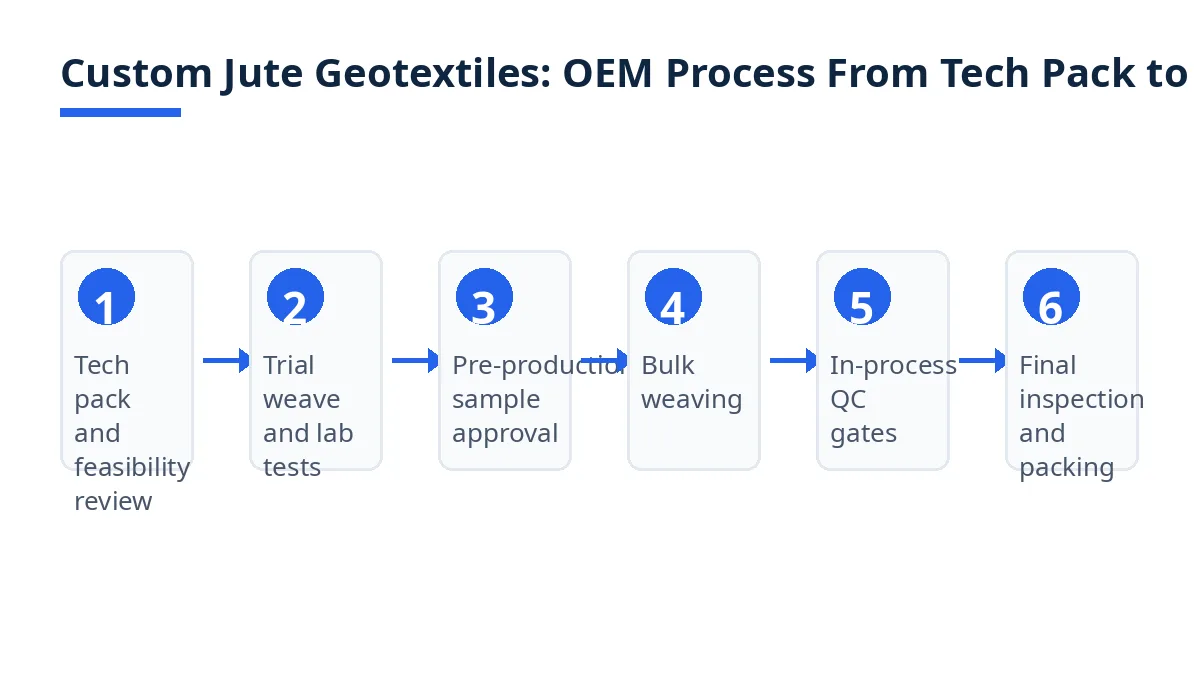
The OEM process at a glance
The diagram shows the six stages, from tech pack to packed rolls.
What happens in the sampling rounds?
Sampling is a staged validation system. Each stage checks different things, and each needs a formal sign-off before the next can begin. In OEM production the stages run proto, fit, pre-production and top of production, and the same logic applies to a woven fabric order, with the checks adapted to cloth rather than garments.5
Sample stage | What the mill makes | What you check | What approval locks |
|---|---|---|---|
Loom trial | A short length to your construction | Weave, aperture, width | The construction is weavable |
Lab test sample | Pieces cut from the trial weave | Tensile strength, opening size, mass | The fabric meets your numbers |
Pre-production sample | A full roll with bulk yarn and packing | Every property, roll size, marks | The sealed reference for bulk |
Top-of-production sample | Rolls pulled from the bulk run | Match to the sealed sample | The shipment standard |
The pre-production sample is the final gate: once you approve it, the factory treats it as the sealed production standard for every bulk roll.5 Keep a sealed reference piece of your own.
Give feedback in writing at each stage, marking each point as a required change or a preference. Vague or verbal-only feedback produces another round of interpretation rather than a corrected sample.5 If a sample fails a lab test, ask what changed in the yarn or loom settings and request a fresh sample. Plan your delivery date from the pre-production approval date: bulk lead time runs from that approval.5
How does bulk production run on the factory floor?
After pre-production approval, the mill schedules your loom time and orders the yarn. The steps below run in order.
Raw jute is graded and spun into yarn at the count your pack states; yarn count decides weight and strength, so a change here shows up in every later test.
The yarn is wound and warped for the loom, with the ends per decimetre set to your construction.
Weaving produces the fabric at your width and aperture, with loom settings checked against the approved trial weave at the start of the run.
Treatment follows, if your pack calls for it: a rot-retardant or bitumen treatment applied evenly across the full width.
The fabric is measured, cut to roll length and rolled, with length and width checked against the pack.
Rolls are wrapped, strapped, labelled with the grade, roll number and quantity, and packed for shipment.
The mill should record which loom wove which roll and which yarn lot went into it.
Which QC gates should you ask the mill to pass?
A QC gate is a check with a written pass limit, run at a fixed point in production. Agree the gates, with the test method and limit for each one, in the order.
Gate | When it runs | What is checked | Method |
|---|---|---|---|
Yarn check | Before weaving | Yarn count and evenness | Mill in-house test |
First-off check | Start of the run | Weave, aperture, width | Against the trial weave |
In-process check | During weaving | Mass, width, weave faults | Measured on the loom floor |
Lab test | On bulk fabric | Tensile strength, elongation, opening size | ISO 10319, ISO 12956 |
Treatment check | After treatment | Even coverage | Visual check |
Final inspection | After packing | Roll count, dimensions, marks | Against the sealed sample |
For road work, IS 14715 Part 1 sets the requirements for woven and non-woven jute geotextiles used to strengthen road sub-grades, covering weight, tensile strength, elongation, permittivity and apparent opening size.6 The same standard expects the manufacturer to keep test records and issue a test certificate for each consignment.6 Ask for the certificate with the shipment. The inspection points for a ready shipment are worth agreeing before any deposit: who inspects, at which stages, and what follows if goods fail.
What does the mill need from you before bulk starts?
Bulk weaving starts only when four items are in place: the signed pre-production approval, with the date and sample reference number; the final pack, frozen, with no construction or finish changes after this point without a new sample round; the payment for the stage you agreed, such as a deposit tied to the approval; and the packing and shipping marks, including the HS code for the documents.
For customs, woven jute geotextiles sit in HS heading 5310, the heading for woven jute fabric and woven fabric of other bast fibres; 5310.10 covers unbleached fabric and 5310.90 covers the rest.7 Use that same code on the commercial invoice, packing list and letter of credit, so every document carries the identical code. How the HS heading is applied to jute geotextiles is set out in our classification note.
The export documents include the commercial invoice, which must show the Export Registration Certificate number and the HS code, the packing list, the bill of lading and the certificate of origin.8 Some destinations ask for an inspection certificate as proof of the goods' quality, quantity and specifications.8 If the shipment uses wooden pallets, a fumigation certificate is often required.8
What can go wrong, and which gate catches it?
Most faults in a custom order are small drifts that grow across a long run. The table pairs each fault with the gate that catches it.
Fault | What causes it | Gate that catches it |
|---|---|---|
Fabric lighter than the pack | Finer yarn or fewer ends than specified | Yarn check, in-process mass check |
Tensile strength below the limit | Weak yarn lot or loose weave | Lab test to ISO 10319 |
Aperture too wide or too narrow | Wrong reed setting or yarn drift | First-off check, lab test to ISO 12956 |
Treatment patchy across the width | Uneven application | Treatment check |
Rolls short or narrow | Cutting or rolling error | Final inspection |
Wrong grade in the shipment | Mixed lots or mislabelled rolls | Final inspection, certificate check |
When a gate fails, stop the run and ask the mill to find the cause before weaving continues. A failed first-off check caught in the first hour costs a few metres of fabric; the same fault caught at final inspection costs the whole run. Ask for the rework record and a fresh test on the corrected lot.
A worked example: one custom order from tech pack to shipment
Example figures: a landscaping contractor needs custom open-mesh jute geotextile for a slope stabilisation project: 500 grams per square metre, 1.2-metre rolls, natural finish, 8,000 square metres in total, bought FOB Chattogram.
The mill confirms the looms can weave the construction and quotes with two sample rounds included. The loom trial matches the construction, and lab tests confirm tensile strength and opening size. The pre-production sample is approved in writing and sealed as the reference. Bulk weaving runs with in-process mass checks and a top-of-production sample pulled from the run. The final inspection checks roll count, dimensions and marks against the sealed sample, and the test certificate travels with the shipment.
The order took four written approvals to reach shipment: trial weave, lab results, pre-production sample and top-of-production sample. Each approval is dated and filed, so any question about the delivered rolls can be answered from the record, not from memory. For the wider import steps around this order, read our import guide.
Next steps on Exportain
Find jute fabric mills among the suppliers listed on Exportain, then send a request for quotation carrying your tech pack, quantity and destination port, so every mill prices the same job.
Sources
- Jute exports rise 37 per cent as Bangladesh plans to double earnings by 2031. The Financial Express, (accessed )
- ISO 10318-1:2026 - Geosynthetics - Part 1: Vocabulary. International Organization for Standardization (accessed )
- ISO 10319:2024 - Geosynthetics - Wide-width tensile test. International Organization for Standardization (accessed )
- ISO 12956:2019 - Geotextiles and geotextile-related products - Determination of the characteristic opening size. International Organization for Standardization (accessed )
- How to Manage the Garment Sampling Process at Every Stage. Runtang Textile, (accessed )
- Product Manual for Jute Geotextiles Part 1: Strengthening of Sub-Grade in Roads — Specification as per IS 14715 (Part 1):2016. Bureau of Indian Standards, (accessed )
- HS, 2012 - Code 5310: Woven fabrics of jute, other textile bast fibres of heading no. 5303. United Nations Statistics Division (accessed )
- Essential export documents for shipping from Bangladesh. DHL (accessed )
- quality control
- Bangladesh exports
- OEM manufacturing
- Jute geotextiles
- Tech pack
- custom jute geotextiles
- geotextile sampling
- jute geotextile production
About the author
Sourcing from Bangladesh?
Post a request for quotation and suppliers on Exportain can send you their quotes directly.
Post an RFQ