How to Import Jute Geotextiles From Bangladesh in 2026: Complete Buyer Guide
Import jute geotextiles from Bangladesh with a written specification, tested samples and a bank-checked payment route. This guide walks through HS code 5310, supplier checks and the documents your shipment needs.
Short answer
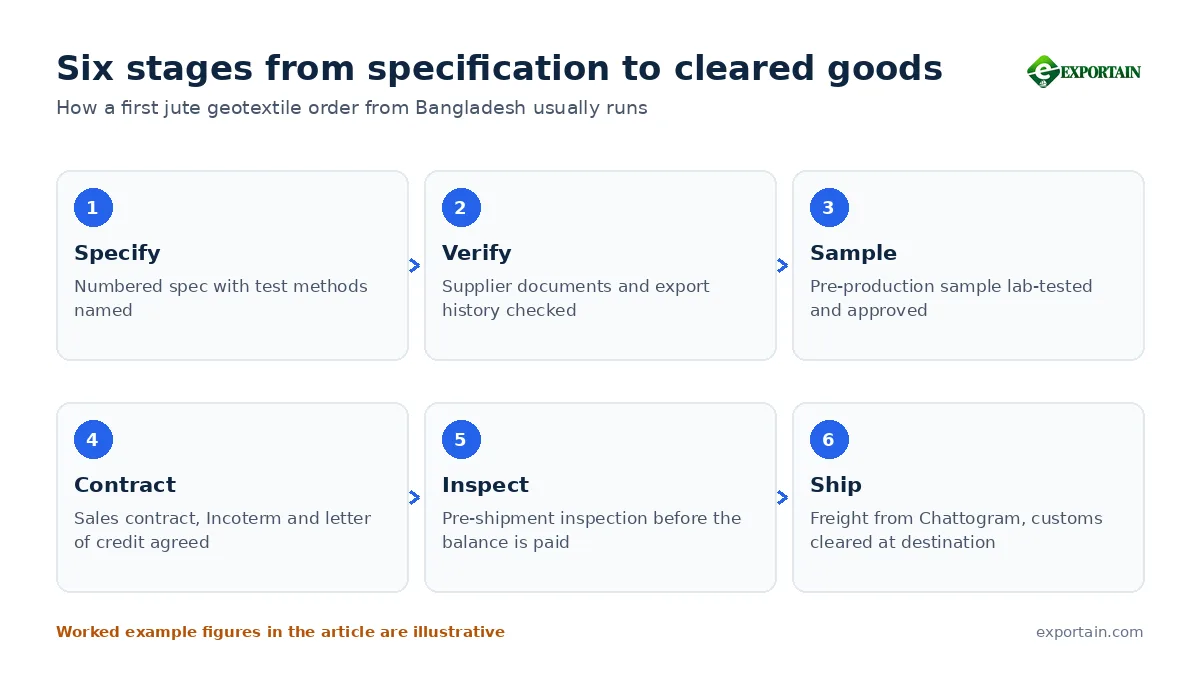
To import jute geotextiles from Bangladesh, write a numbered specification with test methods, classify the fabric under HS heading 5310, shortlist exporters and check their registration and export documents, test a pre-production sample, agree the contract, Incoterm and a letter of credit under UCP 600, inspect before paying the balance, then ship from Chattogram and clear customs with the invoice, packing list, bill of lading and certificate of origin.
On this page
Key takeaways
Jute geotextiles classify under HS heading 5310: 5310.10 unbleached, 5310.90 other.
Write the specification first, naming ISO 10319 for tensile strength and ISO 12956 for opening size.
Test a pre-production sample in a lab and approve it in writing before bulk production.
Use a letter of credit under UCP 600 and inspect before paying the balance.
Check the invoice, packing list, bill of lading and certificate of origin match before the vessel sails.
Jute geotextiles are woven jute fabrics used in contact with soil, and Bangladesh is a natural place to buy them. Bangladesh earned 883.7 million US dollars from jute and jute products in fiscal year 2025-26, up 7.75 per cent on the year before, according to Export Promotion Bureau data.1 This guide walks through a first order from end to end: the product, the HS code, the specification, supplier checks, sampling, payment, inspection, shipping and customs.
What is a jute geotextile, and where is it used?
A geotextile is a planar, permeable polymeric textile material that can be nonwoven, knitted or woven, and jute qualifies because it is a natural polymer fibre.2 ISO 10318-1:2026 lists the functions a geotextile can serve: separation, filtration, reinforcement, drainage, protection and surface erosion control.2 Jute geotextiles are used where a temporary, soil-contact fabric is wanted: slope and riverbank protection, road subgrade separation, landscaping and site cover.
Because jute is a natural fibre, ask your engineer whether the fabric suits the design life of your project before you order. State the intended use in your enquiry so the supplier quotes the right construction.
What HS code covers jute geotextiles?
Woven jute geotextiles fall under heading 5310, woven fabrics of jute or of other textile bast fibres of heading 5303.3 The heading has two six-digit subheadings, and the table below shows how they differ.3
HS code | Description | Use it when |
|---|---|---|
5310.10 | Unbleached woven fabrics of jute | The fabric is unbleached |
5310.90 | Other woven fabrics of jute | The fabric is bleached, dyed or otherwise treated |
Confirm the full national code with your customs broker, because destination countries add digits after the six-digit subheading and treated or coated fabrics can classify elsewhere. Put the agreed code on the commercial invoice, the packing list and the letter of credit so every document matches. For more detail on the classification, see our HS code guide for jute geotextiles.
The import process in six stages
The diagram below shows the six stages of a first order, from the written specification to cleared goods. Each stage below explains what to do, what to ask for and what to keep on file.
Step 1: How do you write a specification a supplier can build to?
A specification is the document the supplier builds against and the inspector checks against, so write it before you ask for prices. State every property as a number with a tolerance, name the test method for each one, and state the roll width, roll length and packing.
Property | What to state | Test method to name |
|---|---|---|
Mass per unit area | Target grams per square metre, with tolerance | State the method your lab uses |
Tensile strength | Minimum load per unit width, machine and cross-machine directions | ISO 10319 wide-width tensile test |
Elongation at break | Maximum strain at maximum load | ISO 10319 wide-width tensile test |
Characteristic opening size | Target opening size in millimetres | ISO 12956 |
Roll size | Width and length per roll, with tolerance | Measure on receipt |
Weave and finish | Weave type, and any treatment, named | Visual check against the approved sample |
ISO 10319 describes a wide-width tensile test that measures load-elongation behaviour, including maximum load per unit width and strain at maximum load.4 ISO 12956 sets out a method for the characteristic opening size of a single layer of geotextile using the wet-sieving principle.5 Name both standards in the specification so the supplier and the test lab work to the same methods.
Step 2: How do you find and check a supplier?
Start with a shortlist of exporters that already ship woven jute fabric, then check each one the same way. Ask for the company registration, a trade licence, the Export Registration Certificate (ERC) number, chamber membership and bank details in the company name, never a personal account. Check that the legal name, address and bank details match across every document, and ask for evidence of past jute fabric exports, such as a bill of lading with sensitive details removed.
Exportain badges record document and photo checks, not factory inspections, so treat them as one input and do your own checks as well. Our jute geotextiles manufacturer guide explains the checks in more depth. Send the same written specification and quantity to every supplier on the shortlist so the quotations can be compared line by line.
Step 3: How do you order samples and test them?
Ask shortlisted suppliers for a pre-production sample cut from the same yarn and loom settings as the bulk order, not a stock swatch. When the sample arrives, check the mass per unit area, the weave, the width and the finish against your specification, and send a piece to a lab for the tensile and opening-size tests named in step 1. Approve the sample in writing, keep a sealed reference piece, and state in the order that bulk goods must match the approved sample.
Build sampling into the schedule before you agree a shipment date. If a sample fails a test, ask the supplier what changed and request a fresh sample rather than accepting a verbal assurance. For the checks to run on bulk goods, see our quality control checklist for jute geotextiles.
Step 4: How do you agree the contract, Incoterm and payment?
Put the agreed terms in a signed sales contract before production starts: product specification, quantity, unit price, Incoterm, shipment date, payment terms, inspection terms and what happens if goods fail inspection. Choose the Incoterm with your freight forwarder so you know who arranges transport and insurance and where risk passes from seller to buyer.
For a first order, a letter of credit is the payment route most buyers choose, because the bank pays against documents rather than against a promise. Most modern documentary credits are issued subject to the ICC Uniform Customs and Practice for Documentary Credits, 2007 Revision, known as UCP 600.6 A credit cannot be amended or cancelled without the agreement of the issuing bank, the confirming bank if any, and the beneficiary.6 Banks have a maximum of five banking days to examine a presentation of documents.6 Read the credit draft line by line before it is issued, and make sure the goods description, HS code, shipment date and required documents match the sales contract. Our letter of credit guide explains the parties and the document checks.
Step 5: How do you inspect before you pay the balance?
Book a pre-shipment inspection once production is finished and the goods are packed, and agree the sampling plan and pass limits in writing before the inspector visits. The inspector should check quantity, roll dimensions, mass per unit area, weave, colour, packing and shipping marks against the specification and the approved sample. Ask for photos of the rolls, the packing and the marks, and a written report.
An inspection certificate may be necessary for some destinations to confirm the quality, quantity and specifications of the exported goods.7 Hold the balance payment until the report is in your hands and any failed items are fixed or replaced. Our pre-shipment inspection guide sets out the process and the checklist to use.
Step 6: How do you ship from Chattogram and clear customs?
Most jute geotextile shipments leave through Chattogram, the main seaport of Bangladesh, which handled 3,296,067 TEUs in fiscal year 2024-25, a record for the port.8 Ask the supplier for the documents in the table below before the vessel sails, and check each one against the sales contract and the letter of credit.
Document | What to check |
|---|---|
Commercial invoice | Goods description, value, Incoterm, ERC number and HS code |
Packing list | Roll count, dimensions and weights per package |
Bill of lading | Shipper, consignee, notify party, port of loading and vessel |
Certificate of origin | Issued by a chamber of commerce or another authorised body |
Insurance certificate | Required when the Incoterm puts insurance on the seller |
Inspection certificate | Matches the agreed specification and sampling plan |
Fumigation certificate | Required where wooden packaging is used |
The commercial invoice must include the Export Registration Certificate number and the HS code of the goods.7 A certificate of origin is required by many countries to determine import duties and preferential trade treatment, and exporters can obtain it from their local chamber of commerce or another authorised body.7 A fumigation certificate is often required for shipments with wooden packaging such as pallets, to prevent the spread of pests and diseases.7
Give your customs broker the HS code, the invoice value and the full document set before the goods arrive, and check the duty rate in your destination tariff database before you order. If any document names a different quantity, value or HS code from the others, ask the supplier to correct it before shipment.
How much does a first order cost?
The table below works through a first order so you can see how the landed cost builds up. Example figures: a European contractor orders 12,000 square metres of 700 gsm woven jute geotextile in 2-metre-wide rolls, bought FOB Chattogram.
Cost item | Example figures |
|---|---|
Goods, 12,000 square metres FOB Chattogram | 14,400 US dollars |
Ocean freight, Chattogram to Rotterdam | 1,850 US dollars |
Marine insurance | 120 US dollars |
Import duty at the rate your broker confirms | 0 US dollars in this example |
Port and broker charges at destination | 420 US dollars |
Total landed cost | 16,790 US dollars |
Landed cost per square metre | 1.40 US dollars |
These are example figures, not market prices. Replace each line with your own quotation, freight rate and duty rate before you commit. Our landed cost guide explains how to calculate the real cost per unit for any product.
What mistakes do first-time buyers make?
Ordering against a vague description instead of a numbered specification with named test methods.
Skipping lab tests on the sample and finding the problem after bulk production.
Paying the full balance before inspection, which removes the reason for the supplier to fix defects.
Using the wrong HS code, which changes the duty and can hold the goods at customs.
Forgetting the fumigation certificate when the shipment uses wooden pallets.
Accepting a sample approval by phone instead of in writing, so there is nothing to check bulk goods against.
How long does the process take, and what can delay it?
Allow time for sampling and testing before you promise a delivery date to your own customer.
Stage | What most often delays it |
|---|---|
Specification and quotations | Suppliers quoting against different constructions |
Sampling and lab tests | A failed test and a second sample round |
Production | Raw jute supply and loom availability |
Inspection | Failed items that need rework |
Shipping | Vessel space and port congestion at Chattogram |
Customs | A document mismatch or a missing certificate |
Next steps on Exportain
Browse suppliers on Exportain for jute fabric exporters, then post a request for quotation with your written specification, quantity and destination port so suppliers quote against the same terms. Read how to buy on Exportain before your first order so you know how enquiries, quotations and orders work on the platform.
Sources
- Jute exports rise 37 per cent as Bangladesh plans to double earnings by 2031. The Financial Express, (accessed )
- ISO 10318-1:2026 - Geosynthetics - Part 1: Vocabulary. International Organization for Standardization (accessed )
- HS, 2012 - Code 5310: Woven fabrics of jute, other textile bast fibres of heading no. 5303. United Nations Statistics Division (accessed )
- ISO 10319:2015 - Geosynthetics - Wide-width tensile test. International Organization for Standardization (accessed )
- ISO 12956:2019 - Geotextiles and geotextile-related products - Determination of the characteristic opening size. International Organization for Standardization (accessed )
- Documentary credits: Rules, guidelines & terminology. ICC Academy, International Chamber of Commerce (accessed )
- Essential export documents for shipping from Bangladesh. DHL (accessed )
- Ctg port handles record 32.96 lakh containers in FY25, revenue hits Tk75,432 crore. The Business Standard, (accessed )
- letter of credit
- pre-shipment inspection
- Bangladesh exports
- import from Bangladesh
- Jute geotextiles
- HS code 5310
- geotextile specification
- erosion control
About the author
Sourcing from Bangladesh?
Post a request for quotation and suppliers on Exportain can send you their quotes directly.
Post an RFQ