HS Code for Fresh Vegetables: Classification Guide for Importers
Fresh vegetables have no single HS code: Chapter 07 headings 0701 to 0709 cover the fresh or chilled vegetable, while state moves the same vegetable to frozen, preserved, dried, or roots-and-tubers headings. This guide works through the decision framework and how to confirm the full national code.
Short answer
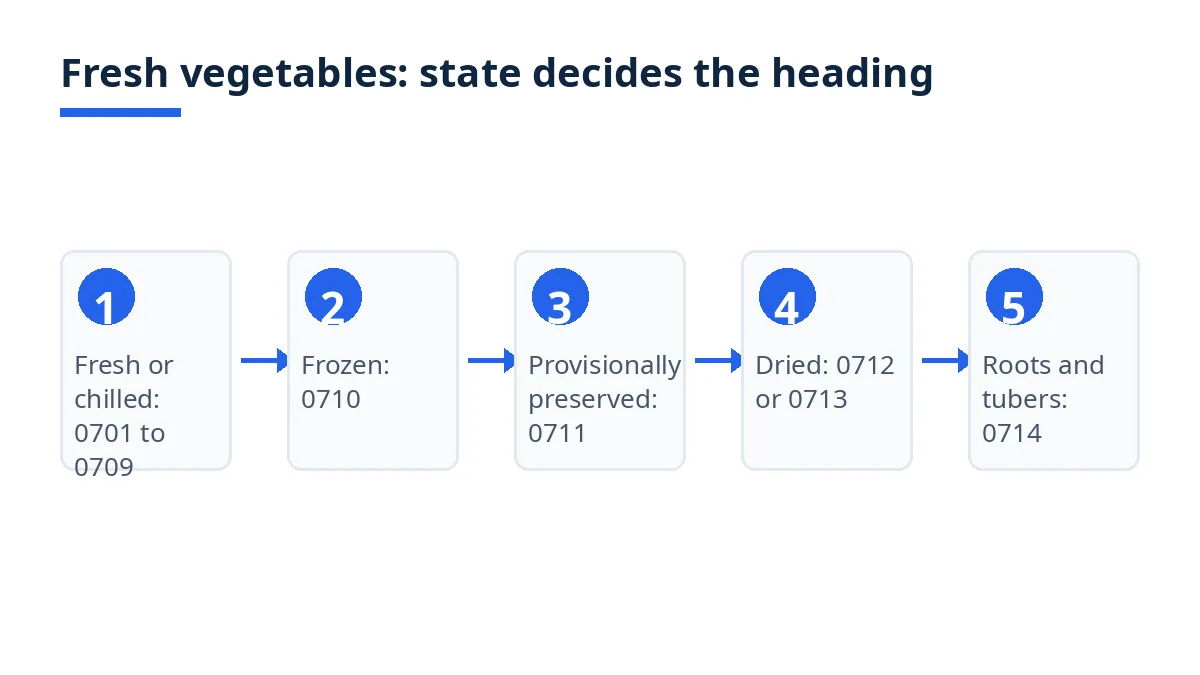
There is no single HS code for fresh vegetables. Fresh or chilled vegetables fall in Chapter 07, headings 0701 to 0709, with the heading decided by the vegetable and its state: frozen goods point to 0710, provisionally preserved goods to 0711, dried goods to 0712 or 0713, and named roots and tubers to 0714. Every heading here is indicative: verify the full national code in the destination tariff for the entry date before filing.
On this page
A buyer who asks for "the HS code for fresh vegetables" is asking a question with no single answer. Fresh vegetables are not one product in the Harmonized System. They are a family of products spread across Chapter 07, and the code for any one shipment depends on which vegetable it is and the state it arrives in.
This guide works through the Chapter 07 decision framework: the fresh or chilled heading for a named vegetable, how a change of state moves the heading, and how to extend the result into the national code for the United States, the European Union, or the United Kingdom. Every heading here is indicative; confirm the full national code in the destination tariff before filing.
Quick answer: indicative HS heading
There is no single settled heading for fresh vegetables as a group. The indicative answer is Chapter 07, "Edible vegetables and certain roots and tubers," with fresh or chilled goods in headings 0701 to 0709. The heading is decided by the vegetable and its state: frozen goods point to 0710, provisionally preserved goods to 0711, dried goods to 0712 (or 0713 for dried leguminous vegetables), and named roots and tubers to 0714.
Verify note: treat every heading here as a starting point only. Check the full national code in the tariff of the country where the goods will be declared, for the date of entry.
How HS codes are structured (2-4-6 digits)
The Harmonized System is an international product nomenclature maintained by the World Customs Organization (WCO). It comprises more than 5,000 commodity groups, each identified by a six-digit code, and is used by more than 200 countries and economies as the basis for their customs tariffs.1
The six digits narrow in three stages. The first 2 digits give the chapter: Chapter 07 covers edible vegetables and certain roots and tubers. The first 4 digits give the heading, for example 0702 for tomatoes, fresh or chilled, or 0706 for carrots and similar edible roots, fresh or chilled.2 All 6 digits give the subheading, for example 0702.00 for tomatoes, fresh or chilled, in the United States tariff.2 In an international sense, "the HS code" usually means this six-digit subheading.
Countries then extend the six digits for their own tariffs: the United States to 10 digits in the Harmonized Tariff Schedule (HTS), the European Union to an 8-digit Combined Nomenclature (CN) code extended in TARIC, and the United Kingdom to a 10-digit commodity code. Only the first six digits are used worldwide.3
Factors that decide the code for fresh vegetables
Four factors decide the heading, checked in this order: the vegetable itself, its state on arrival, any preparation it has undergone, and, for legumes, whether the product is shelled or unshelled and fresh or dried.
The vegetable itself
Headings 0701 to 0709 are organised by vegetable family. Potatoes sit in 0701, tomatoes in 0702, onions, shallots, garlic, and leeks in 0703, cabbages and cauliflowers in 0704, lettuce and chicory in 0705, carrots and similar edible roots in 0706, cucumbers and gherkins in 0707, leguminous vegetables in 0708, and every other fresh or chilled vegetable in 0709.2 4 Chapter 7 note 2 states that in headings 0709 to 0712 the word "vegetables" includes edible mushrooms, truffles, olives, capers, marrows, pumpkins, aubergines, sweet corn, peppers, fennel, and parsley.2
The state on arrival
State is the most decisive factor after identity. United Kingdom guidance states that Chapter 07 goods are classified by genus or plant family, state (fresh, chilled, frozen, dried, or provisionally preserved), and intended use.5
Three state tests catch most errors. First, frozen goods must be held at no more than minus 12 degrees Celsius throughout; otherwise they are fresh or chilled, within headings 0701 to 0709.5 Second, heading 0711 applies only where goods remain unsuitable for immediate consumption; vegetables edible straight from the jar fall to Chapter 20 instead.2 5 Third, note 3 moves dried leguminous vegetables, shelled, from 0712 to 0713, and dried or crushed or ground peppers out of the chapter, to 0904.2
Worked examples: fresh vegetables as classification questions
Each item below is a classification question, with the deciding factor named. All headings are indicative and must be verified in the destination tariff.
Tomatoes, fresh or chilled: which heading? Indicative 0702 (0702.00). Deciding factor: the named heading.2 4
Onions, fresh or chilled: which heading? Indicative 0703. Deciding factor: the alliaceous family.2 4
Carrots, fresh or chilled: which heading? Indicative 0706. Deciding factor: edible roots, fresh or chilled; not 0714, a named list.2 5
Cucumbers, fresh or chilled: which heading? Indicative 0707. Deciding factor: the named heading.2 4
Cauliflower, fresh or chilled: which heading? Indicative 0704 (0704.10). Deciding factor: the brassica family.2 4
Lettuce, fresh or chilled: which heading? Indicative 0705. Deciding factor: head lettuce versus other lettuce.2 4
Green beans, fresh or chilled: which heading? Indicative 0708. Deciding factor: leguminous vegetables; dried, they move to 0713.5
Okra, fresh or chilled: a 0709 question? Indicative 0709. Deciding factor: elimination; no named fresh heading fits.2
Mushrooms, fresh or chilled: a 0709 question? Indicative 0709. Deciding factor: note 2 includes edible mushrooms; state then decides.2 5
National codes: US HTS, EU CN/TARIC, UK commodity code
The six-digit result is only the first stage. The United States uses the Harmonized Tariff Schedule (HTS) to 10 digits, the European Union uses the 8-digit Combined Nomenclature (CN) extended in TARIC, and the United Kingdom uses a 10-digit commodity code, each to be confirmed on the entry date.
For the United States, the opened 2026 HTS Chapter 7 text shows tomatoes at 0702.00, cucumbers at 0707.00, other vegetables at 0709, frozen vegetables at 0710, provisionally preserved vegetables at 0711, dried vegetables at 0712, dried leguminous vegetables at 0713, and named roots and tubers at 0714.2 Digits after the sixth are United States detail, to be read in the HTS itself.
For the European Union, the 2016 Combined Nomenclature text used for this guide shows tomatoes at 07020000, cucumbers at 07070005, cauliflowers and headed broccoli at 07041000, lettuce at 07051100 and 07051900, carrots and turnips at 07061000, and beans at 07082000.4 These are a starting point from an earlier CN edition; the current edition and the TARIC measures in force on the entry date govern.
For the United Kingdom, no specific commodity line is asserted in this guide. United Kingdom guidance states that only the first six digits are used worldwide, and that a code taken from an overseas supplier must be checked for how much of it applies in the United Kingdom.3 Confirm the full 10-digit commodity code in the UK Trade Tariff tool for the entry date.
How to confirm the code officially
Work through these steps in order:
Describe the goods precisely. Name the vegetable, its variety where it matters, and its state on arrival. State the treatment in full, including any brine, freezing temperature, or drying method.
Read the heading text and the chapter notes. Read notes 1 to 5 of Chapter 7 in full. Notes decide cases that heading titles alone do not, including the mushroom inclusion and the dried-legume exclusion.2
Test the state, not just the name. Ask whether the goods are frozen throughout, whether a preserved product can be eaten as it stands, and whether a dried product is a legume. Each answer can move the heading.5
Extend the six digits in the destination tariff. Read the full national line for the entry date in the HTS, the CN and TARIC, or the UK Trade Tariff, as applicable. Do not carry trailing digits over from another country's tariff.3
Get a second check where the answer matters. Where two headings remain plausible, ask a customs broker who files in the destination country, or apply for a binding or advance ruling before shipping.
Record the description, heading, notes applied, national line, and date checked, and share that record with the supplier and broker. Re-check whenever the specification, destination, or tariff edition changes.1
Common classification mistakes
Copying a full foreign code. Only the first six digits are international; check an overseas supplier's code before relying on it.3
Classifying from a trade name or a photo. Customs classifies goods as presented, by objective characteristics. A photo cannot show freezing, edibility, or legume status.
Treating partly frozen goods as frozen. A product not frozen throughout at the required temperature is fresh or chilled, within headings 0701 to 0709.5
Treating jar-ready vegetables as provisionally preserved. Vegetables that can be eaten straight from the jar are not heading 0711 goods, which must remain unsuitable for immediate consumption.2 5
Sending dried legumes to 0712. Dried leguminous vegetables, shelled, belong in heading 0713, not 0712, under note 3.2
Sending every root to 0714. Heading 0714 is a named list; carrots and similar edible roots, fresh or chilled, sit in heading 0706.2 5
Sending ground dried peppers to Chapter 07. Dried or crushed or ground Capsicum or Pimenta fruits are excluded from Chapter 07 and fall in heading 0904.2
Forgetting the edition. A code from an old quotation or CN edition may no longer match the tariff in force.1 Check the code for the entry date, every time.
Related duties and documents
This guide states no duty figures. Duty and tax treatment, preferential treatment, licences, and controls are worked out from the code in the destination tariff, and they change over time and by origin.3 Read the current treatment in the official tariff for the entry date.
Two document points follow. First, the import declaration must show the code confirmed in the destination tariff, not the code on the supplier's invoice alone.3 Second, the supplier specification in writing is the evidence behind the code: variety, state, treatment, and legume status.
FAQs
What is the HS code for fresh vegetables?
There is no single HS code for fresh vegetables. Fresh or chilled vegetables fall in Chapter 07, headings 0701 to 0709, with the heading decided by the vegetable: tomatoes 0702, onions 0703, cauliflower 0704, lettuce 0705, carrots 0706, cucumbers 0707, leguminous vegetables 0708, and other vegetables 0709. Every heading here is indicative; verify it in the destination tariff.
Is the HS code the same in every country?
Only the first six digits are the same internationally. The United States extends them to 10 digits in the HTS, the European Union to 8 digits in the Combined Nomenclature extended in TARIC, and the United Kingdom to a 10-digit commodity code.3 Only the destination tariff confirms the full code.
How do I confirm the correct code?
Describe the goods precisely, read the heading texts and the Chapter 7 notes, apply the state test, and then read the full national line in the destination tariff for the entry date.2 3 Where two headings remain plausible, ask a customs broker or apply for a binding or advance ruling before shipping.
What happens if I use the wrong code?
Customs can reclassify the goods, reassess duty and taxes, delay clearance, and apply penalties or controls that depend on the correct code. Consequences are national and vary, so none are stated here. If an error is found, tell the broker promptly and re-check other shipments that used the same code.
Next steps on Exportain
For the meaning of an HS code and how the six-digit structure works, read the Exportain HS hub: HS Code (Harmonized System Code). For the step-by-step method that sits behind the framework in this guide, read: How to Find an HS Code: Step-by-Step. When the code is settled and you are ready to compare suppliers for the shipment, browse the directory at Exportain suppliers and confirm the specification in writing before ordering.
Sources
- What is the Harmonized System (HS)?. World Customs Organization (accessed )
- Harmonized Tariff Schedule of the United States Revision 8 (2026), Chapter 7. U.S. International Trade Commission (accessed )
- Finding commodity codes for imports or exports. GOV.UK (HM Revenue & Customs), (accessed )
- Commission Implementing Regulation (EU) 2016/1821, Annex I, Chapter 7. European Commission (accessed )
- Classifying edible fruit, vegetables and nuts for import and export. GOV.UK, HM Revenue and Customs (accessed )
About the author
Sourcing from Bangladesh?
Post a request for quotation and suppliers on Exportain can send you their quotes directly.
Post an RFQ