Jute Geotextiles Exporters in Bangladesh: Verified Supplier Checklist
A verification checklist for finding jute geotextile exporters in Bangladesh: the documents to collect, the test reports to read, the factory checks to run, the red flags to walk away from, and a 100-point scorecard for your shortlist.
Short answer
To check a jute geotextile exporter in Bangladesh, collect the same documents from every candidate, starting with a current Export Registration Certificate, trade licence, BIN, chamber membership, bank certificate and EPB enrolment, all in matching names. Ask for independent lab reports tested to ISO 10319 for tensile strength and ISO 12956 for opening size, visit or video-call the mill to confirm loom width and yarn control, and score each candidate on a 100-point card with a pass line of 70.
On this page
Key takeaways
Ask every candidate for the same documents: a current ERC, trade licence, BIN, chamber membership, bank certificate and EPB enrolment, all in matching names.
Check independent lab reports tested to ISO 10319 for tensile strength and ISO 12956 for opening size, and confirm the results against your own pass marks.
Confirm factory capability on the floor: loom width, yarn control, treatment coverage, labelling and traceability.
Score every candidate on the same 100-point card, with a pass line of 70 and at least 15 points in both documents and lab evidence.
Walk away when names differ across documents, payment goes to a personal account, or the exporter cannot name its mill.
A jute geotextile order fails long before the fabric reaches your site. It fails at the point you pick the wrong exporter: a trader posing as a mill, a mill that has never woven your grade, or a supplier whose test report belongs to somebody else. This checklist shows you how to sort real exporters from hopeful ones.
Set your pass marks before you contact anyone
Most buyers collect names first and decide what counts as good later. Reverse that order. Write down your pass marks before you contact a single exporter.
Start with the fabric: the construction, open-mesh or tight woven, the mass per square metre, the tensile strength in both directions, the opening size, the roll width and length, and the finish.
Then set the commercial marks: the largest deposit you will pay before production, the payment method, and the inspection you will require before the balance leaves your account. A letter of credit suits a first order with an unknown exporter; open account terms suit a supplier whose record you have already checked. Bangladesh Bank's consolidated export circular of 30 July 2026 requires export proceeds to be repatriated within four months of shipment, and it allows up to 360 days for raw jute and jute goods paid against an irrevocable confirmed letter of credit or on open account.1 Finally, set a minimum score: the scoring method later in this article runs to 100 points, and a supplier below 70 does not reach your shortlist.
Collect the same documents from every candidate
Ask every candidate for the same set of documents, in the same order.
The first document is the Export Registration Certificate, the ERC. It is issued by the Office of the Chief Controller of Imports and Exports, under the Ministry of Commerce, and it is the registration through which a business is recognised as an exporter under Bangladesh's trade-control framework.2 The governing instrument is the Importers, Exporters and Indentors (Registration) Order, 2023.2 An ERC on its own does not prove a company weaves geotextiles, but the absence of one ends the conversation: a business without an ERC is not registered to export at all. The initial registration runs for one year, renewable for up to five years, with a fee of BDT 10,000 new and BDT 7,000 renewal, plus VAT, so check the name against the trade licence and the expiry date.2
Next, ask for the BIN, the Business Identification Number for VAT. It is not among the six prescribed attachments for an initial ERC application under the 2023 Order, but it becomes mandatory when the exporter applies for its first ERC renewal, and Bangladesh Customs lists the VAT registration and BIN certificate among the general documents for export clearance.2 Also ask for the chamber or trade association membership certificate, which the ERC application itself requires, and check that its name and expiry date match the ERC.2
Ask for the bank certificate from the exporter's nominated bank, which the 2023 Order also lists among the prescribed ERC attachments.2 It ties the company to a bank account in its own name. Also ask for the EPB enrolment certificate. The Export Promotion Bureau issues enrolment certificates that exporters need to use its services, including certificates of origin under preference schemes such as the Generalised Scheme of Preferences, and the tenure of the enrolment certificate has been extended to as long as five years.3
Document | What it proves | What to check |
|---|---|---|
Export Registration Certificate | The business is registered to export | Issuing office, business name, expiry date |
Trade licence | The business is licensed to trade | Current year, matching address |
BIN certificate | VAT registration is in place | Number matches the invoice and renewal records |
Chamber or association membership | The company belongs to its trade body | Current membership year, matching name |
Bank certificate | The company holds a bank account in its own name | Bank name, account name, recent date |
EPB enrolment certificate | The exporter can use EPB services and preference schemes | Current enrolment, REX number where relevant |
ISO 9001 certificate | A quality management system has been audited | Scope covers geotextile production, expiry date |
Read a test report the way a lab would
A test report speaks about the fabric rather than the company, and it is the one most often faked. Read it slowly.
First, match the report to the fabric you are buying. It should name the product, the construction, the mass per square metre and the test methods used. Two methods matter most. ISO 10319:2024 sets the wide-width tensile test, which measures the maximum load per unit width, the strain at maximum load and the secant stiffness of a geosynthetic strip.4 ISO 12956 sets the method for the characteristic opening size, using a wet-sieving principle on a single layer of geotextile.5 The report must show results from these two methods, or from methods your engineer has accepted as equivalent.
Second, look at who ran the test. A report from the exporter's own in-house lab is useful for production control, but it is not independent evidence. Ask for at least one report from an accredited independent laboratory, and check the lab's name, the report number and the date. Ask for the full report, not a summary page, and ask whether the lab tested conditioned or wet specimens, since jute behaves differently when wet and the method covers both.4 ISO 9001 covers a management system, not a single roll of fabric, and ISO itself does not certify companies.6
What to look at on the factory floor
If the order is large enough to justify the trip, visit the mill, or send an inspector on your behalf. A live video walkthrough, where you choose what the camera shows, is a workable substitute for a small order.
Start at the looms. Count them, note their width, and ask which looms would weave your order. A mill that quotes a 2-metre roll width should own looms that can weave it. Ask to see the yarn store and the warping area, and ask where the raw jute comes from and how it is graded before spinning.
Then look at the treatment line, if your fabric needs one, and ask how the mill checks that a rot-retardant or bitumen treatment is applied evenly across the full width. Ask how the mill tracks each roll back to its loom and yarn lot. In the finished-goods area, rolls should be labelled with the grade, roll number and quantity, and stored off the floor, away from damp.
Finally, sit down with the production manager and ask three questions: how many square metres of jute geotextile did you ship last year, what was your largest single order, and what happens here when a lab test fails. A manager who describes a rework record is describing a system.
Score every candidate on the same card
Scoring turns a pile of impressions into a decision you can defend. Use the same scorecard for every candidate, score each one from the documents and the visit. The diagram below shows the scorecard with example weightings.
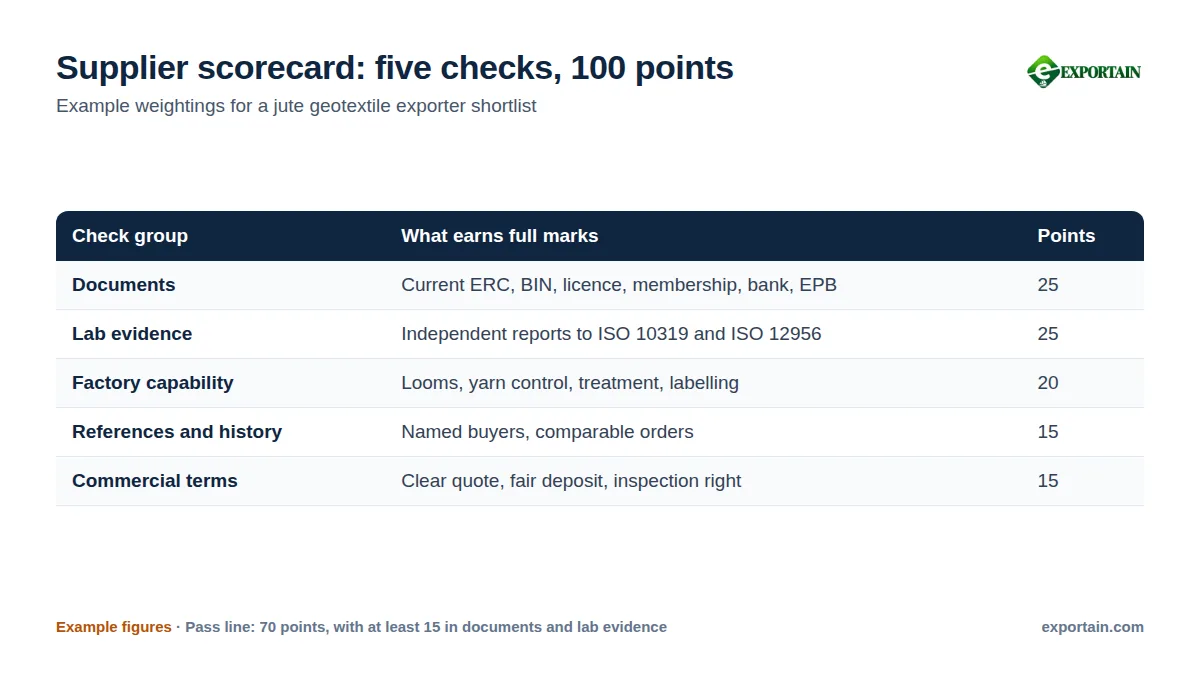
The five groups are documents, lab evidence, factory capability, references and trade history, and commercial terms. Documents carry 25 points: a current ERC, BIN, trade licence, association membership, bank certificate and EPB enrolment together earn the full 25, with points deducted for expired or missing items. Lab evidence also carries 25, earned by independent reports that match your construction and your pass marks. Factory capability carries 20, earned on the visit: looms of the right width, yarn control, treatment where needed, labelling and traceability. References and trade history carry 15, earned by named buyers and a record of comparable orders. Commercial terms carry 15, earned by a clear quotation, a fair deposit, a payment method that fits the rules, and a written inspection right.
Set the pass line at 70 out of 100 and require at least 15 points in both documents and lab evidence. A supplier can score well on charm and price and still fail the two groups that matter most.
Red flags that should stop a deal
Walk away when the business name on the invoice differs from the name on the ERC, when the exporter asks for payment to a personal account or to a company in another country, or when the exporter refuses to name its mill and offers only a trading address.
Pause and ask when the price sits far below every other quotation for the same construction, when the exporter promises a delivery date far shorter than the weaving and treatment time the work requires, or when every answer arrives quickly except the one about inspection. Also watch the communication pattern: a different contact person every week and a phone number that never connects are small signs, but they add up.
A worked example: two exporters, one order
Example figures: a landscaping contractor needs 6,000 square metres of open-mesh jute geotextile for slope work, in 1.2-metre rolls, natural finish, delivered FOB Chattogram within eight weeks.
Exporter A sends a current ERC, BIN, trade licence, association membership, bank certificate and EPB enrolment, all in matching names. Its independent lab report shows the construction you asked for, tested to ISO 10319 and ISO 12956, with results above your pass marks in both directions.4 5 A video walkthrough shows looms of the right width and labelled rolls in a dry store. The quotation is clear, the deposit is 30 per cent, and the contract allows a final inspection before the balance. Exporter A scores 24 on documents, 23 on lab evidence, 17 on factory capability, 13 on references and 13 on commercial terms: 90 out of 100.
Exporter B sends an ERC that expired three months ago, a BIN certificate in a different company name, and no association membership. Its test report is a single summary page from its own lab, with no method named and no independent report offered. The factory video shows a trading office with no looms visible. The price is 18 per cent below Exporter A, the deposit is 50 per cent in advance, and the contract has no inspection clause. Exporter B scores 9, 6, 5, 4 and 6 across the five groups: 30 out of 100. Exporter B is cheaper on paper and far more expensive in risk.
Put the checklist into your first order
Put the inspection right in the contract, not in an email. Name the inspection company, the stage at which it attends, and the sampling plan it will use. Independent inspectors in Bangladesh offer initial production checks, during-production checks and final random inspections, and they work to sampling plans that set the sample size from the lot size and the agreed quality limit.7 The common framework is ISO 2859-1, with ANSI/ASQ Z1.4 as its United States counterpart: general inspection level II is the usual default, and common quality limits for major defects are 1.0, 1.5 or 2.5 per cent.8
Tie payment to the evidence, not to the calendar. A deposit follows the signed order, a middle payment follows the approved sample and lab results, and the balance follows the inspection report and the shipping documents. Under Bangladesh Bank's rules, the shipping documents and the EXP form should reach the exporter's authorised dealer bank within 14 days of shipment, and the exporter's bank must receive the proceeds within four months.1 For the wider steps, see our import guide, manufacturer guide, price guide, MOQ guide and quality-control checklist.
Next steps on Exportain
Begin your search among the jute geotextile suppliers on Exportain, and put your specification, pass marks and inspection terms into a request for quotation so each exporter answers the same brief.
Sources
- How to Receive USD in Bangladesh: 2026 Business Guide. Helm, (accessed )
- Export Registration Certificate (ERC) in Bangladesh | 2026 Guide. Roy Law Nexus, (accessed )
- EPB listing must for preferential trade under GSP, bloc treaties. The Financial Express, (accessed )
- ISO 10319:2024 - Geosynthetics - Wide-width tensile test. International Organization for Standardization (accessed )
- ISO 12956:2010 - Geotextiles and geotextile-related products - Determination of the characteristic opening size. International Organization for Standardization, (accessed )
- ISO 9001: What does it mean in the supply chain?. International Organization for Standardization (accessed )
- Bangladesh Verification Services. Intertek (accessed )
- AQL Calculator: Sampling Plans per ANSI/ASQ Z1.4. NR Tech Studio (accessed )
- supplier verification
- Bangladesh exports
- Exporters Bangladesh
- Jute geotextiles
- ERC certificate
- geotextile testing
- factory audit
- buyer checklist
About the author
Sourcing from Bangladesh?
Post a request for quotation and suppliers on Exportain can send you their quotes directly.
Post an RFQ