Jute Geotextiles Price in Bangladesh: FOB Cost Breakdown for Buyers
An FOB quote for jute geotextiles covers the fabric plus finishing, testing, packing and delivery to the vessel at Chattogram. This guide breaks down each cost part, shows the market ranges, and explains how to compare supplier quotes on equal terms.
Short answer
An FOB price for jute geotextiles from Bangladesh covers the woven fabric plus finishing, testing, packing, inland freight to Chattogram, export clearance and loading on board the vessel. Ocean freight and marine insurance sit with you, the buyer. Published market ranges put standard 500 gsm jute netting near $0.45–$0.80 per square metre at factory gate, before those FOB add-ons. Always compare quotes on the same unit, specification and Incoterm before you judge which one is cheaper.
On this page
Key takeaways
An FOB price covers the fabric plus packing, inland freight, export clearance and loading at Chattogram; ocean freight and insurance sit with the buyer.
Fabric weight, treatment, roll size and order volume move the unit price more than the supplier name does.
Published market ranges put standard 500 gsm jute netting near $0.45–$0.80 per square metre at factory gate, before FOB add-ons.
Compare quotes only after converting every one to the same unit, specification and Incoterm.
Ask for a line-by-line cost build-up in writing before you accept a quote.
Export Promotion Bureau figures put Bangladesh's earnings from jute and jute goods at 883.7 million US dollars in 2025-26, 7.75 per cent higher than the year before.1 Much of that rise came from higher prices rather than higher volumes: exporters say floods damaged jute production, pushing up the price of raw jute.1 If you buy jute geotextiles from Bangladesh, that price pressure lands directly in your quotations, so it pays to know what sits behind the number.
This guide breaks an FOB (Free On Board) quote into its parts, from raw jute fibre to the loaded vessel at Chattogram. You will see the market ranges, what moves the price, and how to compare two quotes on equal terms.
What does an FOB price actually include?
FOB (Free On Board) is one of the eleven Incoterms 2020 rules, and it applies only to sea and inland waterway transport.2 Under FOB, the seller delivers the goods loaded on board the vessel you nominate at the named port of shipment, and risk passes to you at that moment.2 The seller carries the goods from its premises to the port, loads them on board and completes the export formalities.2 You contract the carrier, pay the ocean freight, and handle import formalities at destination.2
That split is what an FOB price buys you. The table below shows where the line falls for a Chattogram shipment.
Cost | Who pays |
|---|---|
Export packing and shipping marks | Seller, inside the FOB price |
Inland freight from mill to Chattogram | Seller, inside the FOB price |
Export clearance and documents | Seller, inside the FOB price |
Port handling and loading on board | Seller, inside the FOB price |
Ocean freight to your port | You, the buyer |
Marine insurance | You, the buyer |
Import clearance, duty and delivery at destination | You, the buyer |
Two details catch first-time buyers out. First, always name the port in full: write "FOB Chattogram, Incoterms 2020" rather than a bare "FOB Bangladesh", because the port decides whose freight and handling the price covers. Second, if your fabric ships in a container handed to the carrier at a terminal, the ICC notes that FCA (Free Carrier) is the more fitting rule, since goods may wait days at the terminal before loading.2 Our FOB vs CIF guide compares the two terms side by side.
The seven cost parts of an FOB quote
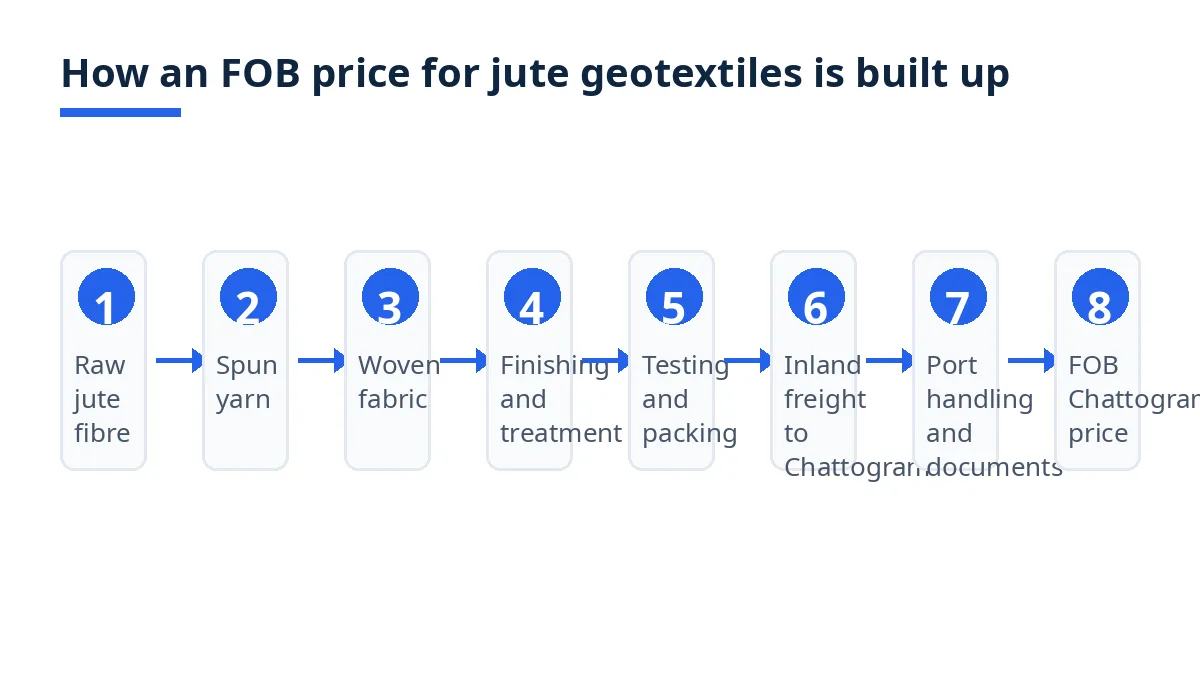
An FOB quote is a stack of seven cost parts. The first four are the fabric itself; the last three move it from the mill gate to the vessel. Ask your supplier to break the quote down the same way, so you can see which part moved.
1. Raw jute fibre
Raw jute fibre is the main cost input in a jute geotextile. Jute is an agricultural fibre, so its price follows the harvest and the season. In fiscal year 2025-26, jute yarn export earnings rose 18.18 per cent to 545.8 million US dollars even though export volume fell 2 per cent, a sign that higher prices, not higher volumes, drove the value.1 A quote that is valid for 30 days can look very different after a raw jute price move, so check the validity date on every quotation.
2. Spinning the yarn
Raw fibre is spun into the yarn that the loom weaves. Finer yarn and tighter counts cost more, because they take more fibre and more machine time per metre of fabric. The yarn count also sets the fabric weight, which is why two fabrics with the same width can carry very different prices.
3. Weaving the fabric
Weaving turns yarn into cloth. The fabric weight, measured in grams per square metre (GSM), is the first thing that sets your price band: heavier fabrics use more yarn per square metre, and published price guides put heavyweight fabrics of 400 to 800 GSM at 10 to 20 per cent above lighter grades.3
4. Finishing and treatment
Natural jute fabric is the cheapest form. Treatments add cost: rot-retardant or bitumen treatment for wet conditions, dyeing, or a coating for a longer design life. Published guides put chemical treatments at roughly 10 to 15 per cent on top of the base fabric price.3 State the treatment in your specification, because an untreated quote and a treated quote are not the same product.
5. Testing and certification
A project specification usually names test methods, and the lab work is priced into the order. ISO 12956:2019 sets out the method for the characteristic opening size of a geotextile, measured by wet sieving.4 Ask who pays for the lab tests and whether the test report is included in the quoted price, because a quote without testing can look cheaper than one that includes it. Before you pay the balance, run through the pre-shipment checks for jute geotextiles so nothing on the specification goes unchecked.
6. Packing
Rolls are wrapped, strapped and marked, and the packing must survive sea freight and handling at both ends. Packing cost rises with roll size and with any special marking or labelling you ask for. Check whether the quote includes export packing: a price that leaves packing out is not a complete FOB price.
7. Inland freight, port charges and documents
The mill is rarely at the port, so the rolls travel by truck to Chattogram. The seller then pays port handling and loading, and the export documents: the commercial invoice, which must show the Export Registration Certificate (ERC) number and the HS code, the packing list, the certificate of origin and, where needed, an inspection certificate.5 Woven jute geotextiles classify under HS heading 5310, with 5310.10 for unbleached fabric and 5310.90 for other woven jute fabric.6 For the full breakdown, see the classification rules for jute geotextiles.
What do jute geotextiles cost in the market today?
There is no published FOB price list for jute geotextiles from Bangladesh, so use published market ranges as a reference point and treat every supplier quote as the real price. A market report for erosion control netting puts biodegradable jute netting at a standard weight of 500 grams per square metre at 0.45 to 0.80 US dollars per square metre at factory gate.7 A separate price guide for geotextiles puts natural jute and coir fabrics at 0.10 to 1.00 US dollars per square metre.3 The ranges are wide because they cover different weights, widths and treatments, and because a factory-gate price still excludes the freight, port and document costs that turn it into an FOB price.
Two patterns in the market data are worth knowing. First, raw material is the dominant input, and jute bale prices move with the monsoon seasons in Bangladesh and India.7 Second, volume matters: large project contracts above 500,000 square metres command discounts of 10 to 20 per cent from standard distributor pricing, and bulk orders generally cut the unit price by 10 to 30 per cent.7 3
One more factor helps Bangladesh on price in Europe: jute netting from Bangladesh enters the EU duty-free under the Everything But Arms scheme, while standard synthetic geotextiles can attract duties of 0 to 10 per cent depending on origin.7 Duty is paid by you at import, not by the seller, but it changes the landed cost you compare against other origins.
What moves the price up or down?
Fabric weight. A heavier GSM means more yarn per square metre, so the price per square metre rises with the weight you specify.3
Roll width and length. Standard roll sizes are the cheapest to produce; custom sizes add 10 to 20 per cent because of extra processing.3
Treatment. Rot-retardant, bitumen or dyed finishes add roughly 10 to 15 per cent to the base fabric price.3
Order size. Bulk orders cut the unit price by 10 to 30 per cent, and very large project contracts command further discounts.7 3
Raw jute supply. Floods and poor harvests push raw jute prices up, and exporters pass that cost on; in fiscal year 2025-26, higher prices drove jute export earnings even as volumes fell.1
How do you compare supplier quotes like for like?
Convert every quote to the same unit. Per square metre is the usual unit for geotextiles. To move from a per-kilogram price to a per-square-metre one, divide by the fabric weight: at 500 GSM, each square metre weighs half a kilogram, so a kilogram of fabric covers two square metres.
Check the specification matches. GSM, weave, roll width, treatment and named test methods must be the same across quotes, or you are comparing different products.
Check the Incoterm and the named port are identical. An FOB Chattogram quote and a CIF Rotterdam quote differ by the ocean freight and insurance, not by the fabric.
Check the validity date and the payment terms. A quote that is valid for 7 days and a quote valid for 30 days carry different exposure to raw jute price moves.
Ask what is included. Testing, packing, documents and port charges should be itemised, so a low headline price cannot hide a missing line.
Ask for the cost build-up in writing. A supplier that can show the seven parts above is easier to negotiate with than one that quotes a single number.
Worked example: build an FOB quote from its parts
Example figures: a European contractor orders 10,000 square metres of 500 gsm open-mesh jute geotextile, bought FOB Chattogram. The table builds the FOB price from its parts.
Cost part | Example figures per square metre |
|---|---|
Woven fabric, 500 gsm, factory gate | 0.62 US dollars |
Rot-retardant treatment | 0.05 US dollars |
Lab testing and test report | 0.02 US dollars |
Packing: wrapping, strapping, marks | 0.03 US dollars |
Inland freight to Chattogram | 0.04 US dollars |
Port handling and loading on board | 0.03 US dollars |
Export documents and clearance | 0.01 US dollars |
Total FOB Chattogram | 0.80 US dollars |
Order total, 10,000 square metres | 8,000 US dollars |
These are example figures, not market prices. The total sits at the top of the published 0.45 to 0.80 US dollar factory-gate range for 500 gsm jute netting, which is what you would expect: the FOB price adds treatment, freight, port and document costs on top of the factory-gate fabric.7 Replace each line with your own quotations before you commit, and use the same build-up to compare two suppliers: if one quote is lower, find which line is lower and ask why.
Common mistakes when reading a jute geotextile quote
Comparing a per-kilogram quote with a per-square-metre quote without converting through the GSM.
Accepting "FOB Bangladesh" with no named port, so the freight and handling split is unclear.
Comparing an untreated fabric with a treated one and wondering why the prices differ.
Ignoring the validity date, then finding the price moved with raw jute.
Assuming FOB includes ocean freight or marine insurance. It does not; those sit with you.
Skipping the test report to save money, then having no evidence the fabric meets the specification.
Paying the full balance before inspection, which leaves you with no hold over the supplier if the fabric fails its tests.
Next steps on Exportain
Start by looking through the jute fabric exporters listed on Exportain, then send a quotation request setting out your specification, quantity and chosen Incoterm, so all replies arrive on a comparable basis. Before placing a first order, go through the buying steps on Exportain, and when payment terms come up, our guide to letters of credit walks through the process.
Sources
- Jute exports rise 37 per cent as Bangladesh plans to double earnings by 2031. The Financial Express, (accessed )
- FOB & FAS Incoterms® 2020 explained: Key differences. ICC Academy (accessed )
- Geotextile Price Per Square Meter. BPM Geotextile, (accessed )
- ISO 12956:2019 - Geotextiles and geotextile-related products - Determination of the characteristic opening size. International Organization for Standardization (accessed )
- Essential export documents for shipping from Bangladesh. DHL (accessed )
- HS, 2012 - Code 5310: Woven fabrics of jute, other textile bast fibres of heading no. 5303. United Nations Statistics Division (accessed )
- World Erosion Control Netting Market 2026 Analysis and Forecast to 2035. IndexBox (accessed )
- Bangladesh exports
- import from Bangladesh
- Jute geotextiles
- FOB price
- HS code 5310
- erosion control
- geotextile cost
About the author
Sourcing from Bangladesh?
Post a request for quotation and suppliers on Exportain can send you their quotes directly.
Post an RFQ