How to Import Snack Foods From Bangladesh in 2026: Complete Buyer Guide
Chanachur, extruded snacks, potato chips, fried lentil snacks and roasted nuts each carry their own BSTI standard, customs heading and shelf life. This guide works through the range, the packaging and the documents, so you can brief a supplier in precise terms.
Short answer
To import snack foods from Bangladesh, start by choosing the snack family — chanachur, extruded snacks, potato chips, fried lentil snacks or roasted nuts — because each carries its own BSTI standard, customs heading and shelf life. Check the supplier BSTI Certification Marks licence, agree nitrogen-flushed packaging with residual oxygen at or below 2 per cent, and confirm the label for your market. Then order samples, pass a pre-shipment inspection, and ship with the commercial invoice, packing list, bill of lading and certificate of origin.
On this page
Key takeaways
Snack foods from Bangladesh fall into five families — chanachur, extruded snacks, potato chips, fried lentil snacks and roasted nuts — each with its own BSTI standard and shelf life.
Chanachur follows BDS 1564:2016, chips and crackers follow BDS 1556:2017 and potato chips follow BDS 1927:2017, all under BSTI's mandatory Certification Marks scheme.
Nitrogen-flushed packing with residual oxygen at or below 2 per cent lifts shelf life from 6 to 8 weeks to 12 to 16 weeks at ambient temperature.
US buyers need FDA facility registration, Prior Notice and an FSVP; EU buyers need a Regulation 1169/2011 label with 14 allergens emphasised.
Snack foods from Bangladesh cover a wider range than most first-time buyers expect. Chanachur sits beside extruded snacks, potato chips, fried lentil snacks and roasted nuts, and each one behaves differently on the shelf, falls under a different standard, and can sit under a different customs heading. This guide starts from that range, then works through sourcing, standards, packaging, flavour and documents.
The snack range at a glance
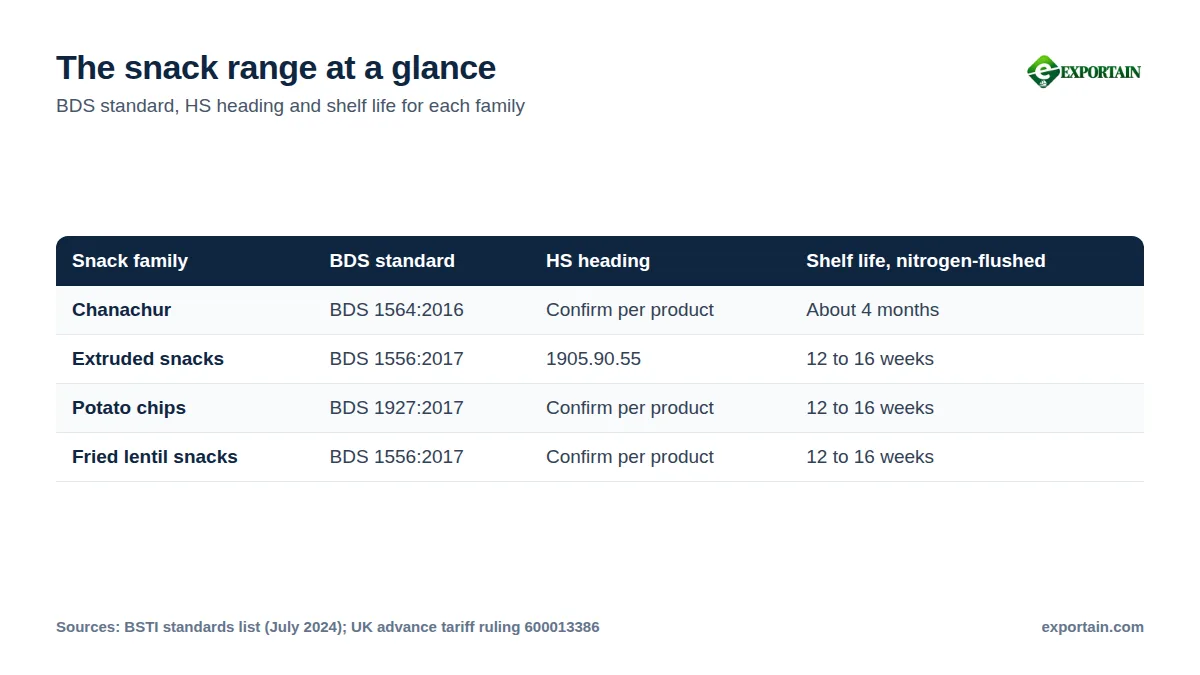
The first decision is which snack family you are buying, because the family decides the standard, the packing and often the heading. Chanachur is a spiced mixture of fried noodles made from pulse flour, flour chips of different shapes, fried and puffed pulses, cereals and peanuts, with spices added for flavour.1 Large producers blend more than ten components.1
Snack family | What it is | BDS standard | HS heading | Typical retail pack | Shelf life, nitrogen-flushed |
|---|---|---|---|---|---|
Chanachur | Spiced mix of fried pulse-flour noodles, chips, pulses and peanuts | BDS 1564:2016 | Confirm per product | 100 g to 1 kg pouches | About 4 months sealed |
Extruded snacks | Dough expanded through an extruder, then oiled and flavoured | BDS 1556:2017 | 1905.90.55 | 25 g to 200 g pouches | 12 to 16 weeks |
Potato chips | Sliced potato, fried and salted or flavoured | BDS 1927:2017 | Confirm per product | 25 g to 200 g pouches | 12 to 16 weeks |
Fried lentil snacks | Lentil or pulse-flour pieces, fried and spiced | BDS 1556:2017 | Confirm per product | 100 g to 500 g pouches | 12 to 16 weeks |
Roasted nuts | Peanuts, cashews or almonds, roasted and seasoned | No dedicated BDS standard | Confirm per product | 100 g to 500 g pouches | Set by the supplier's test data |
The standards in the table sit on the BSTI mandatory Certification Marks list, which covers 100 food items including chips and crackers under BDS 1556:2017, chanachur under BDS 1564:2016 and potato chips under BDS 1927:2017.2 Extruded snacks have been classified under 1905.90.55 in a UK advance tariff ruling covering flavoured potato and chicken snacks made from an extruded dough.3
How do you match a snack type to your market?
Start with who will eat the product, because the buyer for a diaspora grocery in London wants something different from the buyer for a mainstream supermarket in Dubai. Processed foods from Bangladesh earned about US$400 million in fiscal year 2024-25, up 16.6 per cent on the year before, and chanachur alone earned US$21.5 million, making it one of the ten leading processed-food exports.4 Nearly 60 per cent of agro and processed food earnings come from five markets: the UAE, Saudi Arabia, India, the UK and the US.4
Chanachur is sold in packets from 100 g to 1 kg, with 250 g a common retail size.1 For extruded snacks and chips, the 25 g to 200 g pouch is the usual consumer size.3
Which BSTI standards cover snack foods?
BSTI runs a mandatory Certification Marks scheme, and the snack standards sit inside it. The July 2024 BSTI list names BDS 1556:2017 for chips and crackers, BDS 1564:2016 for chanachur, BDS 1927:2017 for potato chips and BDS 1796:2008 for muri, or puffed rice.2 A product on that list must carry a BSTI Certification Marks licence to be sold lawfully in Bangladesh, and the licence is the document to ask for. Request the licence number and the standard number in writing, then check that the licence covers the exact product you are buying.
Two checks turn the standard from a line on a quotation into something you can rely on. First, ask for the latest lab test report against the named standard and read the results, not the cover page. Second, ask which tests the factory runs on every batch, such as moisture and oil content.
What does nitrogen-flushed packaging do for shelf life?
A fried snack goes stale in two ways: oxygen attacks the frying oil and turns it rancid, and moisture softens the crunch. Nitrogen flushing, a form of modified atmosphere packaging, pushes the air out of the bag and replaces it with nitrogen, an inert gas that does not react with the oil. The working target is residual oxygen at or below 2 per cent, using food-grade nitrogen of at least 99.5 per cent purity.5 The effect is large: an unflushed air pack holds about 6 to 8 weeks at ambient temperature, a nitrogen-flushed pack holds 12 to 16 weeks, and a flushed pack in high-barrier metallised film holds 16 to 24 weeks.5
Put the film type, residual oxygen limit, pack size and expected shelf life in the order. Ask the factory to verify the oxygen level with a headspace analyser every shift, sampling a bag every 10 to 15 minutes, and to send you the readings with the production report.5
How do you build a flavour variant for an export market?
A flavour variant is a recipe change, not a label change, so agree it before production starts. Heat, salt, oil, sweetness and the spice blend each change the ingredient list, the allergen statement and sometimes the shelf life. Chanachur makers flavour the mix with ground cloves, cumin, chilli, ginger and pepper, and may add citric acid or lemon juice.1
Run the variant through four gates: a trial batch to the written recipe, a tasting against the brief confirmed in writing, a factory check that the adjusted recipe still meets the named BDS standard, and a redrawn label matching the new recipe. For the European Union, Regulation (EU) No 1169/2011 requires 14 allergens to be declared and visually emphasised inside the ingredient list, including peanuts, sesame, mustard, soybeans and cereals containing gluten.6
Where do you find snack-food suppliers in Bangladesh?
About 1,000 food processing firms operate in Bangladesh, and only around 250 of them export at all, while about 20 large and medium-sized companies generate most export earnings.4 That concentration means the shortlist is small, and a supplier with a real export record is worth more than a long list of names. The processed food sourcing guide explains how to weigh export history, capacity and product range when you compare suppliers.
Search the suppliers listed on Exportain for snack-food exporters, then send the same written brief to two or three of them so their quotations can be compared line by line. A useful brief states the snack family, the BDS standard, the pack sizes, the flavour variants, the nitrogen-flush target, the quantity, the destination port and the Incoterm.
What does the order run look like, from sample to shipment?
A first snack order usually runs through seven stages. Agree the sequence with the supplier before you pay anything.
Send the written brief: snack family, BDS standard, pack sizes, flavour variants, nitrogen-flush target, quantity, destination and Incoterm.
Taste samples of each variant and confirm or adjust the recipe in writing.
Approve the label artwork for each market against that market's rules.
Agree price, minimum order quantity, payment terms and inspection in the quotation, then pay the deposit.
Production runs: frying or extrusion, seasoning, packing under nitrogen flush, with headspace readings recorded each shift.
Lab tests run against the named BDS standard, and a pre-shipment inspection checks packs, counts, marks and documents.
The supplier issues the shipping documents and the goods leave Chattogram, or Dhaka airport for a small air shipment.
Which documents travel with a snack-food shipment?
The commercial invoice is the base document for customs valuation, and in Bangladesh it must carry the exporter's registration certificate number and the HS code of the goods.7 The ERC (Export Registration Certificate) is issued by the Export Promotion Bureau, and every exporter in Bangladesh must hold one.7 The packing list and the bill of lading travel with the invoice. The certificate of origin, obtained from the local Chamber of Commerce or another authorised body, states the country of origin and supports any preferential duty claim.7
Two more certificates matter for snacks. An inspection certificate may be required by the destination to confirm the quality, quantity and specifications of the goods, and a halal certificate confirms the product follows Islamic dietary rules.7 If the shipment uses wooden pallets or crates, a fumigation certificate is often required as well.7 Our export documents guide explains each of these documents in more detail.
What do US and EU rules add at the border?
Destination-market rules sit on top of the Bangladesh export documents. For the United States, the foreign facility that makes, processes, packs or holds the food must register with the Food and Drug Administration (FDA) and renew that registration between 1 October and 31 December of every even-numbered year, designating a US agent.8 The importer must file Prior Notice for every shipment before it arrives, and must run a Foreign Supplier Verification Program for each food and each supplier, using a unique facility identifier such as a DUNS number.8
For the European Union, Regulation (EU) No 1169/2011 sets the mandatory particulars for prepacked food: the name of the food, the ingredient list, allergens emphasised inside that list, net quantity, durability date, storage conditions, the operator's name and address, and the nutrition declaration per 100 g or 100 ml.6 The 14 allergens in Annex II must be declared whenever they appear as an ingredient or a processing aid, and the mandatory text must be printed at a minimum x-height of 1.2 mm.6
A worked example: one first order, landed
Example figures: a UK buyer orders 10,000 pouches of 200 g chanachur, a total of 2,000 kg, bought FOB Chattogram. The supplier quotes US$1.10 per pouch, so the goods cost US$11,000. Sea freight in a shared container is US$1,900, marine insurance US$180, and a pre-shipment inspection US$350. The landed cost before UK duty and VAT is therefore US$13,430, or about US$1.34 per pouch.
The order works because the buyer fixed the details early: the BDS standard was named in the brief, the flavour was agreed from samples, the label was checked before printing, and the inspection was agreed before the deposit. Duty is not in the figures above: it depends on the confirmed HS code and the UK tariff on the arrival date, so confirm both with your customs broker before you order.
What goes wrong with snack-food shipments?
Each failure below has a check that catches it before the goods leave Bangladesh.
Problem | What causes it | The check that catches it |
|---|---|---|
Rancid flavour on arrival | Residual oxygen above the agreed limit | Headspace readings with every production report |
Soft, stale texture | Moisture entering through low-barrier film | Film specification and seal checks in the order |
Duty higher than quoted | Wrong HS code on the invoice | Broker confirms the code before shipment |
Label held at the border | Allergen not emphasised, or text too small | Label proof checked against the market's rules |
Write the standard, the flush target, the film, the recipe, the label rules and the inspection into the order, and the shipment has a written record to be judged against.
Next steps on Exportain
Look through the suppliers listed on Exportain for snack-food exporters with a BSTI licence and a record of shipping to your region, then post a request for quotation carrying your snack family, pack sizes, flavour variants and nitrogen-flush target, so every supplier prices the same job. Our HS code note for snack foods will help you settle the heading before the first quotation comes back.
Sources
- Chana Chur - traditional food product of Bangladesh. Practical Action (accessed )
- List of Bangladesh Standards (BDS) on Agricultural and Food Products. Bangladesh Standards and Testing Institution, (accessed )
- Information for ruling 600013386 - Flavoured Potato and Chicken Snacks. HM Revenue & Customs, (accessed )
- Agro-food exports grow, but foundations look fragile. Daily Sun, (accessed )
- Potato Chips Packaging: Preventing Breakage and Staling. TOPY Machinery, (accessed )
- Understanding EU 1169: A Guide to Food Labelling Compliance. DALIM (accessed )
- Essential export documents for shipping from Bangladesh. DHL (accessed )
- How to Import Food Products to the U.S.. Reidel Law Firm (accessed )
- import from Bangladesh
- Snack foods
- HS code 1905
- food labelling
- chanachur
- BSTI standards
- nitrogen flushing
- shelf life
About the author
Sourcing from Bangladesh?
Post a request for quotation and suppliers on Exportain can send you their quotes directly.
Post an RFQ