

HS Code for Snack Foods: Classification Guide for Importers
Snack foods have no single HS heading: cereal snacks point indicatively to 1904, vegetable snacks to 2005, and nut snacks to 2008, each to be verified. This guide works through the deciding factors and how to confirm the full national code.
Short answer
The indicative headings for snack foods are 1904 for prepared cereal foods, 2005 for prepared vegetables, 1905 for bakers wares, and 2008 for prepared nuts, each to be verified product by product. No single heading covers every snack. Confirm the full national code in the destination tariff for the entry date before filing.
On this page
Snack foods do not form one customs category. A swelled cereal, a fried potato slice, a fried vegetable slice, a roasted nut, a popped grain, and a baked rice product are different classification questions. The main ingredient, process, and form on arrival decide the code, and every code here is indicative until confirmed in the destination tariff for the entry date.
Quick answer: indicative HS heading
There is no single settled heading for all snack foods. Test 1904, 2005, 1905, and 2008 product by product.
Snack description | Indicative heading | Verify note |
|---|---|---|
Swelled or roasted cereal, or pre-cooked cereal in grain or flake form | 1904 | Verify swelling, roasting, or pre-cooking |
Potato crisps and other prepared vegetables, not frozen | 2005 | Verify vegetable, no freezing, no vinegar |
Baked savoury snack foods that are bakers wares | 1905 | Verify it is a bakers ware |
Roasted nuts and other prepared nuts | 2008 | Verify nut, roasting, and coating |
Popped maize and other swelled grains | 1904 | Verify swelling or roasting, and the cocoa limit |
Every line above is indicative. Confirm the full national code on the entry date before filing.
How HS codes are structured (2-4-6 digits)
The Harmonized System is a multipurpose international nomenclature developed by the World Customs Organization (WCO), with more than 5,000 commodity groups, each identified by a six-digit code, used by more than 200 countries and economies for tariffs and trade statistics.1
Level | Digits | For snack foods |
|---|---|---|
Chapter | 2 digits (19 or 20) | Chapter 19 covers cereal preparations and bakers wares; Chapter 20 covers vegetable, fruit, and nut preparations |
Heading | 4 digits (1904, 2005, 1905, or 2008) | A product family, such as prepared cereal foods |
Subheading | 6 digits (1904.10, 2005.20, 2008.19) | International detail, such as swelled cereal foods |
National extension | 8 to 10 digits | Set by the importing country for the entry date |
Only the first six digits are shared internationally. Settle the subheading from the heading wording and notes, then extend it in the destination tariff.
Factors that decide the code for snack foods
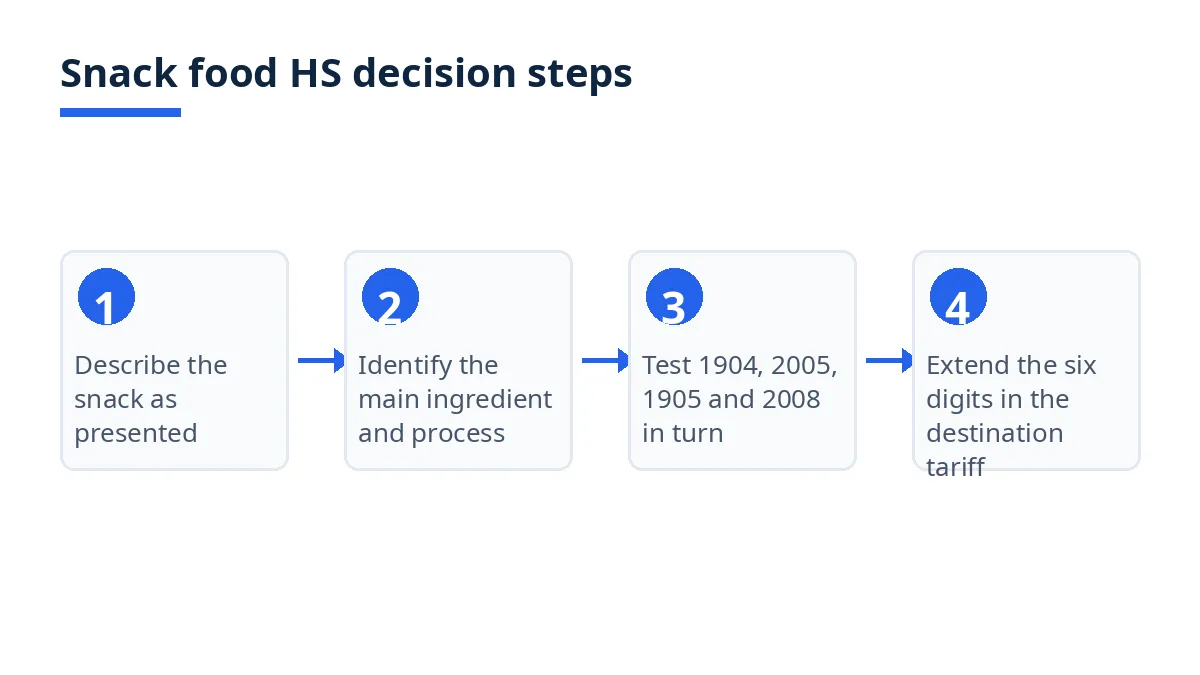
Start with the product as presented, not its trade name. Note the main ingredient, process, state on arrival, and any coating that changes what it is, then read the heading wording and notes for each candidate heading. A note can exclude a product even when a heading text looks like a fit.
First, the main ingredient family. A cereal snack starts in Chapter 19; vegetable and nut snacks start in Chapter 20, with nuts tested against the sugar and chocolate exclusions. A mixed snack is decided by its essential character.
Second, process. Heading 1904 covers foods obtained by swelling or roasting cereals, for example cornflakes, and other cereals in grain or flake form, pre-cooked or otherwise prepared.2 Otherwise prepared means prepared beyond Chapter 10 or 11.2 A raw grain has not passed that test; a swelled, roasted, or pre-cooked cereal has a case under 1904, to be verified.
Third, exclusions. Chapter 19 does not cover preparations with more than 20 percent by weight of meat, fish, insects, or related animal products, except stuffed products of heading 1902.2 Heading 1904 does not cover preparations with more than 6 percent cocoa on a totally defatted basis, or completely chocolate-coated preparations of heading 1806.2 Those limits are classification limits, not duty figures. Chapter 20 excludes Chapter 7, 8 or 11 preparations, Chapter 15 fats and oils, preparations above the same 20 percent limit, bakers wares of heading 1905, and homogenised preparations of heading 2104.3 Headings 2007 and 2008 do not apply to fruit jellies, fruit pastes, or sugar-coated almonds as confectionery of heading 1704 or 1806.3
Fourth, form. Thin slices, fried or baked, in airtight packings for immediate consumption, are a distinct potato line in the United Kingdom tariff, at 2005 2020 00, a national line to be confirmed on the entry date.4 Another vegetable cannot use the potato line, and a frozen or vinegar-preserved potato product cannot use heading 2005, which covers vegetables prepared otherwise than by vinegar, not frozen, other than products of heading 2006.4
Each example below is a fresh classification question, to be verified, not a settled code.
Breakfast cereal bar: is this a 1904 cereal food, or a baked product?
Deciding factor: how the bar was made. A bar from unroasted flakes, or a mixture of unroasted and roasted flakes or swelled cereals, points indicatively to 1904.20, to be verified.2 A baked-dough bar points toward bakers wares, to be tested under 1905 first, and a bar above the 6 percent cocoa limit fails the 1904 test.2
Potato crisps: is this a 2005 potato product, or a cereal snack?
Deciding factor: main ingredient and process. Potato crisps from potatoes, prepared otherwise than by vinegar and not frozen, point indicatively to 2005.20, to be verified.3 In the United States tariff, potatoes sit at 2005.20.00, with potato chips as a statistical line, a national line to be confirmed on the entry date.3
Vegetable chips: is this a 2005 other-vegetable product, or a potato crisp under another name?
Deciding factor: which vegetable was used. A chip from beetroot, carrot, sweet potato, or another non-potato vegetable points indicatively to the other-vegetables lines of heading 2005, such as 2005.99, to be verified vegetable by vegetable.3 In the United Kingdom tariff, other vegetables sit in lines such as 2005 9980, each a national line to be confirmed on the entry date.4
Roasted nuts as a boundary question: is this a 2008 prepared nut, or a sugar or chocolate product?
Deciding factor: preparation and coating. Heading 2008 covers fruit, nuts and other edible parts of plants, otherwise prepared or preserved, not elsewhere specified or included.5 In the United Kingdom tariff, groundnuts sit under 2008.11 and other nuts including mixtures under 2008.19, with roasted lines by pack size, each a national line to be confirmed on the entry date.5 A roasted almond or pistachio points indicatively to the roasted lines of 2008.19, to be verified, while a sugar- or chocolate-coated nut as confectionery fails the Chapter 20 note and must be tested under 1704 or 1806.3
Popcorn: is this a 1904 swelled cereal, or a different prepared food?
Deciding factor: grain and popping process. Popcorn made by heating maize until it swells and pops points indicatively to 1904.10, to be verified.2 The United States tariff carries that line at 1904.10.00, a national line to be confirmed on the entry date.2 A heavily coated popcorn product fails the 1904 test.
Rice crackers as a boundary question: is this a 1904 cereal food, or a 1905 bakers ware?
Deciding factor: baking versus cereal preparation. A rice cracker from baking a rice dough points toward heading 1905 as a question to be tested, while a rice product from swelling, roasting, or pre-cooking points toward 1904 as a question to be tested. The United States tariff lists corn chips and similar crisp savoury snack foods as a statistical line under 1905.90, a national line to be confirmed on the entry date.2 A baked sweet biscuit product is a separate 1905 question, not restated here.
National codes: US HTS, EU CN/TARIC, UK commodity code
Every national line here is a line to be confirmed on the entry date in the country of import.
United States HTS. The United States tariff is built on the HS and extended to 10 digits. Lines opened here include 1904.10.00, 1904.20, and 1905.90, each a national line to be confirmed on the entry date.2 For vegetables, lines include 2005.20.00 for potatoes, with potato chips as a statistical line, and 2005.99 for other vegetables, each a national line to be confirmed on the entry date.3
European Union CN and TARIC. The European Union builds on the same six digits, extends them to 8 digits in the Combined Nomenclature, and adds detail in TARIC. No separate European Union tariff page was opened for a snack line here, so no European Union-only code is asserted. Read the European Union line in TARIC for the entry date, as a national line to be confirmed on the entry date.
United Kingdom commodity code. The United Kingdom tariff lists 10-digit codes. Lines opened here include thin potato slices at 2005 2020 00 and other vegetables under 2005 9980, and for nuts groundnuts at 2008.11 and other nuts at 2008.19, each a national line to be confirmed on the entry date.4 5
How to confirm the code officially
Start with the destination tariff, not a supplier code. Read the heading text and notes for each candidate heading, compare subheadings only at the same level, and record the description, notes, and national line with its entry date.
In the United Kingdom, an Advance Tariff Ruling must be applied for before all customs procedures have been completed, because decisions cannot be made retrospectively, and a separate application is needed for each type of goods.6 HMRC replies in 30 to 120 days, giving the correct commodity code, validity start date, and a reference number.6 When a ruling is received, the ruling reference must be declared.6 A recipe, process, or presentation change needs a fresh check.
Common classification mistakes
Copying a full national code from another country is the first mistake, since only the first six digits are international. Classifying from the trade name is the second: snack, crisps, and chips are shop words, not tariff words. Stopping at a heading that looks close is the third: a potato crisp and a vegetable chip differ by vegetable, and a rice cracker and a cereal bar differ in process. Skipping the chapter notes is the fourth: a snack can pass a heading text and still fail a cocoa, meat-content, or confectionery exclusion. Treating a code as settled for every recipe is the fifth.
Related duties and documents
The code decides how customs treats the goods on entry, including duty treatment and import requirements in the destination tariff. This guide states no duty figure, because treatment is national, changes over time, and depends on origin and the exact national line. Keep the invoice, packing, and declaration descriptions consistent, with the same ingredient, process, and form. If the recipe changes, update the description and recheck the code before the next shipment.
FAQs
What is the HS code for snack foods?
There is no one HS code for snack foods. Test 1904, 2005, 1905, and 2008 product by product, and verify every line in the destination tariff for the entry date.
Is the HS code the same in every country?
The first six digits should be the same internationally for the same product, because they come from the shared WCO system.1 The full code is not the same everywhere, because countries add their own digits and rules after those six digits.
How do I confirm the correct code?
Describe the product as presented, read the heading wording and notes, compare subheadings only at the same level, extend the six digits in the destination tariff, and record the reasoning with the entry date. If two headings remain in contention, apply for a binding ruling before shipping.6
What happens if I use the wrong code?
Customs can reclassify the goods, reassess duty and taxes, and delay clearance. Raise an error with the broker promptly and do not repeat the same code without a fresh check.
Next steps on Exportain
Start with the system in HS Code (Harmonized System Code), then the method in How to Find an HS Code: Step-by-Step. When a supplier and product are ready, browse Bangladeshi Manufacturers and Exporters and ask for the written specification, including ingredient, process, and form, before any code is filed.
Sources
- What is the Harmonized System (HS)?. World Customs Organization (accessed )
- Harmonized Tariff Schedule of the United States Revision 8 (2026), Chapter 19. U.S. International Trade Commission (accessed )
- Harmonized Tariff Schedule of the United States Revision 8 (2026), Chapter 20. U.S. International Trade Commission (accessed )
- Other vegetables prepared or preserved otherwise than by vinegar or acetic acid, not frozen - UK Integrated Online Tariff, heading 2005. GOV.UK, HM Revenue and Customs (accessed )
- Fruit, nuts and other edible parts of plants, otherwise prepared or preserved - UK Integrated Online Tariff, heading 2008. GOV.UK, HM Revenue and Customs (accessed )
- Apply for an Advance Tariff Ruling. HM Revenue & Customs (GOV.UK), (accessed )
About the author
Sourcing from Bangladesh?
Post a request for quotation and suppliers on Exportain can send you their quotes directly.
Post an RFQ


