Wholesale Potatoes From Bangladesh: Prices, MOQ and Reliable Suppliers
Wholesale potatoes from Bangladesh: dated prices, MOQ bands, cold-storage seasonality, grading sizes and payment terms, and how to judge a supplier before you pay.
Short answer
Wholesale potatoes from Bangladesh cost about USD 180 per tonne at export in mid-2026, with Dhaka wholesale prices at Tk 12 to 19 per kg on 12 November 2026. Prices are lowest in the December to March harvest window and rise as cold-storage fees add up. A full container of 25 to 28 tonnes is the usual export unit, trial lots run 1 to 5 tonnes, and a reliable supplier shows a DAM agro-products exporter licence, grades to a written size band, and accepts payment tied to shipping documents.
On this page
Key takeaways
Dhaka wholesale potatoes were Tk 12 to 19 per kg on 12 November 2026, while export prices were about USD 180 per tonne in mid-2026, against about USD 160 per tonne from Pakistan.
Prices are lowest in the December to March harvest window and rise through the cold-storage months as storage fees and quality losses add up.
A full container of 25 to 28 tonnes is the natural export unit; trial lots of 1 to 5 tonnes test grading before a season contract.
Agree the variety, size band and defect limits in writing before you order, because manual sorting in Bangladesh produces inconsistent sizing.
Check the exporter DAM agro-products licence and tie the balance of payment to shipping documents, including a phytosanitary certificate valid for 24 hours.
Wholesale potato buying from Bangladesh rewards buyers who price the whole chain, not just the per-kilo quote. The country grows far more potatoes than it eats, but prices swing hard between harvest and the cold-storage months, and grading quality varies from one supplier to the next.
What does a wholesale potato price actually include?
A wholesale quote is a bundle, and the per-kilo figure alone tells you little. The farm-gate price is only the first layer. On top of it sit grading and sorting, bagging, transport to the packing point, cold-storage rent for stored lots, loading and the export documents.
Storage is the layer buyers most often underestimate. Cold-storage owners raised their fees by Tk 1.0 to 3.0 per kg in 2025, and the Bangladesh Cold Storage Association put the full cost of holding a kilo, including electricity and other charges, at about Tk 25 per kg.1
How much do wholesale potatoes from Bangladesh cost right now?
Prices move fast, so treat every figure below as dated evidence, not as a standing price. On 12 November 2026, the Department of Agricultural Marketing quoted Dhaka wholesale potatoes at Tk 12 to 19 per kg, against a retail range of Tk 25 to 30 per kg on the same day.2
The harvest season tells a very different story. During the January to March 2025 harvest, farm prices fell to Tk 7.0 to 8.0 per kg, after retail prices had reached Tk 75 to 85 per kg in October and November of the previous year.1 In the same season, exporters were buying at USD 0.07 to 0.20 per kg, down from about USD 0.30 per kg the year before.3
Export prices sit in a narrower band than domestic prices. Bangladeshi potatoes were priced at about USD 180 per tonne in mid-2026, while Pakistani supplies averaged around USD 160 per tonne, and in some cases Pakistan offered USD 120 to 130 per tonne in Malaysia.4 That gap matters because Malaysia takes about 80 per cent of Bangladesh's potato exports.4 Check the current Pakistan price for the same variety and size before you accept a quotation.
How does the harvest calendar move the price?
In 2024-25, Bangladesh grew a record 11.57 million tonnes of potatoes, up 9.17 per cent from 10.60 million tonnes the year before.1 The main harvest runs from mid-January to March, and prices are usually at their lowest while it is under way. Early varieties reach the market from December.
Cold storage stretches the selling season through the year, but it cannot hold the whole crop. Capacity stands at only about 3.0 million tonnes against production of roughly 11 million tonnes.5 The Bangladesh Agricultural Development Corporation runs 31 cold-storage facilities, and a government project aims to build 80 mini cold-storage units in 20 districts, of which 60 were already complete by November 2026.5 In 2025 the government also set a minimum price of Tk 22 per kg at cold-storage gates and announced it would buy 50,000 metric tonnes for storage, for release in October and November 2025.6
Storage changes the product as well as the price. Potatoes are naturally dormant for about two months after harvest, and long storage needs controlled temperature and humidity.7 Ware potatoes hold for several months at 4 to 8 degrees Celsius, seed potatoes at 3 to 5 degrees for up to eight months, and processing potatoes need at least 7 to 10 degrees to avoid sweetening and discolouration.7 Humidity should stay between 90 and 96 per cent, and tubers must be kept out of light, which turns them green and bitter.7
Plan around three windows. December to March is the fresh-harvest window, with the lowest prices and the widest choice of lots. April to August is the cold-storage window, when prices rise to cover storage fees. September to November is the tight window, when stored stocks thin out, prices climb and quality varies most.
What MOQ bands should you expect?
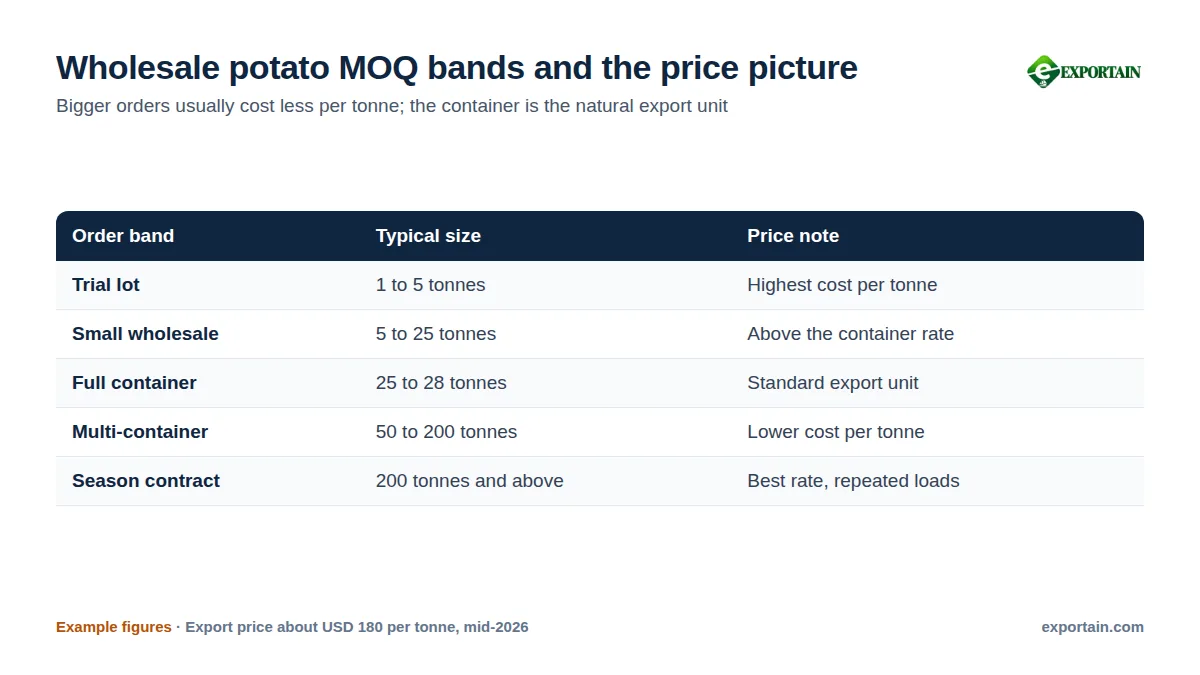
Minimum order quantities follow the way the trade is organised, not a single rule. Small traders in a district market may sell a few tonnes, an exporter filling a container wants a full load, and a cold-storage owner releases lots by the chamber. The bands below are example figures; confirm the band with each supplier before you budget.
Order band | Typical size | Who it suits |
|---|---|---|
Trial lot | 1 to 5 tonnes | Testing grading and delivery |
Small wholesale | 5 to 25 tonnes | A retailer chain or small distributor |
Full container | 25 to 28 tonnes | A standard reefer container load |
Multi-container | 50 to 200 tonnes | A wholesaler or processing plant |
Season contract | 200 tonnes and above | Repeated loads across the season |
A full container is the natural unit for export, because freight, inspection and documents are priced per container. Ordering less than a container means paying for space you do not use, or sharing a container and accepting another buyer's schedule. Ordering several containers at once usually brings the per-tonne price down.
Which grades and sizes should you specify?
Potatoes are traded by end use, and the grade you need depends on what the tubers will become. Table potatoes are judged on variety, shape, skin and flesh colour, even sizing, and clean skins free of greening, sprouts, soil and damage. For processing potatoes, the storage record matters too: tubers kept too cold gather sugars that brown them in the fryer.
Grading is where Bangladeshi supply is weakest, and it is the point buyers should press hardest. Exporters report that manual sorting produces inconsistent sizing and mixed-grade shipments, which reduces acceptance in stricter retail markets.4 Pakistan has strengthened grading, sorting and post-harvest handling, and that is one reason its prices undercut Bangladesh in Malaysia.4 Before you order, agree the size band in writing, the share of tubers allowed outside it, and the maximum share of defects such as cuts, greening, sprouts and rot.
The diagram below sets out the MOQ bands and the price picture side by side.
How do you read a quotation and compare suppliers like for like?
Two quotations for "potatoes" can describe two different products, so compare them line by line. Ask every supplier for the same seven items: variety and end use, size band and defect limits, bag type and net weight per bag, quantity in tonnes, price basis and Incoterm, loading port and shipment date, and the payment terms.
Check the price basis first. A FOB Chattogram price excludes freight and insurance, while a CIF price includes them, and the two cannot be compared without adding the missing costs to the FOB figure. Ask whether the price is for a fresh-harvest lot or a stored lot, and if stored, for how long and at what temperature.
Read the documents into the comparison as well. Ware potatoes from Bangladesh fall under HS code 0701.90, with the national line 07019029 for other potatoes, chilled.8 The phytosanitary certificate for a perishable consignment is valid for only 24 hours, so inspection must be booked close to loading, and the exporter needs an agro-products exporter licence from the Department of Agricultural Marketing, valid for one year.8 A supplier who cannot show that licence is not ready to export, whatever the price. Our HS code guide for potatoes sets out the classification in more detail.
What payment terms are usual, and what protects you?
Payment terms balance two risks: the buyer paying for goods that never arrive, and the supplier shipping goods that never get paid for. The usual structure is an advance against the order, with the balance paid against shipping documents, often through a letter of credit. The example below shows one common shape rather than a rule.
Example figures: a 100-tonne order at USD 180 per tonne is USD 18,000 of goods. A 30 per cent advance is USD 5,400, paid when the order is confirmed, and the remaining 70 per cent, USD 12,600, is paid when the supplier presents the bill of lading, commercial invoice, packing list and phytosanitary certificate. A first order with a new supplier often carries a larger advance, while a repeat order with a supplier you know may carry a smaller one. Our 30/70 TT explainer describes that split in detail.
For smaller orders, suppliers often ask for full advance payment by telegraphic transfer. That is faster and cheaper than a letter of credit, but it leaves the buyer with no protection if the shipment fails, so reserve it for suppliers you have already traded with, or for a trial lot small enough to lose. Never pay an advance to a personal account.
How do you pick a wholesale supplier you can rely on?
Start with the licence and the premises. An exporter of agro-products needs the Department of Agricultural Marketing licence, valid for one year, and a supplier who shows it readily is already ahead of one who stalls.8 Ask where the potatoes are graded and stored, and whether the supplier owns cold-storage space or rents it.
Then check grading with your own eyes. Ask for photos of a graded sample from the lot you would receive, with a ruler beside the tubers for scale, and ask for the size band and defect limits in writing. Follow up with a small trial order before a season contract: one container, inspected on arrival, tells you more than ten phone calls.
References help, but weigh them carefully. Ask for two buyers in your region who have taken at least three loads, and ask them about grading consistency across loads, not just the first one. Our quality checklist for potatoes gives the inspection points to use on arrival, from tuber size and skin condition to sprouting and rot.
A worked example: pricing a 100-tonne order
Example figures: a distributor in Malaysia wants 100 tonnes of Granola table potatoes, graded 45 to 75 millimetres, packed in 25-kilo mesh bags, shipped FOB Chattogram in February, at the height of the harvest window.
The supplier quotes USD 180 per tonne, the export price reported for Bangladeshi potatoes in mid-2026.4 That puts the goods at USD 18,000. Grading, bagging and transport to the port add USD 12 per tonne, or USD 1,200. Loading and export documents add USD 800. The FOB total is USD 20,000, or USD 200 per tonne. Sea freight in a reefer container to Port Klang and insurance add about USD 3,500, giving a CIF value near USD 23,500, or USD 235 per tonne.
Which buying errors should you avoid?
The most common error is buying on price alone. A quote far below the market usually means a mixed lot, an ungraded lot, or a supplier who has not costed storage and documents. The second error is ordering without a size band in writing. Without it, you cannot reject a load of small tubers, and the supplier has no standard to meet.
A third error is ignoring the storage history of the lot. A processing buyer who takes tubers held at 4 degrees will fry dark, because cold storage converts starch to sugar, and the FAO guidance sets a minimum of 7 to 10 degrees for processing potatoes for exactly that reason.7 Ask for the storage temperature before you order, and write the end use on the order.
A fourth error is paying the full amount in advance to a new supplier. Keep the advance modest, tie the balance to documents, and move to better terms only after the first loads arrive as specified. Our import guide covers the wider steps around this order, from phytosanitary checks to landing the shipment.
Next steps on Exportain
Look at the suppliers listed on Exportain and compare their current wholesale potato prices, then open a request for quotation naming your variety, size band, quantity and destination port, so every supplier prices the same lot.
Sources
- Potato yield at all-time high, price at decade low in FY25. The Financial Express (accessed )
- Bangladesh commodity prices: rice, onion, soybean oil and flour prices in Dhaka (October-November 2026). AnalystBro, (accessed )
- Bangladesh potato exports reach 62,135 tons. FreshPlaza (accessed )
- Potato exports in a boom-bust cycle despite record output. tob.news, (accessed )
- Govt to build 80 farmers' mini cold storages in 20 districts: Agri minister. The Business Standard, (accessed )
- Bangladesh sets cold storage potato price at US$0.19. FreshPlaza (accessed )
- Crop handling, conditioning and storage: semi-perishable crops. Food and Agriculture Organization of the United Nations (accessed )
- Other Potatoes Chilled, Nes - Export Requirements (HS Code: 07019029). National Board of Revenue, Bangladesh, (accessed )
- potato grading
- wholesale potatoes
- potato prices Bangladesh
- potato MOQ
- potato cold storage
- Bangladesh potato exports
- buying potatoes Bangladesh
About the author
Sourcing from Bangladesh?
Post a request for quotation and suppliers on Exportain can send you their quotes directly.
Post an RFQ