

Using 30% Deposit / 70% Balance TT When Buying From Bangladesh: Bank Rules and Tips
30/70 TT by leg: what the 30% deposit funds, what triggers the 70% balance, how charge codes create shortfalls on each leg, and which Bangladesh bank rules apply to the deposit and the shipment.
Short answer
A 30/70 TT splits an order into a 30 percent deposit before production and a 70 percent balance paid only when the contract trigger is met, such as a passed inspection report or a copy bill of lading. Each leg is a separate bank transfer with its own charge code, credit check, and shortfall risk. On the Bangladesh side, the deposit follows advance-receipt bank conditions, and the full proceeds must be accounted for on the export file.
On this page
Key takeaways
A 30/70 TT is two transfers, not one payment in two parts: a 30 percent deposit before production and a 70 percent balance paid only on the contract trigger document.
Each leg needs its own charge code and credit check; a SHA shortfall stalls production on the deposit leg and can block document release on the balance leg.
Name the balance trigger as a document, an inspection report or a copy bill of lading, not as a date or a vague phrase such as on shipment.
On the Bangladesh side, the deposit is an advance receipt subject to an Advance Receipt Voucher declaration, no interest, and execution within one year, and full proceeds must be repatriated within four months.
Exportain does not move the TT; payment settles directly with the supplier, and verification is a document and photo review, not a factory inspection.
A 30/70 TT splits one order value into two bank transfers with two different jobs. The buyer sends 30 percent as a deposit before production, and sends the remaining 70 percent as a balance only when the trigger agreed in the contract is met. That trigger may be readiness for shipment, a passed pre-shipment inspection, or receipt of a copy of the bill of lading. A 30 percent deposit with a 70 percent balance before shipment is a standard payment term in international trade and manufacturing, where the deposit covers initial costs such as raw materials and labour and shows commitment to the order.1
Why this matters for buyers and sellers
The deposit funds the seller first costs and confirms intent; holding back 70 percent keeps a check in place until production is done or shipping is proved. A 30 percent advance with a 70 percent balance before shipment is described as shared risk, while a 70 percent balance against a bill of lading gives the seller more exposure because the goods have already shipped.2 Knowing which variant you signed matters more than knowing the headline split, because "before shipment" and "against bill of lading" put the balance payment at different moments.
The split also changes how a dispute plays out. If production stalls, the amount at risk for the buyer is the deposit, not the full order value. If the goods are ready but the balance trigger is disputed, the seller holds finished goods while the buyer holds the balance. A vague trigger such as "balance on shipment" invites argument about whether shipment means loading, sailing, or document issue, so name the event and the evidence for it in the contract.
Step-by-step: how it works
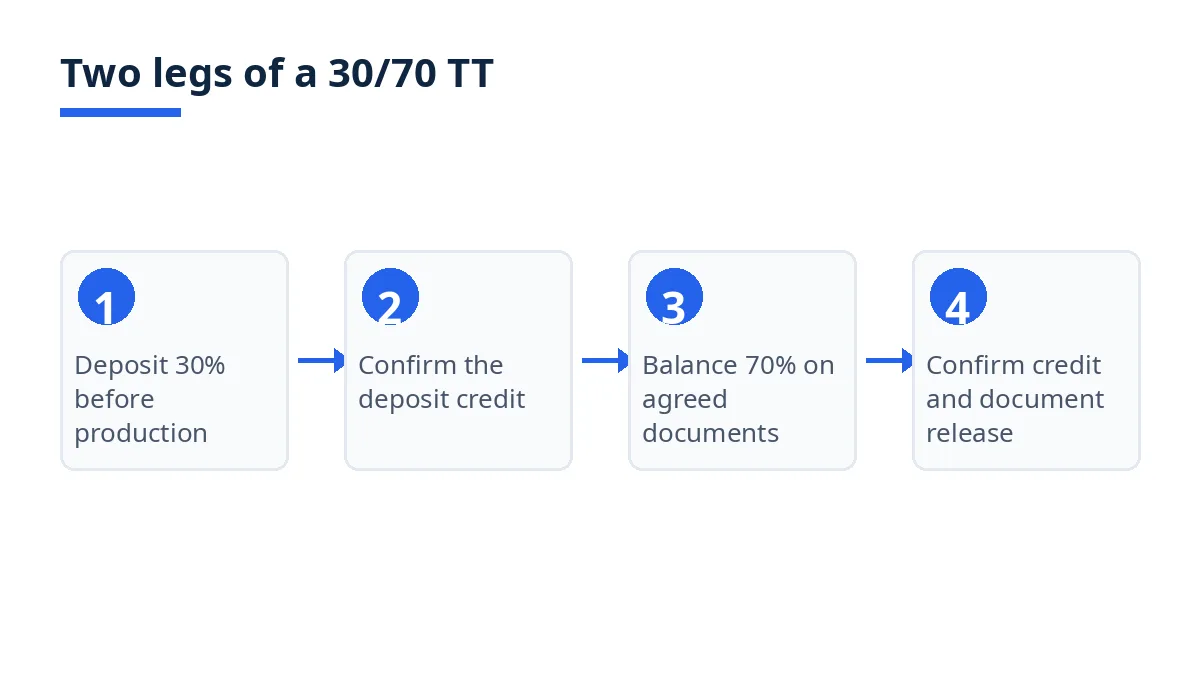
Write the split into the contract. State currency, total value, deposit and balance amounts, the trigger for each leg, the charge code per leg, the remittance reference, and the refund route for the deposit if the export is not executed.
Name the balance trigger as a document. Choose a passed pre-shipment inspection report, a copy of the bill of lading, or a copy of the airway bill, and state whether an original or a copy satisfies the trigger.
Instruct the deposit leg from the seller current written bank details. Use the beneficiary name exactly as registered, the account number, bank name and branch, SWIFT/BIC code, amount, currency, purpose, and charge code. A telegraphic transfer is an electronic payment sent from one bank account to another, usually processed through the SWIFT network.3
Confirm the deposit credit before treating production as funded. Your bank confirmation proves an instruction was sent; only the beneficiary bank credit proves receipt, and the MT103 confirmation carries the reference used to trace the payment.3
Run production against the deposit-leg record. If the credited deposit is short, agree in writing whether the seller starts with the shortfall outstanding, the buyer tops it up, or the order value is adjusted, before materials are committed.
Check the balance trigger document, then instruct the balance leg. For an inspection trigger, read quantity, specification, and result. For a bill of lading trigger, check shipper, consignee, port pair, quantity, and date against the contract.
Confirm the balance credit and the document release together. A balance credit alone does not release goods or documents unless the contract says so. File the balance instruction, credit confirmation, and trigger document as one closed leg.
Costs, timelines and documents
Costs on each leg
A TT carries four cost components, and each leg of a 30/70 split can carry its own set: a sending bank fee, intermediary bank fees, an exchange-rate markup, and a receiving bank fee, with the markup usually the largest and least visible cost.3 One published guide reports intermediary fees of USD 10 to 35 per bank, receiving fees often of USD 5 to 25, and a markup of 1 percent to 5 percent above the mid-market rate, built into the quoted rate rather than shown as a separate fee.3
The charge code decides who bears the middle costs on each leg. Under OUR, the sender pays all fees, including intermediary charges, so the recipient should receive the full amount. Under SHA, the sender pays the sending bank fee and the recipient pays intermediary and receiving fees, so the recipient receives slightly less. Under BEN, the recipient pays all fees, deducted from the amount received.3
Leg | What it pays for | Shortfall effect if sent under SHA |
|---|---|---|
30% deposit | Materials, labour, and production start | Production budget opens short; seller may pause or ask for a top-up |
70% balance | Finished goods, against the agreed trigger document | Document release may be held until the shortfall is settled |
Example figures: a buyer in the United Kingdom orders cotton bath towels for GBP 24,000, paid as a 30 percent deposit of GBP 7,200 before production and a 70 percent balance of GBP 16,800 against a copy bill of lading and a passed pre-shipment inspection report. Example figures: if the deposit leg is sent under SHA with GBP 60 in deductions, the seller bank credits GBP 7,140, leaving a GBP 60 gap in the production budget. Example figures: if the balance leg is sent under SHA with GBP 85 in deductions, the seller bank credits GBP 16,715, leaving a GBP 85 shortfall to settle before document release. The amounts are illustrative only.
Timelines for each leg
One guide reports international TTs typically taking 1 to 5 business days, depending on destination, currencies, intermediary banks, and cut-off times, with delayed or held transfers taking longer where compliance checks, missing information, or screening flags intervene.3 Plan each leg separately: the deposit timeline runs from instruction to credited funds available for production, and the balance timeline runs from trigger document to credited funds and document release.
Documents that control each leg
The deposit leg is controlled by the contract and the seller bank details: the signed contract or proforma invoice showing the split, the seller written bank instruction, the buyer bank instruction and confirmation, and the seller bank credit confirmation. The balance leg adds the trigger document itself, plus the commercial invoice and packing list that identify the shipment.
Bangladesh-specific rules and tips
The deposit leg is an advance receipt on the Bangladesh side, and it carries bank conditions that are separate from the commercial split. Before paying out money against a remittance whose stated purpose is an advance receipt for goods to be exported, the authorised dealer bank should obtain a declaration from the beneficiary on the Advance Receipt Voucher, certifying the purpose, with a report to the online reporting module.4 The conditions include an irrevocable letter of credit or contract, satisfactory previous export performance and adequate capability to execute the order, no interest on the advance, and execution of the export within one year from receipt of the advance.4 If the export is not executed, the bank may allow a refund of the advance, using Exporters Retention Quota funds first and the remainder from Taka accounts.4
The balance leg sits inside the wider repatriation and document rules. All exports must be declared on the EXP Form at the full invoice value, with an undertaking to repatriate the full export proceeds within the period specified by Bangladesh Bank, and the prescribed period for repatriating export proceeds is four months.4 Transport documents add a further check. Title documents for exports from Bangladesh must generally be drawn to the order of the authorised dealer bank and handed to its authorised representative.4 Documents may be drawn to the order of the importer only where the shipment is made against full payment received in advance through the bank and it is a requirement of the export letter of credit or contract, with a certificate from the designated bank to the carrier.4 On a 30/70 split, that full-payment condition is not met at the deposit stage, so do not assume importer-name documents will follow from the deposit alone. Once the full proceeds, including the balance, have been received through the normal banking channel before documents are sent abroad, the bank may endorse the transport documents in favour of the importer as the contract stipulates.4
Two practical tips follow. First, state the deposit purpose on the instruction as an advance receipt for goods to be exported, with the invoice or order reference, so the seller bank can match it to the Advance Receipt Voucher declaration. Second, keep the deposit and balance references distinct but linked, for example one order reference with a leg suffix, so each credit matches its own leg on the export file.
Mistakes and red flags
Deposit-leg mistakes
Treating the deposit as a booking fee with no refund route. A deposit sent without a written refund clause leaves the buyer with no agreed path if production never starts or the export is not executed.
Sending the deposit under an unagreed charge code. A SHA shortfall on the deposit leg is small in absolute terms but large in effect, because it opens the production budget short.
Copying bank details from an old invoice. A misspelled beneficiary name, a superseded account number, or a missing SWIFT/BIC code can delay or return the transfer, and a wrong account number, SWIFT code, or beneficiary name is a common cause of delay or return.2
Balance-leg mistakes
Paying the balance on a promise instead of the named document. A balance sent before the inspection report or bill of lading copy has been checked removes the last control the buyer held.
Accepting a copy document without checking what "copy" means in the contract. A copy bill of lading may prove shipment, but it is not the original document of title. The contract must state whether a copy satisfies the trigger and when the original follows.
Leaving a small shortfall unresolved. A balance shortfall of a few dozen currency units can still block document release, because release is often conditional on full settlement of the leg.
Red flags that justify pausing include pressure to pay the balance urgently outside the agreed trigger, a beneficiary name that does not match the contracting company, refusal to provide written bank details or a written contract, a request to split either leg to an unrelated third party. Treat a changed-details message as a stop signal until it is verified through a contact channel you already trust, because fake or changed bank details are a named TT risk and recovery after funds have moved can be difficult.2
Checklist
Answer every line in writing before you instruct either leg.
Contract states currency, total, deposit and balance amounts, trigger and charge code per leg, and reference per leg.
Balance trigger names a document and a deadline for objections.
Refund clause for the deposit states deadline, currency, bank route, and notice procedure.
Beneficiary name matches the contracting company exactly.
Account number, bank and branch, and SWIFT/BIC code checked character by character.
Any change to bank details verified through a separate, known contact channel.
Deposit credit confirmed, with any shortfall agreed in writing before production.
Balance trigger document checked against the order before instructing.
Balance credit and document release confirmed together.
One-year execution window and four-month repatriation period both diarised.
Amounts sent and credited, deductions, and credit dates filed per leg.
How Exportain helps
Exportain is a marketplace where buyers find Bangladeshi suppliers, post requests for quotation, and compare replies, and that role is separate from the bank transfer: the TT runs between your bank and the supplier bank, and Exportain does not move it. Payment for goods is settled directly between buyer and supplier on the terms in the accepted quotation, and the platform records the quotation history both sides can see, including payment terms.5 Use that record to get the split right before you go to your bank: browse suppliers and post the quantity, delivery term, and 30/70 schedule on the RFQ board so replies quote against the same deposit leg, balance trigger, and charge code.
Badges record checks the Exportain team has reviewed, including identity, phone and email, business registration, and export registration, and a badge is not a capacity, quality, or delivery guarantee.5 Verification is a document and photo review, not a factory inspection. For the buying steps in order, read how to buy on Exportain, where settling on accepted terms directly with the supplier, with inspection and shipment conditions agreed in writing first, is set out as a step.6
FAQs
What should I know first about 30/70 TT?
Know first that 30/70 TT is two transfers with two jobs, not one payment in two parts. The 30 percent deposit funds production and confirms commitment, while the 70 percent balance is paid only when the trigger document agreed in the contract is met, such as a passed inspection report or a copy bill of lading.1
What are the typical costs and timelines?
Costs combine a sending bank fee, intermediary bank fees, an exchange-rate markup, and a receiving bank fee under the OUR, SHA, or BEN code.3 One guide reports intermediary fees of USD 10 to 35 per bank, receiving fees often of USD 5 to 25, and a markup of 1 percent to 5 percent above the mid-market rate.3 Timelines typically run from 1 to 5 business days per leg, lengthened by cut-off times, holidays in both countries, and compliance checks.3
Which documents are needed?
You need the seller full written bank details, your bank instruction with the purpose and reference, and the contract showing the split and the trigger for that leg. Around the transfers, keep the credit confirmation for each leg, the inspection report or bill of lading copy that triggers the balance, and the commercial invoice and packing list that identify the shipment. On the Bangladesh side, the seller gives the Advance Receipt Voucher declaration for the deposit leg, and the export is declared on the EXP Form at full invoice value.4
What are the most common mistakes?
The most common mistakes are paying the balance on a promise instead of the named trigger document, sending either leg under an unagreed charge code, copying bank details from an old invoice, treating a sending confirmation as a credit, leaving a small balance shortfall unresolved, and acting on changed bank details sent by message alone.
Next steps on Exportain
Browse suppliers, then post your quantity, delivery term, and 30/70 schedule on the RFQ board so suppliers quote against the same deposit leg and balance trigger. Before you instruct your bank, read the buyer protection page for what Exportain records and what it does not promise, and check the payment clause against the checklist above.
Sources
- 30% Deposit 70% Before Shipment or Against B/L: What Does it Mean?. Advanta Sourcing (accessed )
- TT Payment in Export: Meaning, Terms, Process and Risks. PayGlocal (accessed )
- Telegraphic Transfer (TT): What It Is & How It Works. Statrys (accessed )
- Consolidated circular on foreign exchange regulations — export trade transactions (FEPD-1 Circular No. 26, July 30, 2026). Bangladesh Bank (accessed )
- Buyer protection: What Exportain does to protect buyers. Exportain (accessed )
- How to source and buy from Bangladesh. Exportain (accessed )
About the author
Sourcing from Bangladesh?
Post a request for quotation and suppliers on Exportain can send you their quotes directly.
Post an RFQ


