Packaging, Paper & Printing Sourcing Guide for Bangladesh
Paper and paper products exports were USD 285.83 million in FY2024-25 on the EPB series. This sourcing guide walks buyers through the brief, shortlist, verification, sampling, pricing, compliance, Incoterms and duties for packaging orders from Bangladesh.
Short answer
Buyers source packaging, paper and printing from Bangladesh by writing a measurable specification covering board grade, dimensions, print and packing, shortlisting mills, converters or printers by production stage, checking documents and operating status, testing samples, and agreeing MOQ, itemised price, Incoterm and inspection in writing. Paper and paper products exports were USD 285.83 million in FY2024-25 on the EPB series.
On this page
Key takeaways
Paper and paper products exports were USD 285.83 million in FY2024-25 on the EPB fiscal-year series, falling to USD 249.01 million in FY2025-26; keep that series separate from the industry-source mill capacity series and from BGAPMEA's own factory count.
There is no industry-wide MOQ, price or lead time for packaging from Bangladesh; all three are quoted per supplier and per product against a written specification, with MOQ set by production stage.
Match the supplier to the production stage: mills sell board, converters make cartons, bags and cups, and printers sell print and binding, and confirm which stages are in-house before asking for a price.
An Exportain badge records a document and photo review, not a factory inspection or guarantee, so run trade licence, export registration, shipment history, board source and test-report checks yourself.
For food-contact packs, Regulation (EC) No 1935/2004 requires good manufacturing practice and no harmful transfer to food, and an FSC claim needs a certificate scope covering the supplier's site and product group.
You have a brief in hand: a product that needs a carton, a bag, a label, or a printed insert, and a shipment date that is already fixed in your plan. This guide turns that brief into a working sourcing process for Bangladesh. It does not ask you to study an industry first and decide later. It starts with the specification you will send, then moves through the shortlist, the checks, the samples, the quote comparison, and the booking plan, in the order you will actually do them.
Read it as a sequence you can act on. Each section ends with the decision you should be able to make before you move to the next one. By the end you should have a shortlist you can defend, a specification a supplier can price without guessing, and a written agreement that covers quality, timing, and cost.
Market overview with latest data
Treat the market figures as a shortlist filter, not as background reading. Paper and paper products exports from Bangladesh were USD 285.83 million in FY2024-25, falling to USD 249.01 million in FY2025-26 on the Export Promotion Bureau fiscal-year series.1 2 That fall does not tell you whether one converter can meet your order. It tells you to test capacity early, ask for current production availability rather than a general assurance, and avoid building a launch plan around a single supplier whose order book you have not checked.
Paper packaging was also named Product of the Year in Bangladesh, a recognition reported in January 2026.3 Recognition of that kind is useful only as a prompt: it suggests the category has domestic attention, but it says nothing about board grade, print quality, or export readiness at any one firm. Your shortlist should therefore stay narrow and evidence-led. Pick three to five suppliers whose product range matches your brief, then let documents, samples, and a trial order narrow the list further.
For an EU buyer, the trade framework with Bangladesh is one more early filter. The European Commission publishes its trade relations with Bangladesh, and that page is the starting point for checking which arrangements apply to your goods before you ask a broker for a duty calculation.4 Do not let a supplier quote a duty figure from memory. Duty depends on classification, origin, and your market, and you should confirm it through an official tariff source or a licensed broker for your shipment.
Decision at this stage: you can state, in one paragraph, what you are buying, for which market, and what would make a supplier unsuitable. If you cannot, the brief is not ready to send.
Main products and production clusters
Shortlist by buyer need, not by catalogue size. A supplier that makes strong export cartons may not print retail labels well, and a printer that binds books may not convert flexible pouches. The table below matches common buyer needs to the product line and supplier type you should approach first.
Buyer need | Product line to shortlist | Supplier type to approach first | First check |
|---|---|---|---|
Protect goods in transit | Corrugated cartons, dividers, edge protectors | Converter | Board grade, flute, and burst or crush test results |
Sell at retail | Folding cartons, paper bags, labels, sleeves | Converter or printer | Print samples on your board, not on stock board |
Ship food or drink | Food-contact board, cups, trays, wraps | Converter with food-contact controls | Food-contact declarations and migration controls |
Publish or pack printed matter | Books, catalogues, inserts, manuals | Printer or binder | Binding samples and page-count pricing |
Wrap or pouch dry goods | Paper pouches, sacks, flexible packs | Converter | Seal strength and barrier requirements |
Paper and paperboard sit under Chapter 48 of the Harmonized System, and the chapter notes set out how paper, paperboard, and articles of them are classified.5 Classification matters at the brief stage because it shapes duty, and it shapes the description your supplier and your broker will use. Give the supplier your product description, your intended use, and your destination market in the first message, and ask which Harmonized System heading they normally declare for that product. If their answer does not match your broker's view, resolve the difference before you agree a price.
Clusters in Bangladesh are treated here as a question to ask, not a map to trust blindly. Ask each supplier where each production stage happens: board supply, converting, printing, lamination, die-cutting, and packing. A firm may convert cartons in-house and outsource printing, or print in-house and buy board from a mill. Neither arrangement is wrong on its own. What matters is that you know which stages are in-house, which are outsourced, and who is responsible when an outsourced stage fails. Write that split into your specification so a later dispute is about a document, not about memory.
Decision at this stage: for each product line, you have two or three supplier types on the shortlist and a note of which stages each one controls directly.
How to find and verify suppliers
Start with a written brief, then use it as the same test for every supplier. A brief that changes from one supplier to the next produces quotes you cannot compare. Send every shortlisted supplier the same document: product and dimensions, board or paper grade, print colours and artwork, quantity, packing method, destination, target shipment window, and the quality standard you will inspect against. Ask for the same reply format from each one: unit price, tooling or plate charges shown separately, MOQ, lead time from artwork approval, and payment terms.
Finding suppliers is the easier half. Verifying them is the work that protects the order. Exportain lists Bangladeshi suppliers and lets buyers post requests for quotation, and its seller pages describe how suppliers present their businesses on the platform.6 A listing or a platform badge is only a starting point. An Exportain badge records a document and photo review, not a factory inspection or a guarantee, so you should still run your own checks before you place an order.
Work through this verification sequence for every supplier that reaches your final two or three:
Ask for the trade licence, the export registration certificate, and the tax identification documents, and check that the legal name matches the name on the quotation and the bank details.
Ask for recent shipment history for the same product line, with buyer names removed if needed, and check that the volumes and destinations are consistent with your order size.
Ask where the board or paper comes from, whether it is local or imported, and what happens to lead time if that source is delayed.
Ask for test reports for your product type, and check the testing laboratory, the test standard, and the date, rather than accepting a summary page.
Ask for a live video walkthrough of the production floor and the packing area, and note which machines you actually see running for your product.
Ask for two references in your product line, and contact them with the same three questions: on-time delivery, print and board consistency, and how problems were handled.
If a supplier will not share documents, will not show production, or will not name a board source, treat that as information. A polite refusal still narrows your shortlist. It is better to lose a candidate at this stage than to discover a gap after artwork is approved and board is ordered.
Decision at this stage: you have two suppliers who passed the document checks and can produce a sample to your specification.
MOQ, pricing and lead times
There is no single MOQ, price, or lead time for packaging from Bangladesh. Each one is quoted per supplier and per product against a written specification, and MOQ is set by production stage: a mill, a converter, and a printer each face different setup costs. A short run that is easy for a digital printer may be uneconomic for a converter that must cut a die and set up a corrugated line. Ask the supplier to explain what drives their MOQ for your item, and whether a lower quantity is possible at a higher unit price, with the tooling charge shown separately.
Read every quote line by line before you compare totals. A quote that looks cheaper may exclude plates, dies, lamination, inner packing, palletising, or transport to port. Build your comparison on the same basis for every supplier, using a table like the one below. The figures in this table are example figures only, included to show the comparison method, not prices you should expect.
Quote line | Supplier A (example figures) | Supplier B (example figures) | Question to ask |
|---|---|---|---|
Unit price, 10,000 folding cartons | USD 0.42 | USD 0.38 | Which board grade and print colours are included |
Plates and die, one-off | USD 180 | USD 260 | Who owns the plates, and can they be reused |
Inner packing and master cartons | Included | USD 0.03 per unit | How many units per master carton |
Transport to port | Excluded | Included to Chattogram | Which port, and who books the truck |
Lead time from artwork approval | 18 days | 24 days | Does that include sample approval time |
Example figures like these are useful only because they force the right questions. Never accept a quote that bundles tooling, freight, and product into one line. Split charges let you see where a price difference comes from, and they let you negotiate one line without reopening the whole order.
Lead time needs the same discipline. Ask for the lead time in stages: artwork approval, sample production, sample approval, bulk production, packing, and transport to port. A supplier that quotes 20 days may mean 20 days of bulk production after sample approval, while another may mean 20 days from order placement. Put the stage breakdown in writing, and agree what happens if sample approval takes longer than planned. If your shipment window is fixed, work backwards from the vessel or flight date, add a buffer for inspection and for a reprint or repair, and only then confirm the order date.
Decision at this stage: you can point to the cheapest quote on a like-for-like basis, and you can explain why it is cheapest in one sentence per line.
Quality, certifications and compliance
Write quality into the purchase specification before production starts, and treat that specification as the inspection standard. A specification for a printed carton should state board grade and thickness, dimensions with tolerances, print colours with a reference, lamination or coating, die-cut tolerance, glue type, packing count per master carton, and the marking on each carton. A specification for a food-contact pack should add the food-contact requirements and the declarations you need from the supplier. Vague phrases such as good quality or export quality cannot be inspected, so remove them from your documents.
Agree the inspection method in the same document. State whether you will use an acceptance sampling plan, how many cartons will be opened, which defects count as critical, major, or minor, and what happens to a failed lot. If you plan to use a third-party inspector, name the firm or the type of firm, and agree who pays when a re-inspection is needed. For printed work, approve a signed physical sample and keep one copy yourself, so bulk production is compared with an object rather than a photograph.
Certifications need checking at the level of scope, not at the level of a logo. For food-contact materials in the EU, Regulation (EC) No 1935/2004 requires good manufacturing practice and requires that materials do not transfer substances to food in quantities that could endanger health or change the composition, taste, or smell of the food.7 Ask the supplier which specific food-contact declarations they can provide for your product, your food type, and your market, and have your own compliance adviser review them before you order. A general statement about food safety is not a substitute for a declaration tied to your product.
For a paper claim, the same scope rule applies. Forest Stewardship Council Chain of Custody certification covers the path of certified material through production and trade, and a claim is only sound when the certificate scope covers the supplier site and the product group in question.8 Ask for the certificate number, check the scope, and confirm that the claim you want on your pack matches the claim the certificate allows. If the scope does not cover your product, either change the claim or change the supplier. Do not print a claim on the strength of a certificate held by a different site or a different product group.
Decision at this stage: your specification names the standard, the sample, the inspection method, and the certificate scope you have checked.
Shipping, Incoterms and duties
Build the landed-cost plan before you confirm the order, not after the goods are packed. Landed cost starts with the product price, then adds inland transport, export handling, international freight, insurance where applicable, import duty, import taxes, port and broker charges, and inland delivery at destination. A quote that covers only the product price will look attractive until the remaining lines arrive. Use a landed-cost worksheet with one row per charge, and fill each row from a named source: the supplier, the forwarder, or the broker.
Incoterms rules decide who pays for each stage and who bears the risk at each point, and the International Chamber of Commerce publishes the Incoterms rules that buyers and sellers use to allocate those responsibilities.9 Choose the rule deliberately rather than accepting the supplier's default. Under an EXW arrangement you collect the goods and arrange most of the journey yourself, which gives you control but also gives you the work. Under FOB, the seller delivers the goods on board the vessel you nominate, and you arrange the main carriage and insurance. Under CIF, the seller arranges carriage and minimum insurance to the destination port, while you still handle import clearance and duty. Each choice changes your cost lines and your risk, so match the rule to the control you actually want. If you are new to importing from Bangladesh, ask your forwarder to price the same shipment under two rules so you can compare the totals and the responsibilities side by side.
For duties, start from classification and origin, then confirm the rate. The Harmonized System chapter notes for paper and paperboard help you describe the product correctly, but the duty rate itself comes from your market's tariff schedule and the origin rules that apply to Bangladesh.5 Ask your broker to confirm the heading, the duty rate, and any preference or documentation needed for that rate, and keep that confirmation with the order file. For EU shipments, the European Commission page on trade relations with Bangladesh is the place to begin checking the framework that applies before you rely on a broker's summary.4 If a supplier or an intermediary quotes a duty rate without naming the heading and the source, treat the figure as unconfirmed.
Booking follows the same written discipline. Confirm the port of loading, the container or shipment type, the cut-off dates, and who books each leg. For printed packaging, confirm the packing plan as well: units per master carton, cartons per pallet, pallet dimensions, and the labels on each pallet. A packing plan agreed late can delay loading even when production finished on time.
Decision at this stage: your landed-cost worksheet is complete, your Incoterm is chosen for a stated reason, and your duty figure has a named source.
Step-by-step buying process
This is the centrepiece of the guide, and it follows the order a buyer actually works through. Treat each step as a gate: do not move on until the document named at the end of the step exists.
Step 1: Write the brief and the specification
Start with the product, not the supplier. Write the dimensions, the board or paper grade, the print colours and artwork files, the quantity, the packing method, the destination, and the shipment window. Add the quality standard and the inspection method you will use. If you do not have artwork yet, state the artwork deadline and who supplies the final files. A supplier cannot price a brief that leaves board grade or print colours open, and a price given on an open brief will change.
Gate document: a one- or two-page specification that any supplier can price without asking for basic facts.
Step 2: Shortlist by production stage
Send the same specification to three to five suppliers matched to the production stage your product needs. Ask each one which stages are in-house and which are outsourced, and what their current availability is for your shipment window. Remove any supplier whose stage split does not fit your product, even if their price looks attractive. A printer cannot solve a board supply problem, and a mill cannot solve a print registration problem.
Gate document: a shortlist table naming the supplier, the stages they control, and the reason each one remains on the list.
Step 3: Verify documents and operating status
Run the verification sequence from the supplier section: trade licence, export registration, tax documents, shipment history for the same product line, board source, test reports, a live production walkthrough, and references. Check that the legal name is the same on every document, the quotation, and the bank details. If a document is missing, ask for it once, with a date, and remove the supplier if it does not arrive.
Gate document: a verification note per supplier, with the documents seen, the dates checked, and any gap still open.
Step 4: Order samples and approve in writing
Order a sample made to your specification, on your board, with your print. Check dimensions, colour, board strength, glue, and packing against the specification, and record each result. For food-contact packs, check the declaration against your market requirements at this stage, not after bulk production. Approve the sample in writing, name the approved sample as the bulk standard, and keep one copy yourself.
Gate document: a signed sample approval that states the specification version, the sample date, and the defects found and fixed.
Step 5: Compare quotes on a like-for-like basis
Ask every finalist for the same quote format: unit price, tooling shown separately, packing, transport to port, MOQ, stage-by-stage lead time, and payment terms. Rebuild the quotes in one comparison table, and challenge any line that is bundled, missing, or described only in general terms. Negotiate line by line, and record every agreed change in a revised quotation rather than in a message thread.
Gate document: a comparison table with one winner on a like-for-like basis and a written reason for the choice.
Step 6: Agree the order, the payment, and the inspection in writing
Put the order in a purchase order or a sales contract that names the specification version, the approved sample, the quantity, the unit price and split charges, the Incoterm, the shipment window, the payment method and timing, the inspection method and the inspector, and the remedy for a failed lot. Agree the payment instrument before production starts, and confirm the bank details through a channel you trust, not only through the document that carries the invoice. If you use a letter of credit, confirm the documents it will require and check that the supplier can produce each one.
Gate document: a signed order that a third party could read and enforce without asking either side what was meant.
Step 7: Inspect, book, and close the file
Inspect during production or before shipment, against the approved sample and the specification, and record the result with photographs of the goods, the packing, and the markings. If the lot fails, follow the remedy you agreed in step 6 rather than negotiating a new one under time pressure. Once the lot passes, confirm the packing plan, the booking, and the shipping documents, and check that the commercial invoice, packing list, and any certificate match the order in names, quantities, and descriptions. After delivery, close the file with the inspection report, the shipping documents, and a short note on what to change next time.
Gate document: an inspection report, a document checklist, and a close-out note for the next order.
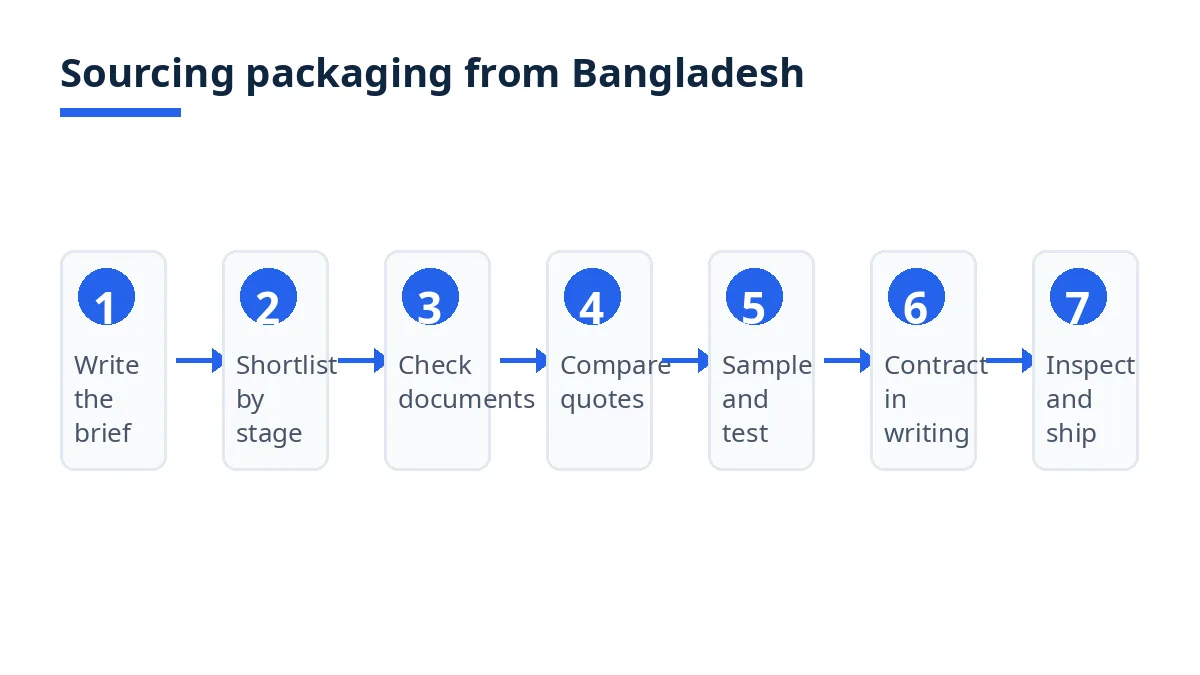
A buyer who follows these gates spends more time before the order and less time fixing problems after it. The gates also make the relationship with a good supplier easier, because both sides are working from the same documents.
Related guides (links to cluster articles)
For the wider import process, read how to import from Bangladesh and find suppliers in Bangladesh. For the documents that accompany a shipment, see export documents from Bangladesh. For the delivery terms and cost planning that sit behind this guide, see CIF Incoterms 2020, FOB free on board, and landed cost for imports from Bangladesh. For the industry background behind the shortlist, see packaging industry in Bangladesh.
FAQs
Is Bangladesh a good place to source packaging, paper & printing?
Bangladesh can be a sound place to source packaging, paper, and printing when the supplier matches your product and passes your document, sample, and inspection checks. Paper and paper products exports were USD 285.83 million in FY2024-25 on the Export Promotion Bureau series, which shows an active export trade, but a national figure does not prove that any one supplier can meet your specification.1 Judge the country question supplier by supplier, using the gates in the step-by-step process above.
What is the typical MOQ?
There is no typical MOQ that applies across packaging from Bangladesh. MOQ is set per supplier and per product by the production stage, the setup cost, and the board or paper source. Ask each supplier what drives their MOQ for your item, whether a lower quantity is possible at a higher unit price, and whether tooling charges are shown separately. A quote that states the MOQ driver is easier to negotiate than a quote that states a number with no explanation.
How long is the lead time?
Lead time depends on the supplier, the product, and the stage breakdown you agree. Ask for the time in stages: artwork approval, sample production, sample approval, bulk production, packing, and transport to port. Work backwards from your shipment date, add a buffer for inspection and for a repair or reprint, and put the stage breakdown in writing. A single lead-time number without stages cannot be planned against.
Which certifications matter?
The certifications that matter are the ones tied to your product, your market, and a certificate scope you have checked. For food-contact packs sold in the EU, the food-contact declarations under Regulation (EC) No 1935/2004 matter, because that regulation requires good manufacturing practice and no harmful transfer to food.7 For a paper claim, an FSC Chain of Custody certificate matters only when its scope covers the supplier site and the product group.8 For quality in production, the inspection plan in your specification matters more than any general certificate claim.
Next steps on Exportain
You have a brief, a shortlist, and a specification. The next move is to put the same specification in front of suppliers and compare their replies on a like-for-like basis. Start by browsing suppliers on Exportain, then post your brief as a request for quotation through Exportain RFQs so replies arrive in a format you can compare. Before you confirm an order, read how to buy on Exportain so the payment, messaging, and order steps match the written process in this guide.
Sources
- Export of paper, paper products dips after years of growth. The Financial Express, (accessed )
- Exports of paper, paper products lose steam after three-year growth run. The Financial Express, (accessed )
- Paper packaging declared Product of the Year. TIMES of Bangladesh, (accessed )
- EU trade relations with Bangladesh. European Commission, (accessed )
- Harmonized System: Chapter 48 notes. World Customs Organization (accessed )
- Sell Bangladeshi Products to Global Buyers | Exportain. Exportain (accessed )
- Regulation (EC) No 1935/2004 on materials and articles intended to come into contact with food. European Union, EUR-Lex, (accessed )
- Chain of Custody Certification. Forest Stewardship Council (accessed )
- Incoterms® rules. International Chamber of Commerce (ICC) (accessed )
- Incoterms
- quality control
- Bangladesh Export Data
- Category Pillars
- Supplier Sourcing
- Packaging Bangladesh
- Paper packaging
About the author
Sourcing from Bangladesh?
Post a request for quotation and suppliers on Exportain can send you their quotes directly.
Post an RFQ