Top Live Eels Manufacturers in Bangladesh: How to Find and Verify Them
A live-eel order is judged at arrival, not at loading. This guide gives eight checks for finding live eels manufacturers in Bangladesh and testing each one: species identity, holding and water quality, grading, packing, transit time, live-arrival terms and destination-market rules, with no factory named or ranked.
Short answer
Live eels manufacturers in Bangladesh should be chosen by verification, not by ranking. Ask each supplier to name the species and source water on every document, show dated holding and water-quality records, grade live animals by weight or length bands, state the packing method and maximum transit time, and put mortality and live-arrival terms in writing. Confirm the destination-market import rules for your market before paying.

On this page
A live-eel order is judged at arrival, not at loading. An eel that arrives dead, weakened, wrongly identified, or without the certificate your market requires has lost its value even when the quotation looked attractive, so sourcing live eels from Bangladesh is a verification job first and a price negotiation second. This article names no factory and ranks none. It gives eight checks for testing whether a supplier can keep eels alive, correctly identified, and correctly graded from holding to your receiving dock.
Live eels are worth more alive than dead, and considerable effort goes into keeping them alive after capture, according to the Food and Agriculture Organization (FAO). Newly caught eels are held in live boxes for up to a fortnight to clear muddy flavour and gut contents, and shore-tank storage lasts several months where temperature and aeration are properly controlled, with dead eels removed at once.1 A supplier that cannot show a holding record, a grade table, or a packing specification is asking you to trust the weakest links in the chain.
Key takeaways
A live-eel supplier is checked on species identity, live holding, grading, packing, transit time, and live-arrival terms, not on a frozen-product record or a sales claim.
Put the species name, source water, grade bands, packing method, and maximum transit time in writing before you compare prices. A quotation missing any of those cannot be compared.
Grade live animals by weight or length bands with a tolerance for animals outside the band. Mixed sizes priced as one grade hide the real cost.
The contract must state how dead-on-arrival eels are counted, evidenced, and settled, and who bears that loss. Agree that wording before dispatch, not after arrival.
Destination-market rules are species-specific and market-specific. Never assume that approval for one market or one species covers another.
The list
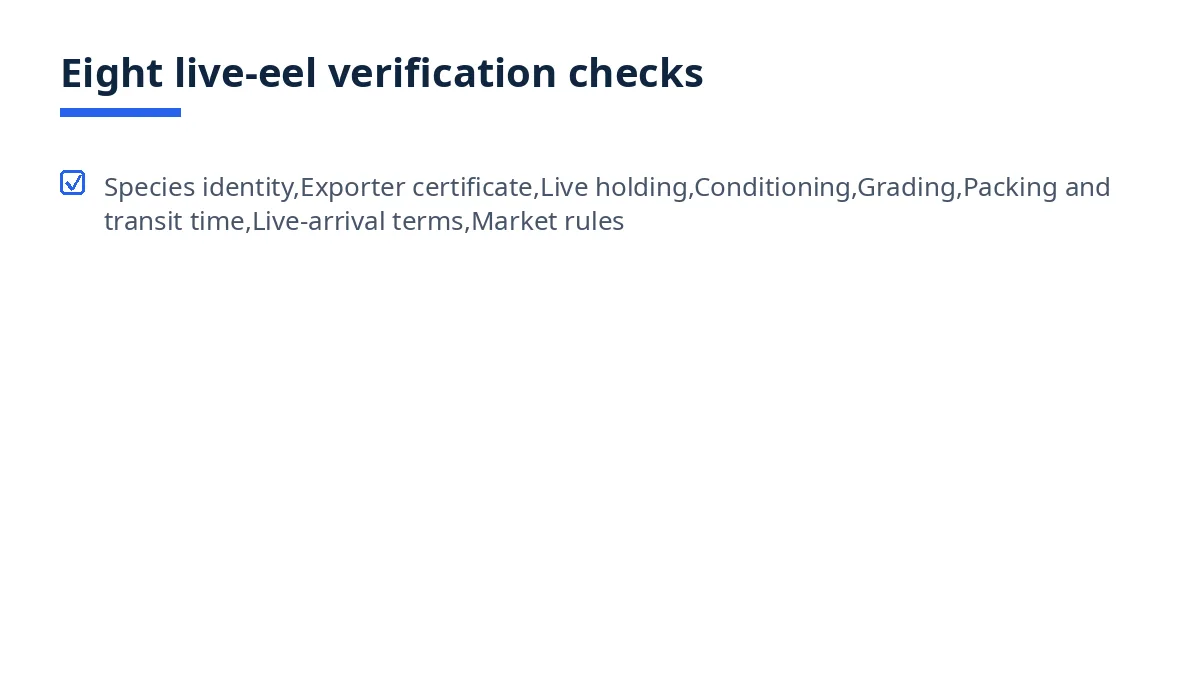
The eight checks below follow the eel from holding water to your receiving dock. Work through them in order, and do not place a bulk order until every check has a document or a written term behind it.
1. Species identity on every document
What to ask. The scientific name, common name, and source water (freshwater, estuary, or marine) on the quotation, proforma invoice, packing list, and label draft.
Why it matters for live eels. Eels look alike across species, and a generic name such as eel leaves room for a different species to be supplied under the name you ordered. The eel most associated with Bangladesh in the national freshwater record is the Indian mottled eel, Anguilla bengalensis, described as brownish and mottled above with a yellowish belly, and recorded from hill streams in Mymensingh.2 That description is a starting point, not a substitute for lot documents.
How to fix a gap. If a document says only eel, ask for the scientific name and source water to be added in writing before you approve a sample.
2. Legal exporter status and the certificate for your market
What to ask. The legal name on the export licence and export registration, and the exact certificate that will accompany a shipment to your market, named by type.
Why it matters for live eels. A certificate for one market does not transfer to another. In Bangladesh, the Department of Fisheries e-certification system covers licences, health certificates, additional health certificates set to the importing country's requirements, sample collection, inspection, test reports, and certificate issuance, and it is connected to customs.3 Reporting on a protocol for China describes clinical compliance certification by the state veterinary office, with animals examined by an official veterinarian before export and confirmed healthy, without clinical symptoms of contagious disease, and suitable for transport.4 That example is market-specific, not a general rule.
How to fix a gap. Ask the supplier to name the certificate for your market and the issuing office in writing. If it cannot, pause and confirm the requirement with your import authority before paying a deposit.
3. Live holding and water-quality evidence
What to ask. Where eels are held between collection and packing, how long they are held, how water temperature and aeration are managed, how holding water is changed, and how batches are kept apart. Ask for dated holding photos and a recent holding record, with mortality stated as a count.
Why it matters for live eels. Holding is where live quality is made or lost. The FAO notes that long-term live storage in shore tanks works only where water temperature and aeration are properly controlled, and that dead eels must be removed immediately.1 Overcrowded holding, stale water, and mixed batches produce stressed eels that die in transit.
How to fix a gap. Ask for holding capacity, holding period, water-change and aeration routine, and the mortality record for the last three shipments, each as a count, not a reassurance.
4. Pre-transport conditioning and vigour selection
What to ask. How eels are conditioned before transport, how long they are held without feed, and how weak or damaged animals are identified and removed at packing.
Why it matters for live eels. Transport is a stress event, and the condition of the animal at loading decides much of the outcome. The FAO transport review states that fish to be transported should be healthy and in good condition, that weakened individuals should be eliminated from the consignment, and that fish other than larvae should be left to starve for at least a day so the gut clears, since fed fish need more oxygen, are more susceptible to stress, and foul the water.5
How to fix a gap. Require packing selection by grade, with weak animals removed and recorded, not packed in hope of recovery. Ask for a short packing video for the trial order.
5. Size and weight grading on live animals
What to ask. A written grade table stating weight or length bands, the count per kilogram where count is used, the tolerance for animals outside the band, and a separate price for each band, with each band packed and listed separately.
Why it matters for live eels. Grading decides what you actually receive and what you actually pay for. The FAO describes live eels packed in tray boxes in trays graded according to size, with each tray holding about 10 kilograms, which shows size grading is normal live-eel handling.1 A mixed box priced as a premium grade is a price increase disguised as a shipment, and hard to prove after onward sale.
How to fix a gap. Write your own grade bands into the specification. Example figures: a lot of 100 kilograms split into bands of 40, 35, and 25 kilograms at three different prices cannot be compared with a single blended price, so compare quotations band by band.
6. Live-transport packing and the transit-time limit
What to ask. The exact packing method for your route: aerated tank or tray box, water volume, oxygen supply, temperature control, eels per container, and labelling, plus its rated maximum transit time.
Why it matters for live eels. Packing is life support, and oxygen is the binding constraint. The FAO transport review calls dissolved oxygen the most important single factor in transporting fish, and notes that a 10 degree Celsius rise in water temperature roughly doubles oxygen consumption.5 Large live-eel consignments are shipped in aerated freshwater tanks, while smaller quantities travel in tray boxes, with cold melt water trickling down through the eels to keep them cool and lively.1
How to fix a gap. Ask for the packing specification in writing, with eels per container, oxygen and temperature control, and the rated maximum transit time. Test it on the trial order, recording arrival condition by container.
7. Mortality and live-arrival terms in writing
What to ask. How dead-on-arrival animals are counted, what evidence counts (arrival photographs, a count signed at the receiving dock, or an inspector's note), the time window for reporting, who bears the loss, and whether the remedy is a replacement, a credit, or a refund.
Why it matters for live eels. Some loss in live transport is a commercial reality, but an unwritten loss is a dispute. Without an agreed counting method, the buyer and the supplier count different things: the supplier counts what left the packing site, and the buyer counts what was alive at the dock. Without an agreed evidence rule, a later claim cannot be checked.
How to fix a gap. Put four lines in the order before dispatch: counting method, evidence, reporting window, and remedy. If the supplier will not agree a counting method, keep the order at trial size until it does.
8. Destination-market live-import rules for your species and market
What to ask. The import rules that apply to your species in your market, confirmed with your own import authority or customs broker, and the documents your supplier must provide.
Why it matters for live eels. Eel trade controls are species-specific, and confusing one species with another can create a compliance failure even when the animals arrive alive. The European eel, Anguilla anguilla, is listed in Appendix II of the Convention on International Trade in Endangered Species of Wild Fauna and Flora (CITES), with the listing in force from 13 March 2009, and the implementation record notes that export of that species requires a non-detriment finding by the scientific authority, and that mis-declaration of European eel as other Anguilla species has been reported by enforcement authorities.6 That control applies to the European eel, not automatically to every eel species. This article states no import ban or quota for any market, because such a claim must come from the authority that sets it for your market.
How to fix a gap. If the supplier cannot describe its species' trade controls, or describes another species' controls as yours, pause the order. Confirm the position with your import authority in writing before returning to price and packing.
Capacity, MOQ and price drivers
Capacity is a question about the named holding site in your order window, so ask for its holding capacity and packing slots for your dates. Minimum order quantity is set by the holding batch, packing run, and transport container for your grade, so ask for the minimum per grade, not one general figure. Price drivers are species and source water, grade band, holding time, packing method, oxygen and temperature control, air routing, mortality terms, and required certificates, and each should be a separate line in the quotation.
Summary table
Check | Document to request | Red flag |
|---|---|---|
Species identity | Quotation, invoice, packing list, label draft with species and source water | A document that says only eel |
Exporter and certificate | Export licence, registration, named certificate for your market | A certificate for a different market |
Live holding and water quality | Dated holding record: temperature, aeration, mortality counts | A holding claim with no record |
Conditioning and vigour | Conditioning period and removal rule for weak animals | Weak animals packed in hope of recovery |
Size and weight grading | Grade table: bands, tolerance, price per band | One price for mixed sizes |
Packing and transit time | Packing specification with rated maximum transit time | A packing method with no time limit |
Mortality and live arrival | Order terms: counting, evidence, reporting window, remedy | No counting method agreed before dispatch |
Destination-market rules | Written confirmation of rules for your species and market | Another species' controls presented as yours |
How Exportain helps
Exportain lets you shortlist suppliers, compare quotations, and message suppliers through the platform, and its supplier profiles carry trust badges for checks the Exportain team has reviewed. Verification on Exportain is a document and photo review, not a factory inspection: approved checks earn badges shown on the company page, product listings, and quotations, and Exportain staff review every submission.7 Read what each badge actually records before you treat it as proof of holding quality, grading accuracy, or live-arrival performance, because no live check is settled by a badge alone. Run the eight checks in writing on the platform, comparing quotations band by band. The live eels quality control checklist turns the holding, grading, and arrival steps into lot-level checks, and the guide to how to import live eels from Bangladesh sets out the import sequence for the same product.
FAQs
What is the biggest mistake?
The biggest mistake is comparing live-eel quotations on headline price before the species, grade bands, packing method, transit-time limit, and live-arrival terms are written down. Two quotations that look alike can describe different species, grades, and mortality terms, so the cheaper quotation can be the more expensive shipment once dead-on-arrival animals and mixed grades are counted.
How can I avoid it?
Run the eight checks in order on a trial order before any bulk commitment. Require the species name and source water on every document, a dated holding record, a grade table with a price per band, a packing specification with a rated transit time, and order terms stating how dead-on-arrival animals are counted, evidenced, and settled. Keep every written answer with the quotation.
Who is responsible?
Responsibility is split, and the split must be written into the order. The supplier is responsible for the species name, the holding record, the grade it packs, and the packing method it states. The buyer is responsible for confirming the destination-market import rules with its own authority, and for inspecting and counting the shipment inside the agreed reporting window. Exportain is a marketplace and is not a party to the goods contract, so the order terms between buyer and supplier settle a dispute, not a platform badge.
Where can I get help?
Start with the offices named in the checks: the Department of Fisheries e-certification system for licences and health certificates in Bangladesh, your own import authority or customs broker for destination-market rules, and the HS code guide for live eels for classification. For shortlisting, use the directory and verification guide linked below.
Next steps on Exportain
Browse suppliers, read how supplier verification works on Exportain, and write a request stating your species, grade bands, packing method, and live-arrival terms by following how to write an RFQ. Read the MOQ guide before accepting one general figure.
Sources
- Catching, Handling and Processing Eels. Food and Agriculture Organization (FAO) (accessed )
- Anguilla bengalensis. Freshwater Biodiversity Portal of Bangladesh (accessed )
- Online certification system rolled out to simplify fish and seafood trade. The Business Standard, (accessed )
- Compliance certificate mandatory under Chinese protocol. The Financial Express (accessed )
- The transport of live fish. A review. Food and Agriculture Organization (FAO) (accessed )
- Implementation of the CITES Appendix II listing of European Eel Anguilla anguilla. Zoological Society of London and TRAFFIC (accessed )
- Supplier verification: Earn trust badges buyers can see. Exportain (accessed )
About the author
Sourcing from Bangladesh?
Post a request for quotation and suppliers on Exportain can send you their quotes directly.
Post an RFQ