HS Code for Live Eels: Classification Guide for Importers
Live eels sit at subheading 0301.92 for Anguilla spp. under heading 0301, live fish. Live condition and species decide the line, and national codes run to 8-10 digits, in some tariffs split by length.
Short answer
Live eels are classified in Chapter 3 under heading 0301, live fish, at six-digit subheading 0301.92 for eels (Anguilla spp.). The deciding facts are that the fish arrive alive and belong to the genus Anguilla. Fresh or chilled eels and frozen eels take different headings, and the full filing code runs to eight or ten digits by destination, in some tariffs split by length.
On this page
Key takeaways
Live eels take subheading 0301.92 for eels (Anguilla spp.) under heading 0301, live fish, in Chapter 3, confirmed in both the United States schedule and the UK tariff service listing.
Live condition decides the heading: fresh or chilled eels take 0302.74 and frozen eels take 0303.26 in the United States schedule, so only eels alive on arrival belong in 0301.92.
Only the first six digits are shared worldwide: the United States gives live eels the single ten-digit line 0301.92.0000, while the EU and Northern Ireland tariff listing splits eels by length into three ten-digit lines.
Juvenile Anguilla, including glass eels and elvers shipped live, stay in the eel line at six digits because the section notes include the young of a genus or species in a reference to that genus or species.
Anguilla anguilla, the European eel, is listed in CITES Appendix II, so the species permit check sits alongside classification and is not settled by the HS code.
If you import live eels for aquaculture stocking, grow-out or food trade, the hs code for live eels is the line your customs entry, duty calculation and licence check depend on. The Harmonized System is a multipurpose international product nomenclature developed by the World Customs Organization (WCO), comprising more than 5,000 commodity groups, each identified by a six-digit code, and used by more than 200 countries and economies as a basis for their customs tariffs.1 For eels, the code turns on two facts you can document before shipping: that the fish arrive alive, and that they are eels of the genus Anguilla. The background explainer is HS code and the Harmonized System, and the general method is in how to classify your product.
Quick answer: indicative HS heading (with verify note)
The HS organises its approximately 5,000 six-digit product categories by sections, chapters (2 digits), headings (4 digits) and sub-headings (6 digits).2 Live fish sit in Chapter 3 under heading 0301, live fish. Inside that heading, the United States schedule lists eels (Anguilla spp.) at subheading 0301.92, in the other live fish block after the ornamental lines, alongside trout at 0301.91 and carp at 0301.93.3
Question | Indicative answer |
|---|---|
Chapter | 03, fish and crustaceans, molluscs and other aquatic invertebrates |
Heading | 0301, live fish |
Six-digit subheading | 0301.92, eels (Anguilla spp.) |
Full national code | 8 to 10 digits, by destination |
Verify the consignment, not the invoice label. Treat 0301.92 as indicative and confirm the full national code in the destination tariff before filing, because the digits after 0301.92, and in some tariffs a split by length, are national choices.
How HS codes are structured (2-4-6 digits)
Each pair of digits narrows the category: chapter 03, heading 0301 for live fish, then subheading 0301.92 for eels (Anguilla spp.), and a national extension to 8 or 10 digits.2 3
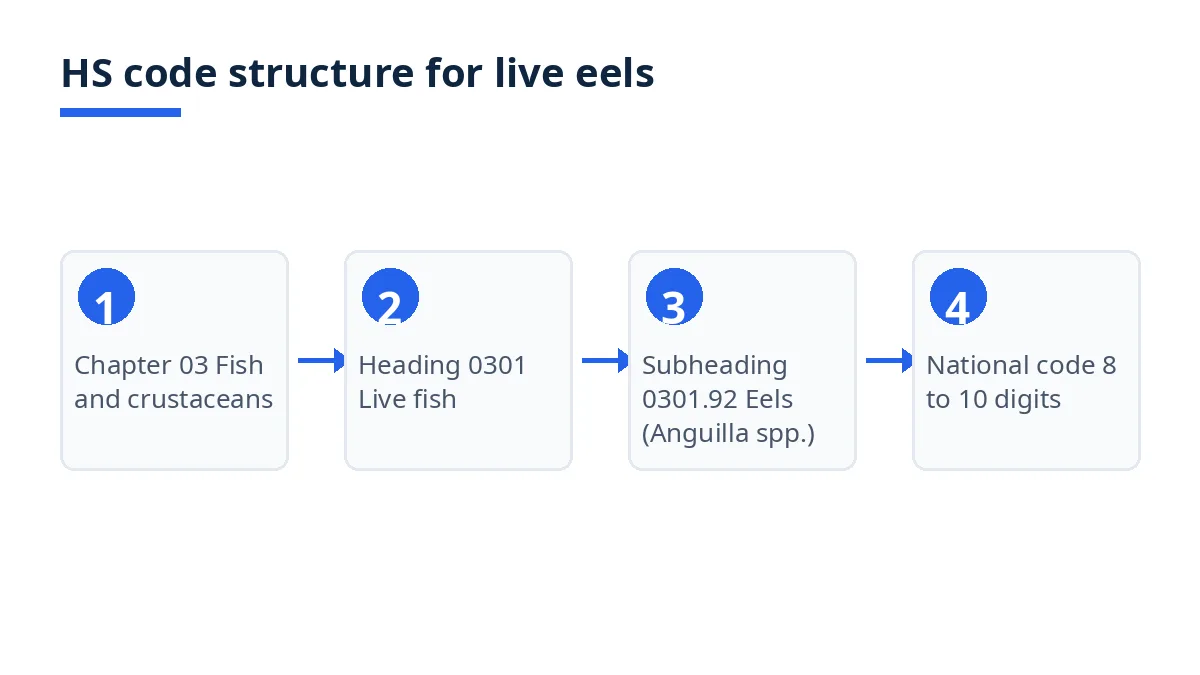
Countries subdivide the six-digit categories into national subheadings, and the European Union Combined Nomenclature uses eight-digit codes.2 The current version is HS 2022.2 Classification follows the General Rules for Interpretation: Rule 1 provides that section, chapter and sub-chapter titles are for ease of reference only and that classification is determined according to the terms of the headings and any relative section or chapter notes.4 Rule 6 extends the same approach to subheadings, so the eel line is read against the other subheadings at the same level inside heading 0301.4 Read the 6-digit HS code guide for more on the structure.
Factors that decide the code for live eels
Live on arrival is the first test. Heading 0301 covers live fish.3 An eel that is no longer live does not stay in 0301: the United States schedule places eels (Anguilla spp.) that are fresh or chilled at 0302.74, inside heading 0302, and frozen eels at 0303.26, inside heading 0303.3 State the condition at import on the invoice, and keep it consistent with the transport record.
Species is the second test. The subheading text names the genus: eels (Anguilla spp.).3 4 A live fish that is not an Anguilla eel takes a different line in the same heading, such as trout at 0301.91, carp at 0301.93, or the other line at 0301.99.3 Record the scientific name for every consignment, not only the trade name eel.
Ornamental presentation is checked before the eel line. Heading 0301 opens with ornamental fish, split in the United States schedule into freshwater ornamental fish at 0301.11 and other ornamental fish at 0301.19, and eels sit in the other live fish block that follows.3 If a shipment is presented as ornamental stock, test the ornamental lines first and record why the consignment does or does not belong there.
Young fish do not take a separate six-digit code. The section notes state that a reference to a particular genus or species includes a reference to the young of that genus or species.4 On that reading, juvenile Anguilla, including glass eels and elvers shipped live for farm stocking, stay in the eel line at six digits. Length can still matter nationally, as the next section shows.4
Farmed or wild origin does not change the six-digit line. The United States line for eels at 0301.92.00 carries no separate split for farmed and wild-caught fish.3 Origin still matters for duty preference and controls, so record how the eels were produced in the shipment file.
One Anguilla species carries a separate permit check. The CITES Appendices list Anguilla anguilla, the European eel, in Appendix II, while the subheading covers Anguilla spp. as a whole.5 A correct HS code does not settle that permit position: identify the species in writing and check its CITES position before contracting.
National codes: US HTS, EU CN/TARIC, UK commodity code
United States: HTS, ten digits. The United States schedule gives live eels a single line, 0301.92.00, with the statistical suffix 00, producing the ten-digit code 0301.92.0000.3 The line carries no split by length, species within Anguilla, or farmed and wild origin.3
European Union: CN at eight digits, TARIC for measures. The Combined Nomenclature integrates the HS and adds EU subdivisions, producing eight-digit codes, so the EU code builds on 0301 92 at the eight-digit level.2 The tariff listing then splits eels by length: 0301 9210 00 for eels under 12 cm, 0301 9230 00 for 12 cm or more but less than 20 cm, and 0301 9290 00 for 20 cm or more.4 Record the length range, read the confirmed line in TARIC for the entry date, and check the origin rules behind any preference claim for Bangladesh.
United Kingdom: commodity code. The UK tariff service lists the same structure, with eels (Anguilla spp.) at 0301 92 and the ten-digit length lines 0301 9210 00, 0301 9230 00 and 0301 9290 00.4 For Great Britain, take the full commodity code from the UK Integrated Online Tariff for your entry date.
Destination | Code for live eels | What decides the final digits |
|---|---|---|
United States | 0301.92.0000 | Single line, no length split in the schedule |
European Union | Builds on 0301 92 at eight digits, with ten-digit length lines in the tariff listing | Length of each fish: under 12 cm, 12 to under 20 cm, or 20 cm or more |
United Kingdom | 0301 92, extended to ten digits in the tariff service | Length lines as listed in the UK tariff service |
How to confirm the code officially
Write a precise description: scientific name, life stage, length range, live condition on arrival, farmed or wild origin, and whether the stock is ornamental or food and aquaculture stock.
Start from the official tariff for the destination, the USITC Harmonized Tariff Schedule, TARIC or the UK tariff service, and read the heading text for 0301 and the Chapter 3 notes.
Check published rulings for similar goods. For the United States, the USITC advises traders to use the Customs Rulings Online Search Service (CROSS), because the correct classification of many items can be found there.6
For a borderline consignment, such as ornamental-presented eels or a mixed-length shipment, apply for a binding decision before you ship. In the EU, a Binding Tariff Information (BTI) application needs a separate application for each type of product and a detailed description.7 In the United Kingdom, a legally binding decision is generally valid for 3 years, through an Advance Tariff Ruling.8 In the United States, if the merchandise is not described in any ruling on CROSS, you may request a binding ruling from U.S. Customs and Border Protection.6
Give your broker the description and the confirmed code, including the length split where the tariff uses one, and use the same code throughout the entry.
Common classification mistakes
Filing dead eels under the live code. Heading 0301 is for live fish.3 Fresh or chilled eels take 0302.74 and frozen eels take 0303.26 in the United States schedule.3 If part of a consignment arrives dead, raise it with your broker before filing.
Using a trade name instead of the scientific name. The subheading covers eels (Anguilla spp.).3 4 A fish sold as an eel but outside the genus Anguilla falls to another line in heading 0301, such as the other line at 0301.99.3
Skipping the ornamental test. Heading 0301 starts with ornamental fish at 0301.11 and 0301.19, before the other live fish block that contains eels.3 Record which side of that split the consignment sits on.
Copying a code from another country. Only the first six digits are shared. The EU extends them to eight in the Combined Nomenclature,2 the United States gives eels a single ten-digit line,3 and the EU and Northern Ireland listing splits eels by length into three ten-digit lines.4
Treating glass eels as a different product. The section notes include the young of a genus or species in a reference to that genus or species.4 Juvenile live eels stay in the eel line at six digits, with the length split applied nationally where the tariff has one.4
Assuming the code settles permits. Anguilla anguilla is listed in CITES Appendix II.5 Classification and species controls are separate checks, and both belong in the shipment file.
Related duties and documents
This guide states no duty rates: the code decides which duty line customs applies, and a rate read beside one national line does not carry to another destination or length line. Read the rate and measures beside your confirmed code for your origin and entry date, and check what proof of origin a preference claim for Bangladesh requires.
Keep the species and permit file with the classification file. For Anguilla anguilla, the CITES Appendix II listing means the permit position needs checking before shipment, separate from the HS code.5 A binding decision also helps you calculate the duties, licensing requirements, quotas or other restrictions that apply in advance.8 Keep the description, scientific name, length range, live-transport record, confirmed code, any binding decision and the origin evidence together. Compare this workflow with the HS code for live crabs, where live condition decides the heading in a similar way.
FAQs
What is the HS code for live eels?
The indicative six-digit code is 0301.92, eels (Anguilla spp.), under heading 0301, live fish, in Chapter 3.3 4 The full filing code is national: ten digits in the United States, and eight digits in the EU Combined Nomenclature with further digits where a length split applies.2 4
Is the HS code the same in every country?
Only the first six digits are harmonised. Beyond six digits, each system adds its own lines: eight digits in the EU Combined Nomenclature,2 ten in the United States, where live eels take the single line 0301.92.0000,3 and ten-digit length lines in the EU and Northern Ireland listing.4
How do I confirm the correct code?
Describe the consignment precisely, then read the heading text and Chapter 3 notes in the destination tariff and check published rulings, such as CROSS for the United States.6 For a borderline consignment, apply for a binding decision before shipping: a BTI in the EU,7 an Advance Tariff Ruling in the United Kingdom,8 or a CBP binding ruling in the United States.6
What happens if I use the wrong code?
Duty, licensing and quota treatment are worked out from the code on the declaration, so a wrong code brings the wrong treatment and can hold the consignment while customs reclassifies it. A binding decision in advance helps you calculate the duties and restrictions that will apply.8
Next steps on Exportain
Browse Bangladeshi suppliers on Exportain, a B2B marketplace where supplier profiles carry document and photo review badges, and post a free RFQ at Exportain RFQs with the species, length range and confirmed code stated. Exportain is not a party to the goods contract and does not inspect goods, book freight or clear customs, so keep your broker and binding decision at the centre of the entry.
Sources
- What is the Harmonized System (HS)?. World Customs Organization (accessed )
- Harmonised System. European Commission (accessed )
- Harmonized Tariff Schedule of the United States, Chapter 3. United States International Trade Commission (accessed )
- Other live fish: Northern Ireland Online Tariff, subheading 030191. GOV.UK, HM Revenue and Customs (accessed )
- Appendices | CITES. Convention on International Trade in Endangered Species of Wild Fauna and Flora (CITES) (accessed )
- MTB 2019: Get Out Ahead of the Pack with a Binding Ruling from CBP. U.S. International Trade Commission (accessed )
- European Binding Tariff Information (EBTI). European Commission, Taxation and Customs Union, (accessed )
- Check what you'll need to get a legally binding decision on a commodity code. GOV.UK, HM Revenue and Customs (accessed )
About the author
Sourcing from Bangladesh?
Post a request for quotation and suppliers on Exportain can send you their quotes directly.
Post an RFQ