MOQ Meaning in Supply Chain: Practical Guide
What MOQ means in the supply chain, why suppliers set it per style and per color, and how buyers confirm it in an RFQ before comparing quotes from Bangladesh.
Short answer
MOQ, or minimum order quantity, is the smallest quantity a supplier will sell in one order, stated in units, weight, or order value. In the supply chain, each variant, such as a color or style, can carry its own MOQ. Suppliers set it to cover setup, materials, and handling. Buyers should confirm the MOQ basis in writing before comparing prices.
On this page
Key takeaways
MOQ is the minimum order quantity for a specific product and specification, and it can apply per style, per color, or per order.
Suppliers set MOQs to cover setup, material, packaging, and shipping costs, and they face material minimums of their own.
A total quantity can meet a per-order MOQ while each color falls below its per-color MOQ.
Compare quotes only on the same specification, quantity, and inclusions, not on unit price alone.
Confirm the MOQ basis, price, and any trial terms in the RFQ and order documents, in writing.
Understanding the moq meaning in supply chain helps you judge, before you send an enquiry, whether a supplier can take your order at a workable price. MOQ is short for minimum order quantity. This guide explains how that minimum is set, how it can apply per style, per color, or per order, and how to record it in an RFQ so quotes from Bangladesh are comparable.
Minimum order quantity is the fewest number of units a business is willing to sell to a single customer in one transaction, and an MOQ may be based on units or on order value.1 Both legs of a supply chain use MOQs, because manufacturers sell in bulk to wholesalers, which then sell in bulk to retailers.1
Why this matters for buyers and sellers
What does MOQ mean for a buyer?
For a buyer, MOQ decides whether a supplier is a realistic fit. Buyers must decide if they can use or sell the MOQ of a product in a reasonable timeframe, and they should also consider whether the item is perishable or likely to go out of style, the cost of warehouse space, the capital tied up in inventory, and any savings from ordering in bulk.1 If the minimum is far above what you can sell, the order ties up cash and storage even when the unit price looks attractive.
MOQ is different from economic order quantity (EOQ). MOQ is the smallest number of products a supplier can produce and ship while remaining profitable, while EOQ is the ideal number a buyer will order to minimize the cost of ordering without holding too much inventory.2 The supplier sets the MOQ; the buyer works out the EOQ. A sound order satisfies the first and stays close to the second.
Why do suppliers set an MOQ?
Suppliers set MOQs so that each order covers the fixed costs linked to production, packaging, and shipping and still yields a profit, and larger quantities can lower the per-unit cost through economies of scale.1 A supplier may also face minimums of its own. Factories that supply raw materials rarely start production without an order, and that order will likely carry an MOQ, so a finished-goods supplier has to take the minimum amount of material into account when setting its own MOQ for buyers.1
That chain effect is clearest with a complex MOQ, which has two or more requirements. A clothing manufacturer is a standard example: buyers may have to meet a minimum length of fabric per color and fabric type, a minimum number of pieces, and a minimum order value, with all conditions met before an order can proceed.1 A simple MOQ, by contrast, has one limit only, stated as a quantity of units or as a minimum spend.1
Read the base term in MOQ — minimum order quantity alongside this guide.
Step-by-step: how it works
Work through these steps in order.
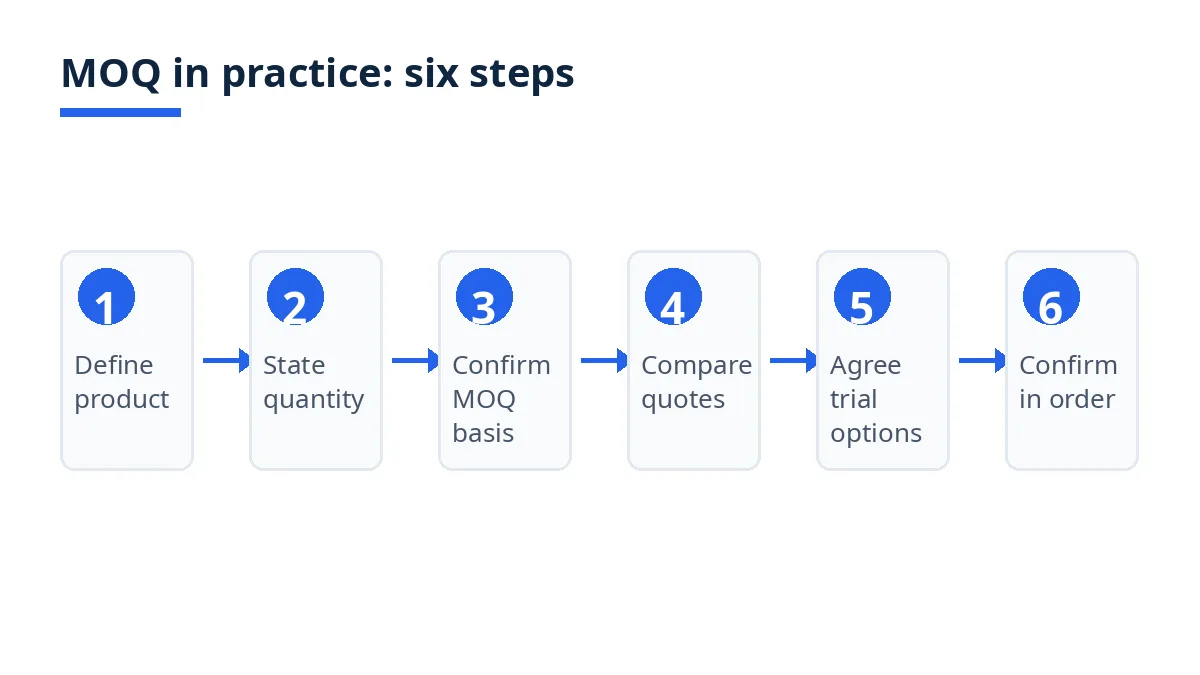
Define your product precisely. Describe the product type, material or fabric composition if known, construction, sizes, colors, branding, labeling, packing, and destination market. A vague enquiry such as "T-shirts, price please" gives a supplier nothing on which to base an MOQ or a price. A precise enquiry lets the supplier check material availability and state whether the minimum applies per piece, per style, per color, per kilogram, per meter, or per carton.
State your quantity and how it breaks down. Give the total quantity and the breakdown. For garments, that means quantity per style, per color, and per size ratio. For other products, it may mean quantity per design, per finish, or per packaging variant. Two orders with the same total can face very different minimums if one is a single color and the other is split across many colors, each needing separate dyeing, printing, or setup.
Ask how the MOQ is structured. Ask the supplier to state the MOQ in writing and explain its basis: Is it per style or per order? Does a different MOQ apply to each color? Can sizes be mixed within the minimum? Does it change if you use available fabric instead of a custom development? Typically, if any feature of an item changes, it becomes a unique stock keeping unit (SKU) and will have its own MOQ.2
Compare quotations on the same basis. Do not compare unit prices alone when MOQs differ. Compare total order value, sampling steps, inclusions and exclusions, packing, inspection, and delivery terms. Different suppliers will have different MOQ thresholds, so compare their MOQs along with overall pricing, lead times, and contract terms.1 A higher unit price from a supplier whose MOQ fits your quantity may cost less in total than a lower price that forces you to order far more than you can sell.
Discuss options if your quantity is below the MOQ. Ask what options exist rather than demanding an exception. Suppliers may consider using available materials, reducing colors or prints, simplifying trims and packaging, combining similar styles on the same base material, quoting a surcharge, or agreeing to a trial order. Buyers can also negotiate a higher overall purchase volume or order frequency in exchange for a reduced MOQ, and other points can include extended lead times and flexible payment terms.1 None of these outcomes is assured, so confirm any agreement in writing.
Confirm everything in your RFQ and order documents. Put the agreed quantity, breakdown, specification, price basis, sampling stage, and delivery plan in your RFQ and then in your purchase documents. A strong RFQ gives vendors everything they need to price accurately, including an overview, detailed specifications, precise quantities, delivery requirements and timelines, a pricing format, payment terms, and submission instructions.3 For a format you can copy, see how to write an RFQ.
A worked example: when the total meets the MOQ but the colors do not
Example figures. The quantities below are illustrative only, to show the arithmetic. They are not a supplier quotation or a market rate.
A buyer plans 1,200 T-shirts split evenly across six colors, so 200 pieces per color. The supplier states an MOQ of 500 pieces per color for a custom-dyed fabric. The total of 1,200 is above a simple per-order minimum, but each color sits below the per-color minimum. The buyer has three clean options: reduce the launch to two colors at 600 pieces each, keep six colors and raise the total to 3,000 pieces, or ask whether an available fabric changes the per-color minimum. Each option changes the total value and the stock the buyer must sell through, which is why the per-color figure matters more than the headline total.
Costs, timelines and documents
How does MOQ affect cost?
MOQ itself is a quantity, not a cost, but it shapes most costs in an order. Unit cost reflects setup and material waste spread across the run, so the smaller the run, the more those fixed steps weigh on each piece. Custom materials can require minimum purchases from mills or dye houses, so a custom color or print often carries a higher effective minimum than a product made from available materials. Sampling, pattern work, or setup may be charged separately or built into the quotation. Always ask which applies.
Be careful with numbers found online. MOQs and prices vary by product, material, factory, season, and specification, and a figure quoted without a full specification is not a reliable basis for a budget. Request a quotation against your exact specification and ask what the price includes and excludes. Build the full landed figure, not only the factory price, using landed cost of imports from Bangladesh.
How does MOQ affect timelines?
Timelines depend on quantity and complexity, not on quantity alone. Sampling must be approved, materials must be sourced or dyed, and production must be scheduled. A small order is not automatically faster, because it may wait for a suitable production slot. Ask for a staged timeline covering sample approval, material readiness, production, finishing, inspection, and dispatch, and do not promise a launch date until the supplier confirms a schedule against an approved sample.
Which documents support an MOQ discussion?
The agreed MOQ should appear in written documents, not only in chat messages.
Document | What it should state about MOQ |
|---|---|
Product specification or tech pack | Material, construction, sizes, colors, branding, labeling, and packing the MOQ applies to |
RFQ | Total quantity and breakdown per style, color, and size, plus destination |
Supplier quotation | MOQ basis (per style, per color, or per order), price at your quantity and at the MOQ, inclusions |
Approved sample reference | The sample production will be matched against |
Purchase order or proforma | Final quantity, breakdown, price basis, and any trial terms |
Export and shipping documents follow later. For the wider set, see export documents from Bangladesh.
Bangladesh-specific rules and tips
Bangladesh sourcing covers ready-made garments at large scale and a wider range of home textiles, leather goods, jute products, and footwear. Match your enquiry to the supplier type. A large export factory, a mid-sized manufacturer, and a smaller workshop can have very different minimums for a similar product, because their material purchasing and production setups differ. Stating your quantity early helps each type answer quickly.
Material availability is often the deciding factor. If you can work with fabrics or materials the supplier already uses, or that are readily available locally, the MOQ discussion is usually easier than for a custom development that needs imported or specially dyed material. Ask what drives the minimum — fabric, dyeing, printing, trims, or packing — and whether an available alternative would change it.
Color and size discipline helps in garment sourcing. Each extra color can mean a separate dyeing step, and complex size ratios complicate cutting and packing. When you test a product, launch with a focused color range and clean size breakdown, then expand on repeat orders.
Be direct about quantity, target market, and whether the order is a trial or a recurring program. Suppliers respond better to an honest smaller quantity with a credible repeat plan than to an inflated quantity that later collapses. Do not promise future volumes you cannot commit to.
Finally, use a structured channel. A complete specification and quantity in one RFQ lets suppliers who can meet the minimum respond, and lets others decline quickly. See how to source products from Bangladesh for the full sequence.
Mistakes and red flags
The most common mistake is asking for a price before stating a quantity. Price and MOQ are linked, so a quotation without a quantity is incomplete. A related mistake is comparing prices without checking whether MOQs, materials, and inclusions match. The cheaper quote may assume a larger quantity, a different fabric, or fewer finishing steps.
Another frequent error is splitting an order too thinly. Buyers divide a modest total across many styles, colors, and sizes, then find that each variant falls below its own minimum, as the worked example shows. Check the MOQ per style and per color, not only the order total, before you finalize a range.
Changing the specification after agreeing a quantity also causes trouble. Adding a custom print, changing fabric, or adding special packaging can change material minimums and therefore the MOQ. Reconfirm quantity and price after any specification change, however small it seems.
Watch for red flags on both sides. Supplier red flags include refusing to state the MOQ basis in writing, pressure to pay before terms are clear, and a minimum that changes repeatedly without explanation. Buyer red flags include refusing to state a quantity and demanding bulk pricing for a sample quantity.
A final mistake is treating a negotiated trial quantity as a permanent term. If a supplier agreed to a lower quantity for a first trial using available materials, that does not mean the same terms apply to a custom repeat order. Record the basis of any exception so both sides know what it depended on.
Checklist
Use this checklist before you confirm any order:
Product specification is complete: material, construction, sizes, colors, branding, labeling, and packing are all stated.
Total quantity and breakdown per style, per color, and per size are stated in the RFQ.
The supplier has confirmed the MOQ in writing and explained whether it applies per style, per color, or per order.
You have asked what drives the MOQ and whether available materials would change it.
Quotations are compared on the same specification, quantity, and inclusions, not on unit price alone.
Sampling steps, timeline stages, and what the price includes and excludes are confirmed in writing.
Any trial arrangement records its basis, and specification changes trigger a fresh confirmation of MOQ and price.
Documents are filed together: specification, RFQ, quotation, and approved sample reference.
Template you can copy into an enquiry: "Product: [name and specification]. Quantity: [total], split as [breakdown per color, size, and style]. Destination: [country and port]. Please confirm your MOQ per style and per color, what drives it, your price at our quantity and at your MOQ, inclusions and exclusions, sampling steps, and a staged timeline to dispatch."
FAQs
What should I know first about MOQ?
First, know that MOQ means minimum order quantity: the smallest quantity a supplier will accept for a defined product and specification. It is specific to that product, material, color, and setup, not a fixed industry number. Know your total quantity and breakdown, and ask the supplier to state the MOQ basis in writing.
What are the typical costs and timelines?
There is no single typical cost or timeline, because both depend on specification, material, quantity, and destination. Smaller runs generally carry higher unit costs because fixed setup steps are spread across fewer pieces, and timelines depend on sampling, material readiness, and scheduling as well as quantity. Ask each supplier for a quotation and a staged timeline against your exact specification.
Which documents are needed?
You normally need a product specification, an RFQ stating quantity and breakdown, and the supplier's written quotation stating the MOQ and price basis. Later you add an approved sample reference and purchase or proforma documents, with export documents following.
What are the most common mistakes?
The most common mistakes are asking for a price without stating a quantity, comparing prices without comparing MOQs and inclusions, splitting an order across too many styles and colors so each variant falls below its minimum, changing the specification after agreeing terms without reconfirming MOQ and price, and assuming a one-off trial arrangement will apply to future custom orders.
Next steps on Exportain
Browse suppliers, read how to buy, then post an RFQ with your full specification, total quantity, and breakdown per color and size. Suppliers can then confirm their MOQ basis and price on the same terms, so you compare like with like.
Sources
- Minimum Order Quantity (MOQ): Formula, Tips, & Benefits. NetSuite, (accessed )
- Minimum Order Quantity: What Is It and Why Does It Matter. Paramount Global (accessed )
- Request for Quote (RFQ) Explained. Stripe, (accessed )
About the author
Sourcing from Bangladesh?
Post a request for quotation and suppliers on Exportain can send you their quotes directly.
Post an RFQ