Quality Control Checklist for Live Eels From Bangladesh
A numbered QC checklist for live eels from Bangladesh: vitality grading animal by animal, species identification and the CITES documentation check, weight and grades, holding and purging, conditioning, packing temperature, flight documents and the carton-by-carton arrival record, with fixes for common failures.
Short answer
Use this live eels quality control checklist before shipment and again on arrival to check vitality animal by animal, species identification for Anguilla bengalensis, individual weight and grade, recorded holding and purging, conditioning, packing temperature and flight documents, and the carton-by-carton arrival record on live eels from Bangladesh. Agree grades and loss thresholds in the purchase order.

On this page
Key takeaways
Grade vitality animal by animal at intake and again before packing: under Codex CXC 52-2003 Section 6.3.6, only healthy and undamaged fish are chosen for live storage and transportation, and damaged, sick and dead fish are removed before holding.
Treat species identification as a documentation check: record Anguilla bengalensis in full on every document, and complete the CITES check, since the CITES Appendices list Anguilla anguilla in Appendix II and no other Anguilla species.
Record holding and purging, do not describe them: log the purging period and water exchange, stop feeding before transport, check holding water and tanks at set rounds, and remove dead animals at each check.
State no universal survival figure in the contract: name the selection, holding, purging, conditioning and packing process, set the acceptable-loss threshold in the purchase order, and record arrival carton by carton.
Use this checklist to check a live eel consignment before it leaves Bangladesh and again when it lands: vitality, species identification, weight and grade, holding and purging, conditioning, packing, documents and arrival. Codex CXC 52-2003 covers the storage and transportation of live fish in Section 6.3.6.1 If you are still setting up the order, work through how to import live eels from Bangladesh first: that guide owns the import process.
Why this checklist matters
A live eel is judged alive: the buyer pays freight on every animal shipped, not only on those that arrive saleable. The export product is the Indian mottled eel, Anguilla bengalensis, recorded in the family Anguillidae, found in the hill streams of Mymensingh and known to descend to the Bay of Bengal during the rainy season.2
A written checklist turns arrival condition into evidence: each animal is recorded against the purchase order, so a loss can be traced to one stage. Set grade bands, packing format and the loss threshold in the purchase order. No universal survival percentage applies across grades, routes and seasons.
Before you start
Do not begin until the references are complete: the purchase order naming species in full, grade bands and supply source, the holding, purging and packing specifications, the flight booking, and the destination documents.
Confirm airline acceptance on the exact flight before packing. The IATA Live Animals Regulations (LAR) govern live animal air shipments, covering carrier and government regulations, documentation including CITES documents, and container requirements including stocking density, marking and labelling.3
Confirm the certificate route: the Department of Fisheries e-certification system covers licences, health certificates and additional certificates per the importing country's requirements.4
Name the destination market. Singapore (Food Agency) places live fish in Fish and Fish Products: check high-risk and CITES status and keep labels complete.5 The European Union requires authorised-country approval, an approved establishment, health certificates and health control.6 Hong Kong (Centre for Food Safety): marine importers should obtain origin health certificates certifying fitness for human consumption.7
Prepare calibrated scales, a carton record, purging logs and a camera.
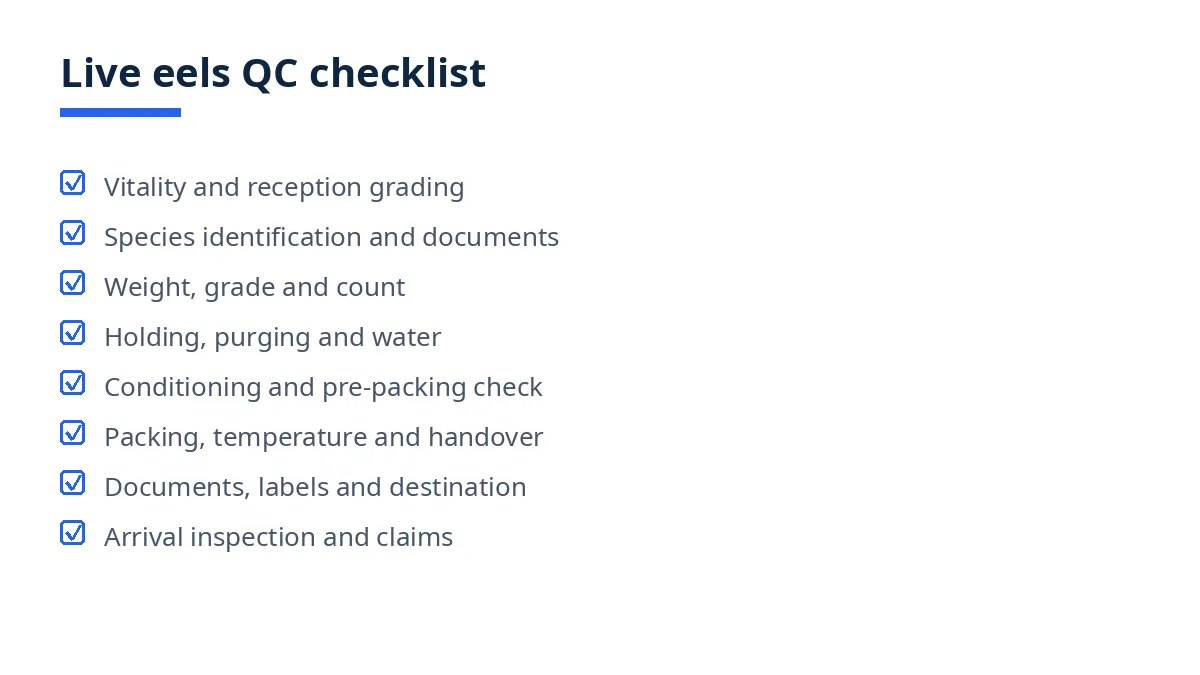
The full checklist (numbered, printable)
Vitality and reception grading
Inspect every animal on receipt. Under Codex Section 6.3.6, only healthy and undamaged fish should be chosen for live storage and transportation.1
Grade vitality animal by animal and record it: active, weak and dead, kept separate.
Remove damaged, sick and dead animals before any animal enters a holding tank, and record the count per lot, per Codex Section 6.3.6.1
Check the skin and body animal by animal: cuts, bite damage, lesions and bruising. Handle live fish to avoid unnecessary stress and physical damage, per Codex Section 6.3.5.1
Hold weak animals apart for a purchase-order decision. Never mix them into export grades to make up weight.
Species identification and the documentation check
Confirm the species against the purchase order as Anguilla bengalensis in full, lot by lot. Identification evidence uses the recorded description: body snake-like, brownish dorsally mottled with darker brown, belly yellowish, pectoral fins well developed.2
Keep every other Anguilla species and every unidentified animal out, and record the identification check per lot, with photographs.
Complete the CITES documentation check as a paperwork item. On the CITES Appendices page opened for this checklist, the family Anguillidae carries one entry, Anguilla anguilla, in Appendix II, and no other Anguilla species is listed there.8 The full position is in how to import live eels from Bangladesh; do not ship on incomplete species evidence.
Match the species name across every document: purchase order, invoice, packing list and health certificate must carry the same full name.
Weight, grade and count per carton
Weigh each animal individually on calibrated scales and sort it into the purchase order grade band. Grade bands are contract figures set per order.
Count animals as you pack, and record count, grade and weight on the carton record the arrival check scores against.
Re-weigh sample cartons after packing against the carton record and packing list, and check that no carton mixes grades outside the ordered mix.
Holding, purging and water
Hold animals by grade for the shortest time the flight plan allows, recording intake and packing times.
Purge as the specification requires. Under Codex Section 6.3.4, fish should be purged, where necessary, to reduce gut contents and pollution during further processing.1 Agree the period and water exchange method in writing, and log both.
Stop feeding before transport. Under Codex Section 6.3.6, no feeding should occur during storage and transportation, and in general fish should not be fed within the 24 hours preceding transportation.1
Check holding water at each round: clean, similar in properties and composition to the source water, and well aerated before transfer, per Codex Section 6.3.6.1
Check holding tanks regularly, and remove damaged, sick and dead animals immediately when found, recording count and time, per Codex Section 6.3.6.1
Keep equipment and holding facilities clean: Codex Section 6.3.5 requires facilities to be cleaned and disinfected regularly and as appropriate, and fish to be transported without undue delay.1
Conditioning and the pre-packing check
Condition animals only to the method named in the specification. Under Codex Section 6.3.6.2, low-temperature conditioning follows the characteristics of the species (minimum temperature, cooling rate, water and humidity requirements, packaging conditions), and only approved anaesthetics and permitted procedures should be used.1
Run the pre-packing check animal by animal just before packing: vitality, damage, species, grade and count again, because holding changes the animal intake passed.
Pack conditioned animals without delay in proper insulated containers, per Codex Section 6.3.6.2.1
Check packing water and material carton by carton: water should be clean, of similar composition and pH to the source water, at the storage temperature, and pads, shavings or sawdust should be clean, not previously used and wet at packaging, per Codex Section 6.3.6.2.1
Packing, temperature and flight handover
Record packing temperature against the purchase order figure for your species and route. Under Codex Section 6.3.6.2, the temperature to be reached should correspond to the species, transportation and packaging conditions.1 This checklist states no universal figure.
Check carton condition and closure: clean, dry outside, undamaged, insulated as specified, marked as live animals with species, grade, count and weight.3
Check product temperature before loading. Codex Section 21 directs handlers to check temperature before loading, avoid exposure to elevated temperatures in loading and unloading, and monitor cargo-hold air temperatures.1
Record the handover: airline, flight number, acceptance time and carton count,3 against the confirmed acceptance from Before you start.
Send the buyer the pre-shipment pack the same day: carton records, purging logs, packing list, certificate copy, air waybill and photographs.
Documents, labels and the destination file
Match the health certificate to this consignment: exporter, species, grades, carton count and destination must agree with the carton records.4
Match the destination file before handover: for Singapore, high-risk and CITES checks and complete labels;5 for the European Union, authorised country, approved establishment and health certificate;6 for Hong Kong, the health certificate.7
Check labels carton by carton against the packing list: species in full, grade, count, weight and destination on every carton.
Arrival inspection and claims evidence
Open cartons promptly on arrival and record condition carton by carton: active, weak, dead and damaged counted separately, with time from landing recorded.
Photograph each opened carton before animals are moved, then weak, dead and damaged animals grouped by carton. Record carton damage, dry or saturated packing and any delay on the waybill.
Compare depot and arrival records line by line, agree the result against the purchase order loss threshold, and send the signed record and photographs to the exporter the same day. The paired method for another live product is the live crabs quality control checklist.
Common failures and how to fix them
The most frequent failure is weak animals packed to complete a grade, shown on arrival as deaths spread evenly across cartons. Stop it at the pre-packing check: re-grade vitality animal by animal, hold weak animals out, and pack short.
Next is fouled packing water from a skipped purge or late feeding: hold the consignment to the purging log and the no-feeding rule, and re-check water before sealing. Mixed species or grades trace to intake: separate at reception. Dry or overheated cartons trace to packing too early: pack to the flight. Correct certificate mismatches before handover.
Downloadable template and summary table
Copy this table into your inspection sheet, add your grade bands and loss threshold, and record the count per line.
Section | Checks | Evidence |
|---|---|---|
Vitality | Active, weak, dead counts | Intake record |
Species and documents | Species evidence, CITES check, name match | Lot record |
Weight and grade | Individual weight, band, count | Carton records |
Holding and purging | Grade separation, water, removals | Holding log |
Conditioning | Method, pre-packing re-check | Packing check |
Packing | Temperature, cartons, handover | Photos |
Documents | Certificate, labels, destination file | Waybill |
Arrival | Carton-by-carton counts, photos | Arrival record |
How Exportain helps
Exportain is a B2B marketplace connecting buyers with Bangladeshi suppliers of live eels and seafood, so this specification can be agreed at the enquiry stage. Browse suppliers, read the frozen seafood sourcing guide and use inspection services to plan the check. Profiles show document and photo checks recorded, not factory inspections. Exportain is not a party to the goods contract and does not inspect goods.
FAQs
When should this checklist be used?
Use it twice: at the depot, from intake to handover, and again on arrival, carton by carton. For first orders, run it on a trial consignment.
Who should complete it?
The exporter completes the depot sections animal by animal; the buyer or the buyer's agent completes the arrival section. An inspector can complete either side if the references are shared first.
What are the most common failures?
Weak animals packed to complete a grade, fouled packing water from a skipped purge, mixed species or grades, and a certificate that does not match the consignment.
Can a third party do it?
Yes, if you share the purchase order, grade bands and specification first, and the inspector records counts per carton, not a summary pass.
Next steps on Exportain
Agree grade bands, packing format, transit condition and loss threshold in the purchase order, then read how to import live eels from Bangladesh and the pre-shipment inspection guide, and plan the check with inspection services. Post a free RFQ via RFQs to compare quotes.
Sources
- Code of Practice for Fish and Fishery Products (CXC 52-2003). FAO and WHO, Codex Alimentarius (accessed )
- Anguilla bengalensis. Freshwater Biodiversity Portal of Bangladesh (accessed )
- Live Animals Regulations (LAR). International Air Transport Association (IATA) (accessed )
- Bangladesh rolls out online certification system to simplify fish and seafood trade. International Collective in Support of Fishworkers (ICSF) (accessed )
- Import Requirements for Food & Food Products. Singapore Food Agency (accessed )
- Health and consumer protection for animal and plant product. European Commission, Access2Markets (accessed )
- Food Safety Bulletin 100th Issue (03/2025). Centre for Food Safety, Food and Environmental Hygiene Department, Hong Kong (accessed )
- Appendices | CITES. Convention on International Trade in Endangered Species of Wild Fauna and Flora (CITES) (accessed )
About the author
Sourcing from Bangladesh?
Post a request for quotation and suppliers on Exportain can send you their quotes directly.
Post an RFQ