

How to Import Frozen Shrimp From Bangladesh to USA: Step-by-Step Guide
Frozen shrimp from Bangladesh to the USA: the HTS 0306.17 line and Free duty in HTS Revision 5, SIMP chain of custody, FDA verification and Prior Notice, supplier checks, and a per-kilogram landed cost example.
Short answer
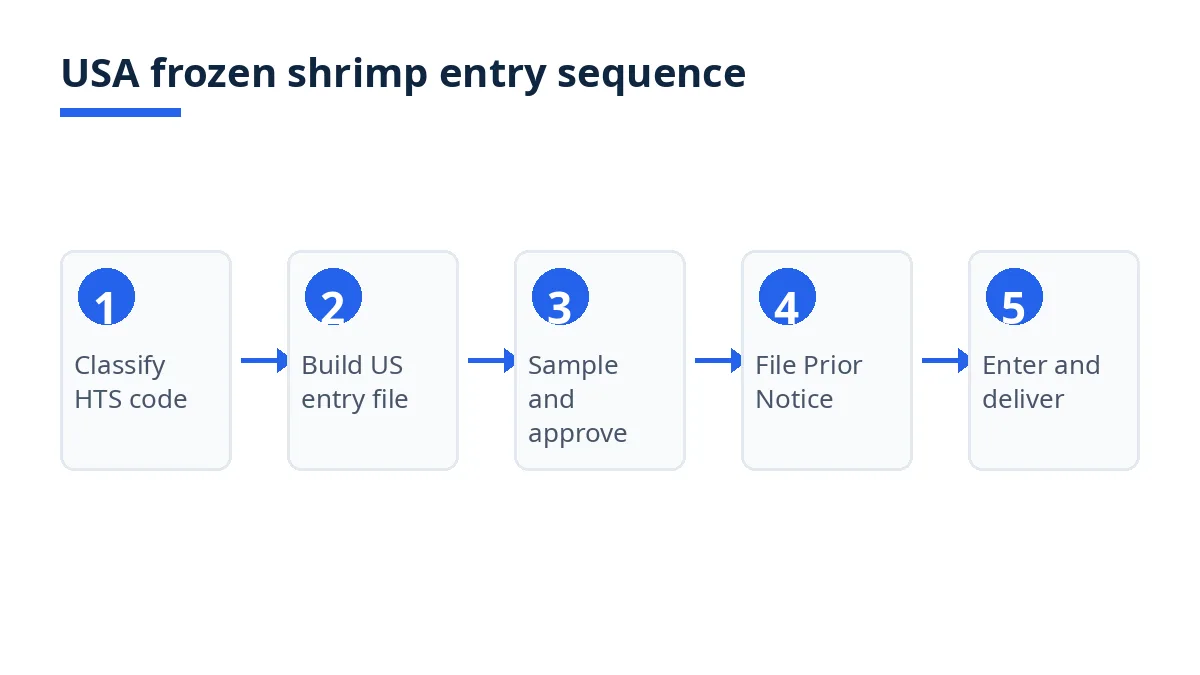
To import frozen shrimp from Bangladesh to the USA, classify each line under HTS 0306.17.00 with its farmed, shell-state and count-size suffix, build the SIMP chain of custody and Part 123 verification file, and file FDA Prior Notice at least 8 hours before arrival by water. In HTS Revision 5 (2026) the General duty rate shown is Free, subject to broker confirmation. Enter the goods within 15 calendar days after landing, with all documents in agreement.
On this page
Key takeaways
Classify first: Bangladeshi warm-water shrimp falls under HTS 0306.17.00, with the ten-digit suffix fixed by shell state, farmed or not farmed status and count size; Revision 5 (2026) shows a Free General rate, subject to broker confirmation on the entry date.
SIMP requires the importer of record to report the chain of custody from harvest to entry, including vessel or farm, landing, product form and trade permit number; keep the records lot by lot.
Build the Part 123 verification file before shipment: lot HACCP and sanitation records, a certificate or facility inspection, the HACCP plan in English with a written guarantee, or periodic testing.
File FDA Prior Notice at least 8 hours before arrival by water, confirmed by FDA, and enter the goods within 15 calendar days after landing, with entry, SIMP data and Prior Notice in agreement.
Compare quotes only on the identical specification, delivery term and document set, and treat the example landed cost of USD 10.31 per kilogram as an example only, reworked at quote stage.
A USA buyer does not start a frozen shrimp order from Bangladesh with a price. The order starts with the United States entry file: the tariff line, the Seafood Import Monitoring Program (SIMP) chain of custody, the processor verification file, the FDA Prior Notice, and the customs entry. A missing record can hold a reefer container at the port.
This guide is for USA importers, wholesalers, retailers and food service buyers of frozen shrimp from Bangladesh. It states no price, minimum or transit time as a standard figure. Confirm every duty line and filing deadline with your broker before you price or ship.
Import duty, taxes and documents
Start with classification, because duty, SIMP reporting and the statistical suffix all follow the code on the entry. In the Harmonized Tariff Schedule of the United States (HTSUS), Revision 5 (2026), dated April 2026, frozen shrimps and prawns sit in heading 0306: subheading 0306.16.00 covers cold-water shrimps and prawns (Pandalus spp., Crangon crangon) and subheading 0306.17.00 covers other shrimps and prawns.1 Bangladeshi warm-water shrimp falls on the 0306.17.00 line, whose ten-digit line turns on shell state, farmed or not farmed status, and count size as headless weight per kilogram, with peeled shrimp taking suffix 41 for farmed and 42 for not farmed.1 The SIMP code list updated in October 2026 carries the same lines, including 0306.17.0004 through 0306.17.0029 and 0306.17.0041 and 0306.17.0042.2 Record those facts for every lot.
In Revision 5 (2026), the General rate beside both 0306.16.00 and 0306.17.00 is Free.1 Treat that as the position in that revision only: ask your broker to confirm the rate in force on your entry date and to check for any additional Chapter 99 measure. Do not price on the Free line until the broker confirms it in writing. State sales tax depends on the state and on how the shrimp is sold after importation, so ask your tax adviser.
What does SIMP require for shrimp?
SIMP is a risk-based traceability program run by NOAA Fisheries. It requires the importer of record to provide and report key chain of custody data, from harvest to entry into United States commerce, for products vulnerable to illegal, unreported and unregulated fishing or seafood fraud.3 More than 1,100 species in 13 groups are included, shrimp among them, and compliance for shrimp became effective on December 31, 2018.3 Collection runs through the International Trade Data System, with the information held confidential.3
The importer of record reports the harvesting entity, the fishing or production event, and the importer details: vessel name and flag state, authorization evidence, vessel identifier when available, farm name and gear type; species code, landing dates and points, product forms with quantity and weight, harvest areas including the farm address, and the entities landed to; and name and contact details, the NOAA Fisheries-issued international fisheries trade permit number, transshipment information, and processing, re-processing and commingling records.3 Where an entry covers more than one harvest event, each relevant event must be reported, although the importer does not need to link each event to a particular fish or portion of the shipment.3 The importer of record is responsible for keeping the chain of custody records.
How does the FDA food safety file work for shrimp?
Under 21 CFR 123.12, every importer of fish or fishery products must either obtain the product from a country with an active memorandum of understanding or similar agreement with the FDA covering the product and documenting the equivalency or compliance of the foreign inspection system, or have and implement written verification procedures showing the products were processed in accordance with Part 123.4 Do not assume the memorandum route applies. Unless your broker or compliance adviser confirms an active, covering agreement in writing, build the written verification procedures route.
The procedures must list product specifications and the affirmative steps: lot HACCP and sanitation records, a continuing or lot-by-lot certificate from an appropriate authority or competent third party, regular facility inspection, a copy in English of the HACCP plan with a written guarantee, periodic testing with a written guarantee, or another measure giving equivalent assurance.4 A third party may assist, but the importer must maintain records in English of performance and results.4 Without evidence of compliance with Part 123, the product will appear adulterated and will be denied entry.4
The FSVP rule sits beside the HACCP route. The FDA states that juice and seafood from suppliers in compliance with the HACCP regulations, 21 CFR Part 120 or 123, are exempt from FSVP.5 Read that exemption as conditional on compliance, evidenced in the file above. Where FSVP applies, the FSVP importer must follow an FSVP for each food imported and identify the FSVP importer at entry with name, electronic mail address and a unique facility identifier, with the Data Universal Numbering System (DUNS) number recognized as acceptable.5 Ask your broker whether your file is an FSVP file, a Part 123 file, or both.
A foreign food facility designates a United States agent: a person residing or maintaining a place of business in the United States, physically present there, who acts as the communications link between FDA and the foreign facility for routine and emergency communications.6 Prior Notice asks for the manufacturer's name and either the registration number, city and country of the manufacturer, or the full address of the manufacturer with the reason the registration number is not provided.7 Ask the processor, at shortlist stage, for its facility registration number and its United States agent details.
What must be filed before the vessel arrives?
FDA Prior Notice is advance electronic notice of a food shipment, submitted and confirmed by FDA before the food arrives at the first United States port. It gives FDA time to review information before arrival, deploy inspection resources, and help intercept contaminated products.7 Food imported with inadequate Prior Notice is subject to refusal and, if refused, must be held at the port of entry unless directed elsewhere.7 For arrival by water, Prior Notice must be submitted and confirmed no less than 8 hours before arriving at the port of arrival; the same table gives 2 hours by land by road and 4 hours by land by rail or by air.7 Do not file more than 30 calendar days ahead through the Automated Broker Interface system, or more than 15 calendar days ahead through the FDA Prior Notice System Interface, and re-check the filing position whenever the sailing, routing or port changes.
The information required includes the submitter and transmitter details, FDA product code, common name, quantity and lot number, manufacturer details, country of production, shipper, anticipated arrival, importer, owner and consignee, carrier and mode, and any country to which the article has been refused entry.7 Confirmation means FDA has deemed the notice facially complete, not that it has approved the shipment, and later review may still lead to inspection.7 If listed information in a confirmed notice changes, a new Prior Notice must be submitted; changes in quantity, arrival and planned shipment information do not require one.7
The customs entry is separate from Prior Notice. Under 19 CFR 142.2, merchandise will be entered within 15 calendar days after landing, or after arrival at the port of destination if transported in bond, and entry documentation may be submitted before arrival.8 Give your broker the full document set before the vessel sails, so the entry, SIMP data and Prior Notice describe the same shipment. Keep the set in one file, checked at order placement and before sailing.
Why source frozen shrimp from Bangladesh
The buying case for Bangladesh is a specification case, not a price case. No market statistic or price ranking is stated here, because neither was verified from an opened official source. The question is whether a processor can hold one written specification and report its chain of custody lot by lot for SIMP.3
Buy on the specification, not on a species name or a headline count. Two shipments can share a species name and still differ in form, count size, glaze, net weight, freezing method and pack format, each changing the shrimp per kilogram, the customs value, the SIMP product form and the ten-digit suffix.1 2 Keep a first order to one specification, one processor and one United States port.
Find and verify suppliers
Send the identical specification pack to every candidate, with the same reply format and deadline: species, form, shell state, farmed or not farmed status, count size, freezing method, glaze, net weight, pack format, label content, delivery term, United States port, and the document list. A supplier that replies to the pack as written is comparable with the others.
Shortlist processors whose current range already includes frozen shrimp for export in the species, forms and pack formats you need. Browse suppliers on Exportain and ask the United States questions first: shipments in the last two years, ports and brokers used, SIMP data supplied, Part 123 records held, and any FDA examination or hold. A profile badge is a document and photo review, not a factory inspection.
Check in three layers before payment: company documents, so names and bank details agree across every document; capability, including production, freezing, cold storage and farm or vessel supply; and United States document discipline, meaning the facility registration number and United States agent, the HACCP plan and lot records, the SIMP route, and a sample document set.4 6 Use the steps in 21 CFR 123.12 as the checklist. Ask for two United States buyers supplied with the same specification, and keep payments to the company bank account named in the documents, never to a personal account.
MOQ, pricing and samples
What is the typical MOQ for frozen shrimp from Bangladesh?
There is no single typical minimum order quantity, and this guide states none. The minimum is set by the processor, per species, form, count size and pack format. Ask how it splits, and whether it is counted in cartons, kilograms or containers. Work the quantity from your sales rate, cold store space and cash tied up in stock. See the frozen shrimp MOQ guide for the working.
How is the price built, and how should you compare quotes?
The price per kilogram follows the specification. Glaze is the point buyers most often misread: more ice means less shrimp per kilogram, so compare quotes on net drained weight. Ask every supplier to state glaze, net weight, count size, farmed or not farmed status, and price basis in the same format, because the same facts fix the ten-digit suffix and the SIMP product form.1 2 Compare quotes only on the same specification, delivery term and document set. See the frozen shrimp price guide for the FOB reading.
Quote element | What to check before you compare |
|---|---|
Species and form | Matches the tariff line and the specification |
Farmed or not farmed | Stated, with shell state, for the suffix |
Count size | Stated in headless weight per kilogram, in the same units by every supplier |
Glaze percentage | Stated, with net weight per carton |
Processing state | Shell-on, headless, peeled or deveined, as specified |
Delivery term | The same term, with the same named place |
Document set | SIMP data, Part 123 records and Prior Notice details included |
Which samples do you need, and how do you approve them?
Work in stages, and approve in writing at each stage. A development sample shows whether the processor can meet the count, glaze and pack format. A pre-production sample, made on the production line in the production pack format, is the sample you approve for bulk. Check it line by line, record the count and net weight you measured, and keep one sealed counter-sample. For a commercial shipment, the equivalent control is the lot HACCP and sanitation record, held in English.4
Quality control and certifications needed
Write the quality specification before production: species, form, shell state, farmed or not farmed status, count size, glaze and net weight, each with a tolerance, freezing method, pack formats, label content, carton marks, and the temperature condition in transit and on arrival, with the temperature record to be supplied. State what happens when a tolerance is missed, and agree the inspection method and defect limits before production.
Check the shipment in this order: documents, temperature, count and weight, then appearance. Species, form, count size, net weight and carton count must agree across the invoice, packing list, bill of lading, SIMP data and lot records. Check cartons drawn across the consignment, not from the top layer only. Use the frozen shrimp quality control checklist as the starting point, and require photographs of count, net weight, carton marks and temperature, with the container number visible, on a first order with a new processor.
Name the laboratory tests required, the laboratory, who pays, and that results are available before shipment. Periodic testing, with a written guarantee on file, is one of the affirmative steps in 21 CFR 123.12.4 Certifications are evidence about a scope, not a guarantee: check scope, products, sites and expiry with the issuing body, and do not treat a private scheme certificate as a substitute for the Part 123 file or the SIMP chain of custody.3 4
Incoterms, shipping and transit time
Agree the delivery term in writing before the price is fixed, because the term decides who books freight, who insures, who files the entry documents and where risk passes. The Incoterms 2020 rules provide 11 rules allocating cost, risk and obligations.9 For a reefer container, buyers most often weigh FOB or FCA at the load port against CFR, CIF or DAP to the United States. Under Incoterms 2020, Free Carrier (FCA) was revised for sea carriage where a bill of lading with an on-board notation is requested.9 That matters for containerized shrimp, handed to the carrier before loading. Agree separately who books the reefer, records temperature, lodges Prior Notice, supplies SIMP data, files the entry, and pays if a container is held.
Ship in a reefer with the set point, temperature recording and pre-cooling agreed in writing, and keep the temperature record in the document set. The 8-hour Prior Notice deadline runs from arrival, so re-check the filing clock whenever the sailing or routing changes.7 Plan the inland leg at the same time. See the Incoterms guide for frozen seafood for the term-by-term reading.
Landed cost example
Example figures only, not a quote: one kilogram of frozen shrimp, shell-on, farmed, in a stated count band, delivered to a United States cold store. Duty is shown at the Free General rate beside 0306.17.00 in Revision 5 (2026), on a customs value built from product price, freight and insurance.1 Confirm the duty rate in the revision in force on the entry date with your broker before you price.
Cost element | Example figures (per kilogram) | How to obtain your figure |
|---|---|---|
Product price, FOB | USD 8.60 | Confirmed pro forma invoice |
International reefer freight | USD 0.95 | Forwarder quote divided by kilograms shipped |
Insurance | USD 0.07 | Policy or forwarder quote |
Customs value | USD 9.62 | Product price plus freight and insurance |
Duty at the Free General rate shown | USD 0.00 | Broker calculation; confirm with broker |
Port, clearance and broker fees | USD 0.31 | Broker and port invoices divided by kilograms |
Inland delivery to cold store | USD 0.18 | Carrier quote divided by kilograms |
Inspection and testing share | USD 0.11 | Inspection quote divided by kilograms |
Cold store buffer | USD 0.09 | Cold store quote divided by kilograms |
Total landed cost | USD 10.31 | Sum of all lines above |
On these example figures, duty is USD 0.00 and the total landed cost is USD 10.31 per kilogram. Work the calculation twice, at quote stage and after shipment: see the landed cost method.
Step-by-step import checklist
Confirm the ten-digit HTS line and duty position with your broker, in the HTS revision in force on the entry date.1
Confirm the SIMP data set and Part 123 file, including facility registration and United States agent, before shortlisting.3 4 6
Write the specification pack: farmed status, shell state, count size, glaze, net weight, label content.
Shortlist processors, send the identical pack to each, and check documents, capability and document discipline.
Approve the pre-production sample in writing; keep a sealed counter-sample.
Agree delivery term, payment triggers, inspection, tests, temperature recording and document timetable in the contract.9
Book the reefer, sailing and inland cold store; confirm port and carrier details for Prior Notice.7
Collect lot HACCP records, SIMP harvest data and chain of custody records; file Prior Notice at least 8 hours before arrival by water.4 7
Enter the goods within 15 calendar days after landing, with entry, SIMP data and Prior Notice in agreement.8
Check the arrival, reconcile the landed cost, file the document set, and judge the processor on the trial.
How Exportain helps
Exportain is a marketplace where USA buyers find Bangladeshi suppliers, post requests for quotation, receive quotations, message suppliers and place orders. Post your specification pack as a request for quotation so quotes are comparable lot by lot. A profile badge is a document and photo review, not a factory inspection. Exportain is not a party to the contract for the goods, and it does not inspect goods, book freight or clear customs.
Frequently asked questions
What is the typical MOQ for frozen shrimp from Bangladesh?
There is no single typical minimum. It is set per species, form, count size and pack format by the processor. Ask how it splits across your specification, work it from your cold store space and sales rate, and start with a trial order.
How long does shipping take?
Transit varies by port pair, routing and season, and clearance varies with the entry file. Work from the forwarder's sailing schedule, and remember the 8-hour Prior Notice deadline for arrival by water.7
What import duty applies?
In Revision 5 (2026), the General rate beside 0306.17.00 is Free, and the ten-digit line turns on shell state, farmed status and count size.1 Confirm the rate in force on your entry date with your broker.
How do I verify a supplier?
Check three layers: company documents, capability, and United States document discipline, meaning SIMP data, Part 123 records and Prior Notice details.3 4 7 Ask for the registration number and United States agent, the HACCP plan and lot records in English, and two references.4 6
Next steps on Exportain
Post your specification pack as a free request for quotation on Exportain and compare quotes on the identical specification, delivery term and document set. Browse suppliers for processors working in frozen shrimp, and read the guide to importing from Bangladesh before your first order.
Sources
- Harmonized Tariff Schedule of the United States (2026) Revision 5. United States International Trade Commission (accessed )
- NMFS Trade Monitoring Program - Harmonized Tariff Schedule (HTS) Codes. NOAA Fisheries (accessed )
- Seafood Import Monitoring Program Facts and Reports. National Oceanic and Atmospheric Administration, NOAA Fisheries (accessed )
- 21 CFR 123.12 — Special requirements for imported products. GovRegs (accessed )
- Final Rule on Foreign Supplier Verification Programs (FSVP) At-A-Glance. U.S. Food and Drug Administration (accessed )
- Food Facility Registration User Guide: Summary of Fields. U.S. Food and Drug Administration (accessed )
- Guidance for Industry: What You Need to Know About Prior Notice of Imported Food Shipments. U.S. Food and Drug Administration, (accessed )
- 19 CFR 142.2 - Time for filing entry. Legal Information Institute, Cornell Law Institute (accessed )
- Incoterms® 2020. International Chamber of Commerce (ICC) (accessed )
About the author
Sourcing from Bangladesh?
Post a request for quotation and suppliers on Exportain can send you their quotes directly.
Post an RFQ


