Quality Control Checklist for Frozen Shrimp From Bangladesh
A numbered QC checklist for frozen shrimp from Bangladesh: temperature records, count uniformity, deglazing and net weight tests, sensory checks, lab tests, certificates and packing, with fixes for common failures.
Short answer
Use this frozen shrimp quality control checklist before shipment to check temperature records and product temperature, species, form and count uniformity, net weight by a deglazing test, sensory condition after thawing, laboratory test reports, market certificates and packing on frozen shrimp from Bangladesh. Agree every pass and fail criterion, test method and destination-market rule in the purchase order, because food-safety requirements differ by market.
On this page
Key takeaways
Record temperature as a reading, not a tick: check the freezing record, probe cartons across the pallet, and review the logger history against the limit for your market.
Weigh shrimp deglazed: run the Codex deglazing test, calculate the glaze share, and compare the deglazed weight with the declared weight, which excludes glaze.
Determine count from deglazed weight by the Codex method, and repeat the count across cartons and production dates to catch grading drift.
Match every lab report and certificate to this lot: EU orders need an authorised country, approved establishment and health certificate, while U.S. orders use a HACCP verification file.
Use this checklist to check a frozen shrimp shipment before it leaves Bangladesh: temperature, count, glaze, sensory condition, lab reports, certificates and packing. Codex CXS 92-1981 covers quick frozen raw, partially cooked and fully cooked shrimps and prawns, peeled or unpeeled.1 If you are still setting up the order, work through how to import frozen shrimp from Bangladesh first; this page covers only the quality check.
Why this checklist matters
A consignment can look correct outside the carton and still be wrong inside it: temperature abuse, dehydration and excess glaze are hidden by the pack, and a certificate for the wrong plant or lot does not cover your goods. Under Regulation (EC) No 853/2004, frozen fishery products must be kept at not more than -18 °C in all parts of the product.2 Under FDA policy, net weight may not include the weight of glazing (ice).3
Before you start
Do not begin until the references are complete: the approved pre-shipment sample from the actual production, the specification for species, form, count size and net weight basis, the test and certificate list for your market, and the packing specification.
Name the destination market, because the evidence differs by market. FDA guidance assists processors in developing their Hazard Analysis Critical Control Point (HACCP) plans and control strategies.4
Prepare a calibrated probe thermometer, calibrated scales, a sieve for the deglazing test and a camera. Draw the sample randomly across cartons, pallets and production dates.
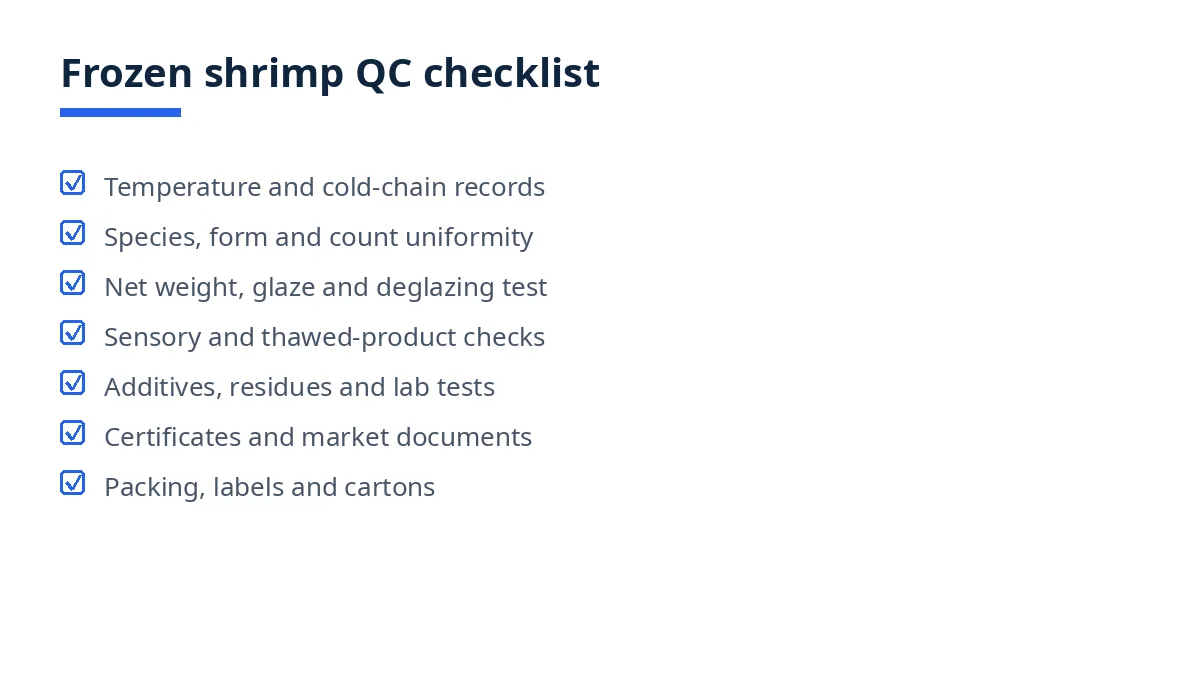
The full checklist (numbered, printable)
Temperature and cold-chain records
Match lot identity first: production date, lot code, species and form on the cartons must match the freezing, cold-store and test records.
Review the freezing record. Under Codex CXS 92-1981, quick freezing is not complete until the product has reached -18 °C or colder at the thermal centre after thermal stabilization.1
Probe product temperature in cartons from different pallet positions, record each value, and compare it with your market limit: for the EU, not more than -18 °C in all parts of the product.2
Check transport records: under Regulation (EC) No 853/2004, frozen fishery products must be kept in transport at an even temperature of not more than -18 °C, with short upward fluctuations of not more than 3 °C.2
Review cold-store and container history for gaps, check the reefer set point against the purchase order, confirm a data logger travels with the load, and record container and seal numbers.
Check for temperature abuse: individually quick frozen pieces clumped together, soft or partly thawed pieces, and heavy frost inside the pack.
Species, form and count uniformity
Confirm species against the sample and specification, and one presentation only per pack: head-on, headless, peeled, peeled and deveined, or the cooked form ordered.
Check form work piece by piece: de-heading, peeling and deveining complete where specified, tails present or removed as specified.
Determine the count by the Codex method: count the shrimp in the container or a representative sample and divide by the actual deglazed weight.1
Check uniformity in each unit: sort the deglazed sample by size and record how many pieces fall outside the declared count range.
Separate broken and damaged pieces, weigh or count them by the purchase order method, per carton.
Repeat count checks across cartons and production dates: a count correct in the first carton and wrong later is a grading failure.
Net weight, glaze and deglazing test
Weigh each sampled unit frozen, packaging removed, and record the frozen weight before thawing begins.
Run the deglazing test by the Codex procedure: open the package immediately after removal from low temperature storage, remove all glaze that can be seen or felt, drain on a weighed sieve, and weigh again; that is the net content.1
Calculate the glaze share from the two weights and compare the deglazed weight with the declared weight, which under Codex is exclusive of the glaze.1
For the United States, net weight may not include glazing, and overstating net quantity misbrands the product.3 FDA laboratories evaluate net weight using a drained weight procedure, the AOAC method named in the FDA short-weighting study.5
Sensory, physical and thawed-product checks
Use trained examiners: under Codex CXS 92-1981, sensory and physical examination is assessed by persons trained in such examination.1
Thaw the sample by the Codex procedure: enclose it in a film-type bag and immerse it in water at room temperature, not greater than 35 °C, until no hard core remains.1 Record the method used.
Check odour and flavour after thawing, and after cooking where a cooked check applies; Codex treats shrimp with persistent objectionable odours indicating decomposition or rancidity as defective.1 Also check texture and appearance against the approved sample.
Check dehydration against the Codex deep-dehydration definition: white or yellow moisture loss masking the flesh colour, over more than 10 percent of unit weight or block surface.1
Check discoloration, including black spot, against the Codex definition: blackening or green/yellow discoloration over more than 10 percent of individual shrimp surface, affecting more than 25 percent of the unit.1
Check for foreign matter in the thawed sample and drained water: any matter not derived from shrimp, as Codex defines it.1
Additives, residues and laboratory tests
List every treatment used on the lot first: sulphites against black spot, other specified additives, and declared aquaculture inputs. FDA guidance covers aquaculture drugs and environmental chemical contaminants as hazard chapters.4
Where sulphites are used, check the result against your order limit. Codex CXS 92-1981 lists a sulphite maximum of 100 mg/kg in the edible part raw, or 30 mg/kg cooked, expressed as SO2.1 Check whether your market sets a different limit.
Confirm the microbiological tests named in the purchase order were run on this lot. Codex states that products under CXS 92-1981 should comply with microbiological criteria established under Codex principles.1
Confirm the residue and contaminant tests named for your market were run on this lot by a laboratory named in advance, with lot code, species and date on each report.
Check declarations against the test file: crustacean allergen wording and any sulphite declaration must match the treatments recorded for the lot. FDA guidance covers undeclared major food allergens as a hazard chapter.4
Certificates and market documents
For the EU, check three documents together: authorised country, approved establishment, and a health certificate naming this plant, species, form and lot.6
For the United States, build the verification file instead: HACCP controls are required for foreign processors and U.S. importers must verify their suppliers; FDA does not require health certificates per shipment, and verification can include holding the processor's HACCP plan and guarantee and obtaining lot-by-lot certifications.7
In Bangladesh, check the official route: the Department of Fisheries e-certification system covers licences, health certificates and additional certificates per the importing country's requirements, with sample collection, inspection and test reports.8
Check any private certificate the buyer named for scope, site, species, form and expiry; a certificate for a different plant or product does not cover this consignment.
Packing, labels and cartons
Check the label against Codex labelling for quick frozen shrimp: name of the food, presentation described next to the name, designation as raw, partially cooked or cooked, a statement if glazed with sea-water, and the term quick frozen.1
Check the storage instruction: Codex labelling states the label shall indicate storage at -18 °C or colder.1
Check packs and cartons: pack count and ratio match the packing list, cartons are dry and undamaged with no thaw staining, and markings show lot, dates, species, form, count size and net weight.
Weigh sample cartons, confirm carton count against the packing list, and photograph the loaded container, logger position and seal.
Common failures and how to fix them
The most frequent failure is short weight from glaze: shrimp weigh correctly frozen and fall short deglazed. Stop loading, re-run the deglazing test on a fresh sample, and hold the lot until a re-test passes.
Next is a broken cold chain: a logger gap, a warm probe reading, or clumped pieces. Segregate the affected pallets and decide them on their own sensory and lab evidence.
Count drift traces to grading: re-grade the affected production, then repeat the count per carton. Black spot usually traces to raw material age or treatment: check the treatment record and test result, and segregate affected pieces. For certificate mismatches, correct the documents before loading; never load on a certificate naming different goods.
Downloadable template and summary table
Copy this table into your inspection sheet and record a result and the actual reading per line.
Section | Checks | Evidence |
|---|---|---|
Temperature | Freezing record, probe, logger | Lot records |
Species and count | Species, form, count | Count sheets |
Weight and glaze | Frozen weight, deglazing | Test record |
Sensory | Odour, dehydration, discoloration | Report, photos |
Laboratory | Microbiology, residues, sulphites | Lab reports |
Certificates | Plant, health certificate, HACCP | Certificates |
Packing | Labels, cartons, seal | Packing list |
How Exportain helps
Exportain is a B2B marketplace connecting buyers with Bangladeshi suppliers of frozen shrimp and frozen seafood, so specifications can be agreed at the enquiry stage. Browse suppliers, see the frozen seafood category and use inspection services to plan the check. Supplier profiles show document and photo checks recorded, not factory inspections. Exportain is not a party to the goods contract and does not inspect goods.
FAQs
When should this checklist be used?
At final inspection, when goods are packed or ready to pack, and again at loading for temperature, carton and seal checks. For first orders, also run temperature, count and glaze lines during production.
Who should complete it?
The buyer, a local agent or an independent inspector, using the approved sample, specification and a randomly drawn sample. Sensory lines should be completed by a person trained in sensory examination.
What are the most common failures?
Short deglazed weight, warm product, count drift between cartons, black spot after thawing, and certificates naming a different plant or lot.
Can a third party do it?
Yes, if you share the sample, specification, test list and criteria first, and the inspector records actual readings per lot, not a summary pass.
Next steps on Exportain
Agree your specification, test list and market criteria, then read the AQL acceptance quality limit explainer and the pre-shipment inspection guide, and plan the check with inspection services. You can also post a free RFQ via RFQs and compare quotes from Bangladeshi suppliers.
Sources
- Standard for Quick Frozen Shrimps or Prawns (CXS 92-1981). Codex Alimentarius Commission (accessed )
- Regulation (EC) No 853/2004 laying down specific hygiene rules for food of animal origin. European Union (accessed )
- Guidance for Industry: 1991 Letter to Seafood Manufacturers Regarding the Fraudulent Practice of Including Glaze (ice) as Part of the Weight of Frozen Seafood. U.S. Food and Drug Administration, (accessed )
- Fish and Fishery Products Hazards and Controls. U.S. Food and Drug Administration (accessed )
- Collection and Analysis of Imported Frozen Seafood for Economically Motivated Adulteration. U.S. Food and Drug Administration (accessed )
- Health and consumer protection for animal and plant product. European Commission, Access2Markets (accessed )
- A Summary of the United States Food and Drug Administration's Food Safety Program for Imported Seafood; One Country's Approach. PubMed Central (accessed )
- Bangladesh rolls out online certification system to simplify fish and seafood trade. International Collective in Support of Fishworkers (ICSF) (accessed )
About the author
Sourcing from Bangladesh?
Post a request for quotation and suppliers on Exportain can send you their quotes directly.
Post an RFQ