Typical MOQ for Frozen Shrimp in Bangladesh (and How to Negotiate It Down)
Frozen-shrimp MOQ in Bangladesh is set per combination — species, grade, presentation and pack format — not per order. This guide explains the mechanics, the destination-market rules, and the negotiation levers that move the number.
Short answer
A frozen-shrimp MOQ in Bangladesh is the smallest lot a processor can run for one combination of species, grade, presentation and pack format, filled into full cartons for reefer shipment. It is set by production logic, not by a single market rate. Buyers negotiate it down by consolidating grades, using one pack format, sharing a production slot, or committing to repeat orders, while keeping destination-market listing, HACCP and certification requirements intact.
On this page
Key takeaways
A frozen-shrimp MOQ is set per combination — species, grade, presentation and pack format — not as one total for the whole order; changing any variable means a new production lot.
Size grade drives the MOQ: HOSO shrimp are graded in pieces per kilogram and other presentations in pieces per pound, so each grade is a separate lot the factory must run.
Negotiation works on structure, not just price: fewer grades, one pack format, full cartons, a shared production slot, or a written repeat commitment are levers a processor can accept.
Destination-market rules are not negotiable: EU orders need an approved-listed establishment and US orders need HACCP coverage for the product form, and the health certificate must match every other document.
A frozen-shrimp minimum order quantity (MOQ) is rarely one number. It is the smallest lot a processor can run, pack, and ship without breaking the production logic of the product: one species and grade, one presentation, one pack size, and enough cartons to fill the cold chain sensibly. Buyers who treat the MOQ as a single take-it-or-leave-it figure usually overpay or over-order. Buyers who understand what builds it can usually negotiate it down without asking the factory to do something unworkable.
This guide explains how frozen-shrimp MOQs are set in Bangladesh, which levers actually move them, and how to negotiate in a way a processor can say yes to. Every quantity, price illustration, and timeline example in this guide is labelled as example figures: they show structure, not market rates.
Why this matters for buyers and sellers
For a buyer, the MOQ decides working capital, storage, and risk. Frozen shrimp must stay frozen, so every extra carton is cold-store rent and a longer sell-through window. For a seller, the MOQ protects the production run: shrimp are graded by count, processed in a specific presentation, glazed, packed, and frozen to a standard, and changing any variable mid-run means stopping, resetting, and re-checking. That is why a processor quotes per combination, not per order.
The practical consequence is simple: the MOQ is negotiable, but only at the points where the processor has real flexibility — grade mix, pack format, consolidation, shipment timing, and commitment over time. Food-safety and labelling requirements, which are fixed by the destination market and by Bangladesh law, are not negotiable.
Step-by-step: how it works
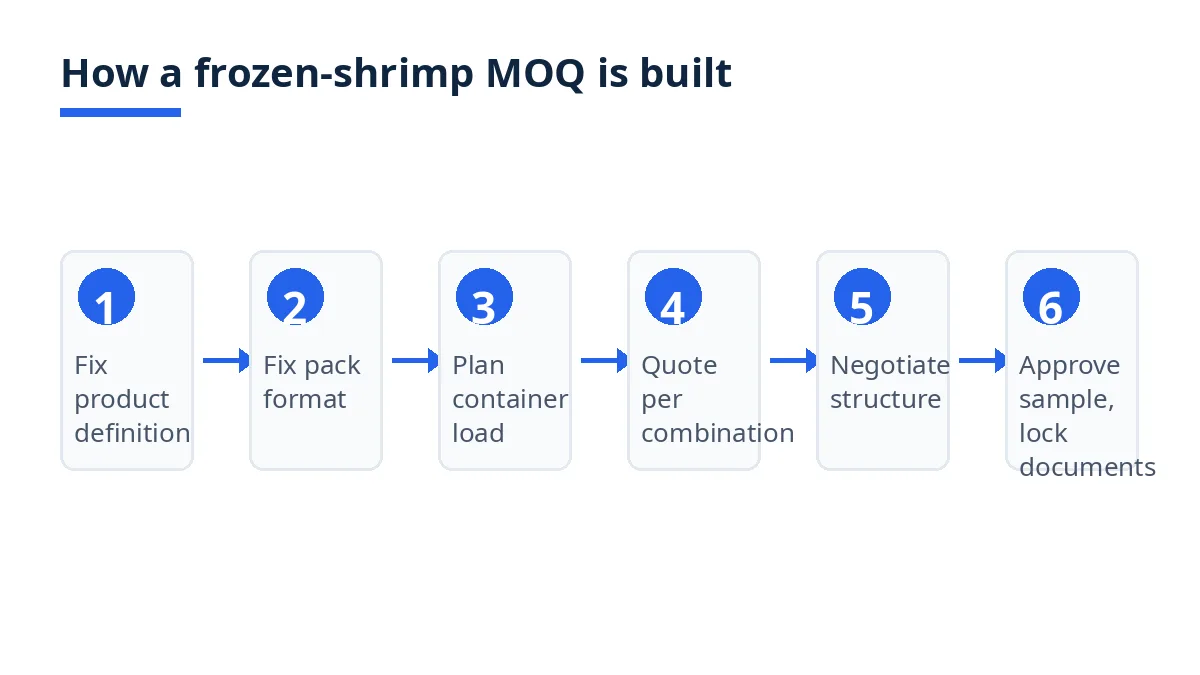
A frozen-shrimp MOQ is built in layers. Work through them in order, and the quote you receive starts to make sense.
1. Fix the product definition. Species, presentation, and grade come first. The main presentations are head-on shell-on (HOSO), shell-on or green headless, peeled tail-on, peeled undeveined, peeled and deveined, peeled deveined tail-off, and butterfly tail-on.1 European and Asian markets tend to prefer the HOSO presentation, while the American market tends to prefer the other presentations.1 Each presentation has its own grading: HOSO shrimp are graded in pieces per kilogram, while the other presentations are graded in pieces per pound, for example 16/20 or 21/25.1 A count of 16/20 means 16 to 20 shrimp per pound, and the smaller the numbers, the larger the shrimp.
2. Fix the pack format. Inner bag weight, bags per master carton, and carton weight turn a grade into a shippable unit. A processor's MOQ is usually expressed in cartons or kilograms of one grade in one pack format, because that is the unit the line actually produces.
3. Fix the container logic. Frozen shrimp move in reefer containers held at frozen temperatures, and the load must make sense as a container plan: full cartons, stable stacking, and no half-empty pallet blocking the next order. A quantity that does not divide into full cartons is really a request to hold part cartons.
4. Get the quote per combination. Ask for the MOQ, price basis, and lead time for each grade and presentation separately, not one blended figure. That is the only way to see which combination drives the total.
5. Negotiate the structure, not just the number. Offer changes the factory can accept: fewer grades, one pack format, a shared production slot, or a firm repeat commitment. Then confirm the agreed structure in writing before samples are made.
6. Confirm with a sample of the exact combination. Approve the sample for the grade, presentation, glaze, and pack you will actually receive, and keep a sealed reference. A sample of a different grade proves nothing about your order.
The diagram below shows this sequence:
Costs, timelines and documents
Costs in a frozen-shrimp order fall into groups a buyer should ask about separately: the product itself, processing and packing, cold storage, inland transport to the port, export clearance, ocean freight in a reefer container, insurance, and destination charges. Which of these the seller pays depends on the Incoterm.
Example figures — structure only, not market rates: a buyer comparing two quotes might see one quote for 1,000 kilograms of a single grade in a single pack format, and another for the same total weight split across four grades and two pack formats. The second will usually cost more per kilogram to produce, because the factory runs four short lots instead of one long lot. Consolidating grades is often worth more than haggling over a small price difference.
Timelines should be agreed as written milestones, not assumed: sample approval, production slot, pre-shipment inspection and testing, health certification, customs clearance, and vessel loading. Example figures — structure only: a buyer might allow one milestone each for sample approval, production, and certification and loading, with a written fallback if any milestone slips. Never treat an example timeline as a promised lead time; the processor's confirmed schedule for your exact combination is the only timeline that counts.
The document set for a Bangladesh export shipment is where many first orders stall. Export clearance involves a Bill of Export submitted through the customs system, supported by documents that typically include the export contract or purchase order, the commercial invoice, the packing list, the EXP form certified by an authorized dealer bank, the certificate of origin, and tax registration documents.2 Bangladesh Customs describes its declaration process through ASYCUDA World, the system through which goods declarations are submitted.3 For seafood, the health certificate is central: Bangladesh's Fish Inspection and Quality Control (FIQC) system under the Department of Fisheries verifies and certifies fishery and aquaculture products for export, and the Fisheries and Fish Products (Inspection and Quality Control) Act, 2020 defines the health certificate and exporter licensing.4 Bangladesh has also moved fish and seafood licences, health certificates, inspection, and test reports onto an online e-certification system connected to customs.5 Ask your supplier which certificates your destination market requires, and confirm who applies for each one, before production starts.
Bangladesh-specific rules and tips
Three destination-market rules shape every Bangladesh frozen-shrimp order, and a buyer should check all three before negotiating quantity.
First, the United States applies its seafood HACCP rule. Under 21 CFR Part 123, processors of fish and fishery products must conduct a hazard analysis and, where hazards reasonably likely to occur are identified, have and implement a written HACCP plan specific to each kind of product and processing location.6 Importers into the United States have verification responsibilities under the same rule.6 Ask how the processor's HACCP plan covers your product form, and what records accompany the shipment.
Second, the European Union admits products of animal origin from third countries only when the country of dispatch appears on the permitted list, the establishment of dispatch appears on the approved list where applicable, the product meets the hygiene and labelling requirements, and the certificate requirements are satisfied.7 The European Commission publishes lists of approved third-country establishments through its TRACES system.8 For an EU-bound order, confirm the establishment's listed status for your product before discussing quantity: an unlisted plant cannot ship to the EU no matter how attractive its MOQ looks.
Third, Bangladesh's own inspection and certification system must be part of the plan. The FIQC system inspects processing plants and products for export and issues the pre-shipment certification that accompanies the consignment.4 Because testing and certification take calendar time, build the certification step into the timeline, and confirm the certificate details — species, presentation, grade, net weight, and establishment details — match the commercial invoice and packing list exactly.
Two practical tips follow from these rules. One: never negotiate the MOQ by asking a supplier to mix grades, species, or genera in one pack to reach a total. The Codex standard states that a pack shall not contain a mixture of genera, although it may contain a mixture of species of the same genus with similar sensory properties.9 Two: settle glazing and net weight in writing. Glaze is the ice layer protecting the shrimp, and the price basis — net weight excluding glaze, or gross weight including it — changes the real cost per kilogram of shrimp. State it in the purchase order, and state how it will be checked.
Mistakes and red flags
The most common MOQ mistakes are structural, and they are all avoidable.
Ordering one total weight across too many combinations is the first. Four grades in three pack formats is twelve production lots, not one order, and the factory will price it that way or decline it. Consolidate first, then negotiate.
Treating an example quantity as a market rate is the second. If a supplier quotes a small trial lot, that is a commercial decision for that supplier and that season, not a benchmark you can quote to the next supplier. Every figure in this guide is an example for the same reason.
Ignoring the destination-market listing is the third. An EU order from an establishment that is not on the approved list, or a US order without HACCP coverage for the product form, is not a bargain. It is a shipment that cannot legally enter the market.
Red flags deserve a pause, not a workaround. A supplier who cannot name the processing establishment, cannot explain the grading basis, or will not put glaze and net-weight terms in writing is signalling that the specification is not under control. A quote far below every other quote for the same grade and presentation, with no explanation of what differs, usually differs in exactly the specification the buyer did not check. And a supplier who offers to skip certification, testing, or cold-chain steps to meet a deadline is offering to transfer the buyer's market-access risk onto the buyer.
Checklist
Use this checklist before you confirm any frozen-shrimp MOQ:
Product definition fixed in writing: species, presentation, grade or count, cooked or raw, and glaze and net-weight basis.
MOQ quoted per combination (grade plus presentation plus pack format), not as one blended total.
Pack format fixed: inner bag weight, bags per master carton, carton weight, and carton count per order.
Container plan confirmed: full cartons only, reefer settings agreed, and loading plan stated.
Destination-market coverage confirmed: for the EU, the establishment's approved-list status; for the United States, HACCP coverage for the product form.
Health certificate and export documents assigned: who applies, who pays, and what details must match across invoice, packing list, and certificate.
Incoterm stated with the named place: FOB, CIF, or another Incoterm, with freight, insurance, and destination charges allocated in writing.
Sample approved for the exact combination ordered, with a sealed reference kept by both sides.
Reorder terms agreed: whether the MOQ changes for repeats, and what commitment earns a lower MOQ next time.
Payment, inspection, and fallback terms in writing: what happens if a milestone slips, a test fails, or a grade is short.
How Exportain helps
Exportain's supplier directory and request-for-quote route let a buyer compare processors on the same written specification, rather than on headline MOQs that describe different products. Sending one specification — species, presentation, grade, pack format, quantity per combination, destination market, and Incoterm — to several suppliers produces comparable answers, and comparable answers are what make negotiation possible.
The verification information on a supplier's Exportain profile helps a buyer ask better questions: which markets the supplier serves, which product forms it handles, and what documentation it provides with a shipment. Use that information to shortlist, then confirm the decisive facts directly with the supplier and against the destination market's own lists before placing an order. Exportain does not replace the buyer's own checks on establishment listing, HACCP coverage, or certificate details, and no directory listing should be treated as a substitute for them.
What should I know first about frozen shrimp?
Start with the product definition, not the quantity. Frozen shrimp are sold by presentation and by count: presentation describes how the shrimp are prepared, and count describes how many shrimp make up a pound or a kilogram.1 The Codex standard covers raw, partially cooked, and fully cooked shrimp, peeled or unpeeled, and requires the thermal centre to reach minus 18 degrees Celsius or colder.9 Fix species, presentation, grade, glaze and net-weight basis, and destination market before you discuss MOQ, because each changes what the factory must run and what the market will admit.
What are the typical costs and timelines?
There is no single typical cost or timeline across grades, presentations, and markets, and this guide gives none. Costs divide into product, processing and packing, cold storage, inland transport, export clearance, reefer freight, insurance, and destination charges, and the Incoterm decides who pays each part: under FOB the seller delivers on board the vessel, while under CIF the seller also pays freight and minimum insurance to the destination port, with risk passing on loading in both cases.10 Timelines divide into sample approval, production, inspection and certification, customs clearance, and vessel loading. Ask for both as a written, per-combination breakdown for your order.
Which documents are needed?
The core export set for a Bangladesh shipment typically includes the export contract or purchase order, the commercial invoice, the packing list, the EXP form certified by an authorized dealer bank, the certificate of origin, and tax registration documents, submitted with the Bill of Export.2 For seafood, add the health certificate issued through the Department of Fisheries' inspection and quality control system, now provided through an online e-certification service connected to customs.4 5 Destination markets may require more: the EU requires the establishment to appear on the approved list and certificate requirements to be met,7 and the United States requires HACCP coverage for the product form.6 Confirm the full list for your market before production, and check that details match across every document.
What are the most common mistakes?
The most common mistakes are ordering too many combinations at once, accepting a blended price with no per-combination breakdown, treating one supplier's example quantity as a market rate, and ignoring destination-market listing or HACCP coverage. The costliest version is a shipment that cannot enter its market: an EU order from an establishment that is not on the approved list, or a US order without HACCP coverage for the product form, fails at the border regardless of price. The fix is one written specification, one MOQ per combination, a sample of the exact combination, and a document check before loading.
Next steps on Exportain
Compare suppliers on the same written specification through the Exportain supplier directory at https://exportain.com/suppliers, read how supplier verification works on Exportain at https://exportain.com/blog/how-supplier-verification-works-on-exportain, and send a structured request for quotes at https://exportain.com/rfqs. For the general concept behind minimum orders, see the Exportain guide to MOQ at https://exportain.com/blog/moq-minimum-order-quantity. Bring the checklist in this guide to every quote, and negotiate the structure of the order before you negotiate the number.
Sources
- Shrimp marketing. Wikipedia (accessed )
- Custom Clearance in Bangladesh: Port Procedures and C and F Agent Guide. Bizmend (accessed )
- Customs Clearance Procedures for Export. Bangladesh Customs, National Board of Revenue (accessed )
- The Fisheries and Fish Products (Inspection and Quality Control) Act, 2020. Government of Bangladesh (accessed )
- Bangladesh rolls out online certification system to simplify fish and seafood trade. International Collective in Support of Fishworkers (ICSF) (accessed )
- Seafood HACCP. North Carolina State University Extension (accessed )
- Regulation (EC) No 853/2004 laying down specific hygiene rules for food of animal origin. legislation.gov.uk (accessed )
- Listing of establishments approved for export commodities to the EU. European Commission (accessed )
- Standard for Quick Frozen Shrimps or Prawns (CXS 92-1981). Codex Alimentarius Commission (accessed )
- Place of delivery & risk transfer in trade contracts. ICC Academy (accessed )
About the author
Sourcing from Bangladesh?
Post a request for quotation and suppliers on Exportain can send you their quotes directly.
Post an RFQ