Frozen Shrimp Price in Bangladesh: FOB Cost Breakdown for Buyers
Read a Bangladeshi frozen-shrimp FOB quote line by line: what sits inside the price, how glaze and count size change comparability, what FOB includes and excludes, and the specification, documents and contract terms to lock before ordering.
Short answer
A frozen-shrimp FOB price bundles raw material, processing, freezing, glazing, packing, cold storage, inland transport, port charges and export clearance up to loading at a named port. Compare quotes only after restating each one per kilogram of drained net weight, on the same species, presentation and count size, and after naming the port, the glaze basis and the document set in the purchase order.
On this page
Key takeaways
A frozen-shrimp FOB price bundles raw material, processing, freezing, glazing, packing, cold storage, inland transport, port charges and export clearance up to loading at a named port; ocean freight, insurance and destination costs sit with the buyer.
Never compare headline prices directly: restate every quote per kilogram of drained net weight, on the same species, presentation and count size, because glaze and count size can reverse which quote is cheaper.
FOB is a sea and inland waterway rule under Incoterms 2020: risk passes when goods are on board the vessel at the named port of shipment, and FOB without a named port states no delivery point.
Confirm the classification, destination food-safety rules and Bangladesh licensing position before ordering: HS 0306.17 for frozen shrimps and prawns other than cold-water species, EU establishment approval or US seafood HACCP as applicable, and the exporting establishment licence.
Lock the specification, weight basis, FOB point with the Incoterms edition, document list and payment terms into the purchase order, so the accepted quote becomes a contract term.
A frozen-shrimp FOB quote looks like one number, but it is a bundle of decisions already made for you: which shrimp, in which form, at which net weight, frozen how, packed how, and delivered to which point. Two quotes with the same headline price can describe different goods, and two with different prices can describe the same goods once the bundle is unpacked. This guide explains what sits inside a Bangladeshi frozen-shrimp FOB price, what FOB includes and excludes, and which questions turn a headline figure into a comparable offer.
This article stays on the quote alone, not on a general import sequence or an inspection list: the line items, the weight basis, the freezing and packing terms, and the point at which cost and risk pass from seller to buyer.
Why this matters for buyers and sellers
For the buyer, the FOB price is the last price the seller controls in full. Everything after loading — ocean freight, insurance, destination charges, import clearance and onward transport — is arranged and paid for by the buyer under FOB. A low FOB figure is therefore not automatically a low landed cost: the comparison that matters is the same goods, on the same weight basis, delivered to the same point.
For the seller, the FOB price must absorb everything up to loading: raw material, processing, freezing, glazing, packing, cold storage, inland transport, origin port handling and export clearance. Without itemised lines, a buyer cannot tell whether a later price move comes from the shrimp market, from processing, or from logistics.
The weight basis is where most quote confusion starts. Frozen shrimp are sold by count size, by presentation — for example head-on, headless, peeled, or peeled and deveined — and by net weight after glazing and draining. A quote that states only a species name and a price per kilogram leaves three questions unanswered: how many shrimp make up the kilogram, what form they are in, and how much of the kilogram is shrimp rather than glaze ice. Ask for all three, in writing, before comparing anything.
Step-by-step: how it works
Work through a quote in this order.
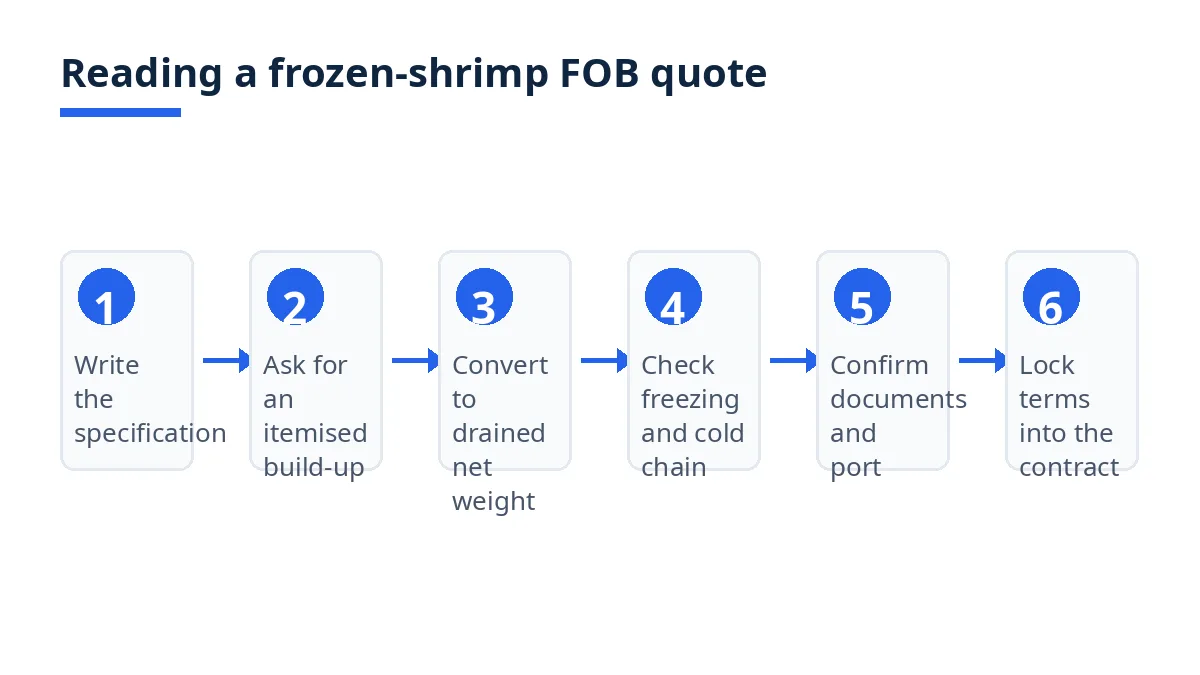
Write the specification before asking for a price. State the species or genus, the presentation, the count size, the freezing method, the glaze basis, the net weight per carton, the carton count, and the destination market. A specification written after prices arrive tends to be fitted to the cheapest quote, which is how a buyer ends up comparing different products.
Ask for an itemised FOB build-up, not a single figure. Request separate lines for raw material, processing, freezing and glazing, packing, cold storage, inland transport, origin port charges and export documentation. If a line cannot be separated, ask what it contains.
Convert every quote to the same weight basis. Restate each offer as a price per kilogram of drained net weight, on the same presentation and count size. A quote that looks cheaper per gross kilogram may be dearer per kilogram of shrimp once glaze is removed.
Check the freezing and cold-chain terms. Confirm the freezing method, the target core temperature, and who holds the cold chain from factory to vessel. Quick-frozen shrimp under the Codex standard must reach minus 18 degrees Celsius or colder at the thermal centre after thermal stabilisation, and must be kept deep frozen during transport, storage and distribution.1
Confirm the documents and the delivery point together. Name the port of shipment in the quote, and list the export documents the seller will supply. Under FOB, the seller clears the goods for export and delivers them on board the vessel nominated by the buyer at the named port of shipment, and risk passes when the goods are on board.2
Lock the agreed basis into the contract. Copy the specification, the weight basis, the FOB point with the Incoterms year, the document list and the payment terms from the accepted quote into the purchase order, word for word.
Costs, timelines and documents
What sits inside the FOB price
Under Incoterms 2020, FOB is a sea and inland waterway rule only. The seller delivers the goods on board the vessel nominated by the buyer at the named port of shipment, having cleared them for export, and the buyer pays the main carriage, insurance and every cost after loading.2 Everything in the table below therefore sits on the seller's side of the loading point, and everything after it on the buyer's side.
FOB cost line | What it covers | Buyer question |
|---|---|---|
Raw material | Harvested or farmed shrimp bought for processing | Species, genus and origin stated? |
Processing | Heading, peeling, deveining, grading and washing as specified | Presentation and count size stated? |
Freezing and glazing | Quick freezing, glaze application and temperature control | Core temperature and glaze basis stated? |
Packing | Inner bags, cartons, labels and marks | Net weight per carton stated? |
Cold storage | Holding at frozen temperature before shipment | Storage period and temperature record? |
Inland transport and port | Refrigerated transport to port, origin handling and loading | Named port of shipment stated? |
Export documents and clearance | Export clearance and the seller's document set | Document list agreed? |
The table below shows structure only. Example figures: an index build-up of 100 units might split as raw material 62, processing 14, freezing, glazing and packing 9, cold storage, inland transport and port charges 10, and export documents and compliance 5. Those figures illustrate how the lines relate, not market rates, and must not be read as a price for any real shipment. They show why raw material dominates the total, and why a small change in raw material or net weight moves the FOB price more than a small change in packing or documentation.
Reading two quotes side by side
Example figures: suppose Quote A offers a lower headline price per kilogram than Quote B, but Quote A's weight basis includes a heavier glaze, while Quote B states a lower glaze and a drained net weight. Restated per kilogram of drained shrimp, Quote B can be the cheaper offer even though its headline figure is higher. The same reversal happens with count size: a larger count (fewer, bigger shrimp per kilogram) and a smaller count (more, smaller shrimp per kilogram) are different products, and their prices per kilogram are not directly comparable until the count is matched.
Timelines work the same way as costs: ask for staged dates for specification, sample, production, checks and loading, rather than one delivery promise. A single shipment date hides the stage at which a delay sits.
Which documents sit in the order file
The export document set should be agreed before loading, not assembled afterwards: commercial invoice, packing list, certificate of origin, health certificate and bill of lading evidencing loading. Bangladesh export clearance requires an export declaration, the Bill of Export or Shipping Bill, submitted to Customs and approved, with enclosed documents including the commercial invoice, packing list, EXP form certified by an authorized dealer, and certificate of origin.3 Check that species, presentation, net weight and carton count match exactly between invoice and packing list.
Bangladesh-specific rules and tips
Start with the licensing position. Under the Fisheries and Fish Products (Inspection and Quality Control) Act, 2020, no person may export fish and fish products, or establish and operate a factory or establishment for producing and processing them, without obtaining a licence, and the central competent authority determines the standards for import, export, production, transport, storage, marketing and processing.4 Ask which licence covers the exporting establishment, and record its details in the order file. Bangladesh has also moved fish and seafood licences and product test certificates, including health certificates, onto an online certification system connected to customs.5
Match the food-safety rules to each destination market. For the European Union, Regulation (EC) No 853/2004 applies to businesses handling products of animal origin, including seafood, and requires establishment approval, with a unique approval number, and traceability from vessel or farm to consumer.6 For the United States, the seafood HACCP rule at 21 CFR Part 123 requires a hazard analysis and, where hazards reasonably likely to occur are identified, a written HACCP plan specific to each location and each kind of product.7 Quotes for the two markets may therefore carry different compliance work for the same shrimp, and that difference belongs on a separate line, not buried in the raw-material figure.
Classify the goods before quoting, not after. Frozen shrimps and prawns other than cold-water species fall under HS subheading 0306.17, while frozen cold-water shrimps and prawns fall under 0306.16.8 Confirm the species and subheading with the supplier and the buyer's customs broker before the quote is finalised, because the code drives the import declaration and the documents the destination authority expects. The Codex standard for quick-frozen shrimps or prawns covers raw or partially or fully cooked shrimps or prawns, peeled or unpeeled, from the Penaeidae, Pandalidae, Crangonidae and Palaemonidae families, with no mixture of genera in a pack.1
Mistakes and red flags
Comparing headline prices on different weight bases. This is the most common and most expensive mistake in frozen-shrimp buying. Never compare a price per gross kilogram with a price per drained net kilogram, and never compare two count sizes as if they were the same product. Restate first.
Accepting "FOB Bangladesh" without a port. FOB is always used with a named port of shipment, and the port decides inland transport, port handling and vessel options.2 A quote that says only "FOB Bangladesh" has not stated the delivery point, and the buyer cannot tell what the seller's transport obligation actually covers.
Using FOB for a container handed over away from the vessel. FOB transfers risk when the goods are on board the vessel.2 If the cargo is handed to a carrier at a container yard or at the factory, the handover point and the risk point do not match, and the contract should use a term that fits the actual handover instead of stretching FOB to cover it. Raise the mismatch before signing, not after loading.
Treating a profile or a badge as a price guarantee. A supplier profile is a starting point for enquiries. Exportain verification is a document and photo review, not a factory inspection, and a badge does not set the price, the net weight or the cold chain for any shipment.9 Price protection comes from the specification, the itemised quote and the contract, not from a badge.
Red flags in a supplier reply. A reply that will not itemise the FOB build-up, will not state the glaze or drained-weight basis, will not name the port of shipment, will not list the export documents, or will not put the agreed specification into the purchase order is a reply to pause on. Each refusal removes one line of comparability.
Checklist
Before you confirm a frozen-shrimp FOB order, every line should be answered in writing.
Specification written: species or genus, presentation, count size, freezing method, glaze basis and destination market.
FOB build-up itemised: raw material, processing, freezing and glazing, packing, cold storage, inland transport, port charges and documents.
Weight basis restated: every quote converted to price per kilogram of drained net weight on the same presentation and count.
FOB point named: port of shipment plus the Incoterms edition, for example FOB Chittagong, Incoterms 2020.2
Freezing terms agreed: quick-freezing to minus 18 degrees Celsius or colder at the thermal centre, with deep-frozen holding through transport and distribution.1
Cold-chain records agreed: temperature recording and handover records from factory to vessel.
Classification agreed: HS subheading confirmed for the species, for example 0306.17 for frozen shrimps and prawns other than cold-water species.8
Document set agreed: commercial invoice, packing list, certificate of origin, health certificate, EXP form and bill of lading, with matching species, weight and carton count.3
Destination compliance checked: EU establishment approval and traceability, or US seafood HACCP plan, as applicable to the market.7 6
Bangladesh licence recorded: exporting establishment licence details in the order file under the 2020 inspection and quality control framework.4
Contract carries the quote: specification, weight basis, FOB point, document list and payment terms copied into the purchase order.
How Exportain helps
On Exportain, browse suppliers and post a request for quotation on the RFQ board with your full specification, weight basis and named port, so suppliers quote against the same product and delivery point. Ask each reply for its itemised build-up, glaze and drained-weight basis, cold-chain record method and document list. Exportain verification records are document checks: Exportain Verified means Exportain has checked identity, phone, email and business registration, and Export Verified means it has checked the Export Registration Certificate.9 Those checks are a starting point, not a substitute for the specification, itemised quote and contract checks in this guide.
FAQs
What should I know first about frozen shrimp?
Know the product before the price. Frozen shrimp are sold by species or genus, presentation, count size and net weight, and quick-frozen to minus 18 degrees Celsius or colder at the thermal centre.1 A price without those four facts does not yet describe a definite product, so it cannot be compared.
What are the typical costs and timelines?
There are no typical FOB figures a buyer can rely on, because each quote prices a specific species, presentation, count size, weight basis, cold chain and port. The structure is stable — raw material first, then processing, freezing and packing, then storage, transport, port and documents — but the figures inside it move with the order. Request timelines as staged dates, not a single delivery promise.
Which documents are needed?
The core set is the commercial invoice, the packing list, the certificate of origin, the health certificate for the consignment, and the bill of lading evidencing loading, together with the export declaration and the EXP form certified by an authorized dealer required for Bangladesh export clearance.3 The invoice and packing list must match on species, presentation, net weight and carton count, and the health certificate must cover the consignment actually shipped.
What are the most common mistakes?
The most common mistakes are comparing headline prices on different weight bases, accepting FOB without a named port, using FOB where cargo is handed over away from the vessel, and treating a profile or badge as a price or quality guarantee. Each has the same root: a term left unstated in the quote and therefore open in the contract.
Next steps on Exportain
Browse suppliers, then post your shrimp specification, weight basis and named port on the RFQ board so quotes arrive on a comparable basis. Before you confirm, read the MOQ guide for the minimum-order mechanics that sit alongside the FOB price.
Sources
- Standard for Quick Frozen Shrimps or Prawns (CXS 92-1981). Codex Alimentarius Commission (accessed )
- Incoterms® 2020. International Chamber of Commerce (ICC) (accessed )
- Customs Clearance Procedures for Export. Bangladesh Customs, National Board of Revenue (accessed )
- The Fisheries and Fish Products (Inspection and Quality Control) Act, 2020. InforMEA (accessed )
- Bangladesh rolls out online certification system to simplify fish and seafood trade. International Collective in Support of Fishworkers (ICSF) (accessed )
- Food safety regulations. Seafish (accessed )
- 21 CFR 123.6 — Hazard analysis and Hazard Analysis Critical Control Point (HACCP) plan. FindLaw (accessed )
- HS Code for Shrimp. FreightAmigo (accessed )
- Trust & Safety Center. Exportain (accessed )
About the author
Sourcing from Bangladesh?
Post a request for quotation and suppliers on Exportain can send you their quotes directly.
Post an RFQ