Import Export Platform Bangladesh: 2026 Buyer's Guide
A buyer guide to using an import export platform in Bangladesh: catalogue search, badge meanings, structured RFQs, versioned quotations, export documents and red flags.
Short answer
An import export platform for Bangladesh connects international buyers with Bangladeshi suppliers in one place to search products, review profiles and request quotations. On Exportain, buyers browse 20 categories, check which documents and photos staff have reviewed for each badge, post a structured RFQ and compare versioned quotations before agreeing terms, samples and inspection in writing.
On this page
Key takeaways
A badge on Exportain records a document or photo review by staff. It is not a factory inspection and not a guarantee of capacity, quality or delivery.
Shortlist on fit, not the first price: post one structured RFQ, then compare versioned quotations on the same Incoterm, destination and document set.
There is no typical cost or timeline without a specification. Require an itemised written quotation and a staged timeline for your order.
Exportain is not a party to your contract and does not inspect goods, book freight or clear customs. Samples, inspection and written terms remain your controls.
If you are looking for an import export platform Bangladesh buyers can use, the value is not a long list of names. It is a structured way to find suppliers, see what has been checked about each one, request quotations on the same specification, and keep the record in one place. Exportain describes itself as a Bangladesh B2B export marketplace, with a catalogue organised into 20 categories from apparel and textiles to frozen seafood and ceramics.1 This guide explains how to use such a platform, what verification does and does not cover, and how to shortlist on Exportain without treating a listing as a guarantee.
Why this matters for buyers and sellers
Searching the open web for Bangladeshi suppliers produces mixed results. Some listings are manufacturers, some are trading companies, some are buying houses, and some pages are out of date, with no common format for products, location or export readiness.
A platform reduces that problem by putting profiles in one format, so a buyer can compare products, minimum order quantities where a seller has set them, and location on the same basis. That helps at discovery. It does not remove the later stages, which remain the buyer responsibility: specification, samples, written terms, inspection and import clearance.
Verification is the part buyers most often misread. On Exportain, supplier verification is a document review by the Exportain team. It is not a factory inspection, and it is not a check against a government database.2 A badge records a specific check that staff reviewed and approved. It is not a guarantee of production capacity, product quality or delivery.2 Reading a platform in that narrower, accurate way is what makes it useful. The badge shortens your shortlist work. It does not finish it.
For sellers, a complete profile with accurate product information and approved checks gives an overseas buyer a clearer starting point than an unstructured listing. It does not promise orders.
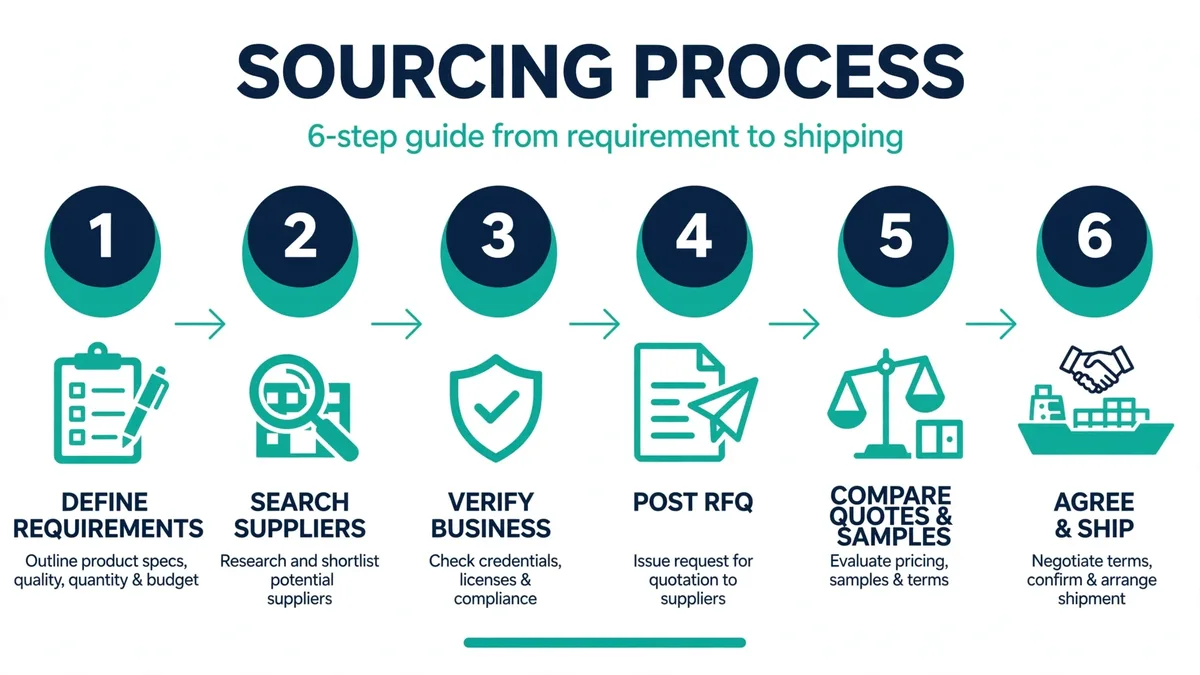
Step-by-step: how it works
Follow the same sequence for each product, even if you already know the category well.
Define the requirement before you search. Write down the product, specification, quantity and unit, packaging, destination, required certifications for your market, and the delivery window you need. Vague enquiries produce quotations that cannot be compared.
Search the catalogue and filter the results. On Exportain, buyers can search published products by keyword and category, and filter to suppliers holding the Exportain Verified badge, sample availability and OEM or ODM capability, and sort by minimum order quantity or lead time.3
Review full supplier profiles, not search snippets. Each profile shows the supplier verification level, location, main products and the certifications the supplier has declared.3 Note the legal company name and business type, and separate checked information from supplier-declared information.
Read the badges by their exact meaning. Exportain Verified means Exportain has checked the seller identity, phone, email and business registration. Export Verified means it has checked the seller Export Registration Certificate. Factory Verified means it has reviewed photos of the manufacturer factory, and Trading Company Verified means it has reviewed photos of a trading company office or warehouse.4 A company without a badge shows no badge at all, which tells you a check has not been approved for that company, not that it failed a check.4
Post one structured request for quotation. State quantity and unit, target price, destination, Incoterm, required certifications and deadline, so suppliers in that category can quote against the same brief.3 For the format, see how to write an RFQ.
Compare quotations on the same basis. Every quotation on Exportain is versioned, with unit price, minimum order quantity, lead time, Incoterm, payment terms and validity, and a buyer can counter-offer in the same thread.3 Compare what each price includes and excludes, not only the headline price.
Order samples, then agree terms in writing. Approve a sample before bulk production where the product allows it. If you accept a quotation, Exportain creates an order record from the accepted terms.3 Confirm price, Incoterm, payment schedule, inspection and the document list in writing.
Arrange inspection, freight and import steps yourself or through listed providers. Exportain is not a party to your trade. It does not inspect goods, book freight or clear customs.4 Buyers can look up freight rates published by forwarders on the platform and request quotes from listed freight, customs and inspection providers, but the arrangements and the contracts remain theirs.3
Costs, timelines and documents
There is no single typical cost or timeline, because both depend on product, specification, quantity, destination and season. Treat any figure as an estimate until it is confirmed in a written quotation with a validity date. Build your timeline in stages: shortlisting, samples, production, inspection and corrections, then shipping and clearance. Ask which parts the supplier controls and which depend on carriers, ports or authorities.
Your transaction costs can include the product price, samples and sample courier charges, inspection, freight, insurance where the agreed term requires it, and duties and taxes at destination. Which side pays for carriage and insurance depends on the delivery term you agree. The Incoterms rules are eleven three-letter trade terms published by the International Chamber of Commerce that clarify the tasks, costs and risks involved in delivering goods from sellers to buyers, and the current edition, Incoterms 2020, entered into force on 1 January 2020.5 Name the term, the place or port and the edition in the quotation and the order, so both sides price the same obligation. For how the terms apply to shipments from Bangladesh, see Incoterms for shipments from Bangladesh.
Payment needs the same care. When a buyer accepts a quotation, Exportain creates one order and issues one proforma invoice from the accepted terms, including quantity, unit price, currency and Incoterm.2 For goods, Exportain holds money only when both parties agree to a funds hold, and without a hold payment is arranged directly between buyer and supplier.2 Agree the method and schedule in writing, and pay only to the company account named in the agreed documents.
Documents fall into three groups. First, supplier documents for due diligence, such as the trade licence, the Export Registration Certificate where it applies, and product certificates relevant to your market. Check that names match the profile and quotation. Second, order documents: RFQ, quotation, proforma invoice, purchase order and specification sheet. Third, shipment and export documents. Bangladesh Customs states that goods shall not be allowed to load for export unless an export declaration, known as a Bill of Export or Shipping Bill, has been submitted and approved, and it lists the documents to be enclosed, including the export letter of credit or, where there is none, the export contract or purchase order, the commercial invoice, the packing list, the EXP form certified by an authorised dealer, the certificate of origin, the VAT registration certificate and the taxpayer identification number.6 Additional documents are required for some categories.6 See export documents from Bangladesh.
Your destination market may require further compliance documents, labelling or testing. Confirm them with your customs broker or adviser before production, and write the list into the order.
Bangladesh-specific rules and tips
Ready-made garments dominate the export basket that a platform in Bangladesh serves. In the first quarter of fiscal year 2026-27, merchandise exports were USD 13.094 billion, of which ready-made garments earned USD 10.578 billion, according to Export Promotion Bureau data reported in October 2026.7 The same data showed growth in jute and jute goods, leather and leather products, pharmaceuticals, light engineering and home textiles in that quarter.7 Expect deep supplier choice in garments and a thinner field in other categories, and allow more time for shortlisting outside the main garment clusters.
Use the correct legal company name in every document. A business may trade under a brand or factory name that differs from the name on its licence. For contracts, invoices and payment instructions, the names should match. If a supplier asks you to pay a differently named company or a personal account without a documented reason, pause and verify before proceeding.
Distinguish the business model before you price the order. A manufacturer, a trading company and a buying house can each be a legitimate route, but they control production, pricing and quality issues differently. Ask whether production is in-house or subcontracted, and who is responsible for final inspection. On Exportain, the facility badge reflects that distinction, because factory photos and trading company office or warehouse photos lead to different badges.4
Plan around production and shipping peaks, and make specifications unambiguous. Factories work to seasonal calendars, and carrier capacity can tighten around peak periods and public holidays. Confirm the production slot and shipment window in writing and keep a buffer in your delivery plan. Use measurements, material compositions, colour references, tolerances and technical packs where relevant, and ask the supplier to repeat the specification back in the quotation.
Mistakes and red flags
Choosing on the first price alone is the most common mistake. A low quotation that excludes freight, testing, packaging or destination charges can cost more than a higher quotation that included them. Compare like with like, on the same Incoterm, destination and specification.
Skipping samples and inspection is the second common mistake. That saving disappears if a bulk shipment arrives out of specification. Samples and an inspection arrangement proportionate to the order value are basic controls. See pre-shipment inspection.
Watch for these red flags during shortlisting and negotiation:
A profile or correspondent that cannot provide a consistent company name, address and basic business documents.
Pressure to move communication or payment away from the documented thread, or to pay a personal account.
Refusal to provide samples, a written quotation, or the Incoterm and terms behind a price.
Prices or timelines that change repeatedly without a documented reason.
Certificates, photographs or product claims that appear to belong to another company, or that the supplier cannot explain.
Urgency pressure to pay before basic checks are complete.
A single issue may have an innocent explanation, so pause and verify rather than accuse. Ask a direct question, request the document, and check the answer against the profile. If the concern does not resolve, remove that supplier from the shortlist. Leaving terms unwritten is a further mistake. Put specification, price, Incoterm, payment schedule, inspection right and document list into the order documents.
Checklist
Before a first order, confirm each item:
Product specification, quantity, packaging and destination market written in one brief.
Supplier profile reviewed in full, with company name, address and business type noted.
Badge meanings read, with checked information separated from supplier-declared information.
The same RFQ sent to each shortlisted supplier, with the same specification and destination.
Quotations compared on the same Incoterm, destination and document set, with exclusions listed.
Business documents requested and checked against the legal company name on the profile.
Samples ordered and approved against the specification before bulk production.
Proforma invoice or purchase order confirmed in writing, including payment and inspection terms.
Destination-market compliance and labelling requirements confirmed with your own adviser or broker.
Shipment document list agreed, including invoice, packing list, transport document and certificate of origin where required.
Payment made only to the company account named in the agreed documents.
Inspection and shipping buffer built into the delivery plan.
If you cannot confirm an item, finish that step before you commit to production.
How Exportain helps
Exportain helps in the discovery and quotation stages. Buyers can browse the supplier directory at Exportain Suppliers, read the badge rules in the Exportain Trust Center, review how verification works in how supplier verification works on Exportain, and post a request through Exportain RFQs so suppliers quote against one brief. Profiles sit in one format, verification is explained in one place, and quotations stay in a versioned thread both sides keep.
That structure addresses the error-prone part of sourcing: building a comparable shortlist from unstructured results. It does not replace your own controls. Exportain is not a party to contracts between buyer and supplier, does not inspect goods, does not book freight and does not clear customs, and it holds money for a goods order only where both parties agree to a funds hold.4
For sellers and service providers, a complete profile presents products in the format buyers compare, with approved checks marked separately from declared information.
FAQs
What should I know first about import export platform Bangladesh?
Know first that a platform is a discovery and quotation tool, not a guarantee of a successful order. On Exportain, verification is a review of documents and photos by staff, not a factory inspection, and a badge is not a guarantee of capacity, quality or delivery.2 Check what each badge covers, then run your own controls: a precise specification, samples, written terms and inspection proportionate to the order.
What are the typical costs and timelines?
There are no typical figures that apply to every order, because cost and timing depend on product, specification, quantity, destination and season. Your costs can include samples and courier charges, the product price, inspection, freight, insurance where the term requires it, and duties and taxes at destination. Ask each supplier for a written, itemised quotation on the same Incoterm and destination, and a staged timeline confirmed in writing for your order. To build the full figure, work through landed cost for imports from Bangladesh.
Which documents are needed?
During due diligence you may request the trade licence, the Export Registration Certificate where it applies, and product or facility certificates relevant to your market, checked against the legal company name. For the order you will normally use an RFQ, quotation, proforma invoice and purchase order. For export clearance from Bangladesh, Customs lists the Bill of Export with the export letter of credit or contract or purchase order, commercial invoice, packing list, certified EXP form, certificate of origin, VAT registration certificate and taxpayer identification number, with extra documents for some categories.6
What are the most common mistakes?
The most common mistakes are choosing on the lowest first price without comparing what is included, skipping samples and inspection, leaving terms unwritten, and ignoring red flags such as inconsistent company details or pressure to pay a personal account. Each is avoidable with the checklist above.
Next steps on Exportain
Start with find suppliers in Bangladesh to build a shortlist, read how supplier verification works on Exportain before you rely on any badge, and use how to import from Bangladesh to plan the order, inspection and shipment stages that follow.
Sources
- Exportain | Bangladesh B2B Export Marketplace. Exportain (accessed )
- Trust & Safety Center. Exportain (accessed )
- How to source and buy from Bangladesh. Exportain (accessed )
- How Supplier Verification Works on Exportain. Exportain, (accessed )
- Incoterms® rules. International Chamber of Commerce (ICC) (accessed )
- Customs Clearance Procedures for Export. Bangladesh Customs, National Board of Revenue (accessed )
- Merchandise exports rise 6.34pc to $13.09b in Q1 FY27: EPB. The Financial Express, (accessed )
About the author
Sourcing from Bangladesh?
Post a request for quotation and suppliers on Exportain can send you their quotes directly.
Post an RFQ