How to Import Live Crabs From Bangladesh in 2026: Complete Buyer Guide
How to import live crabs from Bangladesh: species and grades, supplier checks, trial shipments, HS 0306 duty, air-freight packing and landed cost for buyers.
Short answer
To import live crabs from Bangladesh, specify species, sex, grade and fattened condition, then shortlist exporters whose current trade is live crabs by air. Verify the exporter and its Department of Fisheries health certificate route, run a trial shipment on the intended route, classify the consignment in 0306.33, confirm your market rules, and build the landed cost before bulk orders.
On this page
Key takeaways
Live crabs are classified in subheading 0306.33: in the United States schedule opened for this guide, the live crab line 0306.33.40 is Free, while crabmeat, 0306.33.20, carries 7.5 percent.
There is no single typical MOQ, price or transit time for live crabs, so confirm each one in writing for your exact species, grade, sex mix, packing, flight route and shipment date.
Certification starts with a health certificate through the Department of Fisheries e-certification route, and each market adds its own layer, from GACC registration for China to an approved establishment and health certificate for the EU.
Survival is managed as a process, not a promised percentage: intake selection, tying, short stable holding, animal-by-animal packing checks and a carton-by-carton arrival record.
To learn how to import live crabs from Bangladesh, start with the animal, not with a price per kilogram. A live crab order is a consignment of living mud crabs, graded by species, sex and weight, tied, packed for air freight and cleared against a health certificate at the other end.
The Harmonised System is an international commodity classification of approximately 5,000 six-digit product categories, organised by chapters, headings and sub-headings, and countries subdivide the six-digit categories further for their own tariffs.1 In the United States schedule, live, fresh or chilled crabs sit in subheading 0306.33, inside heading 0306.2 That classification, the destination rules and the exporter's certification status decide whether a shipment can move, before price is discussed.
This guide is for seafood importers, wholesalers, restaurant groups and distributors buying live mud crabs for China, Hong Kong, Singapore, the European Union, the United Kingdom and the United States. It states no typical minimum, price, mortality figure or transit time, because none has a single figure across grades, routes and seasons.
Why source live crabs from Bangladesh
The export product is the mud crab, genus Scylla. Research from the Bangladesh Fisheries Research Institute describes Scylla serrata as widely distributed in brackish coastal waters and estuaries, and records that the importance of live mud crab as an export commodity opened up crab farming for coastal communities in the greater Khulna and Chattogram regions.3 A live order belongs with an exporter whose supply chain starts in those coastal collection and fattening areas, not with a frozen seafood processor.
Supply is built in two ways, and you should ask which one sits behind your consignment. The first is wild collection from tidal rivers and estuaries. The second is fattening: lean crabs are held in enclosures and fed until meat and, for females, gonad content fills out.3 The same research describes fattening mainly in encircled earthen ponds, and notes that gravid female crabs are in great demand in seafood restaurants in South-east Asian countries.3 A lean crab and a fattened crab of the same weight do not carry the same meat yield, so your specification must separate them.
Live trade differs from the frozen trade covered in the frozen seafood sourcing guide: no freezing step stops the clock, the product travels by air, and the buying decision is made on arrival condition. See the frozen seafood industry in Bangladesh for the wider sector.
Find and verify suppliers
Where should you start the search?
Start with a specification, not with exporter names. Write down every line first: species as Scylla serrata or Scylla olivacea, sex, grade by individual weight band as your own choice, meat or gonad condition, wild-collected or fattened supply, claw tying, packing format, destination airport and market. Then shortlist exporters whose current trade is live crabs by air: live export needs holding capacity, daily selection labour and packing that works to flight cut-off times.
Send every candidate the identical specification. Browse suppliers on Exportain and read finding suppliers in Bangladesh.
How do you verify a supplier before you pay?
Verification has three layers. The first is company documents: trade licence, export registration and association membership where applicable, checked so that name, address and bank account name agree across every document. The second layer is the certification route. The Department of Fisheries e-certification system covers licences, health certificates and additional health certificates as per the importing country's requirements, together with sample collection, inspection, test reports and certificate issuance, and it is connected to customs.4 Ask the exporter to show a recent certificate issued through that route for a comparable market.
The third layer is market status. For China, reporting on the bilateral protocol records that the General Administration of Customs of China (GACC) registered Bangladeshi enterprises to export edible aquatic animals, that live crab consignments are not allowed without clinical compliance certification by the state veterinary office, and that the animals must be examined clinically by an official veterinarian before export and confirmed healthy and suitable for transportation.5 For China, GACC registration status is a verification document, not a detail to settle after payment.
The final layer is payment discipline. Keep payments to the company account named in the documents, never to a personal account, and verify any change of bank details separately. Read how supplier verification works on Exportain for what document and photo checks cover. A badge is a review of documents and photos, not an inspection or a guarantee, and Exportain is not a party to the goods contract.
MOQ, pricing and samples
What is the typical MOQ for live crabs from Bangladesh?
There is no single typical minimum order quantity for live crabs from Bangladesh. The minimum is set per shipment and usually per grade, because a consignment is built to a flight and grades are selected animal by animal. Ask each exporter how its minimum splits by grade, sex and species, and whether it is stated in kilograms, cartons or animals.
How is the price built, and how should you compare quotes?
Price follows grade and condition first. Species, individual weight, sex and fattened condition set the raw material cost, and collection cost moves with season and weather because wild supply comes from tidal waters. On top of the animal cost sit selection labour, claw tying, holding, packing, documentation, transport to the airport, and air freight where the delivery term includes it. Air freight is charged on chargeable weight, so packing format changes the freight cost per kilogram of crab on the same flight.
Two quotes can differ because one assumes a lower grade mix, lean rather than fattened animals, or a slower routing. Compare quotes only on the same specification and delivery term.
Which samples do you need, and how do you approve them?
For a live product, the sample is a trial shipment, not a courier parcel. Agree a small first consignment on the full specification, the intended route and the intended packing, and evaluate it on arrival: species and grade, sex mix, count per carton, and arrival condition recorded carton by carton. Record dead, weak and damaged animals separately, with photographs, and share the record the same day. That record is a process report on selection, packing and routing, not a guaranteed rate for the next shipment. A supplier who quotes a fixed survival percentage is giving you a sales figure, not a control.
Approve the supplier for bulk shipments only after the trial record is acceptable, and keep the trial packing, grade definition and route as the approved baseline.
Quality control and certifications needed
Which quality checks are specific to live crabs?
Quality control for live crabs is selection and process control, in four stages. The first stage is intake selection at the depot: active animals only, with the limbs and claws your specification requires, and weak, damaged or dead animals rejected before holding. The research record shows why individual handling matters: at harvest in the fattening study, the pincers of each crab were bound with straw or string to enable easy handling.3 A tied crab cannot injure its neighbours or the handlers in the carton.
The second stage is holding management. Keep holding short and stable, with animals held by grade, and agree in writing how the exporter handles feeding, water exchange and removal of dead animals. Mortality is managed at these points, by selection, separation, time and handling, so your contract should name the process and its records rather than a headline figure.
The third stage is the pre-packing check, done animal by animal: activity, limb condition, grade and sex, and tying checked before the animal goes into the carton. The fourth stage is the arrival check: depot and arrival records are compared line by line, so a loss can be traced to selection, packing, routing or delay. Agree defect definitions and who signs each record before the first bulk shipment. The export documents from Bangladesh guide covers the paperwork that travels with these records.
Which certifications do you actually need?
The certificate that matters on every consignment is the health certificate issued through the Department of Fisheries route for your destination. The e-certification system provides health certificates and additional health certificates as per the importing country's requirements, with sample collection, inspection and test reports handled inside the same system.4 Name your destination at order stage, because the additional wording follows the importing country, not a generic template.
Beyond that base, each main market adds its own layer:
Market | What the route requires, in brief |
|---|---|
China | Exporter registered with GACC for edible aquatic animals, clinical compliance certification, and pre-export clinical examination by an official veterinarian under the bilateral protocol.5 |
European Union | Health approval by an authorised country, an approved establishment, health certificates and health control for fishery products for human consumption.6 |
Singapore | Crabs fall in the Fish and Fish Products category: check high-risk status, check CITES, comply with the high-risk requirements where they apply, and keep labels accurate and complete.7 |
Hong Kong | All food for sale must be fit for human consumption, and marine product importers should obtain health certificates from the origin authority certifying that the products are fit for human consumption.8 |
United States | No health certificate is required with each seafood shipment and no approved-processor list is maintained. Seafood HACCP controls apply to processors, and the importer must hold written verification procedures for its foreign supplier.9 |
Confirm the destination layer before the order: a consignment certified for one market may not be transferable to another at the airport. Treat any certificate offered outside the Department of Fisheries route as a stop signal. The China reporting records an earlier ban on live mud crab imports from Bangladesh after contaminated consignments and forged certificates were found.5
Incoterms, shipping and transit time
Which delivery term should a first order use?
The Incoterms 2020 rules set out, for each rule, where delivery takes place, and risk passes from seller to buyer at the same point and time as delivery.10 On customs, in all rules but EXW the seller must carry out export formalities, and in all rules but DDP the buyer must carry out import formalities.10 The same ICC Academy summary notes that the four sea rules, FAS, FOB, CFR and CIF, are only intended for port-to-port shipments.10 They are the wrong family for an air consignment: a live crab shipment has no vessel to load.
For a first order by air, weigh FCA at the named airport against CIP to your destination airport. Under FCA, the exporter delivers the packed consignment to your carrier, and your forwarder controls the flight and the connection. Under CIP, the seller contracts carriage and insurance, but the routing is then the seller's choice, and routing is a quality variable for a live animal. Keep the delivery point, flight day and maximum connection time in the written order. See the best Incoterm for importing frozen seafood from Bangladesh for the sea-freight comparison.
How is a live crab consignment packed for air freight?
Packing is agreed as part of the specification, and the airline acceptance framework is the IATA Live Animals Regulations (LAR). The LAR contains the requirements that govern live animal shipments by air, including government and carrier regulations, documentation, container requirements covering stocking density, marking and labelling, and handling.11 Confirm airline acceptance on the exact flight before the animals are packed.
Within that framework, agree the packing format in writing: animals tied individually, graded and counted into cartons, packing material and moisture method named, carton weight and dimensions stated, and cartons marked as live animals. Pack to the flight, not to the warehouse: a missed flight or a long connection is a quality event, not only a delay.
How long does shipping take?
There is no single typical transit time for live crabs from Bangladesh. The air leg is short compared with sea freight, but consignment time runs from selection and packing to release at destination, including documentation, airline acceptance, any connection and import inspection. Plan from your forwarder's current schedule, and treat any routing change as a change to the product specification, because the animals experience the routing, not the invoice.
Import duty, taxes and documents
How are live crabs classified for duty?
Duty follows the classification in your destination tariff, not the supplier's product name. The central subheading is 0306.33 for crabs, live, fresh or chilled, inside heading 0306.2 In the United States schedule, that subheading splits into 0306.33.20 for crabmeat and 0306.33.40 for other, the line a live whole crab consignment falls under.2 Confirm the full national code before you price or ship, and classify frozen or cooked crab lines separately.
What import duty applies?
Your rate depends on your market, the confirmed code, the origin and any preference in force on the entry date. In the United States schedule opened for this guide, Revision 16 (2026), the general rate for crabmeat, 0306.33.20, is 7.5 percent, and the general rate for 0306.33.40, which covers live crabs, is Free.2 Confirm the current rate before you commit to a selling price.
In the European Union, the Everything But Arms scheme grants full duty-free and quota-free access for least developed countries for all products except arms and ammunition.12 In the United Kingdom, the Developing Countries Trading Scheme lists Bangladesh in the Comprehensive Preferences tier, with 0 percent import tariffs on 99.8 percent of products.13 A preference depends on origin rules, so agree the proof of origin at order stage. For China, Hong Kong and Singapore, work from the destination tariff for the entry date. Import taxes and destination handling charges are separate from duty.
Which documents do you need for clearance?
The standard set is the commercial invoice, packing list, air waybill and the health certificate issued for your destination through the Department of Fisheries route, plus proof of origin where a preference is claimed and the market-specific documents from the table above. The invoice should name the product plainly, for example live mud crabs, Scylla serrata, with grade bands, carton count, weights, unit prices and the delivery term. Weights and counts must agree across every document, because a mismatch is resolved while the animals wait.
For the United States, add the importer's own file: the FDA programme places the verification duty on the importer, who must have and implement written verification procedures for the foreign supplier, rather than relying on a per-shipment health certificate.9
Landed cost example
A landed cost is the full cost of one kilogram of live crabs, cleared and delivered to your holding facility. Every number below is an example figure only, not a quote. Work the cost per kilogram shipped, then again per kilogram received live and saleable, because arrival condition decides how much of the shipped weight you can sell.
Example figures: 500 kg of live mud crabs, CIP destination airport, air freight from Bangladesh, duty at an example rate only.
Cost element | Example figures (per kg shipped) | How to obtain your figure |
|---|---|---|
Product price, including export packing | $18.50 | Confirmed pro forma invoice |
International air freight | $4.20 | Airline or forwarder quote divided by chargeable weight |
Insurance | $0.15 | Policy or forwarder quote |
Duty | $0.90 | Broker calculation from the confirmed code and rate |
Airport, clearance and broker fees | $0.45 | Broker and handler invoices divided by kilograms shipped |
Local delivery to holding facility | $0.35 | Local carrier quote divided by kilograms shipped |
Total landed cost | $24.55 | Sum of all lines above |
Import taxes are not included, because their treatment depends on your market and tax position. Agree before shipment how dead or unsaleable animals on arrival are reported and credited, if at all, because that agreement decides your cost per saleable kilogram. See landed cost for imports from Bangladesh for the full method.
Step-by-step import checklist
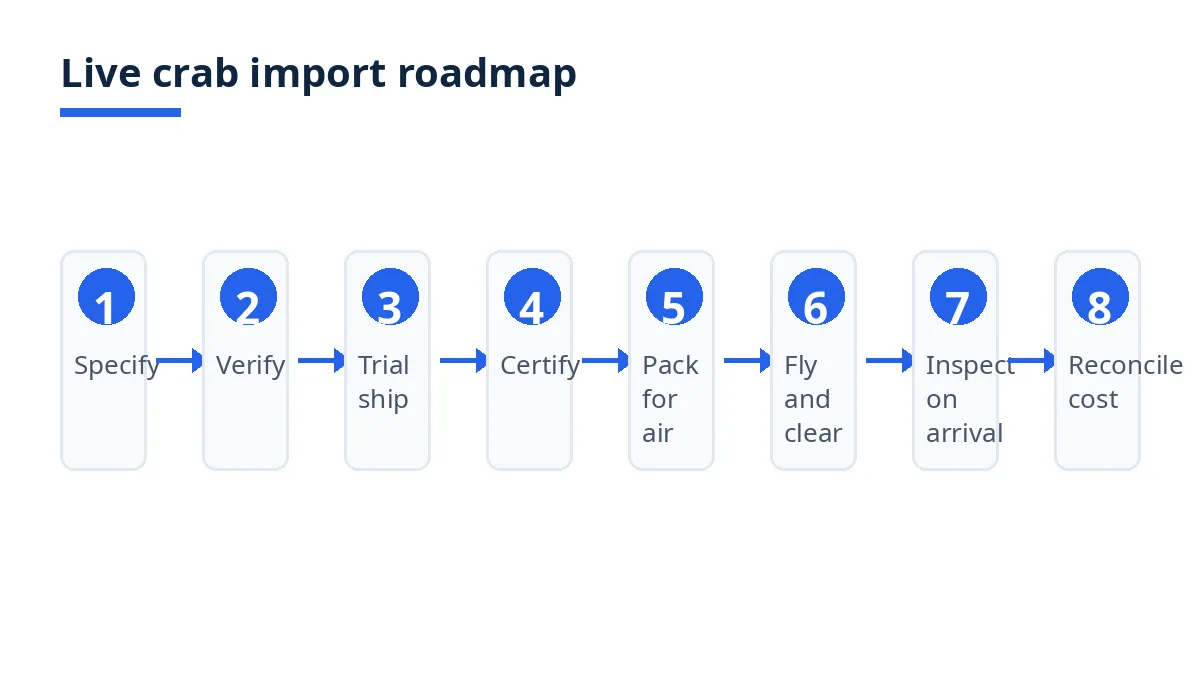
Write the specification: species, sex, grade bands, fattened or wild supply, condition, claw tying, packing format, destination airport and market.
Classify the consignment from subheading 0306.33, and confirm the full national code, duty treatment and destination rules with your broker.
Shortlist exporters whose current trade is live crabs by air, and request comparable quotes on the identical specification and delivery term.
Verify the chosen exporter: company documents, a recent health certificate from the Department of Fisheries route, and market status such as GACC registration where required.
Run a trial shipment on the intended route and packing, and record arrival condition carton by carton, with dead, weak and damaged animals recorded separately.
Confirm the bulk order in writing: purchase order, pro forma invoice, delivery and payment terms, selection and packing process, certificate wording, flight day and the arrival reporting agreement.
Pack to the confirmed flight under the airline acceptance rules, clear export with the health certificate, and track the consignment to arrival.
Complete the arrival check against the depot records, clear customs, and reconcile the actual landed cost per kilogram shipped and per kilogram received saleable.
How Exportain helps
Browse suppliers for Bangladeshi seafood exporters and compare their ranges against your species and grade list. Then post your specification and target quantity as an RFQ and compare replies on the same terms before you choose an exporter for a trial shipment. Exportain is a B2B marketplace where buyers post RFQs, receive quotations and message suppliers. It does not inspect goods, book freight or clear customs.
FAQs
What is the typical MOQ for live crabs from Bangladesh?
There is no single typical minimum. It is set per shipment and usually per grade, because the consignment is packed to a flight booking and grades are selected animal by animal.
How long does shipping take?
Packing and certification time, the flight and any connection, and arrival clearance are separate parts of one consignment time, and none has a single typical figure. Plan from the forwarder's current schedule for your exact route.
What import duty applies?
Duty follows the confirmed classification, the destination and the origin. Live crabs sit in subheading 0306.33, and in the United States schedule opened for this guide the live crab line, 0306.33.40, carries a general rate of Free, while crabmeat, 0306.33.20, carries 7.5 percent.2 Bangladesh has duty-free access to the European Union under Everything But Arms, subject to origin rules,12 and is listed under Comprehensive Preferences in the United Kingdom, with 0 percent tariffs on 99.8 percent of products.13
How do I verify a supplier?
Check company documents first, so that name, address and bank account agree across every document. Then check the certification route, with a recent Department of Fisheries health certificate for a comparable market, and market status such as GACC registration for China. Approve the exporter through a trial shipment before bulk orders.
Next steps on Exportain
Read how to import from Bangladesh for the full process, then follow how to buy to set out your species and grade list. When ready, post a free RFQ on Exportain and compare quotes on the same terms.
Sources
- Harmonised System. European Commission (accessed )
- Harmonized Tariff Schedule of the United States, Chapter 3. United States International Trade Commission (accessed )
- Comparative study of mud crab (Scylla serrata) fattening practices between two different systems in Bangladesh. Journal of the Bangladesh Agricultural University (accessed )
- Bangladesh rolls out online certification system to simplify fish and seafood trade. International Collective in Support of Fishworkers (ICSF) (accessed )
- Five more Bangladesh firms get go-ahead for exporting aquatic animals to China. The Financial Express, (accessed )
- Health and consumer protection for animal and plant product. European Commission, Access2Markets (accessed )
- Import Requirements for Food & Food Products. Singapore Food Agency (accessed )
- Food Safety Bulletin 100th Issue (03/2025). Centre for Food Safety, Food and Environmental Hygiene Department, Hong Kong (accessed )
- A Summary of the United States Food and Drug Administration's Food Safety Program for Imported Seafood; One Country's Approach. PubMed Central (accessed )
- Insider thoughts: Bob Ronai on Incoterms 2020 Rules; What are they about?. International Chamber of Commerce (accessed )
- Live Animals Regulations (LAR). International Air Transport Association (IATA) (accessed )
- Trade arrangements. European Commission, Access2Markets (accessed )
- Preference tiers under the Developing Countries Trading Scheme. GOV.UK (Department for Business and Trade), (accessed )
About the author
Sourcing from Bangladesh?
Post a request for quotation and suppliers on Exportain can send you their quotes directly.
Post an RFQ