How to Import Leggings From Bangladesh in 2026: Complete Buyer Guide
How to import leggings from Bangladesh: specification, supplier verification, MOQ and samples, quality control, shipping, duty and landed cost for buyers.
Short answer
To import leggings from Bangladesh, write a precise specification covering fabric, weight, waistband and sizes, shortlist knitwear factories whose range matches it, verify their documents and capability, and approve a tested pre-production sample in writing. Classify each style for duty, agree the delivery term and inspection plan, build the full landed cost, and inspect packed goods before shipment.
On this page
Key takeaways
Ready-made garment exports were $10.58 billion in July to September 2026, up 6.10 percent year on year, per Export Promotion Bureau data.
Knitwear is the core category for leggings, and BKMEA represents approximately 2,540 knitwear member factories.
Heading 6104 covers women's or girls' trousers, knitted or crocheted, split by fibre, so classify every style before you order.
There is no single typical MOQ, price or transit time for leggings, so confirm each one in writing for your exact specification.
Approve a pre-production sample in writing and inspect packed goods before shipment, using the approved sample as the standard.
Learning how to import leggings from Bangladesh starts with the fabric. Leggings are a stretch knit garment, and opacity when stretched, recovery, waistband hold and colourfastness decide whether the stock sells or comes back. This guide is for brands, retailers and online sellers in the United States, the United Kingdom, the European Union and the United Arab Emirates. It covers supplier verification, minimums, pricing and samples, quality control, shipping, duty and a worked landed cost.
Leggings here means knitted full-length, cropped and capri styles worn as trousers or for sport, usually in cotton, polyester or nylon blends with elastane. Footed tights are a different product and can fall under a different tariff heading.
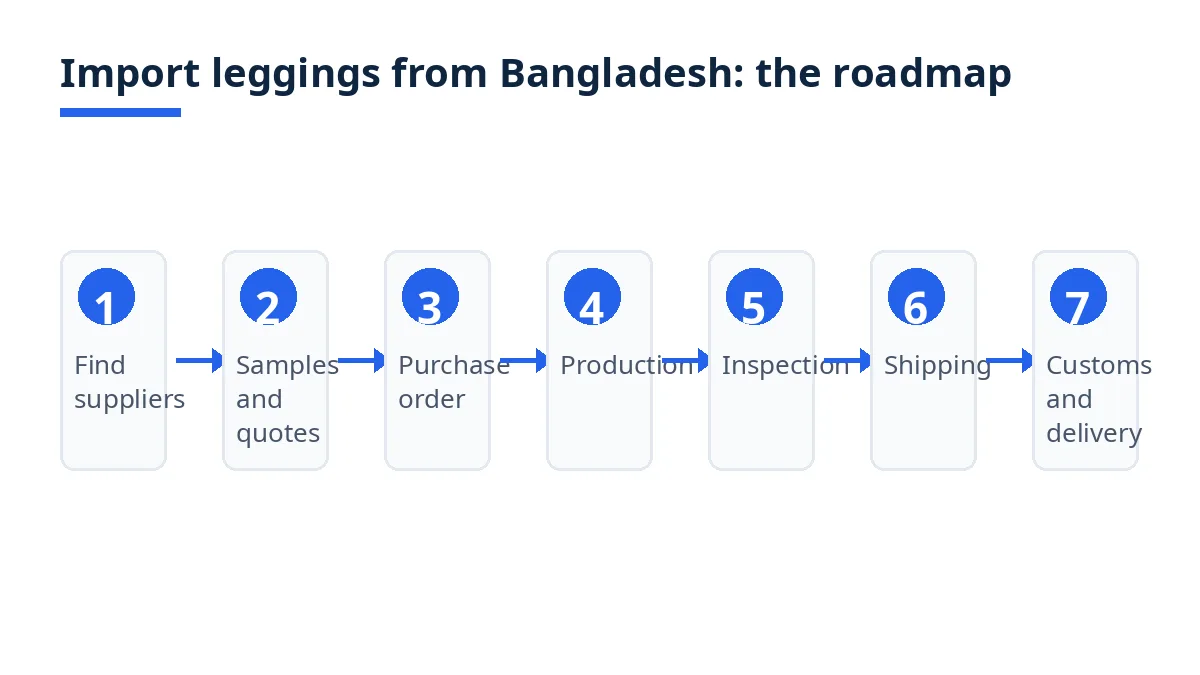
The roadmap below sets out the import process in seven stages, from finding suppliers to customs and delivery. Every stage is covered in order in the sections that follow.
Why source leggings from Bangladesh
Ready-made garment exports reached $10.58 billion in July to September of fiscal year 2026-27, up 6.10 percent year on year, according to Export Promotion Bureau data, with knitwear accounting for $5.96 billion of that total, up 6.88 percent.1 The European Union took 46.36 percent of those shipments, the United States 20.99 percent and the United Kingdom 12.21 percent.1 For a leggings buyer, those figures show depth: many factories already knit, dye and sew stretch garments to the standards of the main destination markets.
The supply base is organised around knitwear. The Bangladesh Knitwear Manufacturers and Exporters Association (BKMEA) states that it represents the knitwear sector and currently represents approximately 2,540 knitwear member factories.2 Membership is a starting point for a long list, not a substitute for your own verification. A factory that knits, dyes, cuts and sews in one site can control fabric weight, shade and stretch at each approval stage, and those three points decide legging quality.
Range is a second reason: the same base covers cotton everyday leggings, polyester activewear styles, printed fashion leggings and plus-size ranges. Cost is a third reason, because sewing is labour-intensive and leggings carry a high sewing share. You still need to match one specific legging to a factory that makes that type of garment routinely.
Find and verify suppliers
Where should you start the search?
Start with the product, not a country search. Write down each style, its fabric, weight, waistband type, sizes and target quantity, then shortlist factories whose range already includes leggings or closely related knitted bottoms. A factory set up for basic T-shirts may not suit a high-waist legging in a heavy interlock. Browse suppliers on Exportain and the guide to finding suppliers in Bangladesh, and ask each candidate for its catalogue and main export markets.
Send every supplier the identical specification and ask for the price basis in writing: what is included, the validity period, and the packing assumed. A quote far below the rest usually means a different fabric or a lower specification. Compare quotations only on the same specification and delivery term.
How do you verify a supplier before you pay?
Verification has three layers. The first layer is documents. Request the trade licence, export registration and association membership where applicable, and check that the company name, address and bank account name match across all documents. A mismatch without a written explanation is a reason to pause. Bangladesh Customs lists the documents enclosed with a Bill of Export, including the export letter of credit or, where there is none, the export contract or purchase order, the commercial invoice, the packing list, the EXP form certified by an authorised dealer bank, and the certificate of origin issued by the Export Promotion Bureau or a chamber of commerce.3
The second layer is capability: machine types for stretch fabrics, monthly capacity for your style, fabric sources, and whether dyeing, printing or finishing is in-house or done by another unit. Record any subcontracted step in writing. The third layer is payment discipline. Keep discussions on the platform or in email, never pay a deposit to a personal bank account, and verify any later change of bank details through a separate route. For a first order, a live video walk-through, or an independent factory audit, is a proportionate step. The how to buy guide sets out each stage, and the guide to how to import from Bangladesh covers the full process.
MOQ, pricing and samples
What sets the minimum order quantity?
There is no single typical minimum order quantity for leggings from Bangladesh. The minimum is set per style and per colour, and sometimes per fabric, because fabric is knitted and dyed in batches and sewing lines are set up per style. Stock fabric usually allows a lower start. Custom-dyed fabric, all-over print, a wide size range and private-label trims raise it. Ask how the minimum splits by colour and size ratio, and at what quantity the unit price changes, in writing. You can often lower a minimum by simplifying colours, consolidating sizes, or accepting a stock fabric that meets your specification.
How is the price built, and how should you negotiate it?
Fabric is usually the largest cost element, followed by sewing, trims such as waistband elastic, printing or branding, testing, packing and the factory margin. Heavier fabrics and higher elastane content cost more than standard jersey. Request a breakdown rather than a single figure, and ask which fabric each price is based on, including composition and weight, because a lower quote built on a lighter fabric is a different product, not a saving. Record the currency and validity date of each quote, and negotiate the specification as well as the price: a small change in fabric weight or print placement can save more than pressing on margin.
Which samples do you need, and how do you approve them?
Work in three stages. A development sample shows whether the factory can make your type of legging. A pre-production sample, made in the actual production fabric and trims, is the sample you approve for bulk. A shipment sample, taken from finished bulk, shows what is actually being sent. Expect to pay for samples and courier costs for custom development, and confirm in writing whether any charge is credited against a bulk order.
Test leggings as your customers will use them: opacity over a stretched knee and seat, stretch and recovery, waistband stay-up performance, seam strength, and colour change and shrinkage after washing. Measure every sample against your size chart. Approve the pre-production sample in writing and keep one sealed counter-sample: production should match that sample, not a photograph. Lead time runs from final sample approval and deposit, not from your first inquiry.
Quality control and certifications needed
Which quality checks are specific to leggings?
Leggings fail in ways general garments do not. Name the defects specific to this product in your inspection standard: show-through when stretched, uneven dyeing, twisted legs, wavy or rolling waistbands, elastic that loses recovery, skipped stitches, seam slippage, and print cracking when extended. Agree the size chart with tolerances for waist, hip, inseam, leg opening and rise for every size.
Agree the inspection method and defect limits before production starts. ISO 2859-1 is the standard for sampling procedures for inspection by attributes, and it uses the acceptance quality limit (AQL) to determine sample sizes and acceptance and rejection thresholds for a lot, where AQL is the maximum average percentage of defective items considered acceptable during random sampling.4 See AQL and pre-shipment inspection.
Inspect in stages. An inline inspection catches a fabric or grading problem while it can still be corrected across the batch. A final random inspection checks quantity, workmanship, measurements, packing, labelling and carton markings against the approved sample. Many buyers appoint an independent inspection company: share your specification and sample comments with the inspector, not only the factory address. If defects are found, agree the remedy in writing before the goods leave.
Which certifications and compliance checks apply?
Certifications depend on your market, your product claims and your brand policies. Common requests include social and environmental audits and fibre or product standards where a recycled or organic claim will be made. Such a claim needs chain-of-custody certification covering your specific order. Check the holder, scope and expiry date of every certificate, and verify certificate numbers with the issuing body.
One framework often requested for skin-contact clothing is OEKO-TEX Standard 100, a label for textiles tested for harmful substances, under which every thread, button and accessory is tested against a list of over 1,000 harmful substances, the requirements become stricter as skin contact becomes more intensive, and the certificate is issued for one year.5 Leggings are worn in direct skin contact, the product class the standard describes for items such as bed linen, so check that any certificate covers the correct class, holder and article.
Labelling needs attention before production, not at packing. Ask for test reports from accredited laboratories for the actual production fabric. In the European Union, Regulation (EU) No 1007/2011 of 27 September 2011 sets the rules on textile fibre names and the related labelling and marking of the fibre composition of textile products.6 Requirements differ in other markets, so agree the exact label wording, covering fibre content, care, size, country of origin and your business name and address, at the sampling stage.
Incoterms, shipping and transit time
Which delivery term should a first order use?
Incoterms are the International Chamber of Commerce rules that clarify the tasks, costs and risks involved in delivering goods from sellers to buyers, and the current edition, Incoterms 2020, entered into force on 1 January 2020.7 Three terms are common here. Under EXW, you collect from the factory and carry almost all cost and risk. Under FOB, the factory delivers goods on board the vessel at the Bangladeshi port, and you arrange and pay for the main freight. Under CIF, the factory arranges freight and minimum insurance to your destination port, while you handle import clearance and onward delivery. For a first order, FOB is a frequent choice: your forwarder handles the sea leg and you see the freight cost directly. Incoterms for shipments from Bangladesh compares the terms.
Sea freight or air freight, and how long does it take?
There is no single typical transit time for leggings from Bangladesh. Sea freight is the economical route for bulk orders, and it takes weeks rather than days. The time varies by destination port, routing, transshipment and season, and production time is separate: it runs from final sample approval. Air freight suits small, urgent orders and samples. Your forwarder's current sailing schedule gives the figure to plan around, and congestion and customs examination can add days at either end.
Packing decides freight cost more than many buyers expect. Leggings are light for their volume, so cartons often fill container space before they reach weight limits, and your forwarder may quote on volume. Confirm pieces per pack, carton dimensions and gross weight in the specification, because that data feeds the landed cost below.
Import duty, taxes and documents
How are leggings classified for duty?
Duty is charged on your product's classification in your destination market, not on the product name. In the United States Harmonized Tariff Schedule, heading 6104 covers women's or girls' suits, ensembles, jackets, dresses, skirts, trousers, bib and brace overalls, breeches and shorts, knitted or crocheted, with the trousers lines split by fibre, including 6104.62 for trousers of cotton and 6104.63 for trousers of synthetic fibres.8 The same schedule gives separate lines for women's trousers containing 5 percent or more by weight of elastomeric yarn, the construction most stretch leggings use.8 Footed tights sit in heading 6115, so a legging worn as a trouser and a footed tight can classify differently. This heading is indicative only: verify the code for your exact garment with your broker or your government's official tariff tool before you order. See HS code and how to classify your product.
What duty and taxes should you expect?
The United States general rates show why classification matters: the general rate for the cotton trousers line 6104.62.20 is 14.9 percent, while the general rate for the synthetic fibres line 6104.63.20 is 28.2 percent.8 Those are general rates for those lines, not a rate for your shipment. Your rate depends on your market, your exact subheading and any preference in force on the shipment date.
Whether a preference applies depends on your market, the origin of the goods and the proof you can provide. In the European Union, Bangladesh benefits from the Everything But Arms arrangement, which grants duty-free, quota-free access to the EU for exports of all products except arms and ammunition, and Bangladesh is the largest beneficiary under that arrangement.9 Never build a selling price on an unconfirmed preference.
Import taxes typically include duty and an import value-added tax or goods and services tax on the customs value. Registered businesses can often recover import VAT through their tax returns, but it remains a cash-flow cost at clearance.
Which documents do you need for clearance?
On the Bangladesh side, goods cannot be loaded for export until the Bill of Export has been submitted and approved, with the document set described in the verification section enclosed.3 On the import side, the standard set is the commercial invoice, packing list, bill of lading or air waybill, and proof of origin where a preference is claimed. Descriptions, quantities, weights and carton counts must agree across every document, because mismatches are a common cause of customs delay.
Landed cost example
A landed cost is the true cost of one unit, ready to sell. Every number in the table below is an example figure for illustration, not a quote, a typical price or a confirmed duty rate: replace each line with your confirmed figures. See landed cost for imports from Bangladesh for the method.
Example figures: 10,000 pairs of polyester and elastane leggings, FOB Chattogram, sea freight to a United States port.
Cost element | Example figures (per unit) | How to obtain your figure |
|---|---|---|
Product price, FOB | $4.20 | Confirmed pro forma invoice |
International freight | $0.55 | Forwarder quote divided by units shipped |
Insurance | $0.05 | Policy or forwarder quote |
Duty | $0.57 | Broker, from your confirmed tariff heading and rate |
Port, clearance and broker fees | $0.18 | Broker and forwarder invoices divided by units |
Local delivery to warehouse | $0.15 | Local carrier quote divided by units |
Total landed cost | $5.70 | Sum of all lines above |
Import VAT or sales tax is not included, because its treatment depends on your market and tax position. Work the calculation twice: at the quote stage, to choose the supplier and set your selling price, and again after shipment with actual invoices. Classification must always follow the actual product, never the rate you would prefer.
Step-by-step import checklist
Write the specification: style, fabric and weight, stretch and finish, waistband, colours, size range and measurements, branding, labels and packing.
Classify every style for duty, confirm taxes and preference eligibility with your broker, and note the labelling and testing your market requires.
Shortlist suppliers whose range matches the product, and request comparable quotes on the identical specification, with the minimum split by colour and size stated.
Verify the chosen supplier: documents, capability, references, and a video or in-person factory check for a first order.
Order samples, test them for opacity, stretch, recovery and colourfastness, then approve a pre-production sample in production fabric and keep a sealed counter-sample.
Confirm the order in writing: purchase order, pro forma invoice, price basis and delivery term, payment terms, inspection plan, labelling, packing and shipment date.
Complete the landed cost calculation with confirmed figures and set your selling price from the total.
Monitor production with photo and video updates, and book the inline and final inspections against the approved sample.
Book freight, confirm carton dimensions and the packing list, and check the full document set before the goods sail.
Clear customs on arrival, check delivered cartons against the packing list and shipment sample, and raise any difference promptly in writing.
Review the order after sale: record the true landed cost, quality results and supplier performance for the next order.
How Exportain helps
Exportain is a B2B marketplace connecting international buyers with Bangladeshi suppliers, manufacturers and trade service providers. Instead of searching factory by factory, you post one detailed request for quotation, stating fabric, sizes, colours, quantity and destination, and receive quotes from suppliers whose range matches it. Profiles help you compare capability, product focus and export experience in one thread.
Exportain's trust badges are reviews of documents and photos. They are not factory inspections, and they do not replace your own verification, sample approval, inspection or customs advice. Exportain is not a party to your contract for goods, and it does not inspect goods, book freight or clear customs.
FAQs
What is the typical MOQ for leggings from Bangladesh?
There is no single typical figure. The minimum is set per style and per colour and depends on the fabric, because fabric is knitted and dyed in batches. Stock fabrics usually allow lower minimums, while custom-dyed fabric, prints and private-label trims require larger runs. Ask each supplier how the minimum splits by colour and size, in writing, with the quote.
How long does shipping take?
Shipping time depends on the route, carrier, whether the service is direct or transshipped, and port and customs conditions at both ends. Sea freight takes weeks rather than days, while air freight is faster and more expensive. Production time is separate and runs from final sample approval. Ask your forwarder for the current sailing schedule for your destination port and build a buffer around it.
What import duty applies?
Duty depends on your destination market and on the classification of each style, determined by fibre, construction and garment type. Most knitted leggings worn as trousers start from heading 6104, split by fibre, with cotton trousers under 6104.62 and synthetic fibre trousers under 6104.63 in the United States schedule.8 Some markets offer preferential rates for goods originating in Bangladesh, subject to origin rules and proof, including duty-free, quota-free access to the European Union under Everything But Arms.9 Confirm the current duty for your exact heading with your broker before you order.
How do I verify a supplier?
Check that the company documents agree with each other, covering the trade licence, export registration, address and bank account in the same company name, and confirm the factory produces your product type in-house. Review samples in production fabric, and use a live video walk-through or an independent audit for a first order. Never pay to a personal account.
Next steps on Exportain
Browse suppliers by category, then read the how to buy guide before your first inquiry. When the specification is ready, post an RFQ stating fabric, sizes, colours, quantity and destination, and use the guide to importing from Bangladesh to plan shipment and clearance.
Sources
- RMG exports rise 6.10pc to US$10.58b in July-Sept of FY27. The Financial Express, (accessed )
- BKMEA at a Glance. BKMEA (accessed )
- Customs Clearance Procedures for Export. Bangladesh Customs, National Board of Revenue (accessed )
- ISO 2859-1:2026 - Sampling procedures for inspection by attributes — Part 1: Sampling schemes indexed by acceptance quality limit (AQL) for lot-by-lot inspection. International Organization for Standardization (accessed )
- OEKO-TEX Standard 100. OEKO-TEX (accessed )
- Regulation (EU) No 1007/2011 on textile fibre names and related labelling and marking of the fibre composition of textile products. European Union, (accessed )
- Incoterms® rules. International Chamber of Commerce (ICC) (accessed )
- Harmonized Tariff Schedule - Heading 6104: Women's or girls' trousers, knitted or crocheted. United States International Trade Commission (accessed )
- EU trade relations with Bangladesh. European Commission, (accessed )
About the author
Sourcing from Bangladesh?
Post a request for quotation and suppliers on Exportain can send you their quotes directly.
Post an RFQ