How to Import Cushion Covers From Bangladesh in 2026: Complete Buyer Guide
How to import cushion covers from Bangladesh: size and closure specification, supplier checks, samples, HS 6304 duty, shipping and landed cost for buyers.
Short answer
To import cushion covers from Bangladesh, write a cover-by-cover specification that fixes finished size, insert fit, fabric, closure and decoration as your own choices, then shortlist home-textile exporters that already make cushion covers. Verify the exporter, approve a pre-production sample fitted over its insert, classify each empty cover in heading 6304, agree the delivery term and inspection plan, and build the landed cost before bulk production.
On this page
Key takeaways
Finished cushion covers are classified in heading 6304: 6304.91 for knitted or crocheted covers, and 6304.92 for cotton, 6304.93 for synthetic fibres and 6304.99 for other textile materials in the other group.
An empty cover and a filled cushion do not share a heading: cushion covers are classifiable in heading 6304, while heading 9404 covers cushions stuffed or internally fitted with material.
There is no single typical MOQ, price or transit time for cushion covers, so confirm each one in writing for your exact fabric, size, closure, decoration, route and shipment date.
Finished size, insert fit, closure and decoration are buyer specification choices: name the size the cover must measure, the insert it must fit, the closure and the decoration placement you want quoted, and compare quotes only on the same specification.
United States general rates in the opened schedule include 5.8 percent for knitted or crocheted covers (6304.91), 6.3 percent for cotton covers not knitted or crocheted (6304.92) and 9.3 percent for synthetic covers not knitted or crocheted (6304.93); EU EBA and UK DCTS preferences can reduce the rate for Bangladesh-made covers.
To learn how to import cushion covers from Bangladesh, start with the finished cover, not with a generic home-textile enquiry. A cushion cover order can combine plain woven cotton covers, printed covers, embroidered covers and knitted covers, with hidden zippers, envelope backs or button closures, each in its own size, fabric and tariff line.
The Harmonised System is an international commodity classification of approximately 5,000 six-digit product categories, organised by chapters, headings and sub-headings, and countries subdivide the six-digit categories further for their own tariffs.1 A finished cushion cover is classifiable in heading 6304, and the Explanatory Notes exclude cushion covers from heading 9404, which covers stuffed cushions themselves.2 An empty cover and a filled cushion in the same shipment do not share a heading.
This guide is for brands, retailers, wholesalers, hotels and importers in the United States, the United Kingdom, the European Union and the United Arab Emirates. It states no typical minimum, price or transit time, because none has a single figure.
Why source cushion covers from Bangladesh
Home textile, as the term is used for Bangladesh exports, covers cushion covers alongside carpets, curtains, towels, bedspreads, furnishing fabric, table linen, bed linen, sheets and pillowcases.3 A cushion cover order therefore belongs with a home-textile mill or exporter whose current range already includes cushion covers and furnishing articles. The operations differ: weaving or buying furnishing fabric, cutting panels accurately, setting prints and embroidery centred on the front panel, sewing piping or flange edges, fitting zippers, and packing covers flat so a matched set arrives complete.
The range you can specify is wide: plain, printed, yarn-dyed or embroidered fronts, solid or contrasting backs, and a fibre and weave you choose. Work orders for home textile are booked for one or two seasons in bulk quantities,3 so plan by season, finish sampling before the bulk order, and settle the fabric and decoration first, since several sizes and colourways usually share one fabric and one design setup.
Find and verify suppliers
Where should you start the search?
Start with a specification, not with factory names. Write down every style first: finished cover width and length, the insert size the cover must fit, fibre composition, weave and finished weight as your choices, front and back fabric, closure type and zipper or button specification, edge finish such as piping, flange or plain seam, decoration and its placement, colour or print, labelling and packing. Then shortlist mills and exporters whose current range already includes cushion covers.
Send every candidate the identical specification and ask for the same reply format: fabric assumed, covers per retail unit or set, price inclusions, validity and minimum per design and per colour. Browse suppliers on Exportain, read finding suppliers in Bangladesh, and compare your approach with the home textiles sourcing guide.
How do you verify a supplier before you pay?
Verification has three layers. The first is company documents: trade licence, export registration and association membership where applicable, checked so that name, address and bank account name agree across every document. The second is capability: monthly cushion cover capacity, whether weaving is in-house or fabric is bought in, fabric width, dyeing, printing and embroidery route, zipper and button sourcing, and which recent cushion cover styles the factory can show. A finished cover from current production shows more than a catalogue photograph: centred decoration, even piping, square corners, and a zipper that opens fully without pulling the seam.
The third layer is payment discipline. Keep payments to the company account named in the documents, never to a personal account, and verify any change of bank details separately. Read how supplier verification works on Exportain for what document and photo checks cover. On Exportain, supplier profiles carry document and photo review badges: a badge is a review of documents and photos, not a factory inspection or a guarantee, and Exportain is not a party to the goods contract.
MOQ, pricing and samples
What is the typical MOQ for cushion covers from Bangladesh?
There is no single typical minimum order quantity for cushion covers from Bangladesh. The minimum is set per design and usually per colour or print, because fabric is woven, dyed or printed in batches and decoration such as embroidery or a print screen is set up per design. A plain woven cover in a stock fabric and an embroidered cover in several colourways will not carry the same minimum. Ask each supplier how its minimum splits by design, colour, size and set composition.
How is the price built, and how should you compare quotes?
Fabric is usually the largest cost element in a cushion cover, followed by cutting and sewing, dyeing or printing, decoration, closure components, finishing, testing, packing and the factory margin. Fabric use per cover depends on finished size and front and back construction. Detail adds operations: a hidden zipper, piping, a flange edge, embroidery and print placement matching each cost more than a plain envelope back. Two quotes can differ because one assumes a lighter fabric, a smaller finished size, a shorter zipper, no piping or a plain back in a cheaper fabric. Ask what each price is based on, in writing, so a lower quote is judged as a different specification rather than accepted as a saving.
Compare quotes on the same basis: same finished size and insert fit, front and back fabric, closure, edge finish, decoration, delivery term and packing. Ask each supplier to state what is excluded, for example zippers, piping cord, embroidery or testing, and whether inserts are included or the price is for empty covers only.
Which samples do you need, and how do you approve them?
Work in stages. A development sample shows whether the factory can cut the panel square, centre the decoration, form the corners, and fit the closure you specified. A pre-production sample, made in the actual production fabric, colour or print, decoration and closure, is the sample you approve for bulk.
Test the samples as your customers will use them: fit the cover over an insert of the exact size in your programme, check that it fills the corners without straining the seams, and measure the finished cover flat against your chart. Open and close the zipper repeatedly, check that an envelope back overlaps enough to stay closed over the insert, and confirm that buttons and buttonholes align. Check the decoration centred against the panel edges, view a full set together for shade consistency, and confirm shrinkage and colour match after a wash following your care label. Approve in writing and keep one sealed counter-sample of each style.
Quality control and certifications needed
Which quality checks are specific to cushion covers?
Against the approved sample and chart, check fabric composition and finished weight, finished width and length within your agreed tolerances, and consistency across the size range. Then check construction cover by cover: seam strength, corner shape, piping evenness, flange width where specified, and decoration position and symmetry on the front panel. Check the closure: zipper type, length and colour, smooth operation over the full opening, a hidden zipper that stays hidden when the cover is filled, and envelope overlap or button alignment where those closures are specified. Fit one cover from each size over its insert, because a cover can measure correctly flat and still fit badly if the seam allowance or corner shape is wrong.
Agree the inspection method and defect limits before production. ISO 2859-1:2026 defines a system of acceptance sampling plans for inspection by attributes, and its summary states that AQL stands for acceptance quality limit, the maximum average percentage of defective items considered acceptable during random sampling, used to determine sample sizes and acceptance and rejection thresholds.4 Inspect in stages: an inline check during sewing catches a decoration placement or zipper drift while correction is still possible, and a final random inspection on packed goods checks quantity, workmanship, measurements, labels and packing. See the acceptance quality limit and pre-shipment inspection guides.
Which label rules apply to cushion covers?
Fibre labelling applies to cotton, synthetic and blended covers alike, and to a back panel in a different fabric. Article 9 of Regulation (EU) No 1007/2011 states that a textile product shall be labelled or marked with the name and percentage by weight of all constituent fibres in descending order.5 Agree the wording at sampling stage and check that the percentages match the fabric you bought, because the labelled composition is also the composition your classification is built on. Add care, size and origin marking as your market requires, and check the finished label before bulk label sewing begins.
Which certifications do you actually need?
No single certificate covers every cushion cover order. What you need follows your market and your customer: a retailer or hotel group may name a specific test or scheme in its own supplier manual, including a flammability requirement for contract or upholstered use where its market imposes one. Name any such requirement in the specification, ask for the matching report or certificate, and check its scope, product covered, issuing body and date.
Incoterms, shipping and transit time
Which delivery term should a first order use?
The Incoterms 2020 rules set out, for each rule, where delivery takes place, and risk passes from seller to buyer at the same point and time as delivery.6 Under FOB, CFR and CIF the seller must place the goods on board the vessel.6 On customs, in all rules but EXW the seller must carry out export formalities, and in all rules but DDP the buyer must carry out import formalities.6 The same ICC Academy summary notes that the four sea rules, FAS, FOB, CFR and CIF, are only intended for port-to-port bulk or break-bulk shipments and are not suitable for container shipments, because a container is handed to the carrier before it is on board.6
For a first order shipped in containers, weigh FOB at the Bangladeshi port against FCA at the named terminal: under FCA, delivery happens when the goods are handed to your carrier, which matches how containerised cargo moves. See the best Incoterm for importing home textiles from Bangladesh for the comparison for this product group.
How long does shipping take?
There is no single typical transit time for cushion covers from Bangladesh. Sea freight is the standard route for bulk orders and it takes weeks rather than days, varying by port, routing, transshipment and season. Plan from your forwarder's current sailing schedule, and add clearance and delivery. Keep production time separate: an order is ready only when every cover has finished sewing, decoration, closure fitting, inspection and packing. Confirm covers per carton, carton dimensions and weight in the specification, because flat-packed covers are light for their size and carton volume can limit a shipment before weight does. State whether inserts ship with the covers, since filled cushions take far more container volume than empty covers.
Import duty, taxes and documents
How are cushion covers classified for duty?
Duty follows the classification of each style in your destination tariff, not the supplier's product name. The central heading is 6304, which covers other furnishing articles, excluding those of heading 9404.7 A finished cushion cover with a zipper closure is classifiable in heading 6304, because the Explanatory Notes state that cushion covers are classifiable in that heading and exclude them from heading 9404.2 Heading 9404 instead covers cushions stuffed or internally fitted with material, so an empty cover and a filled cushion sit in different headings.2
Within heading 6304, after the bedspread and bed net lines, construction and fibre select the line: 6304.91 for knitted or crocheted covers, 6304.92 for covers not knitted or crocheted of cotton, 6304.93 for covers not knitted or crocheted of synthetic fibres, and 6304.99 for covers not knitted or crocheted of other textile materials.7 A knitted cover, a woven cotton cover and a woven synthetic cover in one order can therefore sit on three different lines.
What import duty applies?
Your rate depends on your market, each style's subheading, the origin and any preference in force on the entry date, so there is no single rate for a whole order. In the United States schedule opened for this guide, Revision 17 (2026), the general rate for knitted or crocheted furnishing articles, 6304.91.01, is 5.8 percent.7 For covers not knitted or crocheted of cotton, 6304.92.00, the general rate is 6.3 percent, and for covers not knitted or crocheted of synthetic fibres, 6304.93.00, it is 9.3 percent.7 The 6304.99 group for other textile materials is divided further by article and fibre, so confirm the full line for a linen, jute or blended cover with your broker.7 Read those figures as schedule lines in that revision and confirm the current rate before you commit to a selling price.
In the European Union, the Everything But Arms scheme is a special arrangement for least developed countries, granting full duty-free and quota-free access to the EU Single Market for all products except arms and ammunition.8 The updated scheme, approved for application from 1 January 2027, continues that full duty-free access.9 In the United Kingdom, the Developing Countries Trading Scheme guidance lists Bangladesh in the Comprehensive Preferences tier, with 0 percent import tariffs on 99.8 percent of products, being all products except arms and ammunition.10 The Netherlands Chamber of Commerce (KVK) adds that each HS and commodity code is unique, and that the correct code determines which import duties apply and whether you need permits or certificates.11 A preference depends on the goods meeting the origin rules of the scheme, so agree the proof of origin at order stage. Import VAT is separate from duty: often recoverable, but a cash cost at clearance.
Which documents do you need for clearance?
The standard import set is the commercial invoice, packing list, bill of lading or air waybill, and proof of origin where a preference is claimed. The invoice should name each style plainly, for example woven cotton cushion cover with hidden zipper, empty, with composition, finished size, closure, quantities, unit prices and the delivery term, on its own line. Keep knitted, woven, cotton and synthetic styles on separate lines matching their classifications, and state empty covers as covers so they are not entered as filled cushions. Quantities, weights and carton counts must agree across every document.
Landed cost example
A landed cost is the full cost of one cushion cover, ready to sell. Every number below is an example figure only, not a quote.
Example figures: 5,000 woven cotton cushion covers, empty, FOB Chattogram, sea freight to a European port, duty at an example rate only.
Cost element | Example figures (per cover) | How to obtain your figure |
|---|---|---|
Product price, FOB | $2.85 | Confirmed pro forma invoice |
International freight | $0.42 | Forwarder quote divided by covers shipped |
Insurance | $0.03 | Policy or forwarder quote |
Duty | $0.18 | Broker calculation from confirmed codes and rates |
Port, clearance and broker fees | $0.11 | Broker invoices divided by covers |
Local delivery to warehouse | $0.08 | Local carrier quote divided by covers |
Total landed cost | $3.67 | Sum of all lines above |
Import VAT or sales tax is not included, because its treatment depends on your market and tax position. Work the calculation twice, at quote stage and again after shipment with the actual invoices. See landed cost for imports from Bangladesh for the full method.
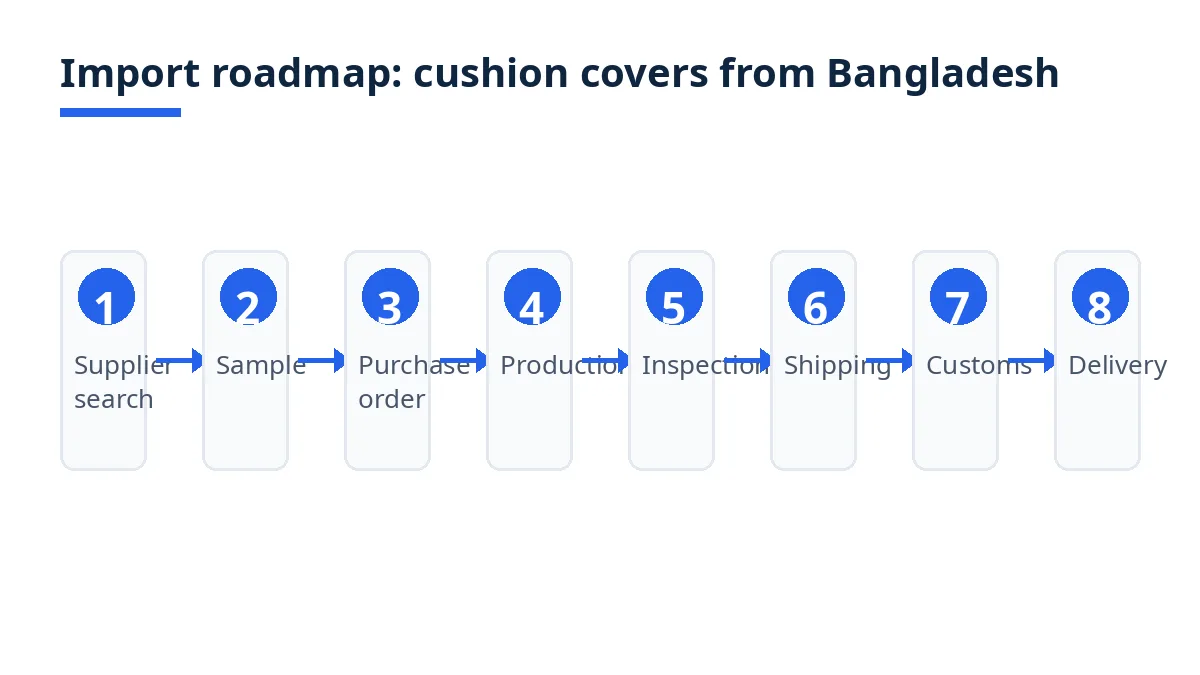
Step-by-step import checklist: how to import cushion covers from Bangladesh
Write the specification style by style: finished width and length, the insert size each cover must fit, fibre, weave and finished weight as your choices, front and back fabric, closure type, edge finish, decoration and its placement, colours or prints, labels and packing.
Classify every style, starting from heading 6304 for finished empty covers, then 6304.91 for knitted or crocheted covers, 6304.92 for cotton, 6304.93 for synthetic fibres and 6304.99 for other textile materials, and confirm each full code and duty with your broker. Classify any filled cushion on its own line in heading 9404.
Shortlist mills and exporters whose range includes cushion covers, and request comparable quotes on the identical specification and delivery term.
Verify the chosen supplier: company documents, cushion cover capacity, fabric source and width, dyeing, printing and embroidery route, and a video or in-person factory check for a first order.
Order samples in stages, fit each sample over its insert, work the closure repeatedly, check decoration placement and corner shape, then approve a pre-production sample of each style in production fabric and decoration.
Confirm the order in writing: purchase order, pro forma invoice, delivery and payment terms, inspection plan with AQL and defect limits, labelling, packing and shipment date.
Inspect during production and again on packed goods against the approved samples, checking insert fit, zipper operation, decoration centring and shade consistency.
Ship, clear customs with the confirmed code for each style, and reconcile the actual landed cost.
How Exportain helps
Browse suppliers for Bangladeshi home-textile exporters and compare their ranges against your style list. Then post your specification and target quantity as an RFQ and compare replies on the same terms before you choose a factory for sampling. Exportain is a B2B marketplace where buyers post RFQs, receive quotations and message suppliers. It does not inspect goods, book freight or clear customs.
FAQs
What is the typical MOQ for cushion covers from Bangladesh?
There is no single typical minimum. It is set per design and usually per colour or print, because fabric is woven, dyed or printed in batches and decoration is set up per design.
How long does shipping take?
Production time and transit time are separate, and neither has a single typical figure. Sea transit takes weeks rather than days and varies by port, routing and season.
What import duty applies?
Duty follows the confirmed classification of each style, the destination and the origin. Finished empty cushion covers sit in heading 6304: 6304.91 for knitted or crocheted covers, and 6304.92, 6304.93 and 6304.99 for other covers by fibre.7 In the European Union, Bangladesh benefits from Everything But Arms duty-free access, subject to origin rules.8 In the United Kingdom, Bangladesh is listed under Comprehensive Preferences, with 0 percent tariffs on 99.8 percent of products.10 For the United States, confirm the current rate beside each code for the entry date.
How do I verify a supplier?
Check company documents first, so that name, address and bank account agree across the trade licence, export registration and invoices. Then check capability: cushion cover capacity, fabric source, decoration route and recent cushion cover production. Keep payments to the company account named in the documents, and approve a pre-production sample before bulk production.
Next steps on Exportain
Read how to import from Bangladesh for the full process, then use how to write an RFQ to set out your style list. When ready, post a free RFQ on Exportain and compare quotes on the same terms.
Sources
- Harmonised System. European Commission (accessed )
- Customs Ruling HQ 953003 - Classification of a pillow shell and a cushion cover; pillow shell is classifiable in Heading 6307; cushion cover is classifiable in Heading 6304. U.S. Customs and Border Protection (accessed )
- Bangladesh's home textile exports bounce back. Asia News Network (accessed )
- ISO 2859-1:2026 - Sampling procedures for inspection by attributes — Part 1: Sampling schemes indexed by acceptance quality limit (AQL) for lot-by-lot inspection. International Organization for Standardization (accessed )
- Regulation (EU) No 1007/2011 on textile fibre names and related labelling and marking of the fibre composition of textile products, Article 9: Multi-fibre textile products. legislation.gov.uk (accessed )
- Insider thoughts: Bob Ronai on Incoterms 2020 Rules; What are they about?. International Chamber of Commerce (accessed )
- Harmonized Tariff Schedule of the United States, Chapter 63: Other made up textile articles; sets; worn clothing and worn textile articles; rags (Revision 17, 2026). United States International Trade Commission (accessed )
- Trade arrangements. European Commission, Access2Markets (accessed )
- New Generalised Scheme of Preferences approved for application in 2027. European Commission, (accessed )
- Preference tiers under the Developing Countries Trading Scheme. GOV.UK (Department for Business and Trade), (accessed )
- Why do you use a commodity code when importing?. Netherlands Chamber of Commerce (KVK), (accessed )
About the author
Sourcing from Bangladesh?
Post a request for quotation and suppliers on Exportain can send you their quotes directly.
Post an RFQ